Author Archive
Prayer for the people of Sharon
Posted on: October 9, 2011
Yom Kippur 5772
Do Not Let Their Homes Become Their Graves
href=”https://neviimtovim.com/wp-content/uploads/2011/10/cohen.jpg”>
The prayers of the High Priest
The Avodah service, which takes place during Mussaf on Yom Kippur, is based on the Temple service, as described in the Mishnah and the Gemara. The High Priest – the Cohen Hagadol – said penitential prayers on behalf of himself and the whole community.
When the High Priest emerged from the Holy of Holies, he prayed that the coming year would be fruitful, prosperous and peaceful, and then added the prayer v’al ha anshei Sharon… for those who lived in the region of Sharon, in danger of sudden earthquakes ‘…do not let their homes become their graves’.
Where does the prayer come from?
The source of this prayer is the Talmud Yerushalmi, also called the Jerusalem Talmud or the Palestine Talmud, or the Talmud of the Land of Israel (Tractate Yoma perek 5 hilchot 2).
The Jerusalem Talmud is shorter than the Babylonian Talmud, and was completed earlier, about 429 CE. As the name suggests, it is a product of the Land of Israel, probably from the academies of Tiberias, Caesarea and Sepphoris.
Life in Palestine had been more agriculturally based than amongst the Babylonian communities, so the Jerusalem Talmud pays more attention to agricultural halakhah than the Bavli, and also more attention to the geography of the region, which may be why we find this focus on the Sharon Plain, the northern half of the coastal plain of Israel, running from Jaffa up to Carmel.
What was the problem for the people of Sharon?
Our translation explains that the region was in danger of earthquakes, but the Hebrew words do not refer to earthquakes, or name any specific danger.
It may be that this region was subject to flooding, being on the coast.
There is a geological fault called the Dead Sea Transform, which extends through the Jordan River Valley, and is part of the Great African Rift Valley and this may have caused seismic disturbances. The geography of Palestine in the time of the Jerusalem Talmud shows that the Sharon was a marshy, swampy area, not easily cultivated until deforestation, around the third century.
The Babylonian Talmud has a more oblique reference, when commenting on exemption from military service. Deuteronomy 20:5 states that a man is exempt who has built a new house and not had time to dedicate it. The Babylonian sages considered the exceptions to this rule:
R. Eliezer says: also he who built a brick house in Sharon does not return home. A Tanna taught: [The reason is] because they have to renew it twice in a period of seven years.
Babylonian Talmud, Sotah 44a
Why do the prayers of the Avodah service conclude with this particular prayer, for the safety of a particular section of the population?
Yehuda Kurtzer (President of the Shalom Hartman Institute of North America): ‘The route to a universal vision runs through our particular experience of the world…If we cannot identify with the particular, will we be able to pray for the universal?’ (YK 2010)
Are earthquakes mentioned in Tanakh?
Resh ayin shin means earthquake, from a verb to shake or tremble.
1 Kings 19:11-13
Alone in the wilderness, Elijah sees a whirlwind, an earthquake and a fire, after which God speaks to Elijah in a still, small voice.
Isaiah 29:6
God tells Isaiah that he will bring thunder, earthquake and a tempest, save Jerusalem (Ariel) from her enemies.
Ezekiel 3:12
Ezekiel hears the sound of an earthquake, during a mystical, prophetic vision
Ezekiel 38:19
God tells Ezekiel that He will bring an earthquake and other upheavals on the day of a future, apocalyptic battle.
Amos 1:1
The time of Amos’s ministry as a prophet is said to be during the reign of King Uzziah of Judah and Jeroboam II, king of Israel, two years before the earthquake.
Zechariah 14:4-5
Zechariah prophesies about a future time when God will intervene to defend Jerusalem from her enemies, causing a rift in the Mount of Olives. The people will run away, he says, just as they fled from the earthquake in the days of King Uzziah.
What did the sages say in times of danger?
Rabbi Joshua says:
One who is travelling in a dangerous place should offer a brief prayer, and say: Save, Hashem, Your people, the remnant of Israel; even when they distance themselves through sin, let their needs be before You. Blessed are you Hashem, Who hears prayer.
Mishnah 4:4
The scriptural source for this mishnah is Jeremiah 31:7:
For thus says the Lord, Sing aloud with gladness for Jacob, and raise shouts for the chief of the nations; proclaim, give praise, and say, ‘O LORD, save your people, the remnant of Israel.’
Our Yizkor service includes a similar prayer:
‘Guardian of Israel, Guard the Remnant of Israel, and suffer not Israel to perish who daily declare Hear O Israel.’ p619 Yamim Noraim
The Talmudic sages used to add personal appeals to God following the set prayers and these were standardized in the Middle Ages, a time of danger for the Jewish people.
What is the modern Jewish response to natural disasters?
It is not to view the disaster as a punishment from God. I believe mainstream orthodoxy repudiates such a view as, of course, does Progressive Judaism. The modern Progressive Jewish response emphasizes human agency, regarding divine agency as a source of support rather than punishment. The modern siddurim include prayers where we ask God to make us strong and effective so that we are able to take responsibility, to withstand disaster and act for the good of the community; then as always, we ask God to spare us.
The High Priest prays for the safety of others, in the region of Sharon, but is it ok to ask God to give us things we want?
Hannah, whose story is told in the opening chapters of 1 Samuel, is cited by the rabbis of the Talmud as exemplary in prayer, and she does indeed ask God for the thing she longs for, a child. God answers her prayer.
Said Hannah before the Holy One, blessed be He: Sovereign of the Universe, of all the hosts and hosts that Thou hast created in Thy world, is it so hard in Thy eyes to give me one son? A parable: To what is this matter like? To a king who made a feast for his servants, and a poor man came and stood by the door and said to them, Give me a bite,8 and no one took any notice of him, so he forced his way into the presence of the king and said to him, Your Majesty, out of all the feast which thou hast made, is it so hard in thine eyes to give me one bite?
Berakhot 31b
Ribbono Shel Olam
Rabbi Nachman of Bratslav, a Chasidic master of the eighteenth century, used to address God with one of the many names used in Talmudic times: Ribbono Shel Olam. He used to repeat this name as a mantra to enhance kavanah in prayer. When God is addressed as ‘Master of the Universe’, the person who says it relinquishes their sense of controlling the world. A person can control his response to a situation, but the situation itself may be outside his control. A mantra can be an expression of faith, when words fail, or when we can’t find the right words, or when too many words make excessively difficult demands on faith.
When all else fails, zog tehillim
Psalms are often specially recited in times of trouble or danger. The Yiddish expression, zogen tehillim, refers to the recitation of psalms, when all else fails. Tsadikim of the East European communities used to say:
Rabosai, Mir Ken Zich Mer Nisht Farlozen Oif Nissim, Kum, Laz Mir Zogen
Tehilim.
My friends, we can no longer rely on miracles, come let us recite Tehillim.<a
Daniel, chapters 7-9
Posted on: July 29, 2011
Daniel Chapters 7 – 9
In the first six chapters of Daniel, we read a series of stories about the integrity and advancement of Daniel and his friends, while captives at a foreign court. For Nebuchadnezzar, Daniel was an inspired interpreter of dreams. Hananiah, Mishael and Azariah survived the fiery furnace, a miracle which caused Nebuchadnezzar to revere God, however briefly.
For Belshazzar – according to the book of Daniel, the son and successor of Nebuchadnezzar – Daniel interprets the writing on the wall which heralds Belshazzar’s demise and the fall of the Babylonian empire. Although a favourite of the next king, Darius the Mede, Daniel becomes the victim of an envious plot, which gets him cast into the lions’ den. Darius is pleased when Daniel survives this ordeal, and has Daniel’s persecutors and their families thrown to the lions.
The language of the book is Hebrew until 2:4, and thereafter in Aramaic until Chapter 8, when the book reverts to Hebrew.
Chapter 7 onward deals with Daniel’s visions, experienced during the reigns of Belshazzar, Darius and Cyrus. These are related by Daniel in the first person, suitable for prophecy, whereas we have had until now a third person narrative.
The first vision, in Chapter 7, resembles the dreams recounted by Nebuchadnezzar insofar as the images are prophetic of future empires, and they are interpreted for Daniel by one of the heavenly beings in the vision. The vision is explicitly a dream,[1] חלמא in Aramaic, which Daniel dreams while in bed at night, and afterwards records in writing.
Four winds from heaven or from the sky break forth on the sea, and four beasts emerge from the sea.
The first animal is a winged lion, usually understood to representBabylon. An archaeologist called Henry Layard, working in Nimrud in Iraq in the 1840s, excavated the palaces of Ashurnasirpal II, Shalmaneser III, and Tiglath-Pileser III and discovered several colossal statues (lamassu) of lions and bulls, two of which are displayed in The British Museum. Winged lions and bulls were part of Assyrian and Babylonian iconography. They were known as lamassu and shedu, protectors of ordinary households and, in more extravagant form, of royal palaces.
Jeremiah uses the metaphor of a lion to refer to Babylon:
A lion has gone up from his thicket, a destroyer of nations has set out; he has gone out from his place to make your land a waste; your cities will be ruins without inhabitant.[2]
Next up is a bear-like animal, with three ribs in its mouth. The bear is said to represent the empire of the Medes and the Persians, but there is no real consensus on the three ribs. One commentator suggests:
They may represent the unsuccessful alliance of the Urartians, Manneans and Scythians who tried to stop the Persians, but they are much more likely to represent Lydia, Babylon and Egypt which were the three major conquests of the Persian empire.[3]
Ibn Ezra suggests that דב be translated not as ‘bear’, the usual translation of dov, but wolf, which in Hebrew is זאב but the zayin may become a dalet in Aramaic.
According to traditions in Talmud and Midrash, the second animal represents the Persian Empire because the Persians ‘…eat and drink like a bear, are fleshy like a bear, overgrown with hair like a bear, and are restless like a bear.’[4]
Jewish commentators suggests that the three ribs refer to three Persian kings: Cyrus, Ahasuerus and Darius. The only consensus is that the beasts symbolize kingdoms. The third animal, the winged leopard, is also regarded asPersia, with the preceding bear like animal representing Medea.
The fourth, most fearsome beast with teeth of iron is understood to be the Greek Empire, which fits the supposed dating of the book of Daniel. Several texts of Daniel were found at Qumnran, the earliest, dating from around 125 BCE represents the terminus ad quem. In other words, the Qumrantexts could be later copies taken from an earlier work, or it could be contemporary with the earliest known manuscript. As we saw, Josephus refers to Alexander the Great receiving a copy of the book of Daniel, so it existed in 330 BCE, if Josephus is accurate.
Alexander’s sudden and untimely death in 323 complicated the succession of his enormous empire and the ten horns of the fourth beast are believed to be the various successors among whom the Macedonian empire was divided. The first successors were called the diadochi, friends, relations and rivals of Alexander, all with some claim to kingship. A state was created in 312 BCE by Seleucus Nicator, one of Alexander’s generals, inSyria, southern Asia Minor, Mesopotamia and Iran. The rulers were called Seleucids, after Seleucus Nicator. The Ptolemaic dynasty, which ruled inEgypt, was founded in 305 BCE by Ptolemy I, the builder of the library atAlexandria.
The Pontine dynasty ruled in north-east Asia Minor until it was absorbed into theRoman Empire.
The Seleucid dynasty eventually produced the tyrant Antiochus IV Epiphanes who ruled from 175 to 163, the period of the Maccabean revolt. The ‘little horn’ of verse 8 is understood to refer to Antiochus IV who tried to suppress the Jewish religion, and to enforce the hellenization of the Jews.
In the vision which begins in verse 9, the scene is being set as if for judgment. Thrones are placed, plural and עתיק יומין, one that was ancient of days sits down, all in white with white hair. His throne is fiery and has wheels. There is a heavenly court, with thousands of thousands ministering.
The judgment is set, and the books were opened.
דינא יתב וספרין פתיחו
William Blake’s painting follows the KJV in using the definite article: ‘The Ancient of Days’. The Aramaic does not call for a definite article, so some of our translations vary from the KJV.
HL Ginsberg in the Jewish Encyclopeda points out that the image is a metaphor for God, just as the beasts are metaphors for human kings and emperors:
One cannot ask therefore ‘Why is God called the Ancient of Days’ in Daniel7?’ because He is not, but only ‘Why is God represented in the vision of Daniel 7 by the figure of an ancient of days?’[5]
The meaning of Daniel’s name, ‘God is my judge,’ is of interest in this vision of judgment, dina in Aramaic.
The fourth beast (presumed to be Greece orRome) is slain and the other beasts cease to rule, but their lives a spared, for a time.
The next vision is one like a son of man, who comes from the clouds of heaven. You may recall that the expression ‘…coming from the clouds of heaven’ occurs in the NT gospel of Matthew and Mark, in connection with The Son of Man.[6] The Aramaic is כבר אנוש, c’var enosh, ‘like a son of man’.
Traditional Jewish interpretations regard this figure as Israe l(as is the case with Isaiah’s Suffering Servant) or as the messiah (as is the case with the Targum to Isaiah 53). Note that the one like a son of man comes from shemaya, from the sky or from heaven, while the beasts came from the sea.
In verse 15, Daniel approaches one of the ministering figures, perhaps an angel, like Zechariah’s guide[7]and asks for an explanation of the vision.
The angel interprets: the beasts are kingdoms, but the holy ones of the Most High will receive and possess these kingdoms, for ever. ‘For ever’ is most emphatic: ad alma v’ad olam almaya. A similar idiom appears in the kaddish. The king represented by the ‘little horn’ would make war against the holy ones and prevail against them, until the Ancient of Days would come and judge. The fourth kingdom would spread across the earth; it would be succeeded by ten further kingdoms, then another which would speak against the Most High. The holy ones would be in his power ‘until a time and times and half a time’. Much depends on the interpretation of idan, ‘time’. It may mean year and refer to two and a half years of persecution under Antiochus.
After this period, the kingdom would be given to the kadishei Elyonin, whose kingdom is everlasting.
Daniel concludes that he was much frightened by his vision, but kept his thoughts to himself.
In chapter 8, the language reverts to Hebrew. Daniel experiences another vision in the third year of the reign of Belshazzar, two years after the previous one. In the vision of chapter 8, the location is Shushan the castle, well-known to us from Megillat Esther. Only in Esther and Daniel do we find this reference to Shushan Ha-birah.
In the vision, Daniel sees a ram with two horns, one, the later horn, larger than the first. Given our experience so far of visions in the book of Daniel, we might suppose these horns to represent kingdoms, and Media andPersiafit the bill, coming from the east, to push west, north and south, as reported in verse 4.
The he-goat from the west must then represent Greece, conquering Persia and the known world and the goat’s horns are Alexander and his successors, followed by Antiochus Epiphanes, encroaching on ‘the beauteous land’ of Israel. We find this use of צבי , which can also mean gazelle, in the writings of another exile, Ezekiel.[8]
The little horn, Antiochus, is self-aggrandising, and pollutes the sanctuary.
Daniel hears one ‘holy one’ speaking to another, just as Isaiah heard a dialogue between celestial beings, which segued into Isaiah’s prophecy, ‘O thou that tellest good tidings to Zion…’[9]Daniel is told that the period of oppression will last for ‘two thousand and three hundred evenings and mornings; then shall the sanctuary be victorious’.[10]
This period works out to about seven years, assuming that 2,300 days are intended, but this verse has been interpreted variously, to signify other periods of time.
When Daniel sought an interpretation of the vision, there stood before him ‘the appearance of a man,’ which suggests a celestial being in the form of a man. The word for man is ‘gever’. Although this is a common word for a man in Aramaic, our text is now in Hebrew, where gever suggests a strong man or warrior; we then learn that the man’s name is Gabriel, a contraction of gever El, mighty man of God. The heavenly dialogue continues when the voice of a man calls to Gabriel, bidding him to interpret for Daniel.
Gabriel explains that the vision belongs to the time of the end, לעת־קץ. He addresses Daniel as ‘son of man’, as Ezekiel also is addressed in his visions. Daniel is the only book in Tanakh where an angel is named, so it is only in Daniel that one finds mention of Gabriel and Michael. Gabriel appears in the NT and the Qur’an as well as in Enoch and in the rabbinic literature.
In the interpretation which follows, Gabriel specifies מדי ופרס, the ram, and the שעיר (an animal usually associated with Esau, Edomand Rome) is מלך יון. The great horn is the first Greek king, implying Alexander and after four successors there will come a new king, cunning, powerful and destructive, who will eventually be destroyed – ‘broken without hand’.[11]
Gabriel assures Daniel that these events belong to the distant future. Daniel faints and is ill, then resumes his work at the king’s court, greatly disturbed by the vision but still not understanding it.
In Chapter 9, there is a new king and a new kingdom: Darius the Mede, who is the son of an Ahasuerus who is also a Mede – not the Ahasuerus of Esther and not identifiable as any known Median king. Xerxes and Astyages have been suggested; the LXX has Ασσουηρος.
Daniel looks at the prophecy of Jeremiah that Jerusalemwill be desolate for seventy years:
This whole land shall become a ruin and a waste, and these nations shall serve the king of Babylon seventy years.[12]
Daniel then makes a confession of sin, on behalf of all Judah, who have been unfaithful to God and the commandments. Daniel also refers to the transgression of ‘all Israel’;[13] it may be that the nameIsrael more accurately expresses the people in exile, whereasJudah expresses the region of and aroundJerusalem. These verses are incorporated into the prayers on Selichot and Yom Kippur. Why is Daniel fasting and repenting? He mentions in verse 2 that he has read Jeremiah’s prophecy thatJerusalem will be desolate for seventy years, so the repentance seems to be associated with the condition of exile and the loss of theTemple. Note that the spelling of the name of God in these penitential verses is several times written in full, rather than as the tetragrammaton.
While Daniel was praying and making confession, ‘the man Gabriel’ appeared. Note that he is not called an angel but האיש גבריאל. You will recall that when the text was Aramaic, Gabriel appeared as one having the appearance of a gever, a man.[14]However,it seems that unlike an ordinary man, Gabriel flies. The verb which is mostly translated as flying, or being caused to fly, seems to be not עןף, to fly, but יעף, to be weary (as in hanoten layaef koah).[15] The form of the verb appears to be hophal, passive causative.
The American theologian Albert Barnes (1798-1870) commented thus:
If derived from this word, the meaning in Hophal, the form used here, would be, “wearied with swift running,” and the sense is, that Gabriel had borne the message swiftly to him, and appeared before him as one does who is wearied with a rapid course. If this be the idea, there is no direct allusion to his “flying,” but the reference is to the rapidity with which he had come on the long journey, as if exhausted by his journey. The Latin Vulgate renders it cito volans and [the Greek versions as] πετομενος … The common representation of the angels in the Old Testament is not with wings, though the cherubim and Seraphim (Isaiah 6:2, following.) are represented with wings; and in Revelation 14:6, we have a representation of an angel flying. Probably the more exact idea here is that of a rapid course, so as to produce weariness, or such as would naturally produce fatigue.[16]
‘I am now come forth to make thee skilful of understanding.’ gabriel appears as a kind of tutor, interpreting visions and revealing the future. Remember that Gabriel appears in other faiths, to announce the miraculous pregnancies of Elizabeth[17]and Mary[18] and to reveal the Qur’an to Muhammed.[19]
In the pseudepigraphical book of Enoch, Gabriel, along with Michael, Raphael, Uriel and Suriel witnesses the blood being shed on earth, in the time before the flood, and appeals to the Almighty.[20]
The seventy weeks
This period has been interpreted as ‘seventy weeks of years’ – in other words, 490 years. Rabbinic commentary on the meaning of this prophecy cites the Seder Olam Rabbah, attributed to a Tannaitic author, R Jose bar Halafta who died around 160 C.E. His Seder Olam, later called Seder Olam Rabbah to distinguish it from a shorter work, is cited several times in the Talmud as an earlier authority. According to R Jose, the first seven weeks are related to the exile and return and the next sixty-two weeks are in the time of the SecondTemple.
The prophecy which Gabriel shares with Daniel has been the subject of so much commentary that we can hardly begin to adumbrate it here. Within an uncertain period of time, weeks or years, or years multiplied by seven, Daniel’s people, the Israelites, are to finish transgression – פּשע, end their sins – חטאות, and to atone for iniquity – לכפר עון, the language of our liturgy on Yom Kippur.Jerusalemwill be restored in the time of a mashiach nagid, a messiah prince. Judah Slotki’s commentary in the Soncino edition suggests that this refers to Cyrus. After sixty-two weeks, an anointed one will be cut off and people will destroy the city and the sanctuary. This is often understood as referring to the Romans, but it could refer to Antiochus, assuming that Antiochus flourished during the lifetime of the author, which is not demonstrable. The description of the desecration of the sanctuary in verse 27 does seem to suggest the period of Antiochus and the Maccabean revolt.
The talk of weeks and half weeks lends itself to all kinds of interpretation and speculation, and the arithmetic can be adapted to fit doctrinal requirements. In the Greek of the Septuagint, mashiach nagid is Χριστου ηγουμενου, that is Christou Hegoumenou. It is not surprising that in a Christian bible, the book of Daniel is found in the prophets, between the major and the minor prophets, that is, between Ezekiel and Hosea. In Tanakh, Daniel is not accorded prophetic authority and is therefore in the ketuvim.
This genre of religious writing which reveals the future and especially suggests events leading to the eschaton, the last times, is called apocalyptic (the book of Revelations in the NT is also called by the Greek name Apocalypse).
Josephus offers a view of Daniel’s vision, writing in an age of Roman domination:
…There should arise a certain king that should overcome our nation and their laws, and should take away their political government, and should spoil the temple, and forbid the sacrifices to be offered for three years…and indeed it so came to pass that our nation suffered these things under Antiochus Epiphanes, according to Daniel’s vision, and what he wrote many years before they came to pass. In the very same manner, Daniel also wrote concerning the Roman government, and that our country should be made desolate by them.[21]
More than a millennium later, Maimonides wrote his rational, non-supernatural understanding of the messianic era;
The Messianic age is when the Jews will regain their independence and all return to the landof Israel. … Do not think that the ways of the world or the laws of nature will change, this is not true. The world will continue as it is. The prophet Isaiah predicted “The wolf shall live with the sheep, the leopard shall lie down with the kid.” This, however, is merely allegory, meaning that the Jews will live safely, even with the formerly wicked nations. All nations will return to the true religion and will no longer steal or oppress. Note that all prophecies regarding the Messiah are allegorical. Only in the Messianic age will we know the meaning of each allegory and what it comes to teach us. Our sages and prophets did not long for the Messianic age in order that they might rule the world and dominate the gentiles, the only thing they wanted was to be free for Jews to involve themselves with the Torah and its wisdom.[22]
Lastly in this chapter, Daniel refers to an abomination in theTemple. This could be the desecrations of Antiochus, or it could be the Roman eagles.
[1] Daniel 7:1
[2] Jeremiah 4:7
[3] George Pytlik, internet article on Daniel 7
[4] Kiddushin 72a et al
[5] Encyclopedia Judaica vol 2 p941
[6] Matthew 24:30, 26:64; Mark 14:62
[7] Zechariah 1:9, 2:2
[8] Ezekiel 20:6, 25:9, 26:20
[9] Isaiah 40:3 – 9
Daniel 8:14
[11] Daniel 8:25
[12] Jeremiah 25:11
[13] Daniel 9:11
[14] Daniel 8:15
[15] Gesenius, Mandelkern, BDB, New Englishman’s concordance.
[16] commentary of Albert Barnes on Daniel 9:21
[17] Luke 1:19
Luke 1:26
Qur’an 2: 97, 98; 66: 4
[20] Enoch 9:1–2,
[21] Josephus, Antiquities 10:11:7
[22] Maimonides, Mishneh Torah, Sanhedrin 10:1

Chapter 10 situates Daniel in the third year of Cyrus’s reign. He has been mourning three weeks,with fasting and abstinence, but we do not know the cause of the mourning. An indication of the time of year comes in verse 4, where the day named is 24 Nisan, shortly after the end of Passover. If Daniel fasted for the three weeks immediately prior to this date, he would have fasted through Passover, resembling Esther, who fasted on 14th, 15th, and 16th Nisan.
The angel by the Tigris
On 24 Nisan, Daniel is by the Tigris when he sees a man (not in this case called a dream or a vision), איש־אחד, with a supernatural appearance. He is clothed in linen and pure gold, and his face and body have the radiance of jewels, lightning and fire. The voice, being ‘like the voice of a multitude’, is at variance with the singularity expressed in ish echad.
The men with Daniel are filled with awe, although they do not see the man. They run away, leaving Daniel alone, and he too is so awed that his strength leaves him and he falls face down on the ground.
The man calls Daniel ‘beloved’, איש־חמדות, repeating the term hamudot which Gabriel uses of Daniel in 9:23 and says ‘Now am I sent to you’. He speaks reassuringly and tells Daniel that he has come because of Daniel’s words. We are not told that this angel is Gabriel.
Verse 13
According to Dr Slotki in the Soncino translation, the prince of the kingdom of Persia is the guardian angel allocated to Persia. The dramatist Tony Kushner employs this concept of angels representing geographical territories in his play ‘Angels in America’ where the angels symbolize the inner life of the characters in the play.
The angel tells Daniel that he has been delayed by the prince of the kingdom of Persia, for a period of twenty-one days. ‘I was left over there’ is unclear. Does this mean the angel was held up in Persia, or in conflict with the guardian angel of Persia?
He was assisted by Michael, echad ha-sarim ha-rishonim. Michael, whose name means ‘Who is like God?’ is one of the foremost of the angels, according to mainly ex-biblical tradition. Daniel is the only canonical book in which Michael is mentioned by name. Rashi commented that the captain of the host who appeared to Joshua is the archangel Michael.
In Daniel 12:1, Michael is named as ‘the great prince who stands for the children of your [Daniel’s] people’, and in the book of Enoch, which develops an elaborate Jewish angelology, Michael is ‘the prince of Israel’.
According to midrashic tradition, Michael is sometimes called upon, as the advocate of Israel, to fight with the princes of the other nations.
This idea of angels representing territories and peoples is prefigured in the Septuagint version of Deuteronomy (Ha’azinu), although not so in the Masoretic Text. The English Standard Version compromises with:
When the Most High gave to the nations their inheritance, when he divided mankind, he fixed the borders of the peoples according to the number of the sons of God.
This ESV translation takes into account the LXX and Qumran documents which reads
‘…according to the number of the angels of God’.
…κατα αριθμον αγγελως Θεου
The Masoretic text varies, saying למספר בני ישראל.
The angel tells Daniel that he has come to give Daniel a vision of the ‘end of days’ – באחרית הימים, εσχατων των ημερων. Daniel becomes faint and dumbstruck, but a being like the sons of men – is it the same angel as before – touches his lips, giving him strength and speech. The being then tells Daniel hazak ve hazak. He is returning to fight the prince or angel of Persia and says that when he goes, the prince of Greece will come – a reference to the Hellenistic empire which came after the Persians. The angel will then tell Daniel what is written in the book of truth, and only Michael will support him against the others – presumably, against the other angels, who support other peoples. Michael, according to the speaker, is שרכם, ‘your prince’, that is to say, Daniel’s prince – Israel’s prince.
Chapter 11
The legacy of Alexander
Dr Slotki identifies the speaker as Gabriel, who declares that he was a supporter of Darius the Mede; however the speaker seems to be the one designated as an ‘appearance like a man’ mentioned in 10:18.
The Achaemenid dynasty of Persians kings is as follows:
559-530 Cyrus the Great
529-522 Cambyses
522 Smerdis (Bardia)
521-486 Darius I the Great
485-465 Xerxes I
464-424 Artaxerxes I
424 Xerxes II
424 Sogdianus
423-405 Darius II
404-359 Artaxerxes II
358-338 Artaxerxes III
337-336 Arses
335-330 Darius III
The events described in chapter 11 are those which took place after Alexander’s conquest of the Persian Empire.
The second verse refers to a military engagement with the Greeks while the third and fourth verses describe the rise of Alexander and the division of territory which followed his death. The king of the south in verse 5 is Ptolemy of Egypt, who made peace with the northern Seleucid empire by marrying his daughter Berenice to Antiochus II.
Berenice, (died c. 246 bc) replaced Laodice, the first wife of Antiochus II and disinherited Laodice’s children when her own were born. When Ptolemey died, Antiochus remarried his first wife but, in a twist worthy of Eastenders, she poisoned him, while her son disposed of Berenice and her son, taking the throne himself. All the young men in this story are called either Seleucus or Antiochus. War ensued between the brother of Berenice – another Ptolemey – and the son of Laodice, Seleucus II. The next verses describe the continuation of these wars between the next generation of Ptolomeys, Seleucuses and Antiochuses.
Verse 16: “The invader will do as he pleases. No one will be able to stand against him. He will establish himself in the Beautiful Land and will have the power to destroy it.” ‘The beautiful land’ always refers to Israel/Judea. Antiochus III attacked Egypt in 200 B.C. but was crushed by the king of the South, Ptolemy V Epiphanes. Antiochus conquered Sidon and by 197 B.C., had taken control of Judea.
The daughter given in marriage in verse 17 is Cleopatra I, daughter of Antiochus III. She was married to Ptolomey around 194 BCE. (The Cleopatra we know from her relations with Julius Caesar and Mark Antony is Cleopatra VII.)
By the time of Antiochus III, Rome was a significant force in the Mediterranean.. They fought the first Illyrian was with the Greeks in 221. They claimed a victory over Carthage after Hannibal’s invasion of Italy in 217. In 191, the Romans, under the leadership of Scipio Africanus, overcame the forces of Antiochus III in the battle of Magnesia, and in the ensuing peace, Antiochus paid reparations to Rome while his son, Antiochus IV (who later was to provoke the Maccabean Revolt), was held hostage in Rome.
Antiochus IV Epiphanes
Verse 20 refers to the fairly brief reign of Seleucus IV, older brother of Antiochus IV, designated in verse 21 ‘a contemptible person’, נבזה from the verb בזה, to despise. Antiochus IV engaged in wars with both Egypt and Rome. The second part of verse 30 refers to his plundering of the Temple in Jerusalem and promoting of Hellenized Jews. His profanation of the Sanctuary is described in verses 31 and 32 while verse 33 describes the persecution of the devout. Verse 34 may be an allusion to the Maccabean Revolt. Antiochus’s tyranny and grandiosity are described and further aggressive wars against Egypt, Libya and Ethiopia. Regarding the Edomites, Moabites and Ammonites, they seem to have formed an alliance with Syria, as, according to I Maccabees:
Then Judas fought against the children of Esau in Idumea at Arabattine, because they besieged Israel: and he gave them a great overthrow, and abated their courage, and took their spoils.
While the revolt continued in Judea, Antiochus led the main Seleucid army against King Mithridates of the Parthians who attacked from the east in 167. Parthia had developed from a satrap under the Achaemenid kings to become the dominating force in Persia. After the death of Antiochus in 164, the Seleucid Empire dwindled away under the pressure of civil wars, Jewish rebellion and Parthian ascendancy. Eventually, the Romans took possession of the region, in 63 BCE, when Pompey made Syria a Roman province.
The author of Daniel 11 has knowledge of events up to 164 BCE as the terminus post quem.
Chapter 12
The last times
There is a question as to whether בעת ההיא refers to an unspecified future time, a specific time, or to the eschaton. Dr Slotki regards it as referring to the time following the death of Antiochus IV.
Verse 1 ‘Written in the book’: this expression sometimes refers to the book of the law – the Torah, and is sometimes used in connection with lost books, as in ‘Is this not written in the book of Yashar/Acts of Solomon/ Chronicles of the Kings of Israel (or Judah). However, Daniel’s meaning appears much closer to that of Malachi, who said:
Then those who feared the Lord spoke with one another. The Lord paid attention and heard them, and a book of remembrance was written before him of those who feared the Lord and esteemed his name. “They shall be mine, says the Lord of hosts, in the day when I make up my treasured possession, and I will spare them as a man spares his son who serves him. Then once more you shall see the distinction between the righteous and the wicked, between one who serves God and one who does not serve him.
Verses 2 – 3
This is the most unambiguous mention in Tanakh of the resurrection of the dead to everlasting life. Although Elijah and Elisha both revived children who died, those children were restored to live out their natural lifespan, as with Lazarus in the NT. It may be a reflection of a Phaisaic belief in the world to come, already germinating in the Maccabean period.
Verse 4
It appears to be the angel who tells Daniel to seal the book, that is, the book of Daniel, which draws to a close.
Verses 5 -7
Daniel then saw two other angels, one on each bank of the Tigris, and one of them questions the ‘man clothed in linen’, that is, the angel who has been addressing Daniel up to this point. As we saw for example in Isaiah 40, angels are sometimes portrayed as multivocal, questioning and answering eachother.
The question is ‘How long shall it be to the end of the wonders?’
עד־מתי קץ הפלאות
The linen-clad angel raises both his hands to heaven and swears ‘by Him that lives forever’ – contrasting the eternity of God with the relative and temporal nature of the happenings on earth – ‘for a time, times and a half’. Daniel 7:25 has the Aramaic equivalent of this expression. The fact that this period of time mentioned in Revelations is also referred to as 1260 days is an indication that this could be an idiom meaning ‘a year, two years and half a year’.
Verse 8 – 9
Daniel asks to know what will be the outcome of these things but the angel tells him that the words are now closed and sealed up until the time of the end.
Verse 10
A distinction is made between the wicked and the wise, the רשעים and the משכילים. Maskilim suggests ‘the enlightened’, as in Haskalah, the Jewish Enlightenment of the eighteenth and nineteenth centuries, in which Moses Mendelssohn was a prominent influence.
Verse 11-12
168 BCE was the beginning of the defilement of the Sanctuary by Antiochus IV, who died approximately four years later in 164. The number of days mentioned in these two verses, 1290 and 1335, like the 1260 previously mentioned, fit approximately the period of persecution by Antiochus.
Verse 13
This verse can be interpreted as speaking of resurrection, meaning that Daniel will rest after death until the time when he is raised up לקץ הימין, ‘at the end of days’. You will recognize this expression from the hymn called the Yigdal, based on Maimonides’ principles of faith, where ‘the end of days’ refers to a messianic time:
ישלח לקץ ימים משיחנו
לפדות מחכי קץ ישועתו
מתים יחיה אל ברוב חסדו
ברוך עדי עד שם תהלתו
And at the end of days
an anointed one will come
redeeming those
who wait for God to save.
Life beyond death,
God gives with greatest love
We bless for evermore
God’s glorious name.
Job 38 – 42
God speaks to Job from a whirlwind. He spoke to Moses through a burning bush, and to Elijah He spoke in a still small voice which followed wind, earthquake and fire.
Theophanies often occur in the bible through natural phenomena, especially extreme weather. Other cultures often held the god of thunder to be preeminent among their gods.
Does God’s answer to Job, which expresses God’s might, transcendence and power of creation, seem any more helpful than the responses of Job’s friends?
God’s first words are a question; ‘Who is this that darkens counsel in words without knowledge?’ Are they a rebuke to Job, who expressed a wish for the darkness of oblivion?
Robert Alter points out that God speaks first of the creation of the earth (38:4-21), then of meteorology (38:22-38), then of zoology (38:39:39:40). The cosmogony includes the control of the sea, also prominent in Mediterranean cultures.
The meteorological verses invoke snow, hail, wind, storm, rain, ice, cloud and lightning, and reference the constellations mentioned by Job in 9:9: the Pleiades, Orion and the Bear. Some translations have ‘rooster’ for sechvi – שכוי in 38:36; BDB suggests celestial phenomenon, meteor or rooster. The word seems to be a hapax. Its meaning in the Yerushalmi is rooster. Lions are distinguished as young or old, lavi and kefir. The bestiary of Job includes the raven, the goat, the gazelle, the donkey, the ox, a large bird which may be a peacock or an ostrich, and the stork, and tells us at least that the author had good zoological knowledge. The verses about the horse have been made familiar to modern theatre-goers by Peter Schaffer, who quoted them in his play Equus. The hawk and the eagle are mentioned. Implicit is God’s providence in the life cycle of all these creatures.
God then calls on Job to answer:
Shall he that contends with the Almighty instruct him? He that reproves God, let him answer it.
Job replies that he is unworthy and has no answer. God speaks again from the whirlwind. He draws Job’s attention to the animal Behemoth, literally ‘beast’ a herbivorous counterpart to leviathan in its mythical proportions. Alter comments that behemoth is derived from the Egyptian hippopotamus, just as leviathan is a mythical version of the Egyptian crocodile. The habitat of behemoth is the river, an indication that this is a hippopotamus rather than a bovine. Rabbinic tradition holds that behemoth and leviathan will be served at the banquet for the righteous in the world to come.
The description of leviathan which follows, sea monster or whale, may be derived from Lotan, the sea monster of Canaanite mythology. Without vocalization, the Hebrew word leviathan -לויתן- resembles the name Lotan.
How can we use this CV of God’s omnipotence?
When Job at last replies he says:
I knew (past tense: ידעתי) that You can do everything.
This significant use of the past tense, not ‘I know now’ but ‘I know already’ is all the more striking as the word is spelled defectively, without a yod at the end. A footnote to the text tells us that the qere is yada’ati. Job’s question in 42:3 ‘Who is this who hides counsel without knowledge?’ is a reference to God’s question to Job: ‘Who is this that darkens counsel, with words without knowledge?’
God asks ‘Mi zeh makhshikh etzah vemilin beli da’at?’
Job retorts ‘Mi zeh ma’lim etzah beli da’at?’
But he is speaking of himself because he goes on to say: ‘I told but did not understand’. Something in Job’s relationship with God has changed – ‘I have heard of You by the hearing of the ear, and now, v’atah, my eye has seen You’.
Although God has rebuked Job, when he turns to Eliphaz to rebuke him, He refers to Job as His servant. Eliphaz and his two companions did not speak correctly, nekhonah, of God, unlike Job. The fourth friend, Elihu, is not mentioned; Elihu occupies only chapters 32 – 37.
God tells Eliphaz that he, Bildad and Zophar should offer seven bulls and seven rams, while Job prays on their behalf.
And my servant Job shall pray for you, for I will accept his prayer not to deal with you according to your folly. For you have not spoken of me what is right, as my servant Job has.
God says of Job ‘I will lift up his face’; thus Job’s prayer is acceptable when the prayers
of his companions are not. There may be an implication here that the the sacrifice of rams and bulls is less potent than the prayer of the broken and contrite heart.
The sacrifices of God are a broken spirit; a broken and contrite heart, O God, you will not despise.
Why does God lift up Job’s face when He has just rebuked him? How is it that God and Job are reconciled?
The Talmud says the following:
Job speaketh without knowledge, and his words are without wisdom. Raba said: This teaches that a man is not held responsible for what he says when in distress.
Job is reputed in popular culture to epitomise patience, but we have seen that he is not always patient. He can complain just as well as the next person.
Maimonides regards Job’s impatient questioning of God as due to a lack of knowledge which is expressed by Job himself when he says ‘I did not understand’.
However, God’s favouring Job above his friends seems to vindicate Job’s argument that suffering is not an indication of retributive justice and a divine rejection of the view of, for example Eliphaz, ‘Whoever perished, being innocent?’ This may be satisfying dramatically, but it leaves the problem of theodicy unanswered.
Rabbi Theodore Friedman in Encyclopedia Judaica writes:
The enigmatic character and dubious relevance of God’s reply to Job have suggested an interpretation that…denies that the book was written as an attempt to solve the mystery of the suffering of the innocent. Neither the colloquy nor the theophany penetrate to the reason for Job’s suffering. That reason, however, emerges quite clearly from the prologue and epilogue. Job’s suffering is merely a divine test of his piety. In addition to controverting the conventional view that suffering is punishment for sin, the book proposes not an answer but an experience. The message of Job is neither theological nor philosophical. It is profoundly religious.
Job’s agony, suggests Friedman, is that Job feels isolated from God; even that God has become his enemy.
God’s reply from the whirlwind is tantamount to the assurance that suffering need not spell isolation from God.
In his patient role, seen at the beginning of the narrative and in his final answer to God, Job becomes a model of proper conduct in the face of suffering.
A saying from Pirkei Avot is: It is beyond our power to understand why the wicked are at ease, or why the righteous suffer.
In this final chapter, poetry gives way to narrative.In 42:7-8, God refers to Job three times as his servant, avdi Iyyov. It evokes the opening narrative of the book, where, in conversation with Satan, God designates Job His servant. Here God uses the term when talking to Eliphaz.
The friends make the sacrifices as God commands and God restores Job’s fortunes, recomensing hime twice over, we are told; the expression is Hashem shav et shevit Iyyov. There is some similarity to the verse from Isaiah that Israel has received double for all her sins, in that instance, a double portion of retribution.
This is what happens to Job:
His brothers, sisters and friends all come round, eat with him, comfort him, and bring him gifts of money and gold. We know they had stayed away from Job during his afflictions, because he complained that his friends abandoned him. The only people who visited at that time were Eliphaz, Bildad, Zophar and Elihu.
The quantity of his flocks, camels and cattle does indeed double – precisely twice the numbers mentioned in chapter one.
Whereas he had seven sons at the beginning,he now has fourteen, but the number of daughters is the same: three. Rabbinic comment is that they were twice as beautiful as the daughters he lost.
And he called the name of the first Jemimah, and the name of the second Keziah, and the name of the third Keren-Happuch – Jemimah, because she was like the day [yom]; Keziah, because she emitted a fragrance like cassia [keziah]; Keren-Happuch because – so it was explained in the academy of R. Shila – she had a complexion like the horn of a keresh (antelope).
The pseudepigraphical ‘Testament of Job’ develops the theme of the inheritance Job gave his daughters. The daughters protested that Job had distributed his goods only among his sons, but Job reassured them that he had not forgotten them. He had three golden boxes brought to his daughters and in each box was a beautiful, multicoloured cord – possibly a phylactery. These cords enabled the daughters to speak charismatically, in the dialect of angels, as well as having curative powers, from which Job had benefited during his illness.
There is a masonic order of women called The Order of Job’s Daughters, founded in Omaha, Nebraska in 1920.
There are six extant manuscripts of the Testament of Job, dating from no earlier than the eleventh century, four in Greek, one Slavonic and one Coptic. No Hebrew or Aramaic version is known.
The Septuagint version of Job has an additional paragraph not found in the Masoretic Text:
And it is written that he will rise up again with those whom the Lord raises up.
This man is described in the Syriac book as dwelling in the land of Ausis, on the borders of Idumea and Arabia; and his name before was Jobab; and having taken an Arabian wife, he begat a son whose name was Ennon. He himself was the son of his father Zara, a son of the sons of Esau, and of his mother Bosorrha, so that he was the fifth (*1) from Abraham. And these were the kings who reigned in Edom, which country he also ruled over. First Balak the son of Beor, (*2) and the name of his city was Dennaba. After Balak, Jobab, who is called Job: and after him, Asom, who was governor out of the country of Thaeman; and after him Adad, the son of Barad, that destroyed Madiam in the plain of Moab; and the name of his city was Gethaim. And the friends that came to him were Eliphaz of the sons of Esau, king of the Thaemanites, Baldad sovereign of the Sauchaens, Sophar, king of the Minaeans.
Job’s Friends (Job 3-37)
Posted on: June 28, 2011
JOB Chapters 3-37 Haftarah Circle 26 January 2011

This long central portion of Job is made up of three cycles of speeches, in which Eliphaz, Bildad and Zophar speak, each receiving a response from Job; they then each speak again, with Job answering them and the third cycle is believed to be incomplete, with Zophar’s speech missing (unless one follows Alter in attributing chapter 27:8ff and 28 to Zophar), and Bildad’s speech cut short.
Chapter 3
Job curses the day he was born and the night of his conception, and laments that he survived infancy. The repetition of day and daylight should be remembered when Job names a daughter Jemima (days) when his fortunes are restored at the end off the book.
Chapters 4-5
Eliphaz the Temanite argues the case for the doctrine of retribution saying:
Remember now, who was innocent that perished, and when were the upright destroyed?
The implication is that Job must have deserved his misfortune. The name Eliphaz the Temanite indicates the house of Esau, who had a son called Eliphaz and a grandson called Teman. We saw that the book of Job seems to be set in the patriarchal period – Job performs his own sacrifices – and in an non-Israelite environment, and the names of Job’s friends are further indicators of this.
There is a touch of schadenfreude in Eliphaz’s suggestion that Job has got above himself: ‘You have chastised many and you have strengthened weak hands. Your words would pick up the stumbler, and you would strengthen buckling knees. Now when it comes to you, you weary; it touches you and you are afraid.’
Eliphaz says ‘Man is born to trouble while the sparks fly upward.’ Translations vary but reshef, translated sometimes as sparks, is also the name of a Canaanite deity or demon, who presides over fire and destruction.
Gerald Abrahams, in the Encyclopaedia Judaica reads reshef רשף as refesh: רפש as in Isaiah 57:20:
‘The wicked are like the troubled sea which cannot rest, whose waters toss up mire and mud.’
So the word reshef could be down to a scribal error, in which two consonants were reversed. Refesh is found in three other instances, both with the meaning of muddy waters.
The parallelism of ‘For He brings pain and binds it; He wounds and His hands heal’ is reminiscent of Hannah’s poem: The LORD brings death and makes alive; he brings down to the grave and raises up. There is also a similarity to Psalm 91, when Eliphaz says ‘You shall be hidden from the scourging tongue and you shall not fear plunder when it comes.’ Compare ‘For he will deliver you from the snare of the fowler and from the deadly pestilence’. Eliphaz speaks psalmodically and Job replies threnodically.
It has been noted that the author of this speech is acquainted with five different words for lion: aryeh, shachal, kefir, layish and lavi. He has a sophisticated vocabulary, and a knowledge of lions
Chapter 6
Job speaks of his anguish but says that he has not earned his afflictions: ‘My cause is righteous.’ In verse 21 the qere is לו where the ketiv is לא. Robert Alter translates this as ‘Now you are His,’ explaining ‘The idea then would be that Job’s friends have gone over to God’s side.’
Job invokes the Canaanite deities Yam and Tannin when he asks ‘Am I the sea or a sea monster that You place a watch over me?’ Robert Alter translates this ‘Am I Yamm or am I the Sea Beast, that you should put a watch upon me?’
And he asks what is perhaps the defining question of the book of Job: If I have sinned, what have I done to you, you who watch over us all? Why have you made me your target?
Chapter 8
The second friend, Bildad the Shuhite, now begins to rebuke Job for accusing God of injustice. He is more severe than Eliphaz, asserting that Job’s children died because they were sinful. ‘Shuhite’ suggests that Bildad is a descendant of Abraham and Keturah. The name Bildad is regarded as Canaanite or Sumerian, Dad being a theophoric syllable with reference to a Mesopotamian god. WF Albright, writing in 1927, with knowledge of Assyrian, refers to a view about the interchangeableness of l and r, lamed and resh, which would make Bildad’s name something like Bir-Hadad. Albright however rejects this conclusion, and connects the name Bildad with that of Balaam. As it happens, Balaam gets connected with Job and his friends by the Vilna Gaon, who said that there were seven heathen prophets: Balaam and his father Beor plus Job himself, Eliphaz, Bildad, Zophar amd Elihu.In the Testament of Job, the three friends are three kings: Eliphas, Baldad and Sophar.
Bildad rebukes Job for attributing injustice to God (something which Abraham did also however). He concludes with the possibly comforting words: ‘God will not reject the innocent, nor will He uphold evildoers.’
Chapter 9-10
Job speaks his mind without answering Bildad’s specific comments. He takes the view that the transcendent God who creates heaven and earth, nature and miracles ‘will not answer one of a thousand’. אם־יחפץ לריב עמו לא יעננו אחת מני־אלף
Job asks ‘If it is a trial of strength,behold He is mighty; and if one of judgment, who will summon me?’ He says that God destroys both the innocent and the wicked. It is as if he believes it is beneath God topay attention to his individual distress. To the Master of the Universe, Job cannot amount to a hill of beans. He longs for his suffering to end, but does not believe that God listens to his prayers.
Note the reference to the constellations in verse 9. the identification of ash, kesil and kimah as the Bear, Orion and the Pleiades has been disputed. The LXX specifies the Pleiades, Hesperus and Arcturus:
Ο ποιων Πλειαδα και Εσπερον και Αρκτουρον
Hesperus is Venus, the evening star and Arcturus is in a direct line with the tail of Ursa Major.
Amos also refers to God as ‘He who made the Pleiades and Orion’, עשה כימה וכסיל
Chapter 11
The third friend, Zophar the Naamathite, speaks up. He is at least as severe than the other two, and his view is that if Job removed wrongdoing from his hand and his tents, then all his wretchedness would disappear.
Zophar’s words are reminiscent of God’s to Cain: If you do well, will you not be accepted?[]And if you do not do well, sin is crouching at the door.
Job’s plight is indeed inexplicable like Cain’s, except that the narrative has assured us of Job’s virtue, whille nothing is known about Cain, prior to the fratricide, except that he was a tiller of the soil whose offering of vegetable produce was unacceptable.
Chapters 12 – 14
Robert Alter says that Job is being sarcastic to his three friends who consider themselves wiser and more righteous than he. ‘I too have intelligence like you; I am not inferior to you,’ he says.
He compares himself to one who calls on god and God answers punitively, to make the righteous mock and despise him. This is a reductio ad absurdum of the theology that only the wicked suffer – to say that the righteous enjoy the suffering of others, because they consider it to be inflicted by God, with justice.
Job goes on to refute this, pointing out that the tents of robbers are secure and the wicked prosper, yet all of Creation is in God’s hands. He overturns the authority of counselors, judges and kings and takes away wisdom from sages. This is a view propounded in Ecclesiastes, that wealth, power and even wisdom are transitory and futile, הבל הבלים.
It is in the course of this monologue that Job says to God:
Why do You hide Your face and regard me as Your enemy? (אויב) Will you frighten a driven leaf?
אדם ילוד אשה קצר ימים ושבע־רגז Man born of woman, short of days and full of fear.
As Woody Allen says: ‘The food here is terrible…and such small portions.’
Job wonders how God can be bothered to judge such an ephemeral creature as man. He compares life to hard labour:
…he serves out his days like a hired man (כשכיר).
Chapter 15
The second cycle of speeches commences, with Eliphaz urging Job to repent of his angry words. He accuses Job of speaking hot air.
Let your own mouth condemn you and not I, and let your own lips testify against you.
The friends are very inflexible in their arguments and are not moved in the least by any of Job’s speeches. No wonder William Blake depicts them pointing accusatory fingers at Job.
Chapter 16 – 17
Job in turn accuses Eliphaz of uttering words of hot air, דברי־רוח. He says that God has delivered him to wrongdoers although he has perpetrated no violence. He cries out:
Oh earth! Do not cover my blood and let there be no place for my cry.
Robert Alter comments that this verse is reminiscent of God’s words to Cain.
Chapter 18
Bildad the Shuhite also urges Job to repent, affirming the terrors in store for evildoers.
Chapter 19
Job replies, complaining of his isolation – everyone has turned against him:
All my intimate friends abhor me, and those whom I loved have turned against me.
He wants to be vindicated, by a judgment in his favour., Alter understands verse 25, ‘I know that my redeemer lives’ to refer to an ally who will testify on his behalf. However the continuation of the verse and the term גאלי make it reasonable to interpret this as referring to God.
Chapter 20
Zophar also wants Job to repent of his outburst. He uses a notable simile for the transience of wordly success of evildoers:
Though his height ascends to the heavens and his head reaches the clouds, like his dung, he shall perish forever; those who see him will say ‘Where is he?’
The Hebrew word is גלל which has other meanings, particularly the verb to roll, from which such words as circle, wheel, ( gilgal גלגל), skull (gulgolet גלגלת) and scroll (megillah מגלּה) are derived. There is a usage in 1 Kings, saying that the house of Jeroboam will be swept away, like dung.
Chapter 21
Job is so unconvinced by all his friends’ arguments that he continues to ask:
Why do the wicked live, grow rich and gather wealth? Their seed is firm-founded before them, their offspring before their eyes, their homes are safe from fear, and God’s rod is not against them.
Whereas his friends find a kind of simpklistic moral order in the world, Job finds the world a lawless place, where suffering is allotted randomly to undeserving victims.
Chapter 22
Now in the third cycle of speeches, Eliphaz remains convinced that Job must deserve his suffering:
Why, your evil is great and there is no end to your crimes.
Chapters 23-24
Job wants an opportunity to defend himself to God. He speaks of his inability to find God in terms of the four points of the compass, or of four directions. Robert Alter has:
Look, to the east I go, and He is not there,
to the west and I do not discern Him,
To the north where He acts, and behold Him not,
He veils the south and I do not see him.
The ESV translates the same verse in terms of directions:
Behold, I go forward, but he is not there,
and backward, but I do not perceive him;
on the left hand when he is working, I do not behold him;
he turns to the right hand, but I do not see him.
Job’s response seems to go beyond the injustice of his personal predicament as he regards the suffering of the innocent and the flourishing of the wicked as being the way of the whole world, with God unreachable and His justice indiscernable.
Chapters 25-26
Job (in Alter’s translation, Bildad is the speaker here) alludes to a variety of creatures from Canaanite mythology. Zaphon is the mountain of the Canaanite god Baal; Yam and Rahab are sea monsters. Rahab is associated with primordial darkness and sometimes with leviathan, being a sea monster slain by Baal in Canaanite poetry. However, zaphon can be translated as ‘north’ and yam as ‘the sea’.
Chapters 27-28
Chapter 28 is known as the Hymn to Wisdom.
The opening verses of Chapter 28 show that the author has some technical knowledge of mining and mineralology, but, by contrast with precious metals, wisdom is priceless and can not be found by human diligence.
There are four different words for gold in verses 15-19: segor, zahav, paz and ketem.
Job (Alter attributes some of this speech to Zophar) asks where wisdom is to be found. It is not in the sea; it can not be bought; it is more precious than valuable gems. It is invisible. When God created the world, measuring wind and water, clouds and thunder, He said to man:
Behold, the fear of the Lord is wisdom and shunning evil is understanding.
There is an obvious similarity to Psalm 111 and Proverbs:
The fear of the LORD is the beginning of wisdom.
The fear of the LORD is the beginning of knowledge.
Note the full spelling of Adonai in Job 28:28, whereas Psalm 111 and Proverbs have the tetragrammaton.
Chapters 29-31
In his final defence, Job yearns for the time when he felt God watching over him, shining a lamp over his head. He dreams of yesterday.Now he is despised by people who were beneath him. He contrasts himself with Adam who hid from God:
Did I hide like Adam my wrongdoings, to bury within me my crime?
Some versions translate Adam as ‘man’. The targum, however uses the term ומדק םדא which does suggest Adam the first man.
Job comes to the end of his testimony, saying:
May Shaddai bear witness for me and may my opponent write a book.
It seems he still desires to be heard and answered, although not with the facile responses of his friends.
Chapter 32-37
The friends are indeed silenced, but now a new character appears: Elihu the son of Barachel the Buzite from the clan of Ram. Robert Alter suggests that this is a satirical name as the literal meaning is ‘He-is-my-God, the son of God-has blessed the scornful one from the high clan.
Rashi however explains that Ram refers to Abraham, which makes Elihu a descendant of Abraham. Ramban said that Ram was an abbreviation of Avram. The Jerusalem Talmud identifies Elihu with Isaac. Ibn Ezra supposes him to be a descendant of Buz, the son of Abraham’s brother Nahor and from Ram, the father of Aminadab, whose son Nachshon was, according to midrash, the first into the Red Sea.
Elihu is considered, by Carol A Newsom for example, to be a late addition to the book of Job. Elihu is not mentioned outside chapters 32-37 and the removal of his speeches would not compromise the narrative integrity of the book. He does not enter into dialogue with Job and his speech consists of a long monologue. He is absent from the conclusion of the story in chapter 42, where Eliphaz, Bildad and Zophar are included.
Alter says of Elihu: ‘The plausible consensus is that he is an interrpolation, the work of another poet.’
Elihu is young and for this reason held back his speech so that his elders would precede him. It soon appears that he considers himself wiser than the older men.He believes Job is unreceptive to the teaching which could come to him through his trials. He rebukes Job for expecting an answer from God, and points out that God answers in many ways, for example, through dreams and visions. He is very self-assured, telling Job that he will teach him wisdom. He refers to the wonders of Creation and the transcendence of God, using the names Shaddai and Eloah. His speech is a long reproach to Job, who, Elihu says, should be ‘tried to eternity’. He argues that Job compounds his evil by complaining about his punishment.
Elihu’s is the last of the human speeches in the book of Job. As we shall see, God answers from the whirlwind.
The Book of Job is about the problem of theodicy, why does God permit bad things to happen to good people. Although the book of Job shows that the righteous do suffer, it does not tell us why, and the various speakers in the book do not reach a consensus about the problem. Job has the experience of feeling abandoned by God, but, as we shall see, he also experiences a theophany which reveals that God has not abandoned him. Perhaps this depicts the two poles of experience, in the way the innocent but suffering person can relate to God.
Daniel chapters 4 – 6
Posted on: May 15, 2011
Daniel 4 – 6
We read the first three chapters of Daniel and saw that that these opening chapters tell a court narrative where a Hebrew or Jewish outsider comes, for one reason or another, to the court of an autocratic king and wins the confidence of the king by having special knowledge or skill. In the cases of Joseph and Daniel, they have clairvoyant insight by which they interpret the kng’s dreams. In the case of Mordecai, he possesses secret intelligence and thereby foils a plot to assassinate King Ahasuerus. David too was brought to the royal court where he won Saul’s favour by his skill in playing music, or by his heroism in vanquishing Goliath. Either of these brings him close to the king.
It is quite interesting that Moses at the court of Pharaoh does not seem to fit this genre (the infancy of Moses fits a different genre, to which Paris, Romulus and Remus, Jesus and Superman belong); the filmic representations of Ten Commandments and Moses Prince of Egypt develop a narrative portraying Moses’ success and good reputation at the Pharaonic court.
In Daniel’s generation, the king is Nebuchadnezzar who brought captives from Jerusalem to Babylon, beginning with the most distinguished and educated members of society. Among them were Daniel, Hananiah, Mishael and Azariah. All are given Babylonian names: Belteshazzar, Shadrach, Meshach and Abed-nego. They refuse the unkosher haute cuisine made available to them, and thrive on lentils and water.
As in the case of the Pharaohs of both Joseph and Moses, the king is surrounded by his own magicians, the hartummin and ashafim, whose achievements are demonstrably inferior to those of Daniel (as they were to Joseph and Moses). When Nebuchadnezzar wants a dream interpreted, he witholds the content of the dream froml his wise men and threatens them with execution when they fail to discern it and make an interpretation of it.
The court magicians speak to the king in Aramaic and from this point forward (chapter 2, verse 4) the language of the narrative and dialogue is Aramaic.
Daniel receives a vision from God regarding Nebuchadnezzar’s dream and, when he comes before the king, he describes the dream of a statue whose head was made of gold, upper body of silver, lower body of brass, legs of iron and feet of iron and clay. When a stone struck the feet of clay, the statue toppled and the stone filled the earth. The various metals represent kingdoms and Nebuchadnezzar is the head of gold, to be followed by lesser empires. The stone represents God who strikes at the empires and fills the earth with His own kingdom, which does not pass away.
Of course there is the question of identifying the kingdoms, very much connected with the dating of the book of Daniel. There is a strong consensus for it being a work from about the time of the Hasmonean revolt, due to the detailed descriptions later in the book of the life and battles of Antiochus IV Epiphanes. The connection with Antiochus was not lost on Josephus who plainly identifies him as one of the subjects of Daniel’s vision.
The kingdoms of Nebuchadnezzar’s dream could be Babylon, Media, Persia, Greece and a combination of the Seleucid and Ptolemaic empires which followed Alexander the Great, as the feet of iron and clay.
If the date is late enough, the last kingdom could refer to the Romans, who engaged with Antiochus in battle, well before Pompey was called in to Judea by Hyrcanus II in 63 BCE.
However, the events described at the beginning of Daniel belong to the period of the Babylonian exile, beginning 597 BCE.
Nebuchadnezzar is so impressed by Daniel’s oneiromancy that he bows down to him and wants to sacrifice to him. Later to suffer a mental breakdown, Nebuchadnezzar already shows signs of being highly strung.
In the third chapter, he has forgotten that he had affirmed that Daniel’s God was God , and has a new golden image, the worship of which is mandatory. Envious Chaldeans tip off the king that Daniel’s friends, Shadrach, Meshach and Abed-nego are not complying and they are summoned to the royal presence. They refuse to worship the idol so the king has them thrown into the fiery furnace. The king then sees that, far from perishing, they are walking unharmed in the fire and a fourth man is with them, lebar-elohin, like a son of God, or like a son of the gods or like an angel. Nebuchadnezzar calls the three out of the furnace, blesses God and promotes Shadrach, Meshach and Abed-nego.
Midrash provides a similar furnace miracle story about Abraham where the persecutory king is Nimrod, another king of Babylon.
The fiery furnace story is extended in both the Septuagint and the Apocrypha as ‘The Song of the Three Children’, taking the form of Azariah’s prayer, followed by a brief description of the young men’s delivery from the furnace, and a psalm spoken by Azariah, Mishael and Hananiah.
In Chapter 4, which we are looking at this evening, the narration, which has been third person so far, is now voiced by Nebuchadnezzar. We have seen first person prophecy in the bible, but it is unexpected to find first person narration by a Babylonian despot.
He relates that he has been frightened by another dream, and sends for Daniel to interpret it when again his magicians fail him. The dream concerns a great tree in the centre of the earth, so tall it reaches to heaven and to the ends of the earth. Daniel’s role is to decode the dream on the presumption that the dream has been sent to Nebuchadnezzar from an external source, where some kind of supernatural knowledge resides.
Freud said:
The pre-scientific conception of the dream which obtained among the ancients was, of course, in perfect keeping with their general conception of the universe, which was accustomed to project as an external reality that which possessed reality only in the life of the psyche.
The bible commentator Walter Brueggemann writes:
[Nebuchadnezzar] had come to think of himself as autonomous and did not acknowledge that sovereignty belongs to whomever God may give it (Dan. 4:25). The dream asserts that Nebuchadnezzar had misunderstood his status in the world by disregarding the ultimacy of the holy God.
Daniel, the gifted Jewish dream interpreter – gifted, surely, because of his rootage in faith – counsels Nebuchadnezzar to practice mercy and justice (4:27). The dream is given because of Nebuchadnezzar’s “insanity.” The narrative goes beyond the dream to tell of a return to sanity: Nebuchadnezzar offers a doxology to the most high God and accepts his own penultimacy in the world of power (4:34-37).
The tree in the dream clearly represents Nebuchadnezzar himself. It shelters and nourishes those who live within its compass. It is to be cut down but not destroyed. What then is the remaining stump? A madman? A penitent? The Unconscious?
In the dream the commandment to cut down the tree comes from ‘a watcher and a holy one’ who comes down from heaven: עיר וקדיש מן־שמיא. Angels are called malachim, anushim, bnei elim, but ir – a wakeful one – is Enoch’s preferred term, in the pseudepigrapha attributed to him. In the Tanakh, ir, as a term for an angel, belongs only to Daniel. It is attested in Midrash Tehillim to Psalm 118:8, with the meaning guardian angel.
As עיר is commonly used to mean town or city, it may be connected with ir as ‘watch-tower’.
Daniel interprets the stump of the tree as the kingdom which will be returned to Nebuchadnezzar after seven years, when he will recover from his madness. Twelve months pass, and the king’s hubris has been restored for he says ‘Is not this great Babylon, which I have built by my mighty power as a royal residence and for the glory of my majesty?’
Then he is struck as described in the dream and he is driven out by his courtiers to live out of doors and eat grass.When Nebuchadnezzar is given ‘a beast’s heart’, does this resemble the situation of Pharaoh whose heart is hardened, a determinism by which even human decision making is ruled by God?
Blake’s water colour of Nebuchadnezzar dominates the imagination, the terrified eyes seeming to show that the king has insight into his condition. Alan Bennett, in The Madness of George III has comparable moments, when King George asks his wife ‘Do you think that I am mad?’ and when he quotes King Lear: ‘To deal plainly, I fear I am not in my perfect mind’.
Nebuchadnezzar’s madness runs its course and he resumes his first person narrative:
At the end of the days I, Nebuchadnezzar, lifted my eyes to heaven, and my reason returned to me, and I blessed the Most High, and praised and honored him who lives forever, for his dominion is an everlasting dominion, and his kingdom endures from generation to generation.
For the third time, he seems almost on the verge of becoming a proselyte, at least he utters a psalm of praise to the God of Israel. He responded similarly to Daniel’s interpretation of his dream about the statue, and to the miracle of the fiery furnace, but this is motif rather than characterization. You will see that Darius does exactly the same when Daniel survives the lions’ den.
Chapter 5
There is a question about the historicity of Belshazzar, and doubt whether he was the son of Nebuchadnezzar, as the only record of this king is the Cylinder of Inscription of King Nabonidus , where Belshazzar was the son and co-regent of Nabonidus.
As depicted in the book of Daniel, Belshazzar has learned nothing from the experiences of /Nebuchadnezzar, his putative father. He makes a lavish feast for a thousand people, using the vessels which Nebuchadnezzar had looted from the holy temple in Jerusalem. There was much drinking and praising of idols, made of gold, silver, brass, iron, wood and stone – perhapsa narrative allusion to Nebuchadnezzar’s dream of a statue. Note the Aramaic words in verse 4 for the various metals and materials.
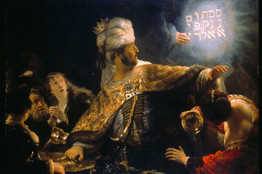
Belshazzar was terrified when a disembodied hand wrote on the wall. He promised purple clothes, a gold chain and the governorship of a third of the kingdom to the person who could interpret the writing. The queen appeared in the banqueting hall and, prefacing her words with the customary ‘May the king live for ever,’ she tells her husband that there is wise and gifted interpreter in the kingdom, Daniel, who had been favoured for his superior knowledge by Nebuchadnezzar – and the queen says twice, ‘your father’, אבוך.
Daniel is brought to the king, who says ‘Art thou Daniel, who is of the children of the captivity of Judah, whom the king my father brought out of Judah?’
In his reply, Daniel gives a resumé of Nebuchadnezzar’s biography, his greatness, his power, his madness, his life as an ox. He uses the terms ‘thy father’ and ‘thou his son,’ so the paternity of Belshazzar is repeatedly emphasised. He then refers to Belshazzar’s grandiosity, the feast, the drunkenness, the idol worship, and finally Daniel interprets the words on the wall: Mene, mene, tekel, upharsin. Verse 26 really needs to be read in the original Aramaic, to catch the way the explanations include the unfamiliar words of the inscription. There is also a pun in the word upharsin, as a slight vowel change to peres, which means ‘divided’, gives the word Persia, which is shortly to bring about the destruction of Belshazzar’s kingdom.
Daniel is instantly promoted, with purple, gold chainsd and proclamations and that very night, Belshazzar is killed.
Chapter 6
Darius the Mede now possesses the kingdom and sets up a hundred and twenty satraps to govern it, with Daniel prominent among them. As with Nebuchadnezzar and Belshazzar, Daniel distinguishes himself above his peers, who become envious. They try to find something incriminating in his life, but he is above reproach – except that he worships a God other than Darius the king. Note verse 7, ‘they came tumultuously to the king.’ The adverb is הרגשו, hargishu, from ר כ ש. They proceed to set a trap for Daniel, persuading the king to sign a statute which prohibits prayer to anyone other than the king, for a period of thirty days. Like Ahasuerus with Haman , the king appears easily manipulated and the statute is unalterable, according to the law of the Medes and the Persians. The penalty for breaking this law is to be thrown into the lions’ den.
Daniel continues to pray three times a day as usual, quite openly with the windows open, and facing Jerusalem. His enemies come upon him tumultuously and then report to the king that Daniel has been praying to his God.
The king, when told that Daniel has breached the unalterable new statute, tries to save Daniel, we are not told exactly how. The Aramaic verb שיזב, shayzayv, means to save or to release and – although it does not look like it – is a version of Hebrew עזב, to forsake, or in certain variations, to cause to be released. Whereas the causative prefix in Hebrew verbs is hi in the past tense, ma in the present, Aramaic includes a shin prefix in some causative verbs (active shaphel, passive hishtaphal), which we are looking at in לשיזבותהּ, ‘to cause him to be released’.
The tumultuous men return and remind the king that he is not empowered to change the unalterable law he has signed. Darius therefore gives the order to cast Daniel into the lions’ den, but says these words to Daniel: ‘May your God, whom you serve continually, deliver you’. By refering to Daniel serving God continually, the king implies that God will find Daniel worthy to be saved. The verb is again the shaphel of עזב, ישיזבנּך, ‘He will deliver you.’
You may remember that, in the narrqtive of the fiery furnace, the miracle is observed from the point of view of King Nebuchadnezzar, rather than that of Hananiah, Mishael and Azariah. Similarly here we are privy to the point of view of King Darius, his fasting, his abstinence from entertainment and his sleeplessness. He rises early and goes to the lions’ den where he calls out to Daniel. The reply he receives is:
O king, live forever! My God sent his angel and shut the lions’ mouths, and they have not harmed me, because I was found blameless before him; and also before you, O king, I have done no harm.
Daniel explains that the lions did not harm him because he was innocent; the following verse tells us it was because he trusted in God.
Retribution comes to Daniel’s accusers as the king has them and their families thrown into the lions’ den, where they perish.
Darius then sent out letters to all the nations of the earth, extolling the God of Daniel, in psalmodic language resembling that of Nebuchadnezzar in chapter 3, verses 31 – 33, chapter 4, verses 31 – 34.
Daniel’s long and successful career continues from his time at the court of Nebuchadnezzar, through to that of Belshazzar; he survives the fall of the Babylonians and the succession of the Medes and Persians to serve at the courts of Darius and Cyrus.
Daniel, chapters 1 – 3
Posted on: May 15, 2011
Daniel, Chapters 1 – 3
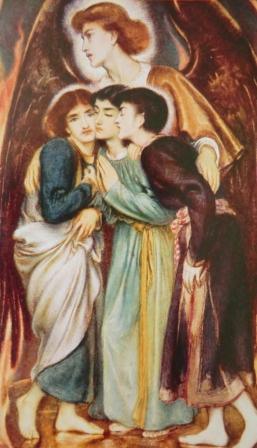
Daniel is written partly in Hebrew and partly in Aramaic. It begins with narratives about Daniel and his friends, in a genre called ‘court tales’ (chapters one to six). Esther also belongs to this genre; as does Bel and the Dragon from the Apocrypha.
The Book of Daniel is in the Ketuvim, but in a non-Jewish bible it will be found in the Prophets, after Ezekiel and before Hosea. Daniel, a Judean exile at the court of Nebuchadnezzar II (605 to 562 BC), the ruler of Babylon, becomes a prominent official in the government. As the author appears to have knowledge of Alexander the Great and the Seleucid and Ptolemaic empires which followed him, there has been a consensus in bible criticism to date the book to the Maccabean period, about 165 BCE, shortly before the death of Antiochus IV Epiphanes.
In particular, the vision in Chapter 11, which focuses on a series of wars between the “King of the North” and the “King of the South”, is generally interpreted as a record of Levantine history from the time of Alexander the Great down to the era of Antiochus IV, with the “Kings of the North” being the Seleucid kings of Syria and the “Kings of the South” being the Ptolemaic rulers of Egypt.
However, Daniel prophesies about Alexander and subsequent events:
And as for me, in the first year of Darius the Mede, I stood up to confirm and strengthen him. 2 “And now I will show you the truth. Behold, three more kings shall arise in Persia, and a fourth shall be far richer than all of them. And when he has become strong through his riches, he shall stir up all against the kingdom of Greece. 3 Then a mighty king shall arise, who shall rule with great dominion and do as he wills. 4 And as soon as he has arisen, his kingdom shall be broken and divided toward the four winds of heaven, but not to his posterity, nor according to the authority with which he ruled, for his kingdom shall be plucked up and go to others besides these.
In Josephus’s account of Alexander’s visit to Jerusalem, Alexander was presented with a copy of the book of Daniel, which would make the work extant around 330 BCE.
The period of Antiochus IV Epiphanes is 175 – 164 BCE, when the Hellenization of Judah was advanced, with the complicity of a high priest called Jason. The religious opposition to Hellenization took the name Hasidim. Antiochus attacked the Egyptian army of Ptolemy VI in 168, but was forced back by Roman intervention, under the direction of a consul called Popilius. Meanwhile Antiochus began to suppress Jewish resistance to his policies in Jerusalem, which led to the Maccabean revolt.
The identification of Antiochus in the prophetic passages in Daniel is reinforced by Josephus in the Antiquities:
Indeed it so came to pass that our nation suffered these things under Antiochus Epiphanes, according to Dasniel’s vision, and what he wrote many years before they came to pass.
While there seems to be a consensus among scholars that the legendary stories of chapters 1-6 are older than the visions in chapters 7-12, there is considerable support for the view that Chapter 7 and following were written as a message of encouragement to the hasidim suffering for their faith under the oppression of Antiochus IV Epiphanes.
The name Daniel is attributed to a son of David and Abigail , to a priest who returned with Ezra to Jerusalem and, without the letter yod, to a legendary hero whom Ezekiel compares with Job and Noah. The name Daniel occurs also in Nehemiah, as a signatory to a written pledge, against intermarriage and concerning shemitta, sacrifice and tithing.
The Talmudic view of Daniel is that it was written by ‘the men of the great assembly’ – ie the leaders during the restoration of the Temple. Rashi said that the reason Daniel did not write the book himself is the prohibition against prophecy outside Eretz Israel. This tradition which dates the book to the fifth or fourth century BCE accounts for the fact that much of the book is written in Aramaic, the language of the Persian empire.
Daniel was present at Belshazzar’s feast, and interpreted the writing on the wall. He surrvived the Babylonian Empire, which fell that night, and achieved prominence in the Persian Empire, under Darius. This enables Daniel to be present, according to some midrashim, at the court of King Ahasuerus. Daniel resembles Joseph, a wise and esteemed foreigner, called to the royal court when the kings’ advisers fail to come up with the goods.
The three chapters we are looking at on 30/03/2011 are in Hebrew up to Chapter 2 verse 4a, and in Aramaic from 2:4b.
Chapter 1 recapitulates the siege of Jerusalem by Nebuchadnezzar, and the abduction of king Jehoiakim to Babylon, called here Shinar, along with the créme de la créme of Jerusalem society, especially good looking and intelligent young men.
The young men are prepared to be presentable to the king, for a period of three years. One trusts they did not pay tuition fees. In the case of Ahasuerus, the maidens were prepared for the king in the course of just one year.
Verse 6 introduces Daniel and his companions, Hananiah, Mishael and Azariah. They are all given Babylonian names, respectively: Belteshazzar, Shadrach, Meshach and Abed-nego.
Daniel did not want to eat the unkosher food and wine which the king provided and ‘God granted Daniel mercy and compassion in the sight of the chief and the officers,’ who provided him and his companions with pulses and water, on which they thrived. The word translated as pulses or vegetables is זרעים , literally seeds.
When they were brought before King Nebuchadnezzar, the surpassed in appearance and learning all the magicians and enchanters of the kingdom.
The Hebrew expression החרטמים האשפים (ha-hartummim ha-ashafim) is particular to the Book of Daniel. Hartummin without ashafim occurs with the meaning of Egyptian magicians in the Egyptian narratives of Joseph and Moses. BDB makes a connection between hartummim and heret, to engrave, suggesting the knowledge of occult writing, perhaps comparable to the runes of Europe. Ashaf is considered a loan word from Assyrian asipu.
Chapter 2
This is reminiscent of Joseph called before Pharaoh to interpret his dreams. Besides the hartummin and ashafim, the king sends for mekashevim. – this term for a sorcerer is not unusual in Tanakh or in the Talmud – and Casdim, that is to say Chaldeans the generic name for Babylonians ruled by Nebuchadnezzar. The connotation here is that sorcery is a significant element of Chaldean scholarship.
It is explained that the Chaldeans speak Aramaic and, from this point, not only the direct speech but the narrative continues in Aramaic. Notice the formula ‘O king, live forever’ – מלכּא לעלמין חיי. We are reminded of Bathsheba’s words to David: ‘May my lord King David live forever.’ ‘O king, live forever’ is used also by Nehemiah to King Artaxerxes and on several subsequent occasions in the book of Daniel. It seems to be a Persian formula for addressing the king.
The sorcerers of King Nebuchadzezzar work under pressure, as the king tells them he will have them cut up if they do not interpret the dream. furthermore, he suspects they will collude to save themselves, by coming up with an agreed answer. To their credit, the sorcerers reply ‘Pass’, for which they receive the due death sentence.
Daniel and his companions may be under this death sentence themselves, being among the wise men of the court. Daniel sought an audience with the king, but before the appointed time, he prayed with Hananiah, Mishael and Azariah that God would be merciful and save their lives. That night, the meaning of the king’s dream was revealed to Daniel in a vision. Daniel utters a hymn of praise, in Aramaic.
Arioch, the captain of the king’s guard, brings Daniel before the king with the words ‘I have found a man of the captives of Judah, that will make known unto the king the interpretation’. You will remember that Joseph was described to Pharaoh by his cup beare who had done time with Joseph: ‘There with us a young man, a Hebrew, servant to the captain of the guard; and we told him, and he interpreted to us our dreams.’
When Daniel speaks to the king, he makes it clear that his interpretation of the dream comes from God and not from his own wisdom. He then describes the image in the king’s dream, of a statue whose head was gold, its chest and arms of silver, middle and thighs of brass, legs of iron and feet of iron and clay. A stone then struck at the feet of clay and the whole statue broke into pieces,which were carried away by the wind while the stone became a mountain that filled the earth.
In Daniel’s interpretation, the gold represents the king and the silver represents the kingdom that will come after him. This would be the kingdom of the Medes and the Persians, or possibly the Medes with the Persians represented by brass. Alternatively, brass refers to the empire of Alexander the Great. The fourth kingdom has been interpreted as the Seleucids and the Ptolomeys, or as the Romans and the Nabatean Arabs. The kingdom of brass will rule the earth – which supports the identification with Alexander. The kingdom of iron will have great oppressive strength. ‘…They shall mingle themselves by the seed of men, but they shall not cleave one to another, even as iron does not mingle with clay.’
When all these kingdoms had run their course, God would set up His own Kingdom, די לעלמין לא תתחבל which would never be destroyed.
On hearing this, Nebuchadnezzar bows down before Daniel and commanded that an offering be made to him, as if he were a god. This evokes an episode described by Josephus, where Alexander the Great, arriving in Jerusalem, bows before the High Priest.
Alexander then gave the high priest his right hand, and went into the Temple and “offered sacrifice to God according to the high priest’s direction,” treating the whole priesthood magnificently. “And when the Book of Daniel was shown him [see Dan. vii. 6, viii. 5-8, 20-22, xi. 3-4], wherein Daniel declared that one of the Greeks [] should destroy the empire of the Persians, he supposed that he was the person intended, and rejoiced thereat.
Nebuchadnezzar now affirms that God is God, saying to Daniel ‘Truly, your God is God of gods and Lord of kings, and a revealer of mysteries, for you have been able to reveal this mystery.’
Like Joseph and like Mordecai, Daniel becomes the king’s highest minister, and he gets top jobs also for Shadrach, Meshach and Abed-nego.
Chapter 3
Nebuchadnezzar reneges almost immediately, erecting a golden image and callig on all the officers of the kingdom to worship it. The term achashdarpnim is essentially the Persian word for a satrap, mentioned also in Esther and Ezra.
The signal to worship the statue is sounded by musical instruments: note סומפּניה, sumponiah. The instruments are translated into Greek as σαλπιγγος, συρινγγος, κιθαρας, σαμβυκης, ψαλτηριου, and παντος γενους μουσικων – ‘all kinds of music’.
The penalty for disobeying the signal to worship was to be cast into the fiery furnace.
We should remember that midrash offers a legend about Abraham and a fiery furnace. Nimrod persecuted Abraham whom he had thrown into a furnace, which Abraham miraculously survived unscathed.
Certain Chaldean men now brought accusations against Shadrach, Meshach and Abed-nego, for not complying with the idol worship, and they were summoned by an irate Nebuchadnezzar. Note that they are referred to by their Babylonian names, not their Hebrew names, perhaps in keeping with the Aramaic narrative, which offers a non Hebrew perspective on the story. The king gave them a chance to worship the idol, on the prompting of the musical instruments; if they refuse, they will be thrown into the furnace, ‘and who is the god that shall deliver you out of my hands?’
The three companions are by no means certain that God will rescue them, but state plainly that they will not worship Nebuchadnezzar’s gods or the golden image he has set up.
Nebuchadnezzar now orders that the furnace be heated to an intensity seven times greater than usual: this conveys his extreme anger and the extremity of the punishment; it enhances the courage of the heroes and provides the circumstance which caused the king’s men at arms to die from exposure to the heat.
They are thrown fully clothed, including hats (כּרבלות) according to some translations, and bound, into the furnace.
The Quaker George Fox reports the following in his Journal of 1656:
When we were brought into the court, we stood a while with our hats on, and all was quiet. …”Why do you not put off your hats?” said the Judge to us. We said nothing. “Put off your hats,” said the Judge again. Still we said nothing. Then said the Judge, “The Court commands you to put off your hats.” … I replied, “Thou mayest read in the third of Daniel, that the three children were cast into the fiery furnace by Nebuchadnezzar’s command, with their coats, their hose, and their hats on.”
The LXX adds that they sang praise and blessings to God as they walked unharmed in the furnace: υμνουντες τον θεον και ευλογουντες τον θεον.
The Apocrypha includes a book called ‘The Song of the Three Children,’ which is the song of praise attributed to Azariah, not called Abed-nego in the Greek of the Apocrypha but Αζαριας. This takes the form of Azariah’s prayer, followed by a brief description of the young men’s delivery from the furnace, and a psalm spoken by Azariah, Mishael and Hananiah, ending with a quotation from Psalm 118: ‘Give thanks to the Lord for his mercy endures forever’.
The Benedicite, used in the Roman Catholic liturgy, is a Latin translation of verses 35ff of The Song of the Three Children and the hymn is used also in Lutheran and Anglican worship.
These verses are not included in the canonical Daniel. There, the young men fall into the furnace and the narrative suddenly focuses on Nebuchadnezzar in film it would be called a POV shot – his perception, his alarmed reaction, and his words: ‘Did we not cast three men bound into the midst of the fire?’
when the ministers reply ‘True O king,’ Nebuchadnezzar announces in his own words the dramatic development:
He answered and said, “But I see four men unbound, walking in the midst of the fire, and they are not hurt; and the appearance of the fourth is like a son of the gods.”
The ESV pluralises אלהין but the KJV has:
He answered and said, Lo, I see four men loose, walking in the midst of the fire, and they have no hurt; and the form of the fourth is like the Son of God.
Elohin having the plural suffix, like the Hebrew equivalent Elohim, the translations seem equally viable, though ‘the son of God’ naturally reflects the theology of a Christian translator. As the words are spoken by Nebuchadnezzar, it is reasonable to think the intention of the words is polytheistic. The fourth person is also referred to, in some translations, as an angel, a translation of Elohim attested in Psalm 8:6.
In his next utterance, Nebuchadnezzar refers to God with a monotheistic usage,אלהא עליא, the equivalent of ‘El Elyon’, because he has witnessed the miracle in the fiery furnace. He calls the men out of the fire, addressing the three by name, and they emerge, unhurt, with no traces of smoke on their clothes.
Nebuchadnezzar then blesses the God of Shadrach, Mesach and Abed-nego, referring to the fourth person as an angel (מלאך) sent by God, and affirming the events which led to the miracle. He declares that no one is to talk against God; the punishment for those who do is to be cut to pieces, and have their houses destroyed. The reason he gives for this decree is that other gods are not able to deliver comparable miracles.
As with Daniel, Mordecai and Joseph, the three are promoted by the king.
Nebuchadnezzar makes a declaration, praising God. The reference to God’s signs and wonders is allusive to the miracles of the Exodus, and Nebuchadnezzar is cast in the role of Pharaoh – the Pharaoh who knew Joseph (Hebrew courtier) and the Pharaoh who knew Moses (signs and wonders). The language makes a connection between exile in Egyptian and exile in Babylon.
In the last verse, the word שלטן, dominion, from ש ל ט, ‘to rule’ is interesting as one can suppose that the word sultan is cognate; shiltun appears in the Yom Kippur liturgy (uvecheyn teyn pachdecha ), and it is more common to Talmudic usage than biblical.
The Apocrypha contains three books which are additions to the biblical Daniel; the first of these, which we noted, is The Song of the Three Children, concerning Hananiah, Mishael and Azariah; in the second, the History of Susanna, a youth called Daniel intervenes in a case of false testimony, and in Bel and the Dragon, set at the court of King Cyrus of Persia, Daniel shows that an idol called Bel is not, as supposed by Cyrus, a living god. Bel appears to eat and drink copious quantities, but this is really a scam by the priests of Bel, to get provisions for themselves and their families. There was also a dragon which the king believed to be a god, but which expired when Daniel poisoned it. This made Daniel so unpopular that the king, under pressure, had Daniel thrown in a lions’ den. However, God sent the prophet Habakkuk with packed lunches for Daniel, and when the king looked in the lions’ den after seven days, Daniel and the lions were all in good health.
This of course resembles chapter six of the canonical Daniel, where envious courtiers tell Darius the king that Daniel persists in worshipping God, illicitly.Daniel is then thrown in the lions’ den; but we shall read of this in our next session.
A Goat for Azazel
Posted on: October 11, 2009
A Goat for Azazel, and Other Scapegoats
Yom Kippur 5770

Who coined the term ‘scapegoat?
The English word scapegoat was coined by William Tyndale who translated the bible into English, and it meant ‘the goat who escapes’. The Hebrew word for goat is seir. In Hebrew, the goat is not exactly called a scapegoat. It is the goat ‘for Azazel’.
What happened in our service on page 471?
And then he would take two goats, marking out one of them for the Lord and marking out the other as a scapegoat for the sins of our people.
Leviticus 16:7
וְלָקַח אֶת־שְנֵי הַשְּעִרִים וְהֶעֱמִיד אותָם לִפְנֵי יְיָ. וְנָתַן עֲלֵיהֶם גּורָלות. גּורָל אֶחָד לַיְיָ וְגורֵל אֶחָד לַעֲזָאזֵל:
At the bottom of page 475 we read:
He shall send the goat away into the desert in the care of a man appointed for the task. The goat will carry on itself all their sins to a solitary place; and the man shall release it in the desert.
Leviticus 16:22-23
וְשִׁלַּח בְּיַד אִישׁ עִתִּי הַמִּדְבָּרָה וְנָשָׂא הַשָּׂעִיר עָלָיו אֶת כָּל עֲוֹנֹתָם אֶל אֶרֶץ גְּזֵרָה וְשִׁלַּח אֶת הַשָּׂעִיר בַּמִּדְבָּר:
What is the origin of this part of the service?
The Mishnah
The source for the our Avodah service is Yoma, a tractate of the Mishnah which deals with matters relating to Yom Kippur. It is quoted at length between pages 469 and 473 of the Machzor. It tells us what became of the scapegoat.
The man designated to lead away the goat was customarily (but not halakhically) a priest.[1] He walked with the goat a distance of twelve miles from Jerusalem to the ravine in the desert.[2] Crowds of people accompanied the man along the way until the last mile or so when he went on alone.
He divided the thread of crimson wool and tied one half to the the rock and the other half between its horns, and he pushed it from behind; and it went rolling down, and was killed before it had reached halfway down the hill[3]
The man then waited till nightfall before returning to Jerusalem. A message that the scapegoat had reached the wilderness was conveyed to the High Priest, by means of sentinel posts from which flags were waved.
Rabbi Ishmael says:
Had they not another sign also? A thread of crimson was tied to the door of the Sanctuary and when the goat reached the wilderness, the thread turned white; for it is written, Though your sins be as scarlet they shall be as white as snow (Isaiah 1:18).[4]
אִם יִהְיוּ חֲטָאֵיכֶם כַּשָּׁנִים כַּשֶּׁלֶג יַלְבִּינוּ
In art
The thread of crimson wool is depicted by William Holman Hunt, the Pre-Raphaelite artist, in his painting The Scapegoat. Hunt wanted to depict an authentically Judean location with a genuinely Middle Eastern goat. He went to Palestine in 1854 and painted the Scapegoat against the background of the Dead Sea. He did not neglect his homework where Jewish writings were concerned so his goat has red wool between its horns.
Around the frame of the painting, which now hangs in the Lever Museum in Liverpool, Hunt inscribed two biblical quotations, one from Leviticus and the other from Isaiah:
And the Goat shall bear upon him all their iniquities unto a Land not inhabited. (Leviticus 16, 22)
Surely he hath borne our griefs, and carried our sorrows, yet we did esteem him stricken, smitten of God, and afflicted.’ (Isaiah 53, 4)
Juxtaposed in this way, the quotations suggest that the scapegoat represents a human being, burdened with problems offloaded by others. Hunt regarded the scapegoat as a Christological symbol, whose punishment and suffering enables the guilty to make atonement, without themselves suffering the punishment and this view was probably in keeping with mainstream Christian opinion.
Who was Azazel?
A non-canonical work called the Book of Enoch dating from around the late Second Temple period developed a mythology of fallen angels, with Azazel prominent among them. Enoch appears briefly in Genesis in the pre-flood genealogies:
When Enoch had lived 65 years, he became the father of Methuselah. And after he became the father of Methuselah, Enoch walked with God three hundred years and had other sons and daughters. Altogether, Enoch lived 365 years. Enoch walked with God; then he was no more, because God took him away.[5]
Azazel is represented in the Book of Enoch as one of the rebellious angels who came to earth in the time preceding the flood.
And Azazel taught men to make swords and knives and shields and breastplates; and made known to them the metals [of the earth] and the art of working them; and bracelets and ornaments; and the use of antimony and the beautifying of the eyelids; and all kinds of costly stones and all colouring tinctures. And there arose much godlessness, and they were led astray and became corrupt in all their ways.[6]
When God punishes the fallen angels, he has Raphael ‘bind Azazel hand and foot and cast him into the darkness: and make an opening in the desert and cast him therein’.
Rashi and Ibn Ezra suggested that Azazel was a place name, a rugged mountain from whence the goat was pushed.
Nachmanides commented on Leviticus 16:8 that Azazel belongs to the class of seirim, goat-like demons of the desert. The name Azazel appears in Mesopotamian mythology as one of the goat-demons, who were believed to haunt the desert. At least one scholar[7] has made a connection with the mischievous Greek deity Pan, who was half goat, to show the prevalence of belief in supernatural goat entities in Mediterranean culture.
Propitiation of the seirim existed among the Israelites to the extent that it was accommodated by King Jeroboam:
[Jeroboam] appointed his own priests for the high places and for the goat and calf idols he had made.[8]
וַיַּעֲמֶד לוֹ כֹּהֲנִים לַבָּמוֹת וְלַשְּׂעִירִים וְלָעֲגָלִים אֲשֶׁר עָשָׂה.
In a later work – perhaps first century CE – the Apocalypse of Abraham, Azazel appears as a bird of prey which came down upon the sacrifice which Abraham prepared, with reference to Genesis 15:11 “Birds of prey came down upon the carcasses, and Abram drove them away.”[9]
When Isaiah foretells desolation in Babylon , he speaks of the land being overrun by wild goats and birds of prey.[10]
But desert creatures will lie there, jackals will fill her houses; there the owls will dwell, and there the wild goats will leap about.
In the mythological background of the region there seems to be an association of the ideas of dry and desolate places with wild goats, birds of prey and possibly minor demons, such as Azazel.
Another suggestion is that the spelling עזאזל is a defective version of עזז אל, which sounds the same, and means ‘strong God’ or ‘fierce God’. This interpretation is more in keeping with Jewish monotheism.
The Scapegoat in Psychology
In 1997, a group of therapists formed the Scapegoat Society, as a resource for people who have experienced being a scapegoat, and for people working professionally to resolve scapegoat problems.
They defines scapegoating thus:
Scapegoating is a hostile social – psychological discrediting routine by which people move blame and responsibility away from themselves and towards a target person or group. It is also a practice by which angry feelings and feelings of hostility may be projected, via inappropriate accusation, towards others. The target feels wrongly persecuted and receives misplaced vilification, blame and criticism; he is likely to suffer rejection from those who the perpetrator seeks to influence. Scapegoating has a wide range of focus: from “approved” enemies of very large groups of people down to the scapegoating of individuals by other individuals. Distortion is always a feature.
The act of scapegoating involves a separation of good and bad, just as the two goats are separated and sent each to its own destiny. The badness is projected onto a scapegoat person or group, so the one who is doing the scapegoating can feel they are in the right and the scapegoat is in the wrong, the guilty one, the troublemaker.
Aaron Esterson, a colleague of RD Laing, wrote a book called The Leaves of Spring: Schizophrenia, Family and Sacrifice in 1970. Like Laing, he believed that so-called insanity was a rational response to extreme problems in the family, and he made a study of a Jewish family of five, where the parents projected negative feelings on to one of their daughters, aged 23. This was a family where hostility was covered up so that the family should appear united and well-regulated in the eyes of other people. When the daughter undermined this united front, preventing the parents from ‘keeping up appearances’ in the way that seemed normal and right to them, they considered that she must be mentally ill and brought her for psychiatric evaluation.
According to the Laingian school of psychiatry, schizophrenia was a construct used to explain away the patient’s reaction to an intolerable family situation. Members of the family failed to acknowledge existing problems among themselves and acted as if the problems would disappear if the so-called patient, the scapegoat, was removed.
Subsequently, trends in biological psychiatry and genetics detracted from Laing’s reputation and his views were widely rejected. It was thought that he scapegoated the families of patients, particularly the mothers whom he blamed for their children’s dysfunction. In recent years there has been some rehabilitation of Laing’s approach, his validation of patients and their experiences being considered by many a valuable contribution to psychiatry.
In literature
Disturbing families
In her novel The Elected Member, Bernice Rubens wrote about a Jewish family in which the gifted adult son is driven to mental breakdown by the burden of his family’s expectations. Writing in 1969, she quotes Laing’s soundbite: ‘When patients are disturbed, families are often disturbing.’ Notice that Bernice Rubens uses the term ‘the elected member’ to designate the scapegoat of the family, as if the requirement for the rôle of scapegoat existed before someone was chosen to play the part.
The controversial American feminist Andrea Dworkin wrote a book called Scapegoat: The Jews, Israel, and Women’s Liberation, published in 2000, in which she links misogyny and anti-semitism, pointing out parallels between these two forms of scapegoating through history. Dworkin argues that while Jews are scapegoated by non-Jews, Palestinians are scapegoated by Israelis, and women are scapegoated by men.
In anthropology
A pair of goats, a pair of birds and a pair of brothers
Mary Douglas, the anthropologist, writes about the scapegoat in her book Leviticus as Literature. She sees the pair of goats as an example of a binary pairing which occurs elsewhere in Leviticus: for example, in a ritual involving two birds where one is sacrificed and the other released.
The priest shall order that two live clean birds and some cedar wood, scarlet yarn and hyssop be brought for the one to be cleansed. Then the priest shall order that one of the birds be killed over fresh water in a clay pot. He is then to take the live bird and dip it, together with the cedar wood, the scarlet yarn and the hyssop, into the blood of the bird that was killed over the fresh water. Seven times he shall sprinkle the one to be cleansed of the infectious disease and pronounce him clean. Then he is to release the live bird in the open fields.[11]
Mary Douglas relates this ritual pairing in Leviticus to the narratives of the book of Genesis, where the narratives are concerned with pairs of brothers. Isaac, who was prepared as if for sacrifice on Mount Moriah, has a brother Ishmael who is sent out into the desert, to survive and become the father of a nation. Jacob has a brother Esau who is so unloved by his mother Rebecca that she conspires to have him dispossessed of his inheritance by Jacob.
James George Frazer’s The Golden Bough was first published in 1890, a defining work of anthropology, examining cultic myths and magic in places which were at that time accessible only to intrepid explorers. He found scapegoat-type rituals in the East Indian islands, in China, in Central and South America, East Africa, India and New Zealand. Frazer considered the rituals primitive, saying:
The notion that we can transfer our guilt or sufferings to some other being who will bear them for us is familiar to the savage mind.[12]
In some societies, where human sacrifice was practised, the scapegoat figure may have been a person, who was put to death, to ensure fruitful harvests. Some of you may remember the film The Wicker Man, on this theme. Human scapegoats were sometimes believed to have divine status. Consider the symbolism of Hunt’s scapegoat.
Frazer noticed that scapegoat rituals usually occurred on a yearly basis ‘…and the time of year when the ceremony takes place usually coincides with some well-marked change of season.’[13] The onset of dangerous conditions such as drought or flooding may be behind seasonal acts of propitiation.
In Midrash
Who was the prototype for the scapegoat?
לָקַח אֶת־שְנֵי הַשְּעִרִים
Midrash identifies the scapegoat (seir) with Esau who was called Seir, meaning hairy, and whose descendants lived in territory called Mount Seir, named after him. The connection with the seir for Azazel is unmistakable. Midrashic legend treats Esau unkindly, describing him as wicked, even from the womb and weaving many stories where Jacob represents goodness while Esau represents evil.
Rebecca tells Jacob to put the hairy skin of a kid on his hands in order to pass himself off more credibly as Esau and obtain the blessing from his blind father Isaac. With a mother like Rebecca, Esau really fits the Laingian view of the scapegoat.
Scapegoats and brothers
Ishmael and Esau are not the only scapegoats to be found in the Genesis narrative. Why was Cain’s face fallen?[14] Why did God accept Abel’s sacrifice and not that of Cain? We should remember that Abel died and Cain was sent away to become a wanderer on the earth.[15]
Staying with Genesis, we might consider the twelve brothers who became the twelve tribes of Israel – Joseph and his brothers. All the tribes flourished and, after the slavery in Egypt and the years in the wilderness, each tribe held territory in the promised land, so you might think there is not a scapegoat among them. However, we all remember how Joseph was roughly treated by his brothers and cast into a pit, to be sold to Ishmaelites.[16] When they returned to their father Jacob, how did they account for Joseph’s disappearance?
וַיִּקְחוּ אֶת כְּתֹנֶת יוֹסֵף וַיִּשְׁחֲטוּ שְׂעִיר עִזִּים וַיִּטְבְּלוּ אֶת הַכֻּתֹּנֶת בַּדָּם
Then they got Joseph’s robe, slaughtered a goat and dipped the robe in the blood.[17]
Jacob, who used the skin of a goat to deceive Isaac, is himself deceived by the skin of a goat.
A goat is slaughtered by Joseph’s brothers, but Joseph is brought alive to Egypt.
There is a Christian tradition of identifying Joseph with the suffering servant of Isaiah 53 and of reading Christological symbolism into the Joseph narrative of Genesis.
Religions as well as families require scapegoats so that sins may be expiated, but the scapegoat plays a vital rôle in the ritual and is by no means an object of hatred.
We should note that only in the Mishnah is the scapegoat pushed over a cliff. According to Leviticus …the goat shall bear upon him all their iniquities unto a land not inhabited: and [they] shall let go the goat in the wilderness.[18]
The scapegoat may be burdened, symbolically, with the transgressions of the Israelites, but once it reaches the wilderness, it is home free.
[1] Yoma 6:3
Yoma 6:4
[3] Yoma 6:7
[4] ibid 6:8
[5] Genesis 5:21-24
[6] 1 Enoch 8:1-3a
[7] The High Places of PalestineW F Albright
[8] 2 Chronicles 11:15
[9] Apocalypse of Abraham 13:4-9
[10] Isaiah 13:21
[11] Leviticus 14:3-6
[12] The Golden Bough OUP p557
[13] ibid p587
[14] Genesis 4:6
Genesis 4:12
[16] Genesis 37:27
[17] Genesis 37:31
[18] Leviticus 16:22
Mikketz
Posted on: August 14, 2009
Mikketz 2008
Genesis 43:15-44:17
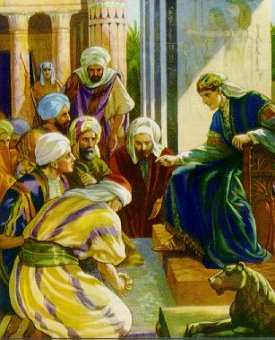
There are parts of Joseph’s story which most people remember: for example that his jealous brothers sold him into slavery and that his personal qualities and clairvoyant skills resulted in him becoming Pharaoh’s right hand man. You may recall that years later, Jacob sent Joseph’s brothers to Egypt to obtain grain, because there was famine in the land of Canaan. When the brothers arrived in Egypt, they failed to recognize Joseph, now the Viceroy or Prime minister, and Joseph showed what must have seemed an odd and threatening interest in these Hebrew brothers from Canaan. He accused them of being spies, demanded that they bring their brother Benjamin to Egypt and meanwhile held Simeon as a hostage to settle the matter. Finally, as the brothers travelled home, they found that the money they had paid for the grain had been returned to them, placed inside their sacks.
Today we read that, when the famine continued, Jacob sent his sons again to Egypt. This time they brought with them Benjamin, much against Jacob’s wishes, for Benjamin, like Joseph, was the son of Rachel, and Jacob favoured the sons of Rachel above the sons of Leah.
Besides Jacob and his twelve sons, there is another player with a speaking role in this part of the Joseph narrative. This is Joseph’s house steward whose name is not recorded so he is called simply הָאִישׁ אֲשֶׁר עַל בֵּית יוֹסֵף, the man over Joseph’s house. This character appears benign but unexpectedly well-informed, knowing some things which he could have learned only from Joseph.
To him, the brothers confide their fears, that they will appear as thieves, because their money had reappeared in their sacks, and that the Viceroy will deal harshly with them, perhaps even take them as slaves. It is an ironic turn of events that the brothers who sold Joseph into slavery now fear being enslaved by him; ironic also that they are wrong in one way and right in another, for Joseph will not enslave them yet their descendants are destined of course to become slaves in Egypt.
Joseph’s house steward says: ‘Do not fear; your God and the God of your father has given you treasure in your sacks.’ He then reunites them with Simeon who had been held hostage and brings them to Joseph’s house, where they receive five star hospitality.
I am curious about this steward and the way he is just called ‘the man,’[1] combined with the fact that the brothers refer to Joseph as ‘the man’[2] and the brothers, if you look closely at this chapter, are not called ‘the brothers’ but ‘the men.’[3] They are called Joseph’s brothers only at the moment when he reveals to them his true identity, which is not yet, not this week.
At last Joseph appears and the brothers bow before him, just as in the dream, which Joseph, as a teenager, related to them, causing them to hate him. They dine with Joseph and get drunk with him, but Joseph never lets down his guard. The next day, he tells his steward to put the men’s silver in their sacks, as before, and to plant in Benjamin’s sack a valuable silver goblet. Years before, the brothers were paid in silver when they sold Joseph to Midianite traders, and now silver keeps coming back to them, an unwanted reminder of a matter they must have hoped was closed.
Joseph gives his steward the job of pursuing the men and accusing them of theft. Although they protest their innocence, the goblet is of course found, to their horror, in Benjamin’s sack. It is, we learn, a ‘divining cup,’ which Joseph uses for divination, a common practice in Egyptian society, and Joseph in particular has a tendency towards the psychic, in his own prophetic dreams and the dreams which he interprets.
The men return to the city and now Judah begins to play a prominent role, acting as a spokesman for his brothers and attempting to protect Benjamin from punishment.
Joseph however declares his intention of keeping Benjamin as a slave and says ‘The rest of you go back in peace to your father.’ The traditional interpretation is that he is testing his brothers, to see if they will abandon Benjamin, as he himself was abandoned, or if they have repented and changed.
The themes of identity theft and deception are part and parcel of the Joseph story. They begin in the previous generation, when Jacob disguises himself as Esau and continue when Laban puts Leah in Jacob’s tent instead of Rachel. Then Joseph’s brothers lie to their father, telling him that Joseph had been killed by a wild beast. Now Joseph withholds the truth from his brothers, exercising his power over them to create fear and revive guilt.
We await the moment of revelation and reconciliation, which will come in the next sidra, with the whole family together in Egypt and the stage set for slavery, exodus and nationhood.
Stay tuned.
[1] see also Genesis 37: 15-17
Genesis 43: 3, 7, 14
ibid vv 15, 17, 18, 24


Shabbat Chazon 5769 (2009) and 5775 (2015)
Posted by: Gillian Gould Lazarus on: July 26, 2009
When I wrote this, in 2009, Tisha b’Av did not seem the most relevant of our festivals. I have no desire to see a third Temple on the Temple Mount, only to see peace there, an idea now as remote as that of rebuilding the Temple. Tisha b’Av, six years ago, seemed a conduit to historical troubles and tragedies, which, b’ezrat Hashem, we would remember but not relive. Now the year is 5775 (2015): antisemitism is present in Europe, America and of course in the Middle East. Our detractors even wish to deny us the word ‘antisemitism’, saying that we are not Semites – as if to say that antisemitism is culpable but hatred of Jews is acceptable. Some of us are critical of Israel’s present governmant, but our fate is nevertheless intertwined with it, bound like tefilin round the left arm. This year, we are truly bein hametzarim – between a rock and a hard place, between Israel and the diaspora. The coming shabbat will be Shabbat Chazon, the Sabbath of Vision, and the evening will be the onset of Tisha b’Av. I pray that we are all delivered safely through it, towards Shabbat Nachamu the following week: the shabbat of comfort.
Torah introduction at ******, 5769:
There’s an old joke to the effect that Jewish festivals can be summarized as follows: ‘They tried to kill us. We survived, let’s eat.’ I can’t tell you where this originated but it’s short, sweet and contains an element of truth. Many of our holy days commemorate historical occurrences outside our control, for example the slavery in Egypt or the wandering in the wilderness, or Haman’s plot. Then we celebrate our deliverance from the event through rituals of remembrance and sanctification: the seder, the succah, the reading of the Megillah. This doesn’t apply only to Jewish notable days. Armistice Day on 11 November works in the same way. A catastrophe comes at us from outside and we give it pattern and meaning and, in our case, a place in the Jewish calendar.
Today is Shabbat Chazon, named after the first word of the haftarah, the first word in fact of the book of the prophet Isaiah. It means ‘vision’. When you see Shabbat Chazon on our haftarah sheet, you know that the ninth day of the month of Av will occur in the coming week.
It might seem that Tisha b’Av barely registers on the radar of most Reform Jews. However, anyone who has attended a shabbat service during the last three weeks will have heard one of the three haftarot of rebuke which fall in the three week period between 17 Tammuz and 9 Av.[1] Even if you don’t notice Tisha b’Av on the day itself, the season wafts past like a ripple in the air, every summer during the dog days.
Tisha B’Av was a day of destruction for both the first and the second Temples in Jerusalem. The first was destroyed by the Babylonians under Nebuchadnezzar; the second by the Romans under Titus. It is a day associated with many disasters from Jewish history: the defeat of Bar Kokhba’s rebellion in 135, the expulsion of the Jews from England in 1290 and from Spain in 1492. Many tragedies also befell the Jews on 9 Av in the twentieth century, especially during the Shoah.
The 17th of Tammuz, three weeks earlier, is the day when the Babylonians breached the walls of Jerusalem and later so did the Romans, give or take a day or two. The rabbis of the Mishnah set aside these days, to mourn and to fast. For their own reasons, the Babylonians also observed 9 Av as a day of sorrow, perhaps because the height of summer in that region is naturally a time of drought with its attendant dangers. This too may have encouraged the Israelites exiled in Babylon to look on the season as a time of mourning.
The Babylonian exile lasted only fifty years and was followed by a return and a restoration, but the Roman triumph in 70 CE exiled the Jews until 1948.
The Crusaders, the Inquisition, the Cossacks, the Nazis have all been likened to the Romans, doing their worst on Tisha B’Av.
Sometimes, in Rabbinic literature, Rome was called Edom – Esau’s other name – a code which enabled the rabbis to refer to the Romans without alerting Roman censorship.
The historian Martin Goodman suggests in his book Rome and Jerusalem that it was not so much Roman policy, as a series of uncontrollable developments which propelled events towards catastrophe. After the death of the emperor Nero, Vespasian and his son Titus became major contenders in the competition for power and, in this cause, much depended on a conclusive victory in Judea, their theatre of war. According to Josephus, Titus was reluctant to destroy the Temple in Jerusalem because he considered it a magnificent work and an ornament for the Roman empire.[2]
Josephus reported that the burning of the Temple came about when a Roman soldier, without orders, snatched up a burning brand and threw it into the Temple.[3] When the Temple was destroyed, Titus’s only option was to proclaim a triumph and demonize his enemy, the people of Judea.
The war with Rome is a history of attrition, ambition, chaos and expediency but it has also a religious significance, representing Jewish tragedies, both ancient and relatively recent, recalled through our modern understanding.
The Jewish calendar is like a lens through which patterns in history come into focus and are more clearly visible and Tisha b’Av, for all its darkness, helps us to see the pattern when we hold the lens before our eyes.
Gillian Lazarus July 2009
[1] Bein haMetzarim, ‘between the straits’.
[2] Rome and Jerusalem Martin Goodman Penguin 2007 pp440-444
[3] Jewish Wars Josephus 6,4