Author Archive
Who Was Enoch?
Posted on: May 19, 2012
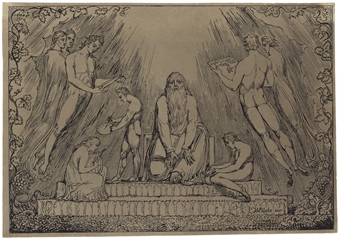
Enoch appears in the antediluvian genealogies of Genesis 5:
18 When Jared had lived 162 years he fathered Enoch.
19 Jared lived after he fathered Enoch 800 years and had other sons and daughters.20 Thus all the days of Jared were 962 years, and he died.
21 When Enoch had lived 65 years, he fathered Methuselah.
22 Enoch walked with God after he fathered Methuselah 300 years and had other sons and daughters.
23 Thus all the days of Enoch were 365 years.
24 Enoch walked with God, and he was not, for God took him.
25 When Methuselah had lived 187 years, he fathered Lamech.
26 Methuselah lived after he fathered Lamech 782 years and had other sons and daughters.
27 Thus all the days of Methuselah were 969 years, and he died.
28 When Lamech had lived 182 years, he fathered a son
29 and called his name Noah, saying, “Out of the ground that the LORD has cursed this one shall bring us relief from our work and from the painful toil of our hands.”
There is another Enoch, or another account of Enoch in Genesis 4, where he is a son of Cain:
16 Then Cain went away from the presence of the LORD and settled in thelandofNod, east ofEden.
17 Cain knew his wife, and she conceived and bore Enoch. When he built a city, he called the name of the city after the name of his son, Enoch.
18 To Enoch was born Irad, and Irad fathered Mehujael, and Mehujael fathered Methushael, and Methushael fathered Lamech.
19 And Lamech took two wives. The name of the one was Adah, and the name of the other Zillah.
The Enoch whose name is given to three pseudepigraphic books is the Enoch of Genesis 5, who walks with God and, mysteriously, vanishes.
The first Book of Enoch is a pentateuchal work, the five books being: the Book of the Watchers, the Similitudes, the Book of Heavenly Luminaries, the Dream Visions and the Epistle of Enoch. It exists only in Ethiopic – the south Semitic Ge’ez language – but Aramaic fragments of 1 Enoch were found at Qumran.[1]Some scholars believe that the original language was Hebrew, others that, like Daniel, it was composed partly in Hebrew and partly in Aramaic. It is usually dated between the third century BCE and the first century CE, during the later period of the secondTemple. Charlesworth describes it as a composite work, with the earliest passages dating from pre-Maccabean times and the latest dating as late a 64 BCE, which is the beginning of the Roman occupation.
The presence of fragments of 1 Enoch at Qumran makes it probable that the work originated inJudea. Professor Gabriele Boccaccini of theUniversityofMichiganbelieves that the Enochic community was the same sect as the Essenes of theDead Sea. It is quoted in the New Testament, in the Epistle of Jude.
The existing Ethiopic text was translated by scribes of the EthiopicChurch, and there are several references to it in early Patristic literature.[2]After the fourth century CE, it was dropped from Christian use, perhaps because Jerome, who translated the bible into Latin, denied its canonicity, although its influence continued uninterrupted inEthiopia.
Charlesworth says:
…1 Enoch is as dependent upon the Old Testament as it is influential on the New Testament and later extracanonical literature. During the exilic and post-exilic periods, apocalyptic became a major trend in Jewish thought. It was inherited by Christianity and remains an element in it to the present. Apocalyptic is both prophetic and revelatory; in apocalyptic literature we find, on the one hand, moral indignation about the present world, and, on the other, the foreboding predictions of eschatalogical events and the ultimate destiny of the world.[3]
The second Book of Enoch, in Old Slavonic, is usually dated to the first century CE.
The third Book of Enoch, a Kabbalistic text in Hebrew is believed to be written in the fifth century CE.
I propose that we defer our study of the second and third books to our next two sessions.
The Content of 1 Enoch
Book I
Enoch discloses a vision which he received from the angels. At a certain time in the future, God will emerge from heaven and march on Mount Sinai.[4]This will be accompanied by geological catastrophes, arousing fear in both mortals and Watchers (the Enochic term for fallen angels, fathers of the Nephilim, the fallen ones of Genesis 6:4). God will then proceed to judge both the righteous, who will be blessed, and the wicked, who will be destroyed.
Enoch speaks about the marriages between the fallen angels and mortal women, referred to in Genesis 6:1-4. He names the leading fallen angel as Semyaz as well as naming other ‘chiefs of tens’ among them. Notable among the fallen angels is Azazel (known to us through the Yom Kippur scapegoat liturgy) who taught the people arts of metallurgy, jewellery making, cosmetics and alchemy. Other angels taught magic – particularly using plants – and astrology. The people were not edified by the knowledge imparted to them by the angels, as it only served to increase their dissipated behaviour.
This is the period just before the flood when the wickedness of humanity causes God to repent that He created it,[5]but, in the Enochian version, it is the angels Michael, Surafel and Gabriel who bring these matters to God’s attention.[6] God tells Michael that he should make known to the Watchers and those defiled by them that they will be destroyed while the survivors will become righteous and the earth cleansed from sin and suffering.[7]
The fallen angels beg Enoch to intercede for them and he writes down their prayers for forgiveness. He then goes to the foot of mount Hermon and recites the prayers, until he falls asleep. While sleeping, he has a vision which he afterwards recounts to the Watchers.[8]
In the vision, Enoch ascends to heaven until he comes into the presence of God. God says ‘Do not fear Enoch righteous man, scribe of righteousness; come near to me and hear my voice.’[9] God tells Enoch to say to the Watchers: ‘You were once in heaven, but not all the mysteries of heaven are open to you, and you know the rejected mysteries.’[10](See text of 1 Enoch 16.)
Enoch is then taken on a tour of the earth where he is enabled to see the four winds, the inside of mountains, souls carried by clouds and the path of angels. He is shown a desolate plateau which is the prison for fallen stars and the angel Uriel tells him that the Watchers will be detained there.[11] He learns the names of the archangels – . Uriel, Raphael, Raguel, Michael, Saraqael, Gabriel and Remiel.[12]He is shown Jerusalem, the tree of life and the tree of judgment, strange beasts and finally the three open gates of heaven which he views from the ends of the earth.[13]
Book II
This is called the Book of the Similitudes, or the Book of Parables. The tone is highly mystical, with descriptions of angels and the secrets of the cosmos. We also find the personification of abstract qualities such as Righteousness and Wisdom, which is familiar to us through the prophetic writings and Wisdom books of the Tanakh.
There is an account of the Son of Man, an expression (c’var Enosh) which occurs in the vision of Daniel chapter 7 as ‘one like a son of man’. In 1 Enoch 48, the concept is developed in a way which resembles the Johannine Logos, as a divine being existing before the creation of the world, as well as the Son of Man themes in the synoptic gospels. It has been suggested[14]but not widely accepted that 1 Enoch 48 is a later Christian addition (See text 1 Enoch 48) but, as the scholarly consensus is that Enoch predates the NT, it is possible that Enoch is one of the influences on themes developed in the NT.
There is a biennial conference called the Enoch Seminar, where scholars of Second Temple Judaism and Christian Origins meet to discuss topics of common interest. At the third Enoch Seminar in 2005, focused on Enoch 48: the Son of Man text.
Enoch 51 affirms that Sheol will ‘return all the deposits which she has received’ and the risen dead will be judged by ‘the Elect One’ who ‘stands before the Lord of Spirits’[15]. The concept of the Elect One in Enoch suggests a very un-Jewish dualism. Kings and potentates are to be cast into the abyss by the angels Michael, Raphael, Gabriel and Phanuel.[16]It is interesting that those judged guilty are the earthly powerful elite.
Enoch speaks of the role of the angels in the world of politics, when the Parthians and Medes will go to war against Israel, but ultimately turn on each other and be destroyed.[17]Gabriele Boccaccini points out that this reference to the Parthians and Medes ‘…anchors us to a specific event that occured in 40 BCE’[18], namely an attempted invasion ofJerusalem by the Parthians, who resisted the advance of the Romans from the west.
The angels then show Enoch the mysteries of nature and the monsters Leviathan and Behemoth. He sees angels hoisting ropes, which they use to make measurements.[19]What are they measuring?
These are the measurements that shall be given to faith and which shall strengthen righteousness. And these measurements shall reveal all the secrets of the depths of the earth, those who have been destroyed in the desert, those who have been devoured by wild beasts, and those who have been eaten by the fish of the sea. So that they all return and find hope in the day of the Elect One. For there is no one who perishes before the Lord of the Spirits, and no one who should perish.[20]
Kings and governors will come before God on the day of judgment, and experience pain like a women in labour, a simile often used by the three major prophets, and once by Micah in the minor prophets.
Enoch’s grandson Noah is shown the wickedness of men and the imminence of the deluge.[21]Enoch tells Noah that he will be saved and his desendants flourish on earth. The next parashot are visions given to Noah. The angels Michael and Raphael nsme the fallen angels, who corrupted mankind, teaching them warfare and misleading Eve.[22]
Enoch ascends to heaven where he sees hosts of angels, seraphim, cherubim and ophanim, and is brought into the presence of the Antecedent of Time, described similarly to the Ancient of Days in Daniel 7.[23]Enoch utters blessings and an angel says to him:
You, son of man, who art born in righteousness and upon whom righteousness has dwelt, the righteousness of the Antecedent of Time will not forsake you.[24]
Book III
The third part of 1 Enoch is The Book of Heavenly Luminaries.
The angel Uriel shows Enoch the celestial bodies. There are gates through which the sun rises and sets for periods of thirty days, and when the sun reaches the sixth gate, the day becomes longer than the night.[25]The author of these passages has made close astronomical and meteorological observations and draws interesting inferences.
And neither does [the sun] diminish…nor take rest but continue to run day and night. As for the intensity of its light, it is sevenfold brighter than that of the moon; nevertheless the sun and the moon are equal in regard to their respective sizes.[26]
The author’s idea that both the sun and moon ride on chariots driven by the wind invokes the image of Apollo’s chariot.
Uriel instructs Enoch to return to earth for a year so that he can teach his son Methuselah everything he has learned, and in the second year, Enoch will be taken away. Enoch tells Methuselah about the heavenly luminaries, which determine the seasons and the festivals and names the angels, or ‘captains’, to whom God delegates responsibility for the days, months and seasons.
Book IV
Enoch communicates his visions to his son Methuselah. In the first vision, he sees the earth being destroyed, and prays to God not to destroy life on earth.
The second vision takes the form of an allegory of the history from antediluvian times (text of Enoch 85) to the time of the Maccabees. The time of composition may be close to the time that the book of Daniel was written and, certainly, much of the imagery of 1 Enoch resembles the imagery of the apocalyptic passages in Daniel.
In Enoch’s dream vision, animals represent human beings (a form of allegory used by Pseudo Philo in Liber Antiquitatum Biblicarum ) and colours represent attributes.
Translators of Enoch, GH Schodde (1854 -1917) and RH Charles (1855 – 1931) interpreted the components of the allegory as follows:
| White | Moral purity |
| Black | sin |
| Red | Blood or bloodshed |
| White bull | Adam |
| Heifer | Eve |
| Red calf | Abel |
| Black calf | Cain |
| White calf | Seth |
| White bull | Noah |
| White bull | Shem |
| Red bull | Ham |
| Black bull | Japheth |
| Lord of the sheep | Hashem |
| Fallen star | Samyaza or Azazel |
| Elephants | Giants |
| Camels | Nephilim |
| Asses | Elioud |
| Sheep | The faithful |
| Rams | Leaders |
| Herds | Tribes ofIsrael |
| Wild Asses | Ishmael and descendants |
| Wild boars | Esau and his descendants |
| Bears (Hyenas/Wolves in Ethiopic) | Egyptians |
| Dogs | Philistines |
| Hyena | Assyrians |
| Ravens | Seleucids |
| Kites | Ptolomeys |
| Eagles | Macedonians |
| Foxes | Ammonites and Moabites |
Book V
Enoch gathers Methuselah and his brothers and addresses them, exhorting them to love righteousness alone. He tells them that violence and plague will break out on the earth.
A great chastisement shall come from heaven upon all these,
And the holy Lord will come forth with wrath and chastisement
To execute judgement on earth.
In those days violence shall be cut off from its roots,
And the roots of unrighteousness together with deceit,
And they shall be destroyed from under heaven.
And all the idols of the heathen shall be abandoned,
And the towers burned with fire,
And they shall be removed from the whole earth.[27]
Section 93 is called the Apocalypse of Weeks where Enoch speaks of ‘ten weeks’ which represent the history of the world, where seven weeks represent the past and three the future, culminating in a criminal, apostate generation, which will be destroyed while those who die in righteousness will live and rejoice:
Their spirits shall not perish , not their memorial from before the face of the Great One unto all the generations of the world.[28]
Enoch tells his children that the righteous should not be afraid when they see the wicked flourish, there will retribution for the wicked and rejoicing for the righteous.
Finally, when Enoch finishes his speech, there is a narrative concerning Methuselah and his son Lamech whose wife gave birth to a son of angelic beauty.[29]Lamech begged Methuselah to go to Enoch, now dwelling among the angels, to learn the meaning of this strange portent of the celestial child.
Enoch explains to Methuselah about the coming deluge, and how Lamech’s child and his family will be saved, alone of all mankind. Methuselah names his grandson Noah, ‘for he will comfort the earth after its destruction.’[30]
The book concludes with the assurance that the righteous will be recompensed for their suffering on earth, and that ‘they shall be resplendant for ages that cannot be numbered’.[31]
Conclusion
Much of 1 Enoch is recognizable to those familiar with the Tanakh, especially Genesis, the prophets and Daniel. It contains terminology familiar to readers of the New Testament, and is believed to date from the intertestamental period, which suggests the possibility of an Enochic influence on the gospels.
It is in the the third book of Enoch, a Hebrew work attributed pseudepigraphically to the tannaitic Rabbi Ishmael ben Elisha, that Enoch is transformed into the angel Metatron. In the first book of Enoch, he ascends to the heavens and is guided by angels who reveal secrets of heaven and earth, but it is not suggested that he is transfigured into an angel.
I suggest that we look at the second and third books of Enoch at our meetings in June and July (2012).
[1] James H Charlesworth, Pseudepigrapha vol 1, p 6
[2] Irenaeus, Origen, Tertullian, Clement ofAlexandria.
[3] Charlesworth vol 1 p9
[4] 1 Enoch 1
[5] Genesis 6:5-7
1 Enoch 9
ibid
[8] 1 Enoch 13
[9] 1 Enoch 15
ibid
[11] 1 Enoch 19
1 Enoch 20
1 Enoch 35 and 36
[14] 1976, by Josef Milik, who worked on the Dead Sea Scrolls
[15] 1 Enoch 49:2
Enoch 54
[17] Enoch 56:5-8
Enoch and the Messiah Son of Man, Gabriele Boccaccini, Eerdmans 2007
[19] Enoch 61
[20] ibid vv 4-6
[21] Enoch 65
Enoch 69
[23] Enoch 71
[24] ibid v14
[25] Enoch 72:14
[26] ibid v37
[27] 1 Enoch 91:7-9
[28] 103:4
[29] 1 Enoch 106
[30] ibid 107:3
[31] ibid 108
Purim Spiel 5772
Posted on: March 8, 2012
- In: Purim
- Leave a Comment
Performed with Powerpoint, music and pictures, at Sha’arei Tsedek North London Synagogue on 7 March 2012
ESTHER CHAPTER ONE
From Ahasuerus (king.ahasuerus@shushan.org.pe)
To medes@media.com; satraps@persia.co.pe; princes@ethiopia.co.et; raj@hodu.co.in;
Cc achaemenids@shushan.org.pe
SUBJECT Invitation
Ahasuerus King of Persia requests the pleasure of your company at a banquet to be held at Shushan the Castle.
‘We’ll teach you to drink deep ere you depart,’ to quote our court poet.
WACS (wives and concubines) will be welcome at a banquet given by Queen Vashti in Her Majesty’s private boutique.
The most royal and gracious
Ahasuerus
Dress: informal blue/purple linen
RSVP info@shushan.org.pe
*
From Ahasuerus (king.ahasuerus@shushan.org.pe)
To Memucan@satraps.com; et cetera
SUBJECT Vashti the Queen
Having REALLY MERRY time with courtiers and satraps – one prince came all the way from India on an ELEPHANT LOL!!!
It will be our pleasure for you to fetch Queen Vashti PRONTO, so that these guys can see her in the flesh. Eat your heart out, Menelaus!
The most royal and gracious sovereign
Ahasuerus
PS Tell her to wear her crown!!!
*
SMS
No way King A! Am having gr8 time in harem with unux, 2BZ2 meet ur geeky friends. C u (much) l8er, VashT
*
From: Memucan Memucan@yesucan.com
To: King Ahasuerus (king.ahasuerus@shushan.org.pe)
SUBJECT Vashti the Queen
Your Majesty
Queen Vashti has wronged not only your royal person but all the husbands in your empire. She has shown the kind of disrespect that leads inevitably to a breakdown in family values and the subversion of identity. I urge you to divorce Vashti at once and replace her with another, better than she.
BTW thanks for the awesome banquet.
Your devoted servant
Memucan (Prince)
*
MEMO
ATTN Princes of Persia and Media
From: Prince Memucan
Re: the person formerly known as queen Vashti
HM King Ahasuerus is divorcing Vashti. She will cease to be Queen forthwith and is not to be referred to as HRH.
Make it known in your own households that every woman is to be subservient to her husband. This is an unalterable decree of the Medes and the Persians and is available in the following languages: Akkadian, Aramaic, Coptic, Elamite, Greek, Hebrew, Klingon, Parsi, Sanskrit, Sumerian and Welsh.
*
CHAPTER 2
Classified
Inexperienced and obedient maiden required by royal male. Must have stunning good looks and an agreeable disposition. Must be amenable to new experiences and say yes to everything.
Apply to hegaitheeunuch@shushan.org.pe
No mingers
*
15th Samiyama
Dear Hegai
My foster daughter Hadassah (also known as Esther) has all the virtues required in your advertisement which appeared in the Star of Shushan on 14th Samiyamas. She is also virtuous, obedient and speaks five languages (Elamite, Aramaic, Hebrew, Elvish and Esperanto). She has just two desires: the well-being of His Gracious Majesty King Ahasuerus, and world peace.
Yours sincerely
Mordecai ben Jair
*
SMS
Hi uncle Mordecai am well treated at Palace – free myrrh and all u can eat!! – and have kept QT re Jewish Gen and whole exile schtick. Got King to autograph my chador. Worst case scenario can sell it on ebay. Esther xx
*
My dear Esther
Just want you to know I’m very proud of you. I’m sure you’ll make the best of your new role, and remember, because this is important, don’t mention the J word, at least not until I say so. Have been networking with some of the eunuchs, who keep me up to date with court gossip (They tell me those nebekhs Bigthan and Teresh are looking for a grievance lawyer).
With love from your affectionate
Uncle Mordecai
*
From estherthequeen@royalapartments.org.pe
To king.ahasuerus@shushan.org.pe
Bcc: mordecaibenjair@benjamites.com
SUBJECT: Conspiracy
My most dear and gracious husband and king, Ahasuerus of Persia and Media,
It pains me to tell you that I have been informed of a plot against your royal person. This has been discovered by your trusted servant Mordecai ben Jair who works in the Accounts Department. He has heard that your chamberlains Bigthan and Teresh seek your life as a reprisal for their failure to make promotion to Grade 6. Bigthan also asserts that he is owed overtime for serving wine at your most recent banquet, which he says is not within his remit.
Mordecai begs you to take steps against these evildoers and thwart their conspiracy, to which petition I add my own signature
Esther
*
From king.ahasuerus@shushan.org.pe
To Memucan@yesucan.com
SUBJECT FW: Conspiracy
Memucan, deal with this ASAP and get it written up in the Book of Chronicles (not that anybody reads those bubbemeisers).
The most Royal etc
Ahasuerus
*
CHAPTER THREE
MEMO
ATTN princes, satraps, chamberlains courtiers and hoi polloi
From: Haman
Re: Haman
All the Kings’ servants are to prostrate themselves in the presence of Haman the son of Hammedatha the Agagite. That includes the princes. No one is exempt. Especially not the accountants.
*
Shushan_cushion Carcas
@Bizzetha What do you make of fact that Mordecai the Jew won’t bow down to #Haman?
2 hours ago
Bizzworks Bizzetha
@Shushan_cushion@Abagtha Someone should have a word with #Mordecai as Haman is getting well miffed. Please RT
1 hour ago
Abagtha Abagtha
@Bizzworks@Cheeseeater Why is #Mordecai trending on twitter? Is this the dude from accounts who won’t bow to #Haman? Do we want him to bow?
25 minutes ago
Cheeseeater Harbona
@Abagtha Of course we want him to bow. And scrape. Got to keep #Haman happy. Tell #Mordecai he has to prostrate himself like rest of us. RT
18 minutes ago
Abagtha Abagtha
@Cheeseeater Prostate?
15 minutes ago
Cheeseeater Harbona
@Abagtha Prostrate. Keep up
14 minutes ago
Bizzworks Bizzetha
@Abagtha. #Mordecai is only trending in Shushan. Doubt that he’s trending in Halicarnassus for example
10 minutes ago
Abagtha Abagtha
@Bizzworks Is anything trending in Halicarnassus?
7 minutes ago
Bizzworks Bizzetha
@Abagtha No way. Nothing ever happens there, place is like a tomb
5 minutes ago
Bizzworks Bizzetha
@Shushan_cushion@Abagtha Someone should have a word with #Mordecai as Haman is getting well miffed. Please RT
Retweeted by Shushan_cushion
*
STAR OF SHUSHAN ¼ silver talent
13 Hadukannaš
12th year of King Ahasuerus
MORDECAI WON’T KOWTOW IN HAMAN BOW ROW
Chief Minister Haman is furious that palace accountant Mordecai ben Jair, 46, still refuses to bow down to him. Haman, 52, has demanded that all the King’s servants prostrate themselves before him. ‘I won’t kowtow’ says Ben Jair, whose Jewish grandparents were carried away from Judah in the time of Nebuchadnezzar.
Haman was not available for an interview but a source close to the Minister has revealed that he has an audience with the King today.
STUDENT UNREST HALTS CHARIOTS IN THERMOPYLAE
Disgruntled Spartan students prevented traffic crossing the pass at Thermopylae yesterday during an anti-Persian demonstration. Several windows were broken in Argos, as rioters laid their hands upon
the spoil.
Banished Vashti sells Sushi from sea shore in Shushan
Disgraced queen Vashti has opened a fashionable Sushi restaurant in West Shushan, offering fresh fish from the Caspian Sea. ‘I find my new business both profitable and empowering,’ Vashti tells our reporter. See page 5 for our exclusive interview.
*
RECORD OF A MEETING BETWEEN HM KING AHASUERUS AND CHIEF MINISTER HAMAN
13 Nisan 12th year of the reign of King Ahasuerus
HIGHLY CONFIDENTIAL
Present: HM King Ahasuerus, Chief Minister Haman, Zethar the Scribe
Haman reported that there is a certain people scattered through all the provinces of the kingdom who do not keep the King’s laws and should therefore be destroyed.
The Minister then explained that he had cast pur, that is to say lots, and found that the 13th day of the month of Adar would be an auspicious time for the destruction of these people.
HM the King then removed his ring and said ‘Haman son of Hammedatha the Agagite, I give you this ring as a seal of my confidence in you. Deal with these people in any way which seems good to you.’
It was agreed that letters to this effect would be posted to the satraps of all the provinces, all the letters to be sealed by the King’s ring.
HM the King said ‘Does that mean I have to sit on the photocopier?’
The decree is to be published instantly in Shushan the Castle.
Recorded by Zethar the Scribe
CHAPTER FOUR
SMS
Uncle M am sending u clothes as hear u tore urs and r wearing sackcloth. Sorry ur :(. Am sending my servant Hatach the unuk 2 c u Esther xx
From Hatach@chamberlains.org.pe
To estherthequeen@royalapartments.org.pe
SUBJECT: Mr M Ben Jair
Your Royal Highness Queen Esther
I visited Mordecai Ben Jair according to your command. He asks me to tell you that Haman the Agagite is plotting the extermination of all the Jews in the Persian Empire (see attachment). He requests very strenuously that you approach the King and ask him to spare your people.
Yours respectfully
Hatach the chamberlain
SMS
Uncle M u know no1 may approach KA unless summoned. He has not called me and if I do what u say he will probably have me killed!!!
E xx
*
SMS
Esther, do not think u will s cape just bcos ur in the palace. If u hold ur pce deliverance will come from an other ¼. Who knows if u have not come to royal est8 4 just such a time as this? M x
*
SMS
Am fasting 3 days. Please have all Jews in Shushan do same. Then I will c king and if I die I die. E
*
CHAPTER FIVE
Bizzetha the Chamberlain
Breaking news: Queen Esther approached His Majesty’s inner court without being summoned. Whoops!
52 minutes ago
2 people like this
View all 11 comments
Abagtha: Pourquoi ‘whoops’?
48 minutes ago
Bizzetha: Because it’s a capital offence, that’s why whoops. Luckily for her, she still has her head.
45 minutes ago
1 person likes this
Harbona: I heard she wants to give a banquet for HM and Haman
30 minutes ago
Abagtha: What’s HM? Is it short for Haman?
28 minutes ago
Bizzetha: His Majesty
25 minutes ago
Harbona: I also heard about the banquet. Haman must be well pleased.
15 minutes ago
1 person dislikes this
Bizzetha: It’s a great honour for him. Can’t understand why he still complains about Mordecai not bowing. He must be a goblet half empty person.
11 minutes ago
Abagtha: Which goblet is that?
9 minutes ago
Bizzetha: It’s a notional goblet.
5 minutes ago
Abagtha: You can get them in Argos.
4 minutes ago
Recent activity
Haman seems to be hell bent on destr… on Harbona’s wall
Bizzetha and Memucan are now friends
Bizzetha has unfriended Vashti, Bigthan and Teresh
SMS
Haman pls call in at B&Q on ur way home and get a gallows 50 qbits high. Arrange with the king to have Mordecai hanged b4 u go 2 the banquet, that will show him. Luv from ur clever wife Zeresh
SMS
Dear Z Am in B&Q now trying to find sales assistant. H
From King Ahasuerus
To Zethar et cetera
SUBJECT Records of the Chronicles
Be advised that I have been reading the records in the book of Chronicles and wish to show gratitude to Mordecai the Jew who uncovered a heinous plot against my life. The wrongdoers were punished but Mordecai has not yet been rewarded.
Another thing: tell the court physician to bring me further supplies of a sleeping potion – I think he calls it mandrazepam – as I have run out.
Your most royal and gracious sovereign
Ahasuerus
*
STAR OF SHUSHAN
¼ silver talent
19 Hadukannaš
12th year of King Ahasuerus
AGAGITE GOES GAGA AT MORDECAI HONOUR SAGA
Chief Minister Haman the Agagite is said to be fuming as King Ahasuerus honoured Mordecai ben Jair today with a horseback procession. Ben Jair, 43, was mounted on the king’s horse and dressed in royal apparel while Haman, 54, led him through the streets of Shushan. Sources close to Haman have revealed that the minister was expecting to be honoured himself and has long held a grudge against Mordecai. Straight after the parade, he was seen hurrying home with his head covered. Haman’s wife Zeresh, an attractive brunette, 49, said: ‘If Mordecai is of Jewish origin, Haman will not prevail against him’. Zeresh’s name has been linked with that of Hocham, one of Haman’s advisors. They were seen last night at one of Shushan’s liveliest venues, ‘The Purple Turtledove’, sharing a goblet of wine with two straws and a papyrus umbrella.
MORDECAI FINDS SUPPORT ABROAD Sha’arei Tsedek, a poor community in the land of the Britons, called on King Ahashuerus to respect the rights of Persian Jews. Their leader, Rav Eimer, seen here addressing a meeting of Mordecai’s supporters warned of the dangers of Amalekite anti-semitism.’
Foreign news: Ezra lambasts Jerusalemites for taking Moabite wives. See page 12
*
CHAPTER SEVEN
Wonderful banquet Esther babe, Californian Pinot has lively bouquet with notes of vanilla. Tell me what u want and I’ll give it 2 u, even if it’s ½ my kingdom LOL!!! King A
*
Majesty I ask only 4 my life and the lives of my people 4 we are sold 2b destroyed. QE xx
*
Say what? Who dunnit? KA
*
An adversary and an enemy, even this wicked Haman. QE xx
*
Omg that makes me cross. Am going outside 4 a smoke. KA
*
Help! Haman being inappropri8 invading my personal space. Yuk! QE xx
*
?? Will he force the queen b4 my face??!!
*
From Harbona
To King Ahasuerus
SUBJECT Gallows
Your Royal Highness
It may interest you to know that Haman owns a gallows fifty cubits high, on which he intended to hang Mordecai. As Mordecai is Your Majesty’s valued advisor, and it seems a shame to waste a good gallows, you may wish to have Haman hanged in his place. (It is in Haman’s garden, next to the shed, just past the garden gnomes.)
Your ever-so-humble servant
Harbona
*
From King Ahasuerus
To Harbona
SUBJECT Gallows
See to it.
Ahasuerus
*
From Harbona
To King Ahasuerus
SUBJECT Gallows
Haman son of Hammedatha sleeps with the fishes.
*
From King Ahasuerus
To Harbona
SUBJECT Gallows
I’m not interested in his private life. Just kill him.
Ahasuerus
*
CHAPTER EIGHT
Dear husband, King Ahasuerus
Uncle Mordecai and I are very grateful for the kind gift of your ring which you took off Haman to give Uncle Mordecai. I am sure he will enjoy wearing it. Thank you also for the generous gift of Haman’s house. It is wonderfully spacious and the garden is charming (I have donated the gnomes to a charity which provides for the gnomeless).
If you will forgive one further demand on your goodwill, I request that you reverse the letters devised by Haman authorising the destruction of the Jews in all the provinces of the Empire.
I do not wish to be importunate, but this means a great deal to me. I was encouraged by the way you held out your sceptre to me last night, which led me to believe that you were pleased to see me.
With gratitude and big hugs xoxox
Esther
*
MEMO
Attn: Scribes
From: His Majesty King Ahasuerus
Re: the Jews
Concerning the Jews
Letters are to be sent to all satraps, governors and princes of the provinces that the Jews are permitted to defend themselves against anyone who attacks them. This is a decree of state. Horses to be sourced from royal stables for maximum speed. No camels, as speed is of the essence. Anyone using a camel to transport a royal decree will be clamped.
Ahasuerus
PS Mordecai to be kitted out by court tailors in blue and white with purple cape and gold crown (not as big as my crown).
*
CHAPTER NINE
STAR OF SHUSHAN ½ silver talent
13th Miyakannaš
13th year of King Ahasuerus
500 DIE IN SHUSHAN AS AGAGITE COUP FAILS
The Jews of Shushan took up the sword today to defend themselves against supporters of the late minister Haman the Agagite. Among the dead are believed to be the ten sons of Haman: Parshandatha, Dalphon, Aspatha, Poratha, Adalia, Aridatha, Parmashta, Arisai, Aridai and Viagra.
Dalphon was a graduate of the London School of Economics, where he had achieved an upper second in Political Science. Poratha was a major shareholder in the company Nabatean Consolidated Olives. Shares in NCO are down by 4%.
Parmashta had been linked romantically with Princess Rhodogune, who is now betrothed to the Armenian satrap Orontes. Rhodogune, an attractive redhead, 22, told our interviewer ‘Even though everything was over between us, I’ll never forget Smashmashta…Parthamster…whatever’.
Memucan the Chamberlain has suggested that Jewish reprisals in Shushan have been disproportionate. The Star of Shushan can reveal Mordecai’s comment, exclusive to our reporter: ‘We had some very old scores to settle with the Agagites. It was necessary to blot out the memory of Amalek.’
SUSHI QUEEN OPENS PIZZA PARLOUR IN PERSEPOLIS
Vashti, CEO of the successful Sushi Queen chain of restaurants, and former wife of King Ahasuerus, has diversified into Etruscan cuisine with her new restaurant ‘Parsi Pizzas’. Let’s hope the Parsi pizzas surpass the Shushan sushi!
.
From Mordecai (Mbjair.privycouncil@shushan.org.pe)
To Board of Deputies of Persian Jews (bod@provinces.org.pe);
Sanhedrin (posterity@yavneh.co.il)
Cc Judah ha Nasi (tannaim@mishnah.co.il)
Bcc Queen Esther (estherthequeen@royalapartments.org.pe)
SUBJECT Purim
As the wicked Haman was foiled in his attempt to exterminate the Jews of the Persian Empire, we enjoin upon all the Jews in the empire and in posterity to keep 14th Adar every year as a festival (14th and 15th if you live in a walled city – you know who you are), from generation to generation, so that the memory of these days shall not perish.
*
From Queen Esther
To Board of Deputies of Persian Jews
Sanhedrin
Cc Judah ha Nasi
Bcc Mordecai
SUBJECT Purim
Hi everyone
I know we haven’t met but I’m the Queen here in Shushan, which isn’t bad going for an exiled Jewish orphan, even if I say it myself LOL!! Anyway I want a book written about these events and I hope there won’t be any argument about its place in the Bible (Rabbi Judah please note!). Don’t forget to mention that Uncle Mordecai and I are from the tribe of Benjamin because I’m not totally happy with the way we Benjamites are depicted in some parts of Judges and Samuel and I think people should know that we finished off Haman and the Agagites and Amalekites ONCE AND FOR ALL. This is very good news for all of us as it spells the END for anti-semitism! 🙂
Xoxox
Esther
CHAPTER TEN
Twitter
Harbona: Mordecai’s become the most powerful man in Shushan. The Chosen People always get themselves chosen for positions of power.
30 minutes ago
Bizzetha: Typical! What about all the Persians who get passed over for promotion?
25 minutes ago
Harbona: Yeah it’s the Jewish lobby, they control everything at Court.
22 minutes ago
Abagtha: I think Mordecai’s all right, he’s a dude. He lent me his dvd of ‘300’, ROTFL comedy where 300 Greek guys beat Persian army AS IF!!
10 minutes ago
Star of Shushan
Macedonians protest as Mordecai introduces VAT on Thracian slaves.
Retweeted 100+ times
Judges, Midwives and Bastards
Posted on: February 28, 2012
Gideon, Jephthah and connected themes

Repetitions in the book of Judges are by no means editorial oversights; the repeated phrases and themes serve a polemical purpose, to let the reader know that the children of Israel are drawn to the idolatry of their neighbours, that this results in domination by the neighbours, but that God elects a righteous military leader to deliver Israel from the hands of the enemy.
The people of Israel did what was evil in the sight of the LORD
This expression is repeated in the book of Judges, each time as an opening to an episode where Israel is rescued from an oppressor by the actions of a judge, who is more like an army general than an adjudicator. Every tribe of Israel is represented by a judge. The oppressor varies – the Midianites for Gideon, Canaanites for Deborah, Moabites for Ehud, and so on.
Yet they did not listen to their judges, for they whored after other gods and bowed down to them. They soon turned aside from the way in which their fathers had walked, who had obeyed the commandments of the LORD, and they did not do so.
Whenever the LORD raised up judges for them, the LORD was with the judge, and he saved them from the hand of their enemies all the days of the judge. For the LORD was moved to pity by their groaning because of those who afflicted and oppressed them.
Israel is delivered from Cushan-rishathaim, king of Mesopotamia, by Othniel, nephew of Caleb.
Ehud delivers Israel from the Moabites and their king Eglon.
And the people of Israel again did what was evil in the sight of the LORD after Ehud died.
Deborah and Barak, with help from Jael deliver Israel from the Canaanites.
Jephthah delivers Israel from the Ammonites and Philistines.
Samson saves Israel from the Philistines.
The fact that the judges each represent a tribe of Israel, including the two half tribes of Ephraim and Manasseh, gives the impression that Judges is a political and diplomatic document, designed to strengthen the ties between tribes and territories.
Although the stories in Judges are introduced by the same formula and have a similar structure, they do not duplicate each other. It is rather more the book of Genesis that is duplicated in Judges. We have already seen how Judges 19, where the guest’s concubine is given up to be raped by local Benjamites, mirrors the way Lot’s visitors are menaced by the local men of Sodom. In both stories, women are offered to the aggressors to protect the male guests from assault. In both cases, transgressive sex occurs, incest in Genesis 19 , rape in Judges.
The circumstances in which an angel visits Gideon are similar to those in which Abraham and Sarah are visited by angels.
Now the angel of the LORD came and sat under the terebinth (אלה)at Ophrah, which belonged to Joash the Abiezrite, while his son Gideon was beating out wheat in the winepress to hide it from the Midianites.
Then the Lord appeared to him by the terebinth trees of Mamre, as he was sitting in the tent door in the heat of the day.
Like Abraham, Gideon makes haste to prepare a meal for his heavenly guests.
So Gideon went in and prepared a young goat, and unleavened bread from an ephah of flour. The meat he put in a basket, and he put the broth in a pot; and he brought them out to Him under the terebinth tree and presented them.
And Abraham went quickly into the tent to Sarah and said, “Quick! Three seahs of fine flour! Knead it, and make cakes.” And Abraham ran to the herd and took a calf, tender and good, and gave it to a young man, who prepared it quickly. Then he took curds and milk and the calf that he had prepared, and set it before them. And he stood by them under the tree while they ate.
Terebinth trees appear at other significant moments in Genesis and 1 Samuel.
Now Deborah, Rebekah’s nurse, died, and she was buried below Bethel under the terebinth tree.
As this is the only mention of Rebecca’s nurse Deborah, it may be worth mentioning that the more famous Deborah, who appears in Judges 4 and 5, also has a tree:
Now Deborah, a prophetess, the wife of Lapidoth, was judging Israel at that time.
And she would sit under the palm tree (תמר) of Deborah between Ramah and Bethel in the mountains of Ephraim.
The author Gary Greenberg writes:
The bible makes reference to two separate women named Deborah. One was the nurse to Abraham’s son Isaac and the other was, in the much later period of the Judges, a military leader referred to as “a mother in Israel”. Both seem to have mythic images and both are identified with a particular Tree of Weeping.
The Egyptian goddess Neith has a reputation as both a military figure and as a mother goddess and nurse, characteristics that caused the Greeks to identify her with the goddess Athena. In Hebrew, Deborah means “Bee” and that symbol is closely identified with Neith. A Temple to Neith was called “House of the Bee”, and the Bee was the symbol of kingship in Lower Egypt.
There is also a terebinth association for Samuel and Saul, at the beginning of their ill-fated relationship. After Samuel has anointed Saul, he gives him these directions for his journey home:
Then you shall go on forward from there and come to the terebinth tree of Tabor. There three men going up to God at Bethel will meet you, one carrying three young goats, another carrying three loaves of bread, and another carrying a skin of wine.
Saul’s response to Samuel the seer is similar to Gideon’s response to the angel:
Saul answered, “Am I not a Benjaminite, from the least of the tribes of Israel? And is not my clan the humblest of all the clans of the tribe of Benjamin? Why then have you spoken to me in this way?”
And he said to him, ‘Please, Lord, how can I save Israel? Behold, my clan is the weakest in Manasseh, and I am the least in my father’s house.’
A fire consumes the meal Gideon has prepared, responding to his request for a sign that he is in the presence of God. Abraham’s visitors eat and then announce the miracle that Sarah will have a child.
With both Abraham and Gideon, a conversation with an angel or angels becomes a conversation with God. When Gideon realizes that his visitor is an angel, his words resemble those of Jacob, after wrestling with an angel:
Then Gideon perceived that he was the angel of the LORD. And Gideon said, ‘Alas, O Lord GOD! For now I have seen the angel of the LORD face to face.’
So Jacob called the name of the place Peniel, saying, ‘For I have seen God face to face, and yet my life has been delivered.’
It is interesting that Deuteronomy tells us: There has not arisen a prophet since in Israel like Moses, whom the LORD knew face to face, bearing in mind that the Patriarch Jacob and the Judge Gideon experienced a face to face encounter with a celestial being.
Local altars
The sacrificial altar was centralised from the time of the First Temple, with Jeroboam’s rival altar at Bethel regarded as transgressive, and local shrines as idolatrous. Building altars is acceptable, even commendable, in the books prior to Kings.
Then Noah built an altar to the LORD.
Then the LORD appeared to Abram and said, ‘To your offspring I will give this land.’ So he built there an altar to the LORD, who had appeared to him.
Then Abram moved his tent, and went and dwelt by the terebinth trees of Mamre, which are in Hebron, and built an altar there to the Lord.
Then Gideon built an altar there to the LORD and called it, The LORD Is Peace.
And Moses wrote down all the words of the LORD. He rose early in the morning and built an altar at the foot of the mountain, and twelve pillars, according to the twelve tribes of Israel.
Joshua built an altar to the LORD, the God of Israel, on Mount Ebal.
Then [Samuel] would return to Ramah, for his home was there, and there also he judged Israel. And he built there an altar to the LORD.
And Saul built an altar to the LORD; it was the first altar that he built to the LORD.
And David built there [the threshing floor of Araunah] an altar to the LORD and offered burnt offerings and peace offerings. So the LORD responded to the plea for the land, and the plague was averted from Israel.
Three times a year Solomon used to offer up burnt offerings and peace offerings on the altar that he built to the LORD, making offerings with it before the LORD. So he finished the house.
It is of course Solomon who centralizes the altar, but this is anticipated by David’s altar on the threshing floor of Araunah, the site of the Temple.
Call the Midwife: prophetic midwives in the bible.
Then they journeyed from Bethel. When they were still some distance from Ephrath, Rachel went into labor, and she had hard labor. And when her labor was at its hardest, the midwife said to her, “Do not fear, for you have another son.”
*
When the time of her labor came, there were twins in her womb. And when she was in labour, one put out a hand, and the midwife took and tied a scarlet thread on his hand, saying, “This one came out first.” But as he drew back his hand, behold, his brother came out. And she said, “What a breach you have made for yourself!” Therefore his name was called Perez. Afterward his brother came out with the scarlet thread on his hand, and his name was called Zerah.
*
Then the king of Egypt said to the Hebrew midwives, one of whom was named Shiphrah and the other Puah, “When you serve as midwife to the Hebrew women and see them on the birthstool, if it is a son, you shall kill him, but if it is a daughter, she shall live.” But the midwives feared God and did not do as the king of Egypt commanded them, but let the male children live. So the king of Egypt called the midwives and said to them, “Why have you done this, and let the male children live?” The midwives said to Pharaoh, “Because the Hebrew women are not like the Egyptian women, for they are vigorous and give birth before the midwife comes to them.” So God dealt well with the midwives. And the people multiplied and grew very strong. And because the midwives feared God, he gave them families.
*
Now his daughter-in-law, the wife of Phinehas, was pregnant, about to give birth. And when she heard the news that the ark of God was captured, and that her father-in-law and her husband were dead, she bowed and gave birth, for her pains came upon her. And about the time of her death the women attending her said to her, “Do not be afraid, for you have borne a son.” But she did not answer or pay attention. And she named the child Ichabod, saying, “The glory has departed from Israel!” because the ark of God had been captured and because of her father-in-law and her husband.
Now gods, stand up for bastards! King Lear, I. ii.
The term mamzer occurs only twice in the bible (the other usage, in Zechariah 9:6, is the prophet’s anti-Philistine rhetoric) firstly in the stringent legislation of Deuteronomy:
No one born of a forbidden union may enter the assembly of the LORD. Even to the tenth generation, none of his descendants may enter the assembly of the LORD. No Ammonite or Moabite may enter the assembly of the LORD, even to the tenth generation.
The union of a man with his concubine was considered legitimate. Therefore one would not consider the following to be bastards: Ishmael, Dan, Naphtali, Gad and Asher. Abraham’s sons by Keturah – Zimran, Jokshan, Medan, Midian, Ishbak, and Shuah – also were legitimate as Abraham married Keturah.
Both the daughters of Lot became pregnant by their father.
The firstborn bore a son, and named him Moab; he is the ancestor of the Moabites to this day. The younger also bore a son and named him Ben-ammi; he is the ancestor of the Ammonites to this day.
Deuteronomy 23:3 therefore alludes to the mamzerut of Ammonites and Moabites.
Timna was a concubine of Eliphaz, Esau’s son; she bore Amalek to Eliphaz
Amalek, while not a bastard, has the status of being a concubine’s child, perhaps of lower rank than the child of a wife.
In the case of Gideon, particular attention is drawn to the son of his Shechemite concubine:
Now Gideon had seventy sons, his own offspring, for he had many wives.
And his concubine who was in Shechem also bore him a son, and he called his name Abimelech.
Like Edmund, the bastard son of Gloucester in King Lear, Abimelech is no good. Consider also who, of the Karamazov brothers, goes so far as to kill his despicable father.
With the connivance of his Shechemite relations, Abimelech kills all of his seventy brothers but one, Jotham, who survives. The Shechemites then turn on Abimelech, who suppresses them with great ruthlessness, setting fire to their stronghold, the Tower of Shechem.
However retribution comes quickly:
And a certain woman threw an upper millstone on Abimelech’s head and crushed his skull.Then he called quickly to the young man his armor-bearer and said to him, “Draw your sword and kill me, lest they say of me, ‘A woman killed him.'” And his young man thrust him through, and he died.
Like Sisera and Holofernes, Abimelech dies of a head injury inflicted by a woman.
Now Jephthah the Gileadite, the son of a prostitute, was a mighty warrior.
Jephthah was cast out and disinherited by his legitimate brothers, and acquired a retinue of ‘worthless men’. When the Ammonites made war against Israel, the elders of Gilead called him back to be their leader. Jephthah prays to God for victory, but makes a foolish vow:
And Jephthah made a vow to the LORD and said, “If you will give the Ammonites into my hand, then whatever comes out from the doors of my house to meet me when I return in peace from the Ammonites shall be the LORD’s, and I will offer it up for a burnt offering.” So Jephthah crossed over to the Ammonites to fight against them, and the LORD gave them into his hand.
In one of his many discreditable acts as king, David appeases the troublesome Gibeonites by handing over the sons and grandsons of Saul, to certain death. Rizpah was Saul’s concubine, her name linked also to Abner’s.
But the king spared Mephibosheth, the son of Saul’s son Jonathan, because of the oath of the Lord that was between them, between David and Jonathan son of Saul. The king took the two sons of Rizpah daughter of Aiah, whom she bore to Saul, Armoni and Mephibosheth; and the five sons of Merab daughter of Saul, whom she bore to Adriel son of Barzillai the Meholathite; he gave them into the hands of the Gibeonites, and they impaled them on the mountain before the Lord. The seven of them perished together.
It would seem that there is no reason to doubt the legitimacy of Merab’s sons, unless we remember that Merab was originally betrothed to David and then given to another man. As a betrothal was legally binding, there is some doubt about the legitimacy of Merab’s children.
In the case of Hosea, who is commanded to have yaldei zenunim, children of whoredom, the paradox is that, if they are his offspring by his wife Gomer, then they are children of the marriage and not of whoredom. Gomer was a prostitute and the children are given names at God’s command with the meaning that God will abandon them.
The book of Hosea concludes on a note of reconciliation and forgiveness, as God tells Hosea:
I will heal their apostasy; I will love them freely, for my anger has turned from them.
There is no such reconciliation between the Duke of Gloucester and his bastard son, but King Lear, unlike the bible, is all about unforgiving fathers.
The Joseph Cycle and the Tamar story in 2 Samuel
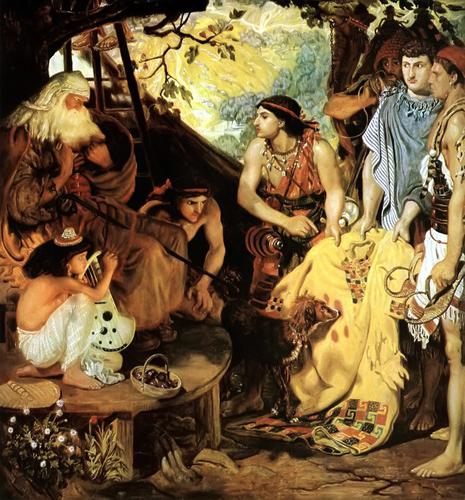
‘Have every man go out from me.’
Genesis 45:1
Then Joseph could not refrain himself before all them that stood by him; and he cried , Cause every man to go out from me.
הוציאו כל־איש מעלי
2 Samuel 13:9
Amnon said, “Send every man out from me.”
ויאמר אמנון הוציאו כל־איש מעלי
The recurrence of this phrase alerts us to the possibility of a single authorial hand, in the Joseph narrative and in the narrative of David’s declining years. It is therefore interesting to find that a coat of many colours, mentioned only twice in Tanakh, occurs within these stories.
Genesis 37:3
Now Israel loved Joseph more than all his children, because he was the son of his old age: and he made him a coat of many colours.
ועשה לו כּתנת פּסּים
2 Samuel 13:18
[Tamar] had a garment of diverse colours upon her: for with such robes were the king’s daughters that were virgins apparelled.
ועליה כּתנת פּסּים
In the case of Tamar, as in the case of Joseph, the tunic is ruined, in a way which represents the harm done to them by one or more siblings.
Genesis 37:23
And it came to pass, when Joseph was come unto his brethren, that they stripped Joseph out of his coat, his coat of many colours that was on him.
2 Samuel 13:19
Tamar put ashes on her head, and rent her garment of diverse colours that was on her.
Avenging brothers and emasculated fathers
Staying with late Genesis and 2 Samuel, there are further similarities.
Genesis 34:25
And it came to pass on the third day, when they were sore , that two of the sons of Jacob, Simeon and Levi, Dinah’s brethren, took each man his sword, and came upon the city boldly, and slew all the males.
2 Samuel 13:28
Now Absalom had commanded his servants, saying , Mark ye now when Amnon’s heart is merry with wine, and when I say unto you, Smite Amnon; then kill him.
Genesis 35:22
Reuben went and lay with Bilhah his father’s concubine: and Israel heard it.
2 Samuel 16:22
Absalom went in unto his father’s concubines in the sight of all Israel.
The latter part of the David narrative discredits and dispatches the sons of David one by one, Amnon, Absalom and Adonijah, so that the last man standing is the youngest, Solomon, who succeeds to the throne and perhaps commissions a court history.
Solomon had good relations with Egypt, the evidence being that he traded with Egypt and had an Egyptian wife. The Joseph story is sympathetic to Egypt, to the extent that the author of Exodus, hostile to Egypt, explains that trouble ensued when there arose a Pharaoh who knew not Joseph.
Daughters deceiving their fathers to protect their husbands
Genesis 31:19-20
Laban went to shear his sheep: and Rachel had stolen the images that were her father’s. And Jacob stole away unawares to Laban the Syrian, in that he told him not that he fled.
ותּגנב רחל את התּרפים אשר לאביה
1 Samuel 19:12-13
Michal let David down through a window: and he went , and fled , and escaped . And Michal took an image, and laid it in the bed, and put a pillow of goats’ hair for his bolster, and covered it with a cloth.
ותּקּח מיכל את־התּרפים ותּשם אל־המּטּה
Other correspondences between these two stories are that Michal has an elder sister Merab, whom Saul offers in marriage to David but Merab is then married to another – perhaps Saul reneges on his offer. However David marries the younger sister, Michal, who loves him. Obviously Jacob loves and is loved by the younger sister Rachel, and although he does indeed marry the older sister Leah, he is tricked by a slippery, untrustworthy father-in-law.
Angels, rapists and hospitality
Genesis 19
1 The two angels came to Sodom in the evening, and Lot was sitting in the gate of Sodom. When Lot saw them, he rose to meet them and bowed himself with his face to the earth 2 and said, “My lords, please turn aside to your servant’s house and spend the night and wash your feet. Then you may rise up early and go on your way.” They said, “No; we will spend the night in the town square.” 3 But he pressed them strongly; so they turned aside to him and entered his house. And he made them a feast and baked unleavened bread, and they ate. 4 But before they lay down, the men of the city, the men of Sodom, both young and old, all the people to the last man, surrounded the house. 5 And they called to Lot, “Where are the men who came to you tonight? Bring them out to us, that we may know them.” 6 Lot went out to the men at the entrance, shut the door after him, 7 and said, “I beg you, my brothers, do not act so wickedly. 8 Behold, I have two daughters who have not known any man. Let me bring them out to you, and do to them as you please. Only do nothing to these men, for they have come under the shelter of my roof.”
Judges 19
[A Levite, his concubine and his servant] went in [to Gibeah]and sat down in the open square of the city, for no one took them into his house to spend the night. 16 And behold, an old man was coming from his work in the field at evening. The man was from the hill country of Ephraim, and he was sojourning in Gibeah. The men of the place were Benjaminites. 17 And he lifted up his eyes and saw the traveler in the open square of the city. And the old man said, “Where are you going? And where do you come from?” 18 And he said to him, “We are passing from Bethlehem in Judah to the remote parts of the hill country of Ephraim, from which I come. I went to Bethlehem in Judah, and I am going to the house of the Lord,but no one has taken me into his house. 19 We have straw and feed for our donkeys, with bread and wine for me and your female servant and the young man with your servants. There is no lack of anything.” 20 And the old man said, “Peace be to you; I will care for all your wants. Only, do not spend the night in the square.” 21 So he brought him into his house and gave the donkeys feed. And they washed their feet, and ate and drank.
22 As they were making their hearts merry, behold, the men of the city, worthless fellows, surrounded the house, beating on the door. And they said to the old man, the master of the house, “Bring out the man who came into your house, that we may know him.” 23 And the man, the master of the house, went out to them and said to them, “No, my brothers, do not act so wickedly; since this man has come into my house, do not do this vile thing. 24 Behold, here are my virgin daughter and his [the man’s] concubine. Let me bring them out now. Violate them and do with them what seems good to you, but against this man do not do this outrageous thing.” 25 But the men would not listen to him. So the man seized his concubine and made her go out to them.
Annunciations and resurrections
Genesis 18:10-12
He said, ‘I will surely return to you about this time next year, and Sarah your wife shall have a son.’ And Sarah was listening at the tent door behind him.
Now Abraham and Sarah were old, advanced in years. The way of women had ceased to be with Sarah. So Sarah laughed to herself, saying, “After I am worn out, and my lord is old, shall I have pleasure?”
Judges 13:2-3
[Manoah’s] wife was barren and had no children.
And the angel of the LORD appeared to the woman and said to her, ‘Behold, you are barren and have not borne children, but you shall conceive and bear a son.’
2 Kings 4:16-17
And [Elisha] said, “At this season, about this time next year, you shall embrace a son.” And she said, “No, my lord, O man of God; do not lie to your servant.”
But the woman conceived, and she bore a son about that time the following spring, as Elisha had said to her.
Abraham and Sarah are visited by three men, who appear to be angelic especially as God speaks directly to Abraham in verse 13. Samson’s parents are visited by an angel and we are not told the name of Samson’s mother. The Shunamite woman is visited by a prophet, not an angel; we are told neither her name nor the name of her son.
There are other barren women who become pregnant, but without the feature of supernatural annunciation. In the case of Hannah, the mother of Samuel, Eli does not prophesy but says ‘Go in peace, and the God of Israel grant your petition that you have made to him.’ Rebecca becomes pregnant after Isaac’s prayer is answered and is told by God that she is expecting twins when she worries about her unusual pregnancy. Rachel becomes pregnant when God remembers her and heeds her prayers.
1 Kings 17-24
After this the son of the woman, the mistress of the house, became ill. And his illness was so severe that there was no breath left in him. And she said to Elijah, “What have you against me, O man of God? You have come to me to bring my sin to remembrance and to cause the death of my son!” And he said to her, “Give me your son.” And he took him from her arms and carried him up into the upper chamber where he lodged, and laid him on his own bed. And he cried to the LORD, “O LORD my God, have you brought calamity even upon the widow with whom I sojourn, by killing her son?” Then he stretched himself upon the child three times and cried to the LORD, “O LORD my God, let this child’s life come into him again.” And the LORD listened to the voice of Elijah. And the life of the child came into him again, and he revived. And Elijah took the child and brought him down from the upper chamber into the house and delivered him to his mother. And Elijah said, “See, your son lives.” And the woman said to Elijah, “Now I know that you are a man of God, and that the word of the LORD in your mouth is truth.”
2 Kings 4:32-37
When Elisha came into the house, he saw the child lying dead on his bed. So he went in and shut the door behind the two of them and prayed to the LORD. Then he went up and lay on the child, putting his mouth on his mouth, his eyes on his eyes, and his hands on his hands. And as he stretched himself upon him, the flesh of the child became warm. Then he got up again and walked once back and forth in the house, and went up and stretched himself upon him. The child sneezed seven times, and the child opened his eyes. Then he summoned Gehazi and said, “Call this Shunammite.” So he called her. And when she came to him, he said, “Pick up your son.” She came and fell at his feet, bowing to the ground. Then she picked up her son and went out.
Like Abraham and Sarah, these mothers seem to be in danger of losing their sons, their only sons, whom they love, and like Isaac, the boys are spared.
The chariots and horsemen of Israel
2 Kings 2:8-14
Elijah took his cloak and rolled it up and struck the water, and the water was parted to the one side and to the other, till the two of them could go over on dry ground.
When they had crossed, Elijah said to Elisha, “Ask what I shall do for you, before I am taken from you.” And Elisha said, “Please let there be a double portion of your spirit on me.”
And he said, “You have asked a hard thing; yet, if you see me as I am being taken from you, it shall be so for you, but if you do not see me, it shall not be so.”
And as they still went on and talked, behold, chariots of fire and horses of fire separated the two of them. And Elijah went up by a whirlwind into heaven.
And Elisha saw it and he cried, “My father, my father! The chariots of Israel and its horsemen!” And he saw him no more. Then he took hold of his own clothes and tore them in two pieces.
And he took up the cloak of Elijah that had fallen from him and went back and stood on the bank of the Jordan.
Then he took the cloak of Elijah that had fallen from him and struck the water, saying, “Where is the LORD, the God of Elijah?” And when he had struck the water, the water was parted to the one side and to the other, and Elisha went over.
2 Kings 13:14
Now when Elisha had fallen sick with the illness of which he was to die, Joash king of Israel went down to him and wept before him, crying, “My father, my father! The chariots of Israel and its horsemen!”
Someone better
1 Samuel 15:28
And Samuel said to him, “The LORD has torn the kingdom of Israel from you this day and has given it to a neighbour of yours, who is better than you.
קרע יי את־ממלכות ישראל מעליך היום ונתנה לרעך הטּוב ממּךּ
Esther 1:19
Let the king give her royal position to another who is better than she.
ומלכותהּ יתּן המּלך לרעותהּ הטּובה ממּנּה
In Esther, royalty is restored to the tribe of Benjamin, represented by Queen Esther, while in 1 Samuel, it is torn away from Saul the Benjaminite, and given to David, of Judah. The repetition of the phrase ‘…give it to his/her neighbour who is better than him/her’ seems more than coincidence.
The relationship between Samuel and Esther, or Samuel/Kings and Chronicles perhaps resembles the relationship between scripture and midrash. The later text is a discrete narrative entity; it has its own agenda and sitz im leben and is much more than a commentary, but it yields most when read in conjunction with the text which inspired it.
Non-Hebrew traditions
David Damrosch suggests that biblical narrative fuses the genres of poetic epic and historical chronicle, applying older epic traditions to historical persons and situations. Thus the story of David includes themes from epic poetry: the giant slaying, being chosen for kingship, the rebellious son. In medieval Europe, these themes show up in Arthurian legends.
Certain themes recur in myths and legends of all cultures: the Creation, fratricide, floods, killing monsters, babies who are abandoned, rescued and go on to great things; adultery, people ascending, like Elijah, directly to heaven; James Frazer in the Golden Bough shows the ubiquity of the scapegoat, and the story of Job appears in several versions of the Ancient Near East, including the Canaanite tale of King Keret, excavated at Ras Shamra.
Vayyakhel
Posted on: December 29, 2011
Exodus 35:20 – 36:7
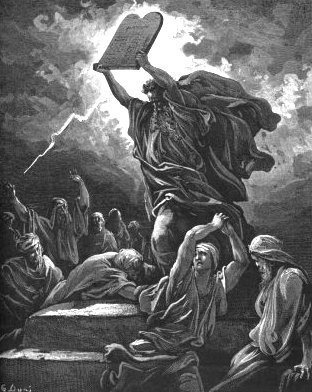
Where are we in the Exodus narrative, which features so many ascents up Mount Sinai, so many conversations between God and Moses, and so many instructions for the building and adornment of the Tabernacle, the portable Sanctuary in the wilderness?
Well, Moses has received the tablets of the law on Mount Sinai and the Israelites have committed the sin of the golden calf. Moses has broken the first set of tablets, and gone back up Mount Sinai, returning with two new tablets.
What happens next? Moses assembles the children of Israel and explains to them the commandment to observe Shabbat. He then charges them to make donations for God, that is to say, for the building of the Tabernacle. He asks for all kinds of precious metals and
valuable textiles, but – and this is repeated several times – the donations are brought only by those with a willing heart. The donors were highly motivated and purposeful, and, besides their valuables, they offered their artistic and creative skills. The women spun fine linen and the goldsmiths Bezalel and Oholiob crafted the treasures of the Tabernacle, with wisdom, understanding and knowledge – chochmah, tevunah and da’at.
For those who were in shul on Shabbat Terumah, just three weeks ago, is there not a sense of déjâ vu? For in Exodus 25, God spoke to Moses, telling him to obtain donations from those of a willing heart: gold, silver, onyx, linen, acacia wood – the whole bag of tricks.
Bezalel and Oholiob were charged with the metalwork, just as in our reading today. After the instructions for the Tabernacle, God told Moses to teach the Israelites the commandment of the sabbath: ‘V’shamru v’nei Israel et ha-shabbat, la’asot et ha-shabbat ledorotam brit olam’.1
Precisely while Moses was receiving these commandments, the children of Israel were making and worshipping the golden calf.
The order of events can be confusing for the reader, even for those who hear these sidrot read every year. In the first instance, Moses goes up Mount Sinai where God commands him concerning the Tabernacle and shabbat, in that order. Moses comes down, sees the calf and breaks the tablets. After punishing the wrongdoers, he obeys God’s command to hew two new tablets of stone, and takes them up the mountain. This time God does not write himself but dictates Torah to Moses. Moses returns from Sinai, numinously radiant and assembles the people. He speaks to them about shabbat and the Tabernacle, in that order.
The kind of literary structure which comes up quite often in the Torah is called chiastic, cross-shaped like the Greek letter chi. The pattern is ABCBA: Tabernacle, Shabbat, Calf, Shabbat, Tabernacle. This literary device is found also in non-Hebrew ancient and epic
literature, for example in Homer’s Odyssey and Iliad.
The passage we are reading today is sometimes seen as describing the repentance of the Israelites, after the sin of the calf, as they bring their treasures so willingly and in such quantities that the wise men tell Moses ‘The people are bringing too much for the work of
the task that the Lord charged to do.’2
But the people are fickle, unreliable. We saw that they donated their jewellery for the molten calf as eagerly as they donate it for the building of the Tabernacle. They are the same multitude of people, changing their opinions and affections, sometimes for Moses and at other times against him; they worship a molten idol and afterwards they worship God.
Moses appears capable of astute political judgment, as he channels the people’s dangerous, volatile energy into building the Tabernacle, governing his unruly nation by involving them in the creation of a Sanctuary where God can dwell among them.
Either Moses knows, or the author of Exodus knows, or God knows that people need sacred objects, sacred space and even sacred land to lead fulfilled religious lives.
A problem may arise if sacredness is seen as residing in the object, rather than in the process where the sacred object plays a symbolic part. Although the children of Israel were more than willing to contribute their gold for the molten calf, their fatal error was in worshipping as a god what was merely an installation. One of the things we hope to learn from these chapters of Exodus is how to call a calf a calf.
26 February 2011
HAFTARAH INTRODUCTION Jeremiah 31:1-17
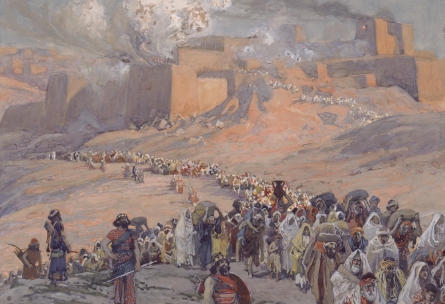
Jeremiah has a reputation for lamentation and bringing on the bad news, but the verses we are reading are from the section called The Book of Consolation. Jeremiah’s subject is the joyful return from distant exile of those from the Northern Kingdom of Israel, which had been overthrown by the Assyrians.
We heard in the Torah about Jacob returning with his family to Canaan, the land which God promised to Abraham and Isaac, and then to Jacob himself. Jacob had a new name, Israel, a name which belonged to all his descendants, the children of Israel. When the kingdom of Israel was divided after Solomon’s time, it was the name taken by the northern kingdom, while the south was called Judah. The biggest tribe in the northern kingdom was Ephraim, and sometimes the prophets used the name Ephraim when they were talking about Israel.
So we have a patriarch with two names, Jacob and Israel, a nation with at least two names, Israel and Judah, and a kingdom, Israel, referred to as Ephraim.
As Jacob and his family travelled south, on the road to Ephrath, his pregnant wife Rachel, whom he loved very much, went into labour and died giving birth to her second son, Benjamin.
Rachel is mentioned in the haftarah, when Jeremiah says:
A voice is heard in Ramah, lamentation and bitter weeping. Rachel is weeping for her children; she refuses to be comforted for her children, because they are no more.
The meaning of the verse is not absolutely clear. Some commentators thought that Rachel was weeping for the exiles, those who lost their homes when the Assyrians conquered Israel, or perhaps the later exiles when the Babylonians conquered Judah. Either way, Rachel had long been dead, and the idea of her spirit lamenting for her children could apply to any generation.
And where was Ramah actually? It would make sense if it was close to Bethlehem where Rachel was buried, and, as Ramah is a fairly common place name, there may have been such a place, on the road to Ephrath. There was a Ramah to the north of Jerusalem, in the territory of the tribe of Benjamin, so that also fits Rachel’s story. This was the birth place of the prophet Samuel, the location where Jeremiah was imprisoned and perhaps most significantly, the place where Jeremiah saw Jewish captives being assembled for deportation to Babylon.[1] This would indeed be a reason why Rachel might weep for her children.
[1] Jeremiah 40:1
Ramah can also mean ‘on high’ which gives the sentence another meaning.
There is a bit of rabbinic folklore, a midrash, which tells that Moses and the patriarchs, Abraham , Isaac and Jacob, all interceded for the children of Israel, asking God to have pity on his children and bring them home from exile. God remained silent. Midrash plays around with chronology, so you can have the patriarchs and Moses all praying at the same time. After that, Rachel interceded, because the exiles were her descendants, through her sons Joseph and Benjamin. She referred to her own experience, overcoming jealousy of her sister Leah, who was Jacob’s other wife and the mother of many of Jacob’s children. Rachel said to God ‘You, too, should forgive my children who have sinned and are now being exiled.’
Then, the midrash tells us, ‘A voice was heard on high of lamentation, of mourning, and weeping, of Rachel weeping for her children’ and God responded ‘For your sake, Rachel, I will restore Israel to their land’. And the midrash cites the verse from our chapter of Jeremiah:
Keep your voice from weeping, and your eyes from tears… There is hope for your future, declares the LORD, and your children shall come back to their own country.
For those of you familiar with Herman Melville’s Moby Dick, you may remember that Ishmael, the sole survivor of the doomed ship the Pequod, is rescued by a another whaling ship, the Rachel. Now this is not a matter of chance; Melville chose biblical names for their symbolic meaning, and the Rachel, searching for survivors in the North Atlantic, is certainly named with Rachel weeping for her children in mind.
Hezekiah and his Kingdom
Posted on: November 26, 2011
Just as Josiah was the son of a bad king of Judah, Amon by name, Hezekiah also was the son of a bad king, Ahaz, who sacrificed and made offerings on the high places. Hezekiah, who succeeded his father in about 720 BCE, ‘…did what was right in the eyes of the LORD, according to all that David his father had done.’
Bearing any kind of resemblance to David was the measure of a good king in Judah, and besides Hezekiah, the comparison is made about Solomon, Asa, Josiah, and Jehoshaphat. Regarding Solomon, there is some ambivalence:
Solomon did what was evil in the sight of the LORD and did not wholly follow the LORD, as David his father had done.
Other kings of Judah are compared unfavourably with David, as in not walking in his ways, while the kings of Israel tended in the majority of cases to permit foreign worship in the high places. The idiom used of the kings of Israel is that they walked in the ways of Jeroboam son of Nebat, who caused Israel to sin.
The political situation in Hezekiah’s time was that Assyria was the dominating power of the region. 2 Kings 18, which deals with the beginning of Hezekiah’s reign, tells us that he removed the high places and the Asherah and broke the brazen serpent which Moses had made; ‘for until those days the people of Israel had made offerings to it (it was called Nehushtan).’ He rebelled against the king of Assyria and refused to serve him and had some military success against the Philistines in Gaza.
In the sixth year of Hezekiah’s reign Samaria fell to the Assyrian Shalmaneser, who abducted the Israelites and resettled them in Assyria. Eight years later Assyria, under the leadership of Sennacherib, attacked the kingdom of Judah. Under pressure of Assyria’s superior military force, Hezekiah offered tributes to Sennacherib, from the Temple treasure. This did not have the presumably desired effect of satisfying the Assyrians and keeping them at a distance from Jerusalem, for Sennacherib’s emissaries came to Jerusalem from the Assyrian stronghold in Lachish , at the head of a large army.
And the king of Assyria sent the Tartan, the Rab-saris, and the Rabshakeh with a great army from Lachish to King Hezekiah at Jerusalem.
These names appear to be military titles: Tartan, Rabsaris and Rabshakeh. The etymology suggests high office – saris is used in Genesis to describe Potiphar as a captain or officer of Pharaoh; Rab means great, and Rab-saqu is Assyrian for chief cup bearer; Tartan spelled with a tav may be connected with sar, prince or leader. According to Wikipedia:
There was a tartanu imni or ‘tartan of the right’, as well as a tartanu shumeli or ‘tartan of the left’. In later times the title became territorial; we read of a tartan of ‘Kummuh’ (Commagene). The title is also applied to the commanders of foreign armies ; thus Sargon speaks of the Tartan Musurai, or ‘Egyptian Tartan’.
The Rabshakeh has a speaking part, and he speaks in Hebrew, to impress or influence the people of Jerusalem, essentially telling them to cease reposing trust in Egypt since Pharaoh is toast, or as the Rabshakeh says: the broken reed of a staff, which will pierce the hand of any man who leans on it. He tells them not to trust in God, since the Assyrians are invincible, without God.
Then Eliakim the son of Hilkiah, and Shebnah, and Joah, said to the Rabshakeh, “Please speak to your servants in Aramaic, for we understand it. Do not speak to us in the language of Judah within the hearing of the people who are on the wall.” 27 But the Rabshakeh said to them, “Has my master sent me to speak these words to your master and to you, and not to the men sitting on the wall, who are doomed with you to eat their own dung and to drink their own urine?” 28 Then the Rabshakeh stood and called out in a loud voice in the language of Judah: “Hear the word of the great king, the king of Assyria! 29 Thus says the king: ‘Do not let Hezekiah deceive you, for he will not be able to deliver you out of my hand. 30 Do not let Hezekiah make you trust in the LORD by saying, The LORD will surely deliver us, and this city will not be given into the hand of the king of Assyria.’ 31 Do not listen to Hezekiah, for thus says the king of Assyria: ‘Make your peace with me and come out to me. Then each one of you will eat of his own vine, and each one of his own fig tree, and each one of you will drink the water of his own cistern, 32 until I come and take you away to a land like your own land, a land of grain and wine, a land of bread and vineyards, a land of olive trees and honey, that you may live, and not die. And do not listen to Hezekiah when he misleads you by saying, The LORD will deliver us. 33 Has any of the gods of the nations ever delivered his land out of the hand of the king of Assyria? 34 Where are the gods of Hamath and Arpad? Where are the gods of Sepharvaim, Hena, and Ivvah? Have they delivered Samaria out of my hand? 35 Who among all the gods of the lands have delivered their lands out of my hand, that the LORD should deliver Jerusalem out of my hand?'” 36 But the people were silent and answered him not a word, for the king’s command was, “Do not answer him.” 37 Then Eliakim the son of Hilkiah, who was over the household, and Shebna the secretary, and Joah the son of Asaph, the recorder, came to Hezekiah with their clothes torn and told him the words of the Rabshakeh.
An identical passage is found in Isaiah:.
In 2 Chronicles 32, the servant of Sennacherib harangues the people of Jerusalem with a very similar speech, but he is not designated as Rabshakeh, Rabsaris or Tartan.
On being told the Assyrian’s words, Hezekiah rends his garments in distress, and sends for Isaiah the prophet. Isaiah tells him:
Thus says the LORD: Do not be afraid because of the words that you have heard, with which the servants of the king of Assyria have reviled me. Behold, I will put a spirit in him, so that he shall hear a rumor and return to his own land, and I will make him fall by the sword in his own land.
The Rabshakeh departs as Sennacherib is engaged in wars on other fronts, but Hezekiah receives a threatening letter from the Assyrian king, in the same mode as the Rabshakeh’s speech, which Hezekiah takes to the Temple.
Hezekiah went up to the house of the LORD and spread it before the LORD. And Hezekiah prayed before the LORD and said: “O LORD, the God of Israel, enthroned above the cherubim, you are the God, you alone, of all the kingdoms of the earth; you have made heaven and earth. Incline your ear, O LORD, and hear; open your eyes, O LORD, and see; and hear the words of Sennacherib, which he has sent to mock the living God. Truly, O LORD, the kings of Assyria have laid waste the nations and their lands and have cast their gods into the fire, for they were not gods, but the work of men’s hands, wood and stone. Therefore they were destroyed. So now, O LORD our God, save us, please, from his hand, that all the kingdoms of the earth may know that you, O LORD, are God alone.”
Isaiah tells Hezekiah that God has heard his prayer and declaims an oracle in defiance of Sennacherib:
Thus says the LORD concerning the king of Assyria: He shall not come into this city or shoot an arrow there, or come before it with a shield or cast up a siege mound against it. 33 By the way that he came, by the same he shall return, and he shall not come into this city, declares the LORD. For I will defend this city to save it, for my own sake and for the sake of my servant David.”
That night an angel of God killed 185,000 in the camp of the Assyrians. After this Sennacherib returned to Nineveh where he was later assassinated by his sons Adrammelech and Sharezer,and succeeded by his son Esarhaddon.
Hezekiah became ill and Isaiah told him that God said he would not recover.
Then Hezekiah turned his face to the wall and prayed to the LORD, saying, “Now, O LORD, please remember how I have walked before you in faithfulness and with a whole heart, and have done what is good in your sight.’
Isaiah told Hezekiah that God had relented and that in three days Hezekiah would be recovered sufficiently to go up to the Temple. God would add another fifteen years to his life, while saving Jerusalem from Assyrian aggression.
Curiously, Hezekiah asked Isaiah for proof, a sign from God, and was duly granted a miracle, when the shadow on the sundial went backwards.
After this, Hezekiah made a strange misjudgment while showing hospitality to some Babylonian envoys. At this time, Babylon was not yet a great power, and Hezekiah felt secure enough to show them all the treasures of his kingdom.
There was nothing in his house or in all his realm that Hezekiah did not show them.
Isaiah perceived the error of this and told Hezekiah that the time would soon come when all the treasures would be carried off to Babylon and Hezekiah’s sons with them. In fact it was the sons of Josiah who were carried off to Babylon. Hezekiah heard the prophecy stoically, commenting that these events would not befall during his lifetime. The year of Hezekiah’s death is 692 BCE, so nearly a hundred years will pass before Isaiah’s prophecy is fulfilled.
This is not the only instance of an apparent conflation of the reigns of Hezekiah and Josiah.
Hezekiah in Chronicles
In the Chronicles account, Hezekiah becomes king at the age of twenty-five, as in Kings. He appoints Levites to carry out the cleansing of the Temple and the Levites get rid of all the utensils of idolatry which had been permitted by King Ahaz, the father of Hezekiah. The Temple is reconsecrated with the priests slaughtering large quantities of bulls, sheep and goats, as sin offerings, on behalf of all Israel. The sacrifices took place to musical accompaniment, including singers and trumpeters. There were not enough priests to do all the sacrifices:
…so until other priests had consecrated themselves, their brothers the Levites helped them, until the work was finished, for the Levites were more upright in heart than the priests in consecrating themselves.
Hezekiah then sent letters to all Israel and Judah that they should come to Jerusalem to celebrate Passover. This was to take place in the second month, Iyyar, as there were not enough consecrated priests in Jerusalem during the month of Nisasn to hold the Passover on the usual date. Hezekiah’s couriers went as far as the tribe of Zebulun in the north, where they were mocked, but some men from Asher, Manasseh and Zebulun responded to the call and came to Jerusalem.
And the people of Israel who were present at Jerusalem kept the Feast of Unleavened Bread seven days with great gladness, and the Levites and the priests praised the LORD day by day, singing with all their might to the LORD.
Hezekiah arranged the divisions of priests and Levites, according to their appointed tasks and commanded the people to tithe their produce as a means of support for the priests and Levites.
After this, Sennacherib invaded Judah, and Hezekiah prepared for war, building fortifications and diverting the water supplies outside the city. The Assyrian servants – in this version, anonymous – of Sennacherib addressed the people of Jerusalem, as in the accounts in 2 Kings and Isaiah.
Hezekiah and Isaiah resorted to prayer, and God sent an angel, who annihilated – יכחד – the Assyrian commanders and warriors, so that Sennacherib withdrew to his own country. 2 Chronicles does not include the poem spoken by Isaiah in 2 Kings 19. 2 Kings does have the angel who smote – יך – the Assyrian officers.
The Chronicler tells of Hezekiah’s illness, and that God answered his prayer and cured him, but does not mention the sun-dial.
But Hezekiah did not make return according to the benefit done to him, for his heart was proud. Therefore wrath came upon him and Judah and Jerusalem. But Hezekiah humbled himself for the pride of his heart, both he and the inhabitants of Jerusalem, so that the wrath of the LORD did not come upon them in the days of Hezekiah.
In Kings, Hezekiah’s pride is shown in his dealings with the Babylonian envoys, when he shows them the treasures of the kingdom. Isaiah then warns him that the city will fall to the Babylonians, although not in his own lifetime.
Hezekiah compared with Josiah
Passover
The narratives concerning Asa and his son Jehoshaphat, kings of Judah, have material in common, as do those of Hezekiah and Josiah, notably ending the cult of male prostitutes, and engaging in both war and diplomacy with Israel and Syria, but Jehoshaphat was Asa’s successor, which permits some continuity in foreign and domestic affairs.
A notable point in common for Hezekiah and Josiah is that they revive the celebration of Passover. Josiah’s Passover seems to have taken place on the usual dates, beginning on 14 Nissan, as there is no assertion to the contrary, whereas Hezekiah’s Passover was the precedent for Pesach Sheni, occuring in the middle of Iyyar. The author of josiah’s narrative does not alluide to Hezekiah’s Passover, which would have taken place nearly a hundred years earlier than that of Josiah.
No such Passover had been kept since the days of the judges who judged Israel, or during all the days of the kings of Israel or of the kings of Judah. But in the eighteenth year of King Josiah this Passover was kept to the LORD in Jerusalem.
Hezekiah and Josiah both sacrifice thousands of sheep, goats and cattle for the Passover.
The reference to the time of the Judges may refer to Joshua who had celebrated the first Passover in the promised land with the people at the camp in Gilgal,
Destroying the idols
Hezekiah smashed the sacred stones and cut down the Asherah.Josiah smashed the sacred stones and cut down the Asherah.
Hezekiah also breaks the bronze serpent which Moses had made, because it had become an object of worship.
The bronze serpent is therefore not there in Josiah’s day, but Josiah fills the empty spaces of the former Asherim with human bones, which had the dual effect of rendering the places ritually unfit for worship and invoking the prophecy of the Ish Elohim in 1 Kings that Josiah would burn human bones on the high places.
We read that Jerusalem was to be spared destruction in the time of Hezekiah but Huldah the prophetess has similar words for Josiah:
Because your heart was penitent, and you humbled yourself before the LORD, when you heard how I spoke against this place and against its inhabitants, that they should become a desolation and a curse, and you have torn your clothes and wept before me, I also have heard you, declares the LORD. Therefore, behold, I will gather you to your fathers, and you shall be gathered to your grave in peace, and your eyes shall not see all the disaster that I will bring upon this place.
Because your heart was tender and you humbled yourself before God when you heard his words against this place and its inhabitants, and you have humbled yourself before me and have torn your clothes and wept before me, I also have heard you, declares the LORD. Behold, I will gather you to your fathers, and you shall be gathered to your grave in peace, and your eyes shall not see all the disaster that I will bring upon this place and its inhabitants.
Names in common
Certain proper names appear in both the Hezekiah and Josiah narratives. Hilkiah is one example, thus, in the reign of Hezekiah:
And when they called for the king, there came out to them Eliakim the son of Hilkiah, who was over the household, and Shebnah the secretary, and Joah the son of Asaph, the recorder.
In the reign of Josiah:
And Hilkiah the high priest said to Shaphan the secretary, “I have found the Book of the Law in the house of the LORD.”
Shebnah and Shaphan are similar and may be cognate.
Other names common to both reigns as written in Kings or Chronicles are: Eliakim, Zechariah, Azariah, Conaniah and Shemei/Shemaiah, Jehiel, Asaph, Heman and Jeduthun and Jozabad, the latter appearing in the Levite accounts of the Chronicler:
Then Hezekiah commanded them to prepare chambers in the house of the LORD, and they prepared them. 12 And they faithfully brought in the contributions, the tithes, and the dedicated things. The chief officer in charge of them was Conaniah the Levite, with Shimei his brother as second, 13 while Jehiel, Azaziah, Nahath, Asahel, Jerimoth, Jozabad, Eliel, Ismachiah, Mahath, and Benaiah were overseers assisting Conaniah and Shimei his brother, by the appointment of Hezekiah the king and Azariah the chief officer of the house of God.
[Josiah’s] officials contributed willingly to the people, to the priests, and to the Levites. Hilkiah, Zechariah, and Jehiel, the chief officers of the house of God, gave to the priests for the Passover offerings 2,600 Passover lambs and 300 bulls. 9 Conaniah also, and Shemaiah and Nethanel his brothers, and Hashabiah and Jeiel and Jozabad, the chiefs of the Levites, gave to the Levites for the Passover offerings 5,000 lambs and young goats and 500 bulls.
Dual narratives
The replication of names and incidents raises the question of common narrative source used in the histories of Hezekiah and Josiah.
However, there are very many examples in the bible of dual versions, with or without the replication of names. The case of Abraham and Isaac pretending that their wives are sisters; the thankless children of both Jacob and David and the stories of Dinah and Tamar; Michal, like Rachel, deceiving her father to protect her husband; David sparing Saul’s life in two separate caves; Elijah and Elisha each reviving a child; we could make this the subject of future study. Edward Greenstein has written on this subject in an article The Formation of the Biblical Narrative Corpus and he notes a tendency for the book of Judges to retell versions of the Genesis narrative – when an angel appears to Gideon under a terebinth in Judges 6, there are parallels with the angels which appear to Abraham and Sarah in Genesis 18 and with Jacob’s encounter with the angel at the ford of Jabbok; the annunciation to Samson’s parents in Judges as aspects in common with the angels’ annunciation to Abraham and Sarah.
Hezekiah and archaeology
Hezekiah’s historicity is attested by archaeological evidence: the well-known Siloam inscription records the construction of Hezekiah’s tunnel which brought water from the Gihon Spring to the Pool of Siloam in East Jerusalem. The inscription, in paleo-Hebrew script, is believed to date from the late eighth century, during the reign of Hezekiah.
William J Dever, in his 2005 book ‘Did God Have a Wife’ uses archaeological finds such as inscriptions at Khirbet el-Qom and Kuntillet Ajrud as evidence to support his view that the worship of the Asherah was common practice in ancient Israel and Judah.
He cites archaeological evidence that a central cult room, dated to the late eighth century, of the fortress at Arad was demolished, with altars and massevot concealed under the floor. Dever writes:
The deliberate dismantling of the temple and its replacement by another structure in the days of Hezekiah is an archeological fact. I see no reason for skepticism here.
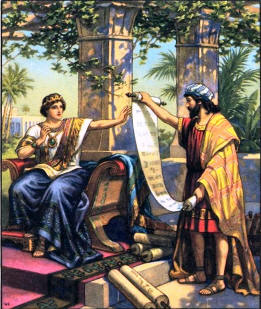
Josiah’s birth is predicted by ‘a man of God’at King Jeroboam’s altar at Bethel, notable for being ornamented with two golden calves. The ish Elohim says:
O altar, altar, thus says the LORD: ‘Behold, a son shall be born to the house of
David, Josiah by name, and he shall sacrifice on you the priests of the high places
who make offerings on you, and human bones shall be burned on you.’
After king Amon of Judah was assassinated, his son Josiah, at the age of eight, became king of Judah. He reigned for thirty-one years, until he was killed by the Egyptian Pharaoh Neco on the battlefield of Megiddo.
And he did what was right in the eyes of the LORD and walked in all the way of
David his father, and he did not turn aside to the right or to the left.2 Kings 22:1
It should be noted that the assessment of a king as good or bad depends on the extent to which he prioritises the Temple and its cult. The northern kings were therefore at a disadvantage, and Jeroboam’s altar at Bethel with its two golden calves is a symbol of corrupt kingship.
Josiah was the son of King Amon who reigned briefly in Judah after King Manasseh. Both Amon and Manasseh encouraged and participated in idolatrous cults. There is some dispute as to whether the hegemony of Assyria over Judah left Manasseh and Amon much choice, whereas Josiah ruled in a Judah which was for a short time free of external domination. Mordechai Cogan has suggested that ‘the foreign innovations reported of the reigns of Ahaz and Manasseh are attributable to the voluntary adoption by Judah’s ruling class of the prevailing Assyro-Aramaean culture.’1
Discovery of the scroll
In the eighteenth year of his reign, Josiah was having repairs and renovations carried out in the Temple, under the supervision of the high priest, Hilkiah. The background story that Josiah commences renovations in the Temple indicates that he was worthy of the discovery of the sacred sefer ha Torah.
Jeremiah the prophet was the son of a priest called Hilkiah, who would be roughly contemporary with the Hilkiah of Josiah but Hilkiah the father of Jeremiah served as a priest in Anathoth.
Jeremiah has an involvement with the Josiah story, and, while the usual opinion is that the two Hilkiahs are two different people, the possibilty of them being one and the same is not rejected in every commentary. Jeremiah is not mentioned in Kings, although his use of language connects him with the Deuteronomistic history.
Josiah sent a scribe called Shaphan to Hilkiah, with instructions for paying the workmen, and Hilkiah took the opportunity to tell Shaphan that he had discovered a book of the Law in the Temple. The term used in 2 Kings 22:8 is Sefer ha Torah, with the definite article. In 2 Chronicles, a connection with Moses is emphasised: sefer Torat Hashem b’yad Moshe.
While reporting to the king on the business of paying the workmen with Temple silver, Shaphan told him about the scroll and read it to him. In the account of Josiah in 2 Chronicles, he begins his reforms before the discovery of the scroll.
Josiah responded by rending his clothes, as mourners do, repenting because the laws of the scroll had not been kept during the years while it was hidden away. He told Hilkiah, Shaphan and other scribes and ministers to go and enquire of God – Lechu dirshu et Hashem – concerning the words of the scroll. This they did by consulting the prophetess Huldah who lived in Jerusalem.
Huldah is one of seven prophetesses named in the Talmud. The others are Sarah, Miriam, Deborah, Hannah, Abigail and Esther. Huldah replied in an oracle from God, that He would bring disaster on Jerusalem and its inhabitants, because they had gone after other gods, and committed evil deeds. However, Josiah would be spared the sight of this, as he was repentant, so the destruction of Jerusalem would not occur in his lifetime.
Destroying the high places (bamot)
Josiah went to the Temple and had the sefer ha brit read to all the people, great and small. He then destroyed the idolatrous altars, beginning with those in the Temple.
And he broke down the houses of the male cult prostitutes who were in the house of
the LORD, where the women wove hangings for the Asherah.
He destroyed all idolatrous centres in and around Jerusalem, and beyond, including the altar at Bethel. This was the altar about which the man of God in 1 Kings 13 had prophesied to Jeroboam that human bones would be burned on the altar. Josiah fulfilled this prophecy, then went on to destroy the pagan altars of Samaria, after which returned to Jerusalem.
Josiah’s Passover
According to 2 Kings 23:
21 And the king commanded all the people, “Keep the Passover to the LORD your
God, as it is written in this Book of the Covenant.” 22 For no such Passover had been
kept since the days of the judges who judged Israel, or during all the days of the
kings of Israel or of the kings of Judah. 23 But in the eighteenth year of King Josiah
this Passover was kept to the LORD in Jerusalem.
The expression ‘no such Passover’ resembles the locution that there was no king, before or since, such as Josiah, no prophet such as Moses.
The Chronicles version is:
No Passover like it had been kept in Israel since the days of Samuel the prophet.
None of the kings of Israel had kept such a Passover as was kept by Josiah, and the
priests and the Levites, and all Judah and Israel who were present, and the
inhabitants of Jerusalem.
The Chronicles version of Josiah’s Passover is much longer, with details of the great quantity of animals slaughtered by the priests for the paschal feast and the notable presence of the Levites at the forefront of the organization. The Temple singers – the sons of Asaph – were a feature of the Second Temple One of the differences in the Chronicles version of Josiah’s story is the prominent role of the Levites, not surprisingly as the author of Chronicles is an advocate for the Levites of the Second Temple. One of the offices of the Levites was to provide music, especially psalmody; another was to be keepers of the gate, a responsible position, perhaps to maintain the security of the Temple precinct. They were also scribes and teachers.
Was the scroll the book of Deuteronomy?
Why is there such a broad consensus that the book of the law found by Hilkiah is Deuteronomy? The language, the theology and the account of Passover correspond to Deuteronomy. The expression ‘book of the law’ comes from no other book of the Pentateuch than Deuteronomy. Abolition of the high places and centralisation of the cult is prescribed only in Deuteronomy. The passover in Josiah’s time (2 Kings 23:21-23) corresponds with verses in Deuteronomy:
1 “Observe the month of Abib and keep the Passover to the LORD your God, for in
the month of Abib the LORD your God brought you out of Egypt by night. 2 And
you shall offer the Passover sacrifice to the LORD your God, from the flock or the
herd, at the place that the LORD will choose, to make his name dwell there. 3 You
shall eat no leavened bread with it. Seven days you shall eat it with unleavened
bread, the bread of affliction–for you came out of the land of Egypt in haste–that
all the days of your life you may remember the day when you came out of the land
of Egypt. 4 No leaven shall be seen with you in all your territory for seven days, nor
shall any of the flesh that you sacrifice on the evening of the first day remain all
night until morning. 5 You may not offer the Passover sacrifice within any of your
towns that the LORD your God is giving you, 6 but at the place that the LORD your
God will choose, to make his name dwell in it, there you shall offer the Passover
sacrifice, in the evening at sunset, at the time you came out of Egypt. 7 And you
shall cook it and eat it at the place that the LORD your God will choose. And in the
morning you shall turn and go to your tents. 8 For six days you shall eat unleavened
bread, and on the seventh day there shall be a solemn assembly to the LORD your
God.
Was the scroll found, in some kind of genizah, or was it written during the early reign of Josiah? A German theologian called De Wette, writing in 1805, believed that Deuteronomy was the book Hilkiah handed over to King Josiah and that it was written during the reign of Josiah, to justify his religious reform. ‘Book of the law’ may refer to the Code of Laws which form the central passages of Deuteronomy, chapters 12 to 26, the huqim and mishpatim, statutes and ordinances, whereas the introductory and
supplementary chapters are a review of the history of God’s relationship with the Israelites in the wilderness and the imminence of entering the Promised Land.
Deuteronomy is believed to be written in stages between the 7th century BCE and the early 5th. The term Deuteronomistic history was coined in 1943 by the German biblical scholar Martin Noth, referring to the authorship of Deuteronomy, Joshua, Judges, Samuel and Kings which he believed were the work of a sixth century historian seeking to explain the fall of Jerusalem and the Babylonian exile. In the so-called Deuteronomistic history, Israel goes through a cycle of infidelity, punishment and restoration, ultimately facing exile by the end of 2 Kings.
In 1968, Frank Moore Cross, who was an authority on the Dead Sea Scrolls, made the radical suggestion that the Deuteronomistic History was written first in the time of Josiah in the late 7th century (he called this Deuteronomy 1), and revised by a 6th-century author in a version which he called Deuteronomy 2. Deuteronomy 1 is positive towards Judah and negative towards Israel and its kings. Deuteronomy 2, written in exile according to Frank Moore Cross, adds warnings of a broken covenant, followed by punishment and exile.
Deuteronomy includes in its legal code the Law of the King, as follows:
14 “When you come to the land that the LORD your God is giving you, and you
possess it and dwell in it and then say, ‘I will set a king over me, like all the nations
that are around me,’ 15 you may indeed set a king over you whom the LORD your
God will choose. One from among your brothers you shall set as king over you. You
may not put a foreigner over you, who is not your brother. 16 Only he must not
acquire many horses for himself or cause the people to return to Egypt in order to
acquire many horses, since the LORD has said to you, ‘You shall never return that
way again.’ 17 And he shall not acquire many wives for himself, lest his heart turn
away, nor shall he acquire for himself excessive silver and gold. 18 “And when he
sits on the throne of his kingdom, he shall write for himself in a book a copy of this
law, approved by the Levitical priests. 19 And it shall be with him, and he shall read
in it all the days of his life, that he may learn to fear the LORD his God by keeping
all the words of this law and these statutes, and doing them, 20 that his heart may
not be lifted up above his brothers, and that he may not turn aside from the
commandment, either to the right hand or to the left, so that he may continue long in
his kingdom, he and his children, in Israel.
These laws show that the king is subordinate to the Torah and in fact the only duty prescribed for a king is that he should read Torah every day, fear God and keep the commandments. It does not require that he should be a military leader or a judge, although the kings often filled these roles, or that he should have quantities of horses and wives, although this was precisely the manner of Solomon’s rule.
Bernard M Levinson in a 2001 article shows that the Deuteronomic Law of the King limits the authority of the king and queries why Josiah would have promulgated such a book. From this point of view, it does not seem likely that Josiah would commission the
writing of Deuteronomy. Levinson argues that the Deuteronomistic author of Kings reverses the Law of the King, as found in Deuteronomy, by showing Josiah as the instigator and advocate of the Law. Josiah follows Deuteronomy on Passover, commanding the people to observe it and presiding over the centralized festival.
Levinson says:
Despite the royal insistence upon conformity to the law, Josiah’s very invocation of
that law transforms it…Torah is here implemented under royal aegis, The king
commanded the people…In one deft stroke the Deuteronomistic Historian revokes
and redefines both the Deuteronomistic Passover, now enacted under royal
command, and Deuteronomy’s Law of the king, as the monarch now leads the cultus.
The Deuteronomistic historian subordinates Deuteronomistic law to his own more
conservative view of the proper relation between king and cult and thus reverses
Deuteronomy’s innovation. With Josiah made the royal enforcer of Torah as the law
of the land, the Deuteronomistic historian, several generations after Deuteronomy,
returns to the monarch the active connection to cultus and law that had been, so
briefly and idealistically, denied him.
Cross’s ‘dual redaction’ thesis about Deuteronomy is widely accepted, but there is also a view that there is a post exilic phase in the composition of the book, and that Chapters 1-4 and 29-30 were added in the time of the Persian Empire. The additions in the narrative are about the Israelites being about to enter the Promised Land, an analogy with the end of the exile, when they were about to return to it.
The Death of Josiah
Josiah became king of Judah in about 641/640 BC, when the Assyrian Empire was beginning to disintegrate. Babylon and Egypt jostled for ascendancy but neither had yet achieved it so Josiah was able to rule without external interference.
In 609, Pharaoh Neco II led an army up to the Euphrates River to aid the Assyrians. Josiah attempted to block Neco’s advance at Megiddo, and in the course of the battle, Josiah was killed.
Herodotus (c484 BC – 425 BCE) wrote:
Necos…stopped work on the canal and turned to war; some of his triremes were
constructed by the northern sea, and some in the Arabian Gulf, by the coast of the
Sea of Erythrias. The windlasses for beaching the ships can still be seen. He
deployed these ships as needed, while he also engaged in a pitched battle at
Magdolos with the Syrians, and conquered them.
Josephus says of Josiah:
He was of a most excellent disposition and naturally virtuous and followed the
actions of King David as a pattern and a rule to him in the whole conduct of his life.
Josephus reports that Josiah turned the people away from the practice of idol worship
and destroyed the altars which previous kings had permitted.
His account of Josiah’s last battle and death is as follows:
Now Neco, king of Egypt, raised an army, and marched to the river Euphrates, in
order to fight with the Medes and Babylonians, who had overthrown the dominion
of the Assyrians, (9) for he had a desire to reign over Asia. Now when he was come
to the city Mendes, which belonged to the kingdom of Josiah, he brought an army to
hinder him from passing through his own country, in his expedition against the
Medes. Now Neco sent a herald to Josiah, and told him that he did not make this
expedition against him, but was making haste to Euphrates; and desired that he
would not provoke him to fight against him, because he obstructed his march to the
place whither he had resolved to go. But Josiah did not admit of this advice of
Neco, but put himself into a posture to hinder him from his intended march. I
suppose it was fate that pushed him on this conduct, that it might take an occasion
against him; for as he was setting his army in array, (10) and rode about in his
chariot, from one wing of his army to another, one of the Egyptians shot an arrow at
him, and put an end to his eagerness of fighting; for being sorely wounded, he
command a retreat to be sounded for his army, and returned to Jerusalem, and died
of that wound; and was magnificently buried in the sepulchre of his fathers, when
he had lived thirty-nine years, and of them had reigned thirty-one.
According to 2 Chronicles:
Jeremiah also uttered a lament for Josiah; and all the singing men and singing
women have spoken of Josiah in their laments to this day.
The Chronicler does not refer to the Assyrians in his account of the battle at Megiddo,
and asserts that Josiah was carried wounded but alive from battle, to die in Jerusalem,
with which Josephus’s version agrees. The much briefer version in Kings speaks of
Neco killing Josiah at Megiddo, but does not mention the battle.
We must remember Huldah who prophesied of Josiah:
You shall be gathered to your grave in peace.
There is also an account of Josiah’s reign in the apocryhal book of 1 Esdras, which
follows closely the Chronicles version. Here is the story of the death of Josiah, as
related by Esdras (which is Greek for Ezra):
25 Now after all these acts of Josias it came to pass, that Pharaoh the king of Egypt
came to raise war at Carchamis upon Euphrates: and Josias went out against him. 26
But the king of Egypt sent to him, saying, What have I to do with thee, O king of
Judea? 27 I am not sent out from the Lord God against thee; for my war is upon
Euphrates: and now the Lord is with me, yea, the Lord is with me hasting me
forward: depart from me, and be not against the Lord. 28 Howbeit Josias did not
turn back his chariot from him, but undertook to fight with him, not regarding the
words of the prophet Jeremy spoken by the mouth of the Lord: 29 But joined battle
with him in the plain of Magiddo, and the princes came against king Josias. 30 Then
said the king unto his servants, Carry me away out of the battle; for I am very weak.
And immediately his servants took him away out of the battle. 31 Then gat he up
upon his second chariot; and being brought back to Jerusalem died, and was buried
in his father’s sepulchre. 32 And in all Jewry they mourned for Josias, yea, Jeremy
the prophet lamented for Josias, and the chief men with the women made
lamentation for him unto this day: and this was given out for an ordinance to be
done continually in all the nation of Israel. 33 These things are written in the book
of the stories of the kings of Judah, and every one of the acts that Josias did, and his
glory, and his understanding in the law of the Lord, and the things that he had done
before, and the things now recited, are reported in the book of the kings of Israel and
Judea.
Josiah in Midrash
Genesis Rabbah records:
Three were called by their names before they were born: Isaac, Solomon and Josiah.
What is said in the case of Isaac? ‘Nay but Sarah thy wife shall bear thee a son and
thou shalt call his name Isaac.’ In the case of Solomon? ‘Behold a son shall be born
to thee, who shall be a man of rest, and I will give him rest from all his enemies
round about, for his name shall be Solomon.’ In the case of Josiah? ‘And he cried
against the altar by the word of the Lord: O altar, altar, thus saith the Lord, Behold a
son shall be born to the house of David, Josiah by name.’
Lamentations Rabbah tells:
[Josiah] had sent two disciples of the sages to eradicate idolatry from the people’s
houses. When they entered the houses, they found nothing. As they went out, they
were told to shut the doors, and when they shut the doors, the people inside could
see the idol.
This failure of Josiah to implement his reforms throughout the land may be a
rationalization of his violent death,which does not fulfil the prophecy of Huldah. Kings
is very favorable to Josiah but Chronicles even more so with its devotion to the
Davidic/Solomonic dynasty. The fact that Josiah is brought back alive to Jerusalem in
Chronicles (and in Esdras) permits the interpretation that his end was peaceful, as
foreseen by the prophetess.
There are many parallels between the narratives of King Josiah and King Hezekiah, and, next time, we can look more closely at the reign of Hezekiah, about a hundred years before Josiah.


And his name was called…
Posted by: Gillian Gould Lazarus on: March 25, 2012
When babies are given names in the bible, the name is chosen to reflect the situation of the birth, sometimes as a comment on the parents’ predicament, sometimes an acknowledgement of God’s role in the birth or the general situation, and sometimes prophetically, as an expectation of what the named child will become.
A Who’s Who of the Hebrew bible will explain the meaning of any name, and very often, as with the characters invented by Charles Dickens, the name expresses some characteristic of the person.
In the modern world, a child’s given name may indicate many things: nationality, religion and class for example. They reflect social trends, media and celebrity culture. The influence of celebrity names is determined by other factors besides the popularity of the celebrity. For some reason, more Marilyns than Elvises were born in the 1950s; perhaps more Nevilles than Winstons in the 1940s. Even certain patterns of sound can become popular trends: consider that Aidan, Jayden and Kayden were amongst the top boys’ names in the UK in 2011, Ella, Bella (an allusion to the Twilight series of fiction) and Ellie for girls. Surnames such as Howard and Harrison become popularized as given names. Why were so many Jewish boys in the 1940s given the Welsh name Melvyn?
Cain and Abel
Cain’s name is from the verb ק נ ה, to acquire, buy, get. It has two strong consonants in common with ק נ א, to be jealous, conceptually linked with possession or acquisition. God’s relationship with Israel is expressed as קנה at the Song at the Sea: … till your people, O LORD, pass by, till the people pass by whom you have purchased.
The naming of Abel is not accounted for in the Genesis narrative, but הבל is usually translated as vanity, especially in its context in Ecclesiastes, suggesting something transitory and insignificant. In our morning prayer service we say: Ki hacol havel levad haneshamah hatehorah – Everything is trivial except the pure soul.
Noah
The names Nahum or Nahman would have fitted the etymology of yenachamenu, and the name of Noah looks as if it comes from נ וּ ח, to rest, as in ותּנח התּבה …and the ark came to rest on the mountains of Ararat.
Ishmael’s name, connected with shema, comes from the same source as Simeon, chosen later by Leah for her second son. Note that the name Samuel is spelled with an aleph rather than an ayin, so is not linked to the concept of hearing in the same way.
The source of the name Isaac is well known, based on a pun made by Sarah:
More puzzling is the naming of Esau:
Esau is described as admoni, ruddy, and seir, hairy, which explains his names Edom and Seir, but what does Esav mean? The letters ayin sin vav spell the word that means ‘do’, third person or imperative plural, as in, for example עשו להם ציצית, ‘make themselves fringes’. Does the fact that Esau is a hunter have any bearing on a name which might be connected with ‘doing’?
Jacob’s sons are all given significant names, which reflect the circumstances of their birth. Leah in particular names her sons with pious allusions to God who responded to her prayers.
Rachel, in naming the children of Bilhah her handmaid, reveals her competitive feelings about her sister and Leah responds similarly when Zilpah gives birth:
The sisters then quarrel, haggling over the valuable mandrakes found by Reuben. Rachel bargains with Leah by promising access to Jacob, and the fertile Leah gives birth to another son:
Rachel’s two sons’ names are poignantly descriptive of Rachel experience:
On ‘Thought for the Day’ last Friday (23 March 2012), Rabbi Lord Sacks referred to the Egyptian etymology of the name Moses, a suffix meaning ‘child’, as in Ramses, child of Ra, while acknowledging that the Hebrew etymology gives Moses another meaning:
Regarding Moses’ two sons, we know very little other than their names and the strange circumstances of Gershom’s circumcision. We can find the names of their descendants, however, in 1 Chronicles 23.
The naming of Samuel is interesting as his name should mean something like ‘Name and God’, Shem v’ El. Hannah makes an association with שאל, to ask, which seems to belong less to Samuel than to his protegé Saul.
The unnamed widow of Phinehas, Eli’s son, alludes to the loss of the Holy Ark, which is seized by the Philistines:
Solomon, unusually, is given two names, the second, Jedidiah, at the instigation of the prophet Nathan. Robert Alter suggests that Jedidiah, meaning ‘beloved of God’ indicates Nathan’s identification with Bathsheba’s cause, as will become apparent when he supports Solomon later, against his older brother Adonijah, as the successor to David.
Isaac was also called yedid, the son whom Abraham loved.
Sometimes the etymology is approximate, or based on a transposition of consonants, as in the case of a descendant of Judah called Jabez, based on the word B’azav, ‘in pain’. When the adult Jabez prays to God to enlarge his territory, he adds the words: levilti azbi, ‘that it may not pain me’ and God answers his prayer.
Some names allude to disasters which have befallen the person naming the child:
We have seen that Hosea’s wife bore children whose names suggested God’s abandonment of Israel. Conversely Job’s daughters have names which mean daylight, perfume and reversal of fortune:
Names which reveal character or destiny from birth seem to belong more to the realm of literature than that of history. It is common for historical personages to be called ‘the Great,’ ‘the Terrible’, ‘Epiphanes’, ‘Longshanks’, ‘Milk-snatcher’ etc, but these are soubriquets, based on deeds or appearance.
The question arising from biblical names concerns their prophetic character. Does the parent know que sera, or are they simply expressing their hopes and fears about the future? Perhaps the etymology is added, with historical hindsight, as an explanation of the named character.
Some biblical names are meaningful in the absence of any infancy narrative; an instance of this would be David, whose name, ‘beloved’, is highly significant. Another is Saul, the ‘asked-for’ king.
The absence of any clearly discernible meaning in a biblical name seems to argue in favour of the historicity of the person in question.