David’s Shield
Posted on: June 4, 2026
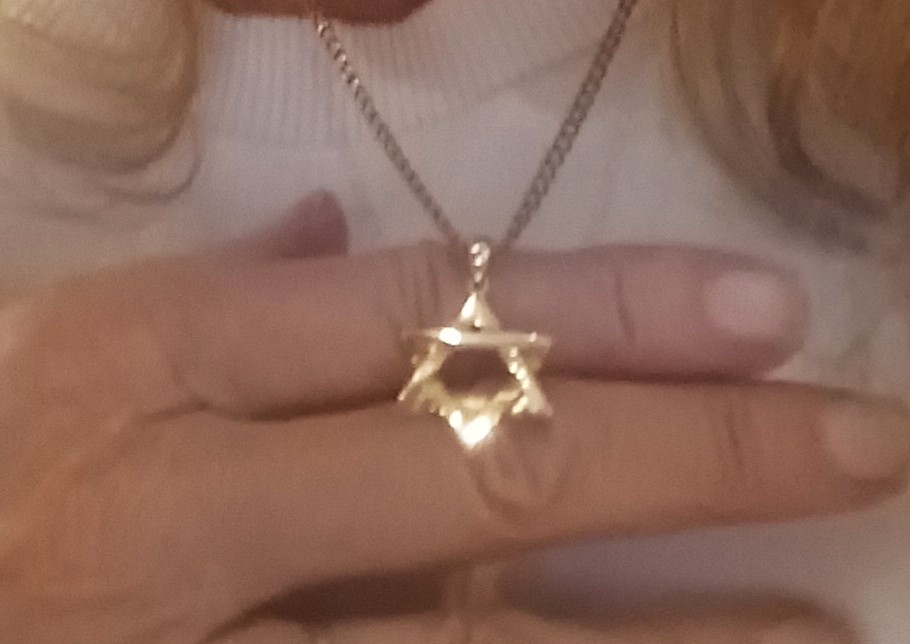
I wear a Star of David pendant which, occasionally, I twist round so that the star is at the back and not visible. This happens only when I judge discretion to be the better part of valour, for example, when I last had a covid vaccination. The chances that the kindly clinician will give me a vicious jab with the syringe are vanishingly remote but one does not want to arouse hostility in this situation.
It is sometimes argued that a placard often held aloft at pro Palestinian demonstrations depicting a Star of David being thrown into a rubbish bin is merely criticism of Israel which does of course display the star on its national flag. In support of this position, it is then argued that the Magen David is not an authentic Jewish symbol. It is not biblical, they say.
It should be noted that the Hebrew word magen means shield, not star, and magen is attested frequently in the Hebrew bible as a metaphor for the Almighty, who tells Abraham, ‘Fear not Abram, I am thy shield.’1 This was before the childless Abram received a theophoric syllable, making his name Abraham, ‘father of many.’
Moses, in his long address to the Children of Israel, the content of the book of Deuteronomy, tells them that God is ‘the shield of your help.’ 2
David, in his Psalms, sings ‘You O Lord are a shield about me,’ 3 ‘my strength, in whom I will trust; my shield, and the horn of my salvation’4 ‘…for the Lord God is sun and shield,’5 ‘Israel, trust in the Lord; He is their help and their shield.’ 6
There are many more instances of David using magen – shield – as a metaphor for God and an illustration of his relationship with God.
In the liturgy too, the first paragraph of the Amidah prayer concludes, ‘Blessed are You God, the Shield of Abraham,’ and the blessings after the haftarah, the reading from the Prophets, include ‘Blessed are you God, the Shield of David,’ in Hebrew, Magen David.
There are many more biblical and liturgical instances of this phrase, which account for the attachment to the symbol of the six pointed star, bearing the name, ‘Shield of David.’ As for the shield which David carried into his many battles, we do not know what it looked like. The bible is not as descriptive as, for example, the works of Homer, except in the case of the building of the Tabernacle in the wilderness, the template for the later Temples in Jerusalem. This is a case of specific instructions rather than description: the passages I have heard being alluded to as the DIY chapters of Exodus. Rarely is there a description of a person beyond the hint of their being well-favoured or tender-eyed, ruddy or tall or, in the case of the Moabite King Eglon, obese.
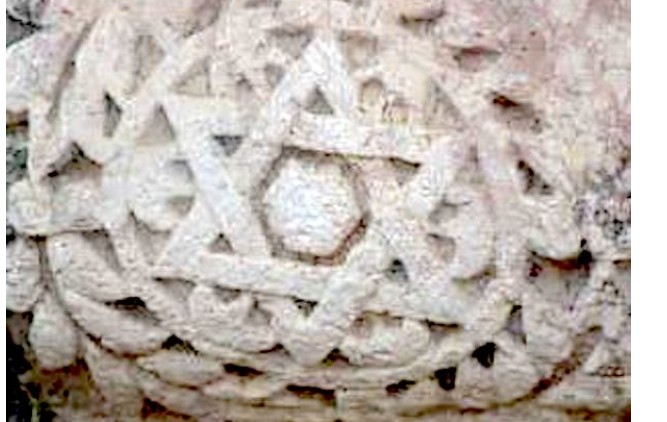
The six pointed star appears on the cover of the Leningrad Codex, the earliest extant version of the Masoretic text, which is to say a Hebrew bible with the vocalizing marks not found on the scrolls from which biblical passages are read in the synagogue. Housed at the National Library of Russia in St Petersburg, the Leningrad Codex was produced in Cairo according to a colophon at the end of the book, in the early eleventh century. The Star of David appears on the mosaic floor of a third century synagogue in Galilee but usage of the symbol occurs also in other cultures.
In Kabbalistic thought, the two intersecting triangles were symbolic of people reaching towards heaven and heaven reaching down towards earth.
In seventeenth century Prague, the Jewish community adopted the six pointed star as their symbol. It appeared on the Altneuschul and, across Central Europe, the hexagram was used widely in synagogal decoration and on Jewish gravestones. It appears on most tombstones in Jewish cemeteries.
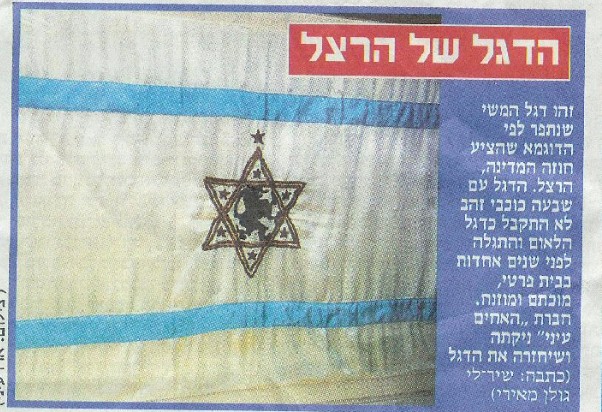
In 1897 at the First Zionist Conference in Basel, it was chosen as the symbol to be displayed on the flag of the future Jewish State. Blue and white alluded to the blue and white of the traditional tallit, the fringed prayer shawl. The image below is headed, ‘Herzl’s flag’. The Lion of Judah is positioned at the centre of the star. This was dropped from the Israeli flag which centres the intersecting triangles of the Star of David but the lion appears on contemporary municipal seals in Jerusalem.
Notoriously, a yellow Star of David inscribed Jude meaning Jew was the obligatory badge to be worn by Jews in German occupied lands in World War Two. This was used to facilitate segregation, exclusion, ghettoization and eventually the deportation of Jews to the concentration camps.
On Independence in 1948, the star on a blue and white background was chosen as the State of Israel’s national flag. Just as the Jewish star was used in the Third Reich for the ostracism of Jews, the star is used in anti Zionist culture to ostracize Israel, depicted not just discarded in a bin but dripping with blood, sometimes with a different vice named for each of the six points. This, they say, is merely criticism of Israel.
The symbol remains ubiquitous in Jewish communal locations and wearing it as jewellery or on clothing has a stronger pull than ever, despite the arguable risk of arousing hostility.
The word magen, shield, is derived as is gan, garden, from the root letters גנן, GNN, to defend. In European languages too, there are etymological connections of gardens with guarding. A garden is an enclosed area, defended by fences or walls.
The Talmud refers to the phrase ‘Shield of David,’ in connection with the verse from the second book of Samuel: ‘I have made for you a great name, like the names of the great ones that are in the earth.’7
״וְעָשִׂיתִי לְךָ שֵׁם גָּדוֹל כְּשֵׁם הַגְּדוֹלִים״, תָּנֵי רַב יוֹסֵף: זֶהוּ שֶׁאוֹמְרִים ״מָגֵן דָּוִד״
‘Rav Yosef teaches, “This means that people will say, the Shield of David.’8
When I was born, here in London, my aunt in Australia sent me a little gold Magen David. I wore it often and somehow lost it, when I was a adult. When I turned seventy, I asked my children to buy me a Magen David on a chain, which they did and I never take it off. It is a star, a shield, a promise and continuity of both time and space.


June 5, 2026 at 9:26 am
Excellent piece, Gillian.
The antisemitic goysplaining suggestion that the Star of David is not “authentic” as a Jewish symbol simply because it is not biblical in origin is, anyway, utterly risible.
For example, we don’t see anybody suggesting that, because the kirpan does not have its origins in a foundational prophetic Sikh text, therefore it’s non-authentic as a Sikh symbol or religious item.
The crucifix as a symbol is not explicitly referenced in foundational Christian texts (NT biblical writings do not describe the wearing or veneration of physical icons depicting Jesus on the cross; the extensive use of the physical cross and the crucifix as visual symbols emerged in Christian iconography later, primarily from the 4th century onward), and yet nobody disputes it being a Christian symbol.
And let’s talk about the crescent moon and star, which predate Islam by thousands of years. The crescent was associated with the Sumerian moon god Sin (or Nanna) and the Greek moon goddess Diana. By 300 BCE, the crescent became the symbol of the ancient city of Byzantium. The symbol became intrinsically linked to the Muslim world when the Ottoman Empire captured Constantinople in 1453. The Ottomans adopted the city’s existing crescent and star emblem for their own imperial banners. Over centuries of Ottoman rule, European powers and global perception began using the star and crescent to represent the Islamic world. And I suspect that the same is true of the iconic symbols of other faiths.
To even engage in debate or discussion of this in relation to the Magen David is to validate the intellectually vacuous nonsensical claims of antisemites.
June 5, 2026 at 10:54 am
Such interesting points tbere – if I’d known them, I would have wanted to include them in the piece.