Posts Tagged ‘faith’
The Day After Yom Kippur
Posted on: September 22, 2026
I take some pride in saying that I no longer get a migraine during Yom Kippur, presumably because after decades of fasting on the appointed days, my body knows that the fast will end after twenty-five hours and does not feel the need to raise the alarm, which is often the trigger for a migraine.
Nevertheless, I have one now and just medicated for it, which is usually sufficient management for my increasingly rare migraines. It struck while I was looking again at the book of essays produced this year by the Movement For Progressive Judaism, entitled ‘Progressive Judaism, Zionism and the State of Israel.’ Most of the contributors are rabbis from the formerly named Liberal and Reform synagogues and a few are from religiously knowlegeable lay authors: political activists associated with anti Zionist organizations or publications. In some of the essays, older rabbis reflect that their earlier love for the State of Israel has been compromised in the years since 1967, when the State defends its control over disputed territories, which they would rather relinquish. Some of the clergy advocate a liturgy which makes room for expressions of fraternity with the Palestinians, with whom our fate seems to be intertwined.
This year, 2026, also known as 5787, was the first year when the congregation I have belonged to for more than half a century used the new Days of Awe prayer books, a two volume set for use on Rosh Hashanah and Yom Kippur. As some of the congregants mentioned, the two separate volumes work well, being considerably lighter than a single volume to be carried on both holy days. It is also easier to find the place and the Torah readings are conveniently inserted at the point in the text when they are read, rather than as addenda at the end of the book.
I usually participate in an aftertoon discussion group which meets between Mussaf and Minchah (additional and afternoon prayer services) so that congregants have an opportunity to talk about matters arising from the service or aspects of contemporary Jewish life. This year, we were to discuss the new machzor, the new prayer books for Rosh Hashanah and Yom Kippur. In preparation, I had opened mine on the kitchen table at home next to the previous, 1985 machzor, to compare and contrast at least a portion of it, the Mussaf service. The most consistent and obvious difference is the ungendered language of the new machzor in the English translations of the Hebrew, in discourse about God, which matches the language of the 2008 prayer book. God is not called King, Lord, Father, Master of the Universe or He. The translations are carefully chosen and I have written about them in a blog post some years ago called, ‘The Lord, the Lord: Translating the Tetragrammaton.’ If it were up to me, I would choose the poetic sound of the gendered language but I understand that people have good reasons for not wanting to speak of God as male.
The trend towards universalism has also been in place since 2008, with the words ‘V’al col ha olam’ ‘…and on all the world,’ added to the Kaddish which traditionally ends with the words ‘May He who makes peace in the highest make peace for us and for all Israel.’ It is reasonable enough to suppose that Israel’s peace depends on the peace of other countries. Another way of looking at ‘and on all the world’ is that it is insufficient to pray for our own people without pleading for the good of other peoples. I just hope that, quid pro quo, they are praying for us.
I also picked out a paragraph in the new machzor which I could not find in the previous one:
‘The High Priest’s third confession was for all Israel. Can this be sufficient for us today? God is God of all the earth and we are all partners in the repairing of God’s world, for a future and a hope. We must confess the part we play in the sins of humanity, for our action and our inaction.’
The idea that a confession ‘for all Israel’ devised in antiquity is insufficient for us today seemed to me to belong with a theme in some of the essays of ‘Progressive Judaism, Zionism and the State of Israel’, that being citizens of the world trumps our national identity as Am Yisrael, the People of Israel.
I think I was alone in this impression, so cannot assert it with much confidence. Neither can I believe that our citizenship of the world abrogates our identity as Jews or vice versa. I think the Progressive clergy would say that one reinforces the other.
Meanwhile, I have been greatly impressed by an essay in the Progressive Judaism book by Rabbi Andrea Zanardo , who advocates that educational resources should include remembrance of the mass displacement of Jews from Arab lands, as well as the history of the persecutions in Europe.
Rabbi Zanardo writes:
‘Hillel’s warning in Pirkei Avot remains the hinge: Al tifrosh min ha tzibbur, “Do not separate yourself from the community.” When prayers for Israel are stripped of kibbutz galuyot – the gathering of exiles – of Middle Eastern/North African refugee history, and of language that acknowledges defence and survival, they cease to sound like prayers spoken by a people.’
One might suppose that Tikkun Olam, the repairing of the world, was the foremost commandment of contemporary progressive Judaism. Certainly, the phrase occurs in our ancient prayer Aleynu, ‘l’takken olam b’malchut Shaddai,’ ‘…the world will be set right by the rule of God.’ ‘Malchut’ is literally kingship, but it is translated in our prayer books as ‘rule’ to avoid the maleness of kings and kingship.
But Tikkun Olam is not mentioned in the Ten Commandments, nor in the Shema. In this insistent reaching for the world, ha olam, are we at risk of letting our peoplehood slip away? Not to worry – the other nations of the world, concerned with their own identity, will not let us lose sight of ours.
‘
The Mauve Tallit
Posted on: May 12, 2026
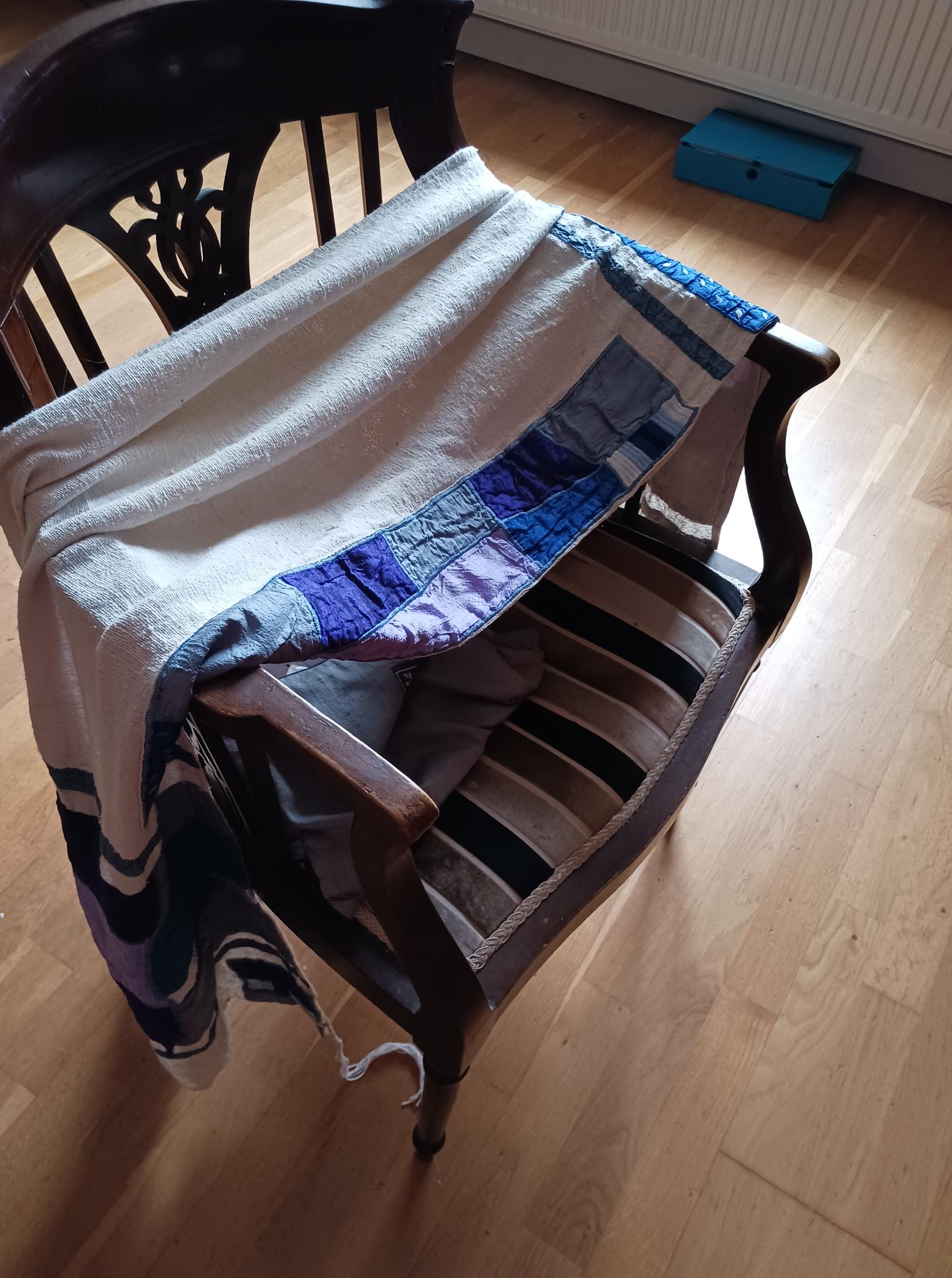
In the nineteen-eighties, a woman rabbi came to speak at my synagogue about women wearing tallit (fringed prayer shul, a garment required for men and for boys over thirteen), which was being advocated by some of the Progressive clergy. Three women congregants were in the vanguard, wearing tallit for morning services and all day on Yom Kippur. A celebrity visiting the shul called them an abomination, which we thought was rude and uncalled-for.
There were then perhaps half a dozen women rabbis in the UK, Reform or Liberal, denominations which are now merged as the Movement for Progressive Judaism. There was discussion of the gender specificity in our prayer books, masculine pronouns and terminology for God and the omission of the Matriarchs, Sarah, Rebecca, Rachel and Leah, from the opening paragraph of the Amidah prayer, where the Patriarchs, Abraham, Isaac and Jacob are named. An updated prayer book in 2008 amended this, whereas the new prayer book for Rosh Hashanah and Yom Kippur published in 1986 had retained ‘Lord’, ‘Father’ and ‘King’ which disappointed some rabbis and some congregants.
A traditionally minded member of my shul invited my husband, David Gould, who was also traditionally minded, to take some sort of stand against women wearing tallit in our services. Undecided this far, I did not want David to be drawn into opposing the women and resolved to wear a tallit myself on Yom Kippur. David lent me one of his and, when I put it on, reciting the prayer about enveloping oneself in tzitzit (the fringes on the prayer garment), I was literally shivering, fear and awe both being upon me.
At about that time, a significant number of women in my shul came to the same decision, mostly women of about my age, then in our thirties, influenced by second wave feminism and progressive Jewish discourse.
I became accustomed to wearing a tallit and, in Israel with David in 1990, a few months before he died, I bought a beautiful handwoven tallit in shades of pale mauve, from Robert Kleiman’s workshop in the Artists’ Colony in Jerusalem.
I wore it once in another Reform synagogue and found I was the only woman there to wear a tallit. Some congregants asked me if I was a rabbi, which made me feel somewhat of an imposter. I didn’t wear it again outside my own synagogue, seeing it was not the minhag – the custom – elsewhere, but in my shul I was sometimes the Shaliach Tzibbur, leading the prayer services, and it would have felt improper to do so without a tallit.
I once put it in the washing machine, which was a fatal mistake; at least, switching on the cycle was a mistake. The woollen tallit was ruined. I went to John and Judy Trotter’s bookshop in the grounds of Leo Baeck College, to buy another, and chose one, not woollen but again mauve and I wear it to this day. You can wash it in the machine, too.
I have three daughters and a son and my third daughter wore a tallit at her bat mitzvah in 1994, which was by then usual for the girls in our community. I had bought it in Jerusalem when we went there again, after David died. It had colourful stripes. My son wore his late father’s tallit at his bar mitzvah in 1995.
That generation of young women didn’t take to wearing tallitot as their mothers had done and I think my daughter did not wear it again.
On Yom Kippur, I wear a white one, also from the Manor House Bookshop adjacent to Leo Baeck College. They are expensive items but I enjoyed taking my grandson to a Judaica shop in North West London, to choose his bar mitzvah tallit. It was a happy day and even more so when he wore it to be called up to the reading of Torah (in an affiliate of the United Synagogue).
Of course I did not wear my tallit there. It would have caused offence. When I first put on the prayer shawl, that Yom Kippur in the 1980s, I thought that it would become more and more normal for women, at least in progressive Judaism and, in my shul, that was so. One had to go to other progressive synagogues to find that it had not caught on, that it was the minhag very particularly of my own community.
It is not something I want or feel able to undo. Women rabbis and cantors obviously wear tallitot when they lead services, as do several women congregants of my generation. What do you do when minhag – expected and appropriate behaviour according to a community – ceases to be a minhag?
I am a little estranged from Progressive Judaism and attend shul less often now, perhaps once a month. When one gets old, as I am, one is less likely to accept other people’s opinions as authoritative, even when they have authority.
I still believe in gender equality in religious life. I prefer not to sit behind a mechitzah, which separates women from men in orthodox services. I like to have an aliyah to recite the blessings before and after the Torah reading and even to read from the Torah scroll, which would not yet be possible in the United Synagogue.
‘Yet’ is the load-bearing word there. We cannot see how religions will evolve. Who expected to see a female Archbishop of Canterbury in their lifetime? We can only do what seems right at the time.
Narrow Bridge
Posted on: June 24, 2025
I’m never afraid when some keyboard warrior tells me that I am soon to die; for one thing, they are usually in the United States and I am in England. I do get annoyed that X Support doesn’t find it breaks their rules. If the person tells me that I will be gassed, because they are hoping for another Shoah, the algorithm probably does not identify ‘gassed’ as a threat. As for those who tell me my death is imminent, they may simply have noticed that I have three-quarters of a century behind me and decided that it’s even stevens they’ve got it right.
The things I fear are different from anything which alarmed me in time gone by, such as nuclear bombs, flying or the London underground.
This is what I fear:
award ceremonies such as the Academy Awards or BAFTA.
arts festivals and music festivals
the Labour Party Conference
the TUC
doctors and teachers, particularly when they gather for policy making conferences
BBC News and Sky News
The Guardian and the Independent
Holocaust Memorial Day because the trolls get hyper-active
stand up comedians, apart from Yohay Sponder.
any festival or conference where the great and good are gathered together
As David Hirsh has said, we Zionists are excluded from the so-called ‘communities of the good’. How easily can we even drop into casual conversation the fact that we are Jewish? We are cautious.
In his first days at his Jewish secondary school, my grandson asked, ‘Who are those people?’ indicating the security guards. By now he will be accustomed, like all the children at the school, to the fact that the watchful guards are always in place, for their protection, just as they are always present at my synagogue.
My children used to have a song book, in which a famous quotation from Rabbi Nachman of Bratslav was set to music: ‘The whole world is a very narrow bridge, but the main thing is not to be afraid at all.’
כל העולם כולו
גשר צר מאוד
והעיקר, והעיקר
לא לפחד, לא לפחד כלל
The biggest fear is fear of the future -the auspices don’t look promising – but I suppose all fear is fear of the future as it is always orientated towards something which hasn’t yet happened.
We have a psalm which tells us: ‘You shall not be afraid of the terror by night, nor of the arrow that flies by day.’
לא תירא מפחד לילה מחת יעוף יומם
That’s Psalm 91. It doesn’t mean that we should be foolhardy, cross the road when the traffic light is green or refuse the covid vaccine when it’s offered, but it does encourage confidence.

