Posts Tagged ‘judaism’
The Day After Yom Kippur
Posted on: September 22, 2026
I take some pride in saying that I no longer get a migraine during Yom Kippur, presumably because after decades of fasting on the appointed days, my body knows that the fast will end after twenty-five hours and does not feel the need to raise the alarm, which is often the trigger for a migraine.
Nevertheless, I have one now and just medicated for it, which is usually sufficient management for my increasingly rare migraines. It struck while I was looking again at the book of essays produced this year by the Movement For Progressive Judaism, entitled ‘Progressive Judaism, Zionism and the State of Israel.’ Most of the contributors are rabbis from the formerly named Liberal and Reform synagogues and a few are from religiously knowlegeable lay authors: political activists associated with anti Zionist organizations or publications. In some of the essays, older rabbis reflect that their earlier love for the State of Israel has been compromised in the years since 1967, when the State defends its control over disputed territories, which they would rather relinquish. Some of the clergy advocate a liturgy which makes room for expressions of fraternity with the Palestinians, with whom our fate seems to be intertwined.
This year, 2026, also known as 5787, was the first year when the congregation I have belonged to for more than half a century used the new Days of Awe prayer books, a two volume set for use on Rosh Hashanah and Yom Kippur. As some of the congregants mentioned, the two separate volumes work well, being considerably lighter than a single volume to be carried on both holy days. It is also easier to find the place and the Torah readings are conveniently inserted at the point in the text when they are read, rather than as addenda at the end of the book.
I usually participate in an aftertoon discussion group which meets between Mussaf and Minchah (additional and afternoon prayer services) so that congregants have an opportunity to talk about matters arising from the service or aspects of contemporary Jewish life. This year, we were to discuss the new machzor, the new prayer books for Rosh Hashanah and Yom Kippur. In preparation, I had opened mine on the kitchen table at home next to the previous, 1985 machzor, to compare and contrast at least a portion of it, the Mussaf service. The most consistent and obvious difference is the ungendered language of the new machzor in the English translations of the Hebrew, in discourse about God, which matches the language of the 2008 prayer book. God is not called King, Lord, Father, Master of the Universe or He. The translations are carefully chosen and I have written about them in a blog post some years ago called, ‘The Lord, the Lord: Translating the Tetragrammaton.’ If it were up to me, I would choose the poetic sound of the gendered language but I understand that people have good reasons for not wanting to speak of God as male.
The trend towards universalism has also been in place since 2008, with the words ‘V’al col ha olam’ ‘…and on all the world,’ added to the Kaddish which traditionally ends with the words ‘May He who makes peace in the highest make peace for us and for all Israel.’ It is reasonable enough to suppose that Israel’s peace depends on the peace of other countries. Another way of looking at ‘and on all the world’ is that it is insufficient to pray for our own people without pleading for the good of other peoples. I just hope that, quid pro quo, they are praying for us.
I also picked out a paragraph in the new machzor which I could not find in the previous one:
‘The High Priest’s third confession was for all Israel. Can this be sufficient for us today? God is God of all the earth and we are all partners in the repairing of God’s world, for a future and a hope. We must confess the part we play in the sins of humanity, for our action and our inaction.’
The idea that a confession ‘for all Israel’ devised in antiquity is insufficient for us today seemed to me to belong with a theme in some of the essays of ‘Progressive Judaism, Zionism and the State of Israel’, that being citizens of the world trumps our national identity as Am Yisrael, the People of Israel.
I think I was alone in this impression, so cannot assert it with much confidence. Neither can I believe that our citizenship of the world abrogates our identity as Jews or vice versa. I think the Progressive clergy would say that one reinforces the other.
Meanwhile, I have been greatly impressed by an essay in the Progressive Judaism book by Rabbi Andrea Zanardo , who advocates that educational resources should include remembrance of the mass displacement of Jews from Arab lands, as well as the history of the persecutions in Europe.
Rabbi Zanardo writes:
‘Hillel’s warning in Pirkei Avot remains the hinge: Al tifrosh min ha tzibbur, “Do not separate yourself from the community.” When prayers for Israel are stripped of kibbutz galuyot – the gathering of exiles – of Middle Eastern/North African refugee history, and of language that acknowledges defence and survival, they cease to sound like prayers spoken by a people.’
One might suppose that Tikkun Olam, the repairing of the world, was the foremost commandment of contemporary progressive Judaism. Certainly, the phrase occurs in our ancient prayer Aleynu, ‘l’takken olam b’malchut Shaddai,’ ‘…the world will be set right by the rule of God.’ ‘Malchut’ is literally kingship, but it is translated in our prayer books as ‘rule’ to avoid the maleness of kings and kingship.
But Tikkun Olam is not mentioned in the Ten Commandments, nor in the Shema. In this insistent reaching for the world, ha olam, are we at risk of letting our peoplehood slip away? Not to worry – the other nations of the world, concerned with their own identity, will not let us lose sight of ours.
‘
The Mauve Tallit
Posted on: May 12, 2026
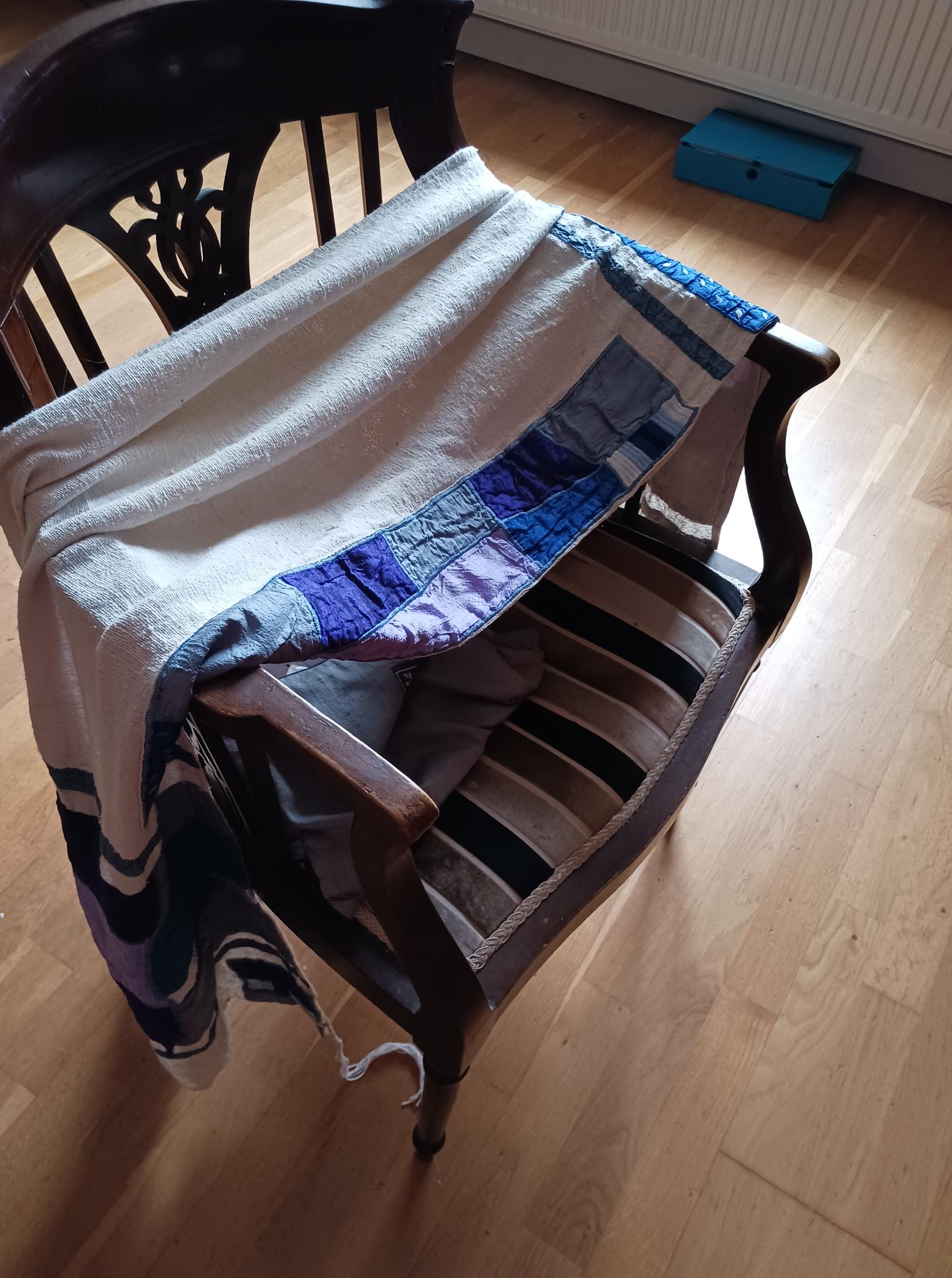
In the nineteen-eighties, a woman rabbi came to speak at my synagogue about women wearing tallit (fringed prayer shul, a garment required for men and for boys over thirteen), which was being advocated by some of the Progressive clergy. Three women congregants were in the vanguard, wearing tallit for morning services and all day on Yom Kippur. A celebrity visiting the shul called them an abomination, which we thought was rude and uncalled-for.
There were then perhaps half a dozen women rabbis in the UK, Reform or Liberal, denominations which are now merged as the Movement for Progressive Judaism. There was discussion of the gender specificity in our prayer books, masculine pronouns and terminology for God and the omission of the Matriarchs, Sarah, Rebecca, Rachel and Leah, from the opening paragraph of the Amidah prayer, where the Patriarchs, Abraham, Isaac and Jacob are named. An updated prayer book in 2008 amended this, whereas the new prayer book for Rosh Hashanah and Yom Kippur published in 1986 had retained ‘Lord’, ‘Father’ and ‘King’ which disappointed some rabbis and some congregants.
A traditionally minded member of my shul invited my husband, David Gould, who was also traditionally minded, to take some sort of stand against women wearing tallit in our services. Undecided this far, I did not want David to be drawn into opposing the women and resolved to wear a tallit myself on Yom Kippur. David lent me one of his and, when I put it on, reciting the prayer about enveloping oneself in tzitzit (the fringes on the prayer garment), I was literally shivering, fear and awe both being upon me.
At about that time, a significant number of women in my shul came to the same decision, mostly women of about my age, then in our thirties, influenced by second wave feminism and progressive Jewish discourse.
I became accustomed to wearing a tallit and, in Israel with David in 1990, a few months before he died, I bought a beautiful handwoven tallit in shades of pale mauve, from Robert Kleiman’s workshop in the Artists’ Colony in Jerusalem.
I wore it once in another Reform synagogue and found I was the only woman there to wear a tallit. Some congregants asked me if I was a rabbi, which made me feel somewhat of an imposter. I didn’t wear it again outside my own synagogue, seeing it was not the minhag – the custom – elsewhere, but in my shul I was sometimes the Shaliach Tzibbur, leading the prayer services, and it would have felt improper to do so without a tallit.
I once put it in the washing machine, which was a fatal mistake; at least, switching on the cycle was a mistake. The woollen tallit was ruined. I went to John and Judy Trotter’s bookshop in the grounds of Leo Baeck College, to buy another, and chose one, not woollen but again mauve and I wear it to this day. You can wash it in the machine, too.
I have three daughters and a son and my third daughter wore a tallit at her bat mitzvah in 1994, which was by then usual for the girls in our community. I had bought it in Jerusalem when we went there again, after David died. It had colourful stripes. My son wore his late father’s tallit at his bar mitzvah in 1995.
That generation of young women didn’t take to wearing tallitot as their mothers had done and I think my daughter did not wear it again.
On Yom Kippur, I wear a white one, also from the Manor House Bookshop adjacent to Leo Baeck College. They are expensive items but I enjoyed taking my grandson to a Judaica shop in North West London, to choose his bar mitzvah tallit. It was a happy day and even more so when he wore it to be called up to the reading of Torah (in an affiliate of the United Synagogue).
Of course I did not wear my tallit there. It would have caused offence. When I first put on the prayer shawl, that Yom Kippur in the 1980s, I thought that it would become more and more normal for women, at least in progressive Judaism and, in my shul, that was so. One had to go to other progressive synagogues to find that it had not caught on, that it was the minhag very particularly of my own community.
It is not something I want or feel able to undo. Women rabbis and cantors obviously wear tallitot when they lead services, as do several women congregants of my generation. What do you do when minhag – expected and appropriate behaviour according to a community – ceases to be a minhag?
I am a little estranged from Progressive Judaism and attend shul less often now, perhaps once a month. When one gets old, as I am, one is less likely to accept other people’s opinions as authoritative, even when they have authority.
I still believe in gender equality in religious life. I prefer not to sit behind a mechitzah, which separates women from men in orthodox services. I like to have an aliyah to recite the blessings before and after the Torah reading and even to read from the Torah scroll, which would not yet be possible in the United Synagogue.
‘Yet’ is the load-bearing word there. We cannot see how religions will evolve. Who expected to see a female Archbishop of Canterbury in their lifetime? We can only do what seems right at the time.
Being an Apikoros
Posted on: August 15, 2025
I grew up in Upper Clapton, on the north side of Hackney, considered a little more bourgeois than Hackney Central, where my maternal grandparents, aunts, uncles and cousins resided, in a house in Amhurst Road. Each floor was home to a family and the basement was converted into a flat for the widowed and remarried Uncle Simy. One of my cousins, zichrona livracha, once said, ‘It wasn’t a house, it was an institution.’
In our house in Upper Clapton there were just my parents, my sister, me, and my paternal grandmother, Booba Malka. Booba used to light the shabbat candles and occasionally went to shul, I knew not where.
Cazenove Road, off of Upper Clapton Road, was inhabited almost entirely by haredim whom the mainstream non-orthodox Jews called ‘frummers’ – meaning devout people. My parents were not actually mainstream as they were atheists and socialists and my father was a school teacher, which meant he had a higher level of education than anyone else in the family at that time. Lest you imagine that their socialism stood in the way of their Zionism, it did not. They were proud of Israel, Ben Gurion and the kibbutz system.
I sometimes heard my father called ‘Jack the teacher’ by visitors to the Amhurst Road house, a hub for card games, delicatessen and – to a lesser degree- political talk, but only for the men. If we had lived in Wales, would my Dad have been ‘Yankel the School’? At Amhurst Road, all the adults smoked. My parents did not smoke and I must say they were blessed with greater longevity than any of their siblings, or their parents. The smokers did not drink, but my father had respect for alcohol and chose wine and liqueurs carefully. In our cocktail cupboard were bottles of Benedictine, Kirsch and lime green Chartreuse, and, in the fridge, Aquavit from Denmark.
Sometimes, from beyond the end of our garden, behind the shed, came the sound of riotous male singing. These, said my mother, were the frummers, who had a shul or a yeshiva opposite our back fence. Was it Simchat Torah or perhaps the Hallel sung at some other festival? I was an Apikoros* and did not know.
At my primary school, about a third of the pupils were Jewish and about the same at the girls’ grammar school I attended but there I met girls from orthodox families – girls who had attended a Jewish primary school and now, remarkably, were allowed by their parents to enter secular education, a prize no doubt for passing the Scholarship aka the 11 Plus. Some were friendly and talked and joked with everyone; others kept their distance. My best friend and I made an atheistic, argumentative twosome. What did they make of us? Not much. One girl showed me a photo of her brother, a grown up man, bearded with peyos and a streimel.
The frummers were sometimes resented by the non-frum. It was as if their enclaves and haredi dress code might bring the rest of us into disrepute. In the 1950s and 60s, some degree of assimilation was considered desirable. Our very names were secular: Gillian, Jacqueline, Angela, Sylvia, Melvyn and Howard. It was the aunts and uncles who were called Rae, Issy, Hymie, Manny, Leah and Esther. I did have a cousin, born about 1930 (he had been a Bevin Boy in the war), whose name was Judah, but he was universally called Jack. His surname also was changed to something more English than the original. Why call your boy Judah and then give him an English-sounding surname?
It is easy to sneer at the anglicisation of names but these were people who had fled from pogroms and would rather be safe than sorry. Great Britain allowed us to be British, so we grasped the opportunity and were gefruntzled to see the haredim passing it by.
We used the word ‘hasids’ rather than haredim. I had no idea of the different sects. A Lubavitch House was opened in Stamford Hill in the late sixties, after we had moved out of the area. Everyone was moving out, to Ilford, Redbridge, Southgate, Hendon or Finchley. Meanwhile, the frummers remained. ‘Hackney is all cowboys and Indians now,’ was a popular waggery. The ‘Indians’ were Asians and the ‘cowboys’ were haredim in their wide-brimmed hats.
I sometimes wonder why there was such a pervasive impulse among the Jews of Hackney to regard the ultra-orthodox as separate from ourselves. Did it cut both ways? No doubt they regarded the women of our families with uncovered hair and short sleeves as being not properly Jewish, despite the mezuzot on our doors.
Everything was driven by a sense of danger. What was divisive was the perception of danger, where it would come from, what trigger would activate it. The sense of danger is no less in 2025 and neither are the differences among us of how best to weather the storm. What would we have to do, to weather it?
I think of Rabbi Akiva’s parable, related in the Talmud Bavli, Berakhot 61b.
The Sages taught: One time, after the Bar Kokhba rebellion, the evil empire of Rome decreed that Israel may not engage in the study and practice of Torah. Pappos ben Yehuda came and found Rabbi Akiva, who was convening assemblies in public and engaging in Torah study. Pappos said to him: Akiva, are you not afraid of the empire?
Rabbi Akiva answered him: I will relate a parable. To what can this be compared? It is like a fox walking along a riverbank when he sees fish gathering and fleeing from place to place.
The fox said to them: From what are you fleeing?
They said to him: We are fleeing from the nets that people cast upon us.
He said to them: Do you wish to come up onto dry land, and we will reside together just as my ancestors resided with your ancestors?
The fish said to him: You are the one of whom they say, he is the cleverest of animals? You are not clever; you are a fool. If we are afraid in the water, our natural habitat which gives us life, then in a habitat that causes our death, all the more so.
- ‘Apikoros’ is a term within Jewish discourse, signifying a departure from established religious beliefs and practices, its most emphatic meaning being something like ‘heretic’.

