The Mauve Tallit
Posted on: May 12, 2026
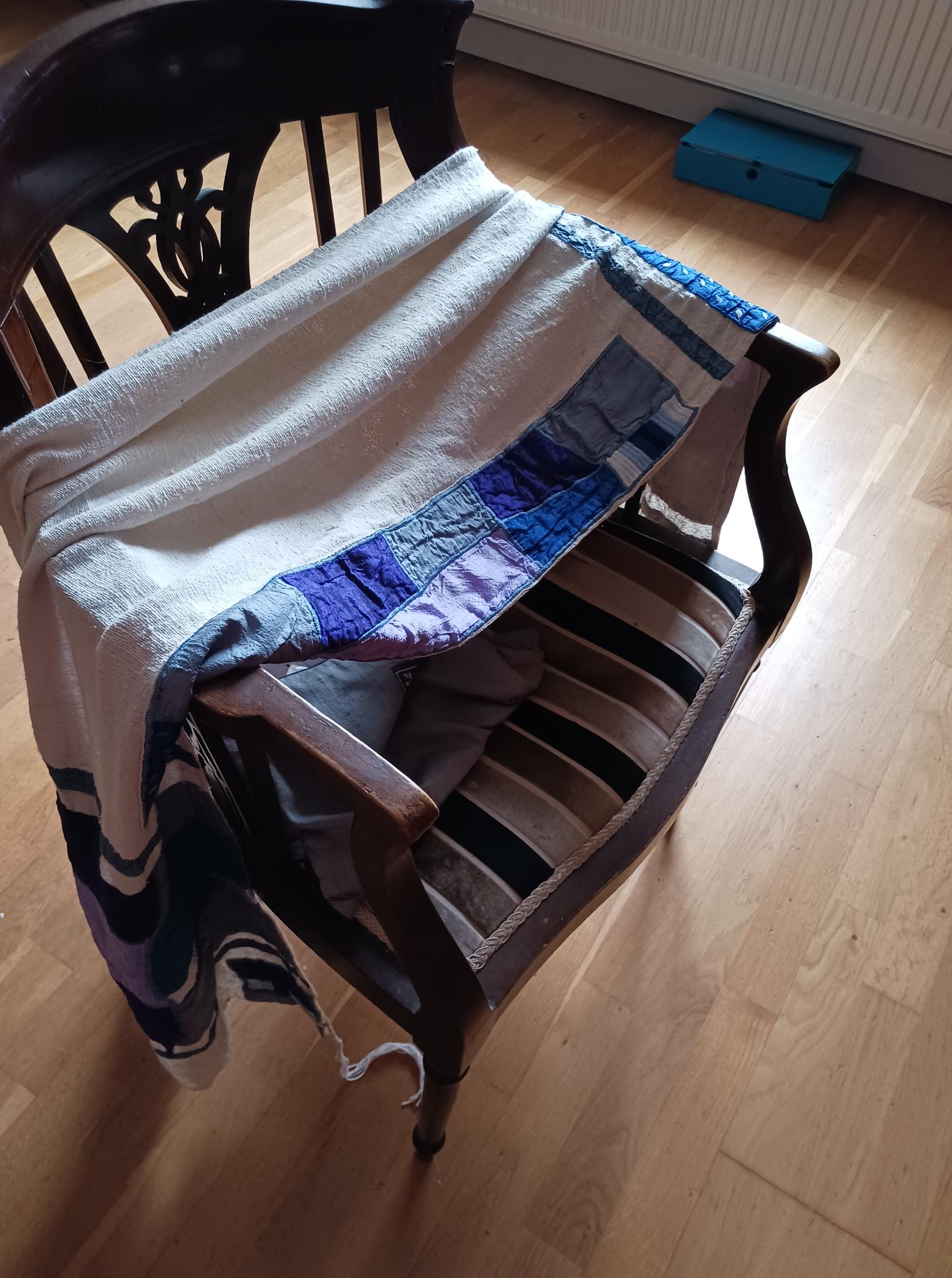
In the nineteen-eighties, a woman rabbi came to speak at my synagogue about women wearing tallit (fringed prayer shul, a garment required for men and for boys over thirteen), which was being advocated by some of the Progressive clergy. Three women congregants were in the vanguard, wearing tallit for morning services and all day on Yom Kippur. A celebrity visiting the shul called them an abomination, which we thought was rude and uncalled-for.
There were then perhaps half a dozen women rabbis in the UK, Reform or Liberal, denominations which are now merged as the Movement for Progressive Judaism. There was discussion of the gender specificity in our prayer books, masculine pronouns and terminology for God and the omission of the Matriarchs, Sarah, Rebecca, Rachel and Leah, from the opening paragraph of the Amidah prayer, where the Patriarchs, Abraham, Isaac and Jacob are named. An updated prayer book in 2008 amended this, whereas the new prayer book for Rosh Hashanah and Yom Kippur published in 1986 had retained ‘Lord’, ‘Father’ and ‘King’ which disappointed some rabbis and some congregants.
A traditionally minded member of my shul invited my husband, David Gould, who was also traditionally minded, to take some sort of stand against women wearing tallit in our services. Undecided this far, I did not want David to be drawn into opposing the women and resolved to wear a tallit myself on Yom Kippur. David lent me one of his and, when I put it on, reciting the prayer about enveloping oneself in tzitzit (the fringes on the prayer garment), I was literally shivering, fear and awe both being upon me.
At about that time, a significant number of women in my shul came to the same decision, mostly women of about my age, then in our thirties, influenced by second wave feminism and progressive Jewish discourse.
I became accustomed to wearing a tallit and, in Israel with David in 1990, a few months before he died, I bought a beautiful handwoven tallit in shades of pale mauve, from Robert Kleiman’s workshop in the Artists’ Colony in Jerusalem.
I wore it once in another Reform synagogue and found I was the only woman there to wear a tallit. Some congregants asked me if I was a rabbi, which made me feel somewhat of an imposter. I didn’t wear it again outside my own synagogue, seeing it was not the minhag – the custom – elsewhere, but in my shul I was sometimes the Shaliach Tzibbur, leading the prayer services, and it would have felt improper to do so without a tallit.
I once put it in the washing machine, which was a fatal mistake; at least, switching on the cycle was a mistake. The woollen tallit was ruined. I went to John and Judy Trotter’s bookshop in the grounds of Leo Baeck College, to buy another, and chose one, not woollen but again mauve and I wear it to this day. You can wash it in the machine, too.
I have three daughters and a son and my third daughter wore a tallit at her bat mitzvah in 1994, which was by then usual for the girls in our community. I had bought it in Jerusalem when we went there again, after David died. It had colourful stripes. My son wore his late father’s tallit at his bar mitzvah in 1995.
That generation of young women didn’t take to wearing tallitot as their mothers had done and I think my daughter did not wear it again.
On Yom Kippur, I wear a white one, also from the Manor House Bookshop adjacent to Leo Baeck College. They are expensive items but I enjoyed taking my grandson to a Judaica shop in North West London, to choose his bar mitzvah tallit. It was a happy day and even more so when he wore it to be called up to the reading of Torah (in an affiliate of the United Synagogue).
Of course I did not wear my tallit there. It would have caused offence. When I first put on the prayer shawl, that Yom Kippur in the 1980s, I thought that it would become more and more normal for women, at least in progressive Judaism and, in my shul, that was so. One had to go to other progressive synagogues to find that it had not caught on, that it was the minhag very particularly of my own community.
It is not something I want or feel able to undo. Women rabbis and cantors obviously wear tallitot when they lead services, as do several women congregants of my generation. What do you do when minhag – expected and appropriate behaviour according to a community – ceases to be a minhag?
I am a little estranged from Progressive Judaism and attend shul less often now, perhaps once a month. When one gets old, as I am, one is less likely to accept other people’s opinions as authoritative, even when they have authority.
I still believe in gender equality in religious life. I prefer not to sit behind a mechitzah, which separates women from men in orthodox services. I like to have an aliyah to recite the blessings before and after the Torah reading and even to read from the Torah scroll, which would not yet be possible in the United Synagogue.
‘Yet’ is the load-bearing word there. We cannot see how religions will evolve. Who expected to see a female Archbishop of Canterbury in their lifetime? We can only do what seems right at the time.


May 18, 2026 at 1:42 pm
Gillian, I love your writing, and I admire you, your courage, your insight, your integrity and your intellect. There is so much that we agree on – but on this, I’m afraid, I have to fundamentally disagree.
Coming at this topic from an orthodox perspective (while having grown up in a reform-affiliated family), of course I can’t really be expected to agree with, condone or approve of non-orthodox, reform/progressive practice.
But more than that, it saddens me above all else to see progressive movements, or movements that believe themselves to be progressive, engaging in what I think the gender identity wars of today show us is actually very regressive practice.
Equality is not sameness. It saddens me to see progressive movements eliding the unique role of women in Judaism and colluding in, indeed promoting, the notion that women can only achieve equality of status, self-worth, and spiritual attainment and inspiration, by aping what men do.
It’s interesting that, in much the same way that in broader society there is no significant movement of trans men (i.e. biological women identifying as men) trying to gain access to men-only spaces (because why would you?) – other than in tiny numbers that are not shaping current debate, discourse and argument – so too, in progressive Judaism we don’t see men clamouring to take on the roles of women in order to feel equality.
It’s almost as though women feel they can’t be accepted as equals or feel spiritual inspiration and attainment for who they are – different but equal, as are men – and can’t find alternate but equally valid ways of connection to spirituality, without aping men.
As I say, it leaves me sad more than anything else.
Orthodox women, overwhelmingly (of course, with some exceptions), feel no need to ape men in order to feel spiritually satisfied and fulfilled. Provided, of course (and this is equally true of men as well), they properly and fully understand, in depth, and commit to the mitzvot, the actions, and the opportunities for engagement, self-esteem, closeness to God, leadership and influence within the community, intellectual advancement in Torah, and so on, that are available to them as who they are.
With deep respect and friendship,
Yitz
May 18, 2026 at 2:23 pm
Thank you Yitz. I do understand your point of view and, as you see from what I’ve written, am conflicted about the question of tallit for women. After my husbnd David died of cancer, when he was 41, I was comforted by doing an MA in Jewish Studies at Leo Baeck College. For this I did a foundation course in biblical Hebrew and then studied some rabbinic writings as well as Jewish history between 1789 and 1945. I was often asked to do the dvar torah on shabbat mornings in my shul, or to read the parashah, which meant practising beforehand, so that I could manage without nikkud. It felt that it would be a personal loss, if I were not allowed to do this. and yet, at my grandson’s bar mitvah in a United Synagogue, I was as happy behind the mechitzah as I am in the mixed pews of my own shul.