Bechukkotai 2014
Posted on: May 4, 2014
This is one of the most difficult readings in the Torah and it bears a resemblance to an equally difficult passage in Deuteronomy, which likewise lists the punishments due to the people of Israel, if they reject God and His commandments and follow the gods of the neighbouring peoples. They are known by the Hebrew word Tochechot, which means ‘warnings.’ The preceding verses are a series of blessings which God will bestow if the people keep His commandments, so the passage which we are going to read is a counterbalance – the stick and not the carrot.
The blessings, like the punishments, are collective and it is the people, rather than individuals, who are spoken of as being faithful to God or turning away from Him. In fact, all the warnings are in the second person plural, being addressed to all Israel.
The bottom line is God’s warning that He will punish the people with famine to the extent that they will have recourse to cannibalism. The scriptural author must have had experience of famine, indirect if not direct, as he or she was aware that cannibalism is sometimes a consequence of famine.
Can this be our conception of God? Or is it recognizable as human interpretation of catastrophe, where disaster is seen as the retribution of God and the wages of sin?
Bechukkotai threatens other punishments: exile, subjugation by enemies, sickness, weakness and terror. We find in this Torah reading the saying ‘The sound of a driven leaf shall pursue [those left among you] and they shall flee as in flight from the sword and fall, with none pursuing.’
Then the tone changes. So deep is the abyss that is threatened, that up is now the only possible direction. The sins of Israel will be expiated by confession and suffering, and God will remember his covenant with the Patriarchs. The patriarchs are named here as Jacob, Isaac and Abraham, reversing the usual order. The first named, Jacob, stands for Israel more so than Abraham or Isaac, from whom other nations besides Israel are descended.
This passage suits the temperament of at least two kinds of reader. There are those who make a superstitious connection between catastrophe and retribution. Then there are the critics of bible and particularly Tanakh, who denounce the cruelty of what they often call ‘the God of the Old Testament.’
How can we say those interpretations are unreasonable, given the text, in black and white, on our sefer Torah?
I am not able to answer this, but I can see that the first view, of extreme punishment being deserved, tends to be favourable to cruelty; the second view is certainly critical of cruelty but it is perhaps a facile way of reading of scripture.
There is in today’s Torah portion a binary division: reward and punishment, good and evil, strength and weakness, remembering and forgetting.
It reflects a noticeably binary or dual aspect to the stories of Genesis, with its pairs of brothers from Cain and Abel onwards and the adversarial pairing of women: Sarah and Hagar, Rachel and Leah, and the less famous Adah and Zillah, before the flood. We see it too in the story of the raven and the dove sent out by Noah. In the sacrificial system of Leviticus, we find pairs of birds and pairs of goats; one is chosen for sacrifice, the other discarded and sent away, not unlike Cain and Ishmael, the discarded partners of Abel and Isaac who, each in his own way, is associated with acceptable sacrifice. Here, in Bechukkotai, we have blessings and curses in close juxtaposition.
My view is that our reading of the Torah should be informed by a perception of grey areas and in-between realities. Enlightened interpretation of scriptural texts has been a characteristic of the modern age, if you regard the modern age as beginning around the time of the seventeenth century, when the Jewish philosopher Spinoza got into trouble for his non-literal interpretation of the bible.
There is great complexity in our politics, our ethics, our wars, our relationship with God and, above all, our perception of cause and effect. The Torah is indeed our inheritance and I think it’s desirable that we read all of it, but we should read it carefully. The tradition is to read these reproofs in an undertone and in orthodox tradition, as a single aliyah. Adam Frankenberg, a rabbinical student at LBC, writes:
All the curses are read within one aliyah and verses which are not curses are read before and after them, which not only means that reading them is completed as quickly as possible but also that the curses themselves are not blessed.
It seems to me that, if we are going to read this passage, that is the way to read it.
- In: poetry | Purim
- 2 Comments
Performed by the rabbinic team of XXXXXX
and written by Gillian Lazarus
Chapter one
In the days of King Ahasuerus
They drank without unit awareness
The satraps and princes
Ate shashlik and blintzes
And talked about Queen Vashti’s fairness.
They feasted in Shushan the Palace
Each man had a solid gold chalice
And spent night and day
Knocking back Chardonnay
And a very fine bourbon from Dallas.
After filling his goblet with whisky
The king was predictably frisky
He said ‘No one’s seen
Such a wife as my queen
So I’m going to try something risky.’
Queen Vashti was called to the party
While the king grew increasingly hearty
Saying ‘Let her come wearing
An outfit that’s daring,
I want her to look downright tarty.’
Resplendent with eye kohl and rouge,
Vashti answered ‘I’m nobody’s stooge,
The king is a boozer
A nerd and a loser
And only his chutzpah is huge.’
The king was both angry and grieved
And his hotshot advisors were peeved,
They called Vashti seditious,
Rebellious and vicious,
And this is the plan they conceived:
‘Get rid of the queen and don’t tarry,
And Sir, you should quickly remarry,’
The king’s main enforcer
Insisted ‘Divorce her,
You’ll soon feel as happy as Larry.’
They mailed every Mede and each Persian
Saying ‘Guard against wifely subversion,
If the women protest,
Robust tactics are best
And don’t draw the line at coercion.’
Chapter two
Mordechai, who lived in the city,
Was a man full of kindness and pity
He loved Torah and peace
And he brought up his niece
Who was lively, good-natured and pretty.
He called for his niece and he blessed her
He said ‘I’ve a plan, dearest Esther,
I’ve thought up a ruse
And it’s good for the Jews
All it takes is a bullish investor.
Now you are my pearl and my treasure
An asset, in truth, beyond measure
I don’t wish to scare you
But I mean to share you,
Our aim is His Majesty’s pleasure.’
Esther moved to the king’s royal quarters
Where Persia’s most glamorous daughters
Used oils and cosmetics
And tantric athletics,
Enjoying the natural hot waters.
The king said ‘This Esther’s appealing,
Let her put on a dress that’s revealing
When she’s on my divan
She’ll think, “Oh what a man!”
There’s a looking glass, too, on the ceiling.’
To Mordechai, Esther was loyal
She submitted to being a royal
It was hardly devotion
But clearly promotion
So Esther tried not to recoil.
Two chamberlains meanwhile conspired;
The death of the king they desired,
But Mordechai heard
And their plan was deterred
And he told them ‘Go home, you’re both fired.’
Chapter three
There rose shortly after to power
A certain man, haughty and sour,
He was Haman by name
And was greatly to blame
Making poor people grovel and cower.
Now Mordechai wouldn’t kowtow;
Before God alone would he bow,
No man could assuage
Haman’s terrible rage
‘I’ll see Mordechai hanged,’ was his vow.
He sought out the king to suggest
That all Jews be placed under arrest,
And sentenced to die,
Though he didn’t say why,
And the king did not choose to protest.
For this crime, they selected a date
Haman said ‘We had better not wait,
But just to be sure
We’ll cast lots, known as ”pur”,
Then the Jews will be sent to their fate.’
Chapter four
When the dreadful news reached Mordechai,
He said, with a loud, bitter cry,
‘This decree must be seen
Take it straight to the queen
And I hope for a speedy reply.’
Esther realized with dread that her mission
Meant breaching the king’s prohibition;
To intrude on his court
When an audience was sought,
Could be viewed as an act of sedition.
Said Mordechai, ‘Do not falter
Or we shall be sent to the slaughter
For our lives you must plead,
For the Jews, intercede,
Help will come from a heavenly quarter.’
‘This prospect,’ she said ‘I don’t relish,
Unless the king’s minded to cherish,
But I’ll make the approach
And this subject I’ll broach
And then if I perish, I perish.’
Chapter five
Esther fasted three days and three nights,
Shunning all culinary delights
Then she dressed to the nines
In enticing designs:
A basque and some black fishnet tights.
The king rested on his throne, drowsing,
Sleeping off a long night of carousing,
When Esther drew near,
He said ‘Sweetie, come here,
I find your attire arousing.’
She sidled up at his behest;
He said ‘Tell me babe, what’s your request,’
Esther, no longer scared,
Said ‘I’ve dinner prepared,
You bring Haman and I’ll do the rest.’
‘If this is your wish,’ said the king
‘It seems like a very small thing,
I always assume
Women want more perfume,
Expensive Swiss handbags and bling.’
Haman said to his wife ‘I’m excited
To be in this manner invited,
For in Queen Esther’s eyes
My stock’s on the rise
So I’ll tell her that I’d be delighted.
Yet Mordechai’s conduct still galls me
His refusal to bow just appalls me;
I’ll see the man swing,
Then I’ll go to the king
The esteem of whose wife quite enthralls me.’
Chapter six
At quarter past three in the morning
The king was still tossing and yawning
Then he’d fidget and cough
But he couldn’t drop off
And he longed for the day to start dawning.
A chamberlain wearing a monocle
Read aloud from the court’s Daily Chronicle
It consisted of lists
But no longer exists,
Which is why it was never canonical.
The chamberlain said ‘Here’s a nugget
And nobody’s bothered to plug it
But the Jew Mordechai
Foiled an evil plot by
Installing a wire, to bug it.’
‘So the plot,’ said the king, ‘was recorded,
It was traitorous, wicked and sordid,
But the plotters were sacked
And their telephones hacked
By a man we have not yet rewarded.’
‘Send for Haman, the man I rely on,
He may have some thoughts I can try on;
He can be rather grim
But I get on with him
Just so long as I don’t mention Zion.’
Although he found Haman unnerving,
He said ‘There’s a man most deserving,
So help me devise
Some acceptable prize
As his loyalty’s truly unswerving.’
So Haman considered and, duly,
He thought ‘This refers to Yours Truly.
I’ll soon be raised high
Then I’ll show Mordechai
How I punish the proud and unruly.’
He said ‘Gladly, sir, I’ll be your mentor;
Clothe the man in Chanel and La Renta
Select a fine horse,
Your own stable, of course,
Then he’ll ride through the town’s Arndale Centre.
‘Your idea is too good to waste,’
Said the king ‘And it’s much to my taste
To Mordechai, go
And fix it just so,
Now off with you Haman, make haste.’
Haman went, but his language was blue,
He hatred, if anything, grew,
He cursed his bad luck,
Cried aloud ‘WTF?
I’ll soon be revenged on that Jew!’
When Mordechai mounted the steed,
He said ‘Here’s a turn up, indeed,
I’m not an equestrian,
Just a Red Sea pedestrian,
Shanks’s pony is all that I need.’
Chapter seven
At the banquet of Esther the Queen
There was sushi and nouvelle cuisine,
Chopped liver and borscht
And Bloom’s garlic wurscht
And a jelly, without gelatine.
The king, amidst drinking and laughter
Said ‘Esther just what are you after?
Is it diamonds or land
Or a colliery band
Or some other gift even dafter?’
Then Esther got down on her knees,
Saying ‘Husband, be serious please,
You accepted a bribe
To extinguish my tribe,
Alas! What dark hours are these!’
The king pleaded incomprehension
And asked ‘What’s this bribe that you mention?
My dear, you’re my wife
Any risk to your life,
Would bring on my old hypertension.’
Said Esther ‘This Amalekite
Is the man I would have you indict,’
The king said ‘No kidding?
Well I’ll do your bidding
Now Haman get out of my sight.’
The king then stormed into the garden
He could feel all his arteries harden;
Haman sat next to Esther,
Which greatly distressed her,
And asked her to plead for a pardon.
When the king very shortly returned
His anger now kindled and burned
Barely catching his breath
His said ‘Put him to death
And consider this banquet adjourned.’
Chapters eight, nine and ten
The prospect for Jews now looked healthy,
And Mordechai grew very wealthy
For the king now despised
The plot Haman devised,
Saying ‘Damn but that bastard was stealthy.’
Royal letters were sent near and far
Regarding the month of Adar,
The plot was depraved
But the Jews would be saved
While for Haman it was au revoir.
There followed a great deal of fighting
Which was triggered by Haman’s inciting,
But to Esther’s relief
Haman’s men came to grief
And she put the whole thing down in writing.
Esther wrote in a detailed report
How Mordechai managed to thwart
Those evil intentions
By bold interventions,
And rose to distinction at court.
At Purim we drink like the Persians
With nobody casting aspersions
The villain gets hissed,
We all get Brahms and Liszt
And engage in light-hearted diversions.
So this is the end of our thriller
With Haman condemned as a killer
Mordechai and his niece
Both had gladness and peace,
And that is the gantzer megillah.
Shabbat Shoftim 2013
Posted on: August 4, 2013

Today’s reading, Shoftim, which means ‘judges’ is so-called because the sidra opens with the words ‘You shall appoint judges and officers in all your towns that the Lord your God is giving you, according to your tribes, and they shall judge the people with righteous judgment.’
The verse which follows is repeated in the rabbinic Ethics of the Fathers and in our siddur:
‘You shall not show partiality, and you shall not accept a bribe.’
Devarim 16:19
The expression ‘show partiality’ doesn’t really convey the interesting metaphor in the Hebrew Lo takir panim v’lo tikkach shochad. ‘You shall regard no faces and take no bribe.’
From a previous verse in Deuteronomy, we read that an attribute of God is that He is not partial and takes no bribe, or, in a more traditional translation, ‘God…who regardeth not persons, nor taketh reward.’
Devarim 10:17
Asher lo yissa panim v’lo yikkah shochad, the literal meaning of which is He does not lift up faces and takes no bribe.
In Pirke Avot (4:29), you find the same phrase, V’lo masso fanim, [God] does not lift up faces, and on page 172 of the siddur, again V’lo masso fanim v’lo mikkach shohad, ‘He shows to favour and takes no bribe.’
Respecting persons, acknowledging faces, lifting up the face, showing favouritism is seen as a corrupt practice, which implies a recognition of who might be able to return a favour or who might gainfully be treated as important. This sort of respect works to the advantage of the powerful, influential or rich, who are in a position to return favours.
Masso fanim is part of everyday life and is understandable. The celebrity gets the best table in the best restaurant and the millionaire doesn’t have to wait in line for the bank clerk. Researchers found that, in job interviews, good looks and height are both advantages. You see why Napoleon had to take Europe by force. When Napoleon hadEurope, it was a good thing to be related to him.
Well, Deuteronomy tells us not to be snobbish or sycophantic in dealing with persons, and, in the wider context, it implies that we owe respect to a person for their humanity rather than their status.
There’s a Chasidic story of a certain famous rabbi whose distinction and erudition were belied by his insignificant appearance and ragged clothes. Some yeshiva students encountered him and were disrespectful, even treating him roughly. Afterwards they were mortified to learn it was the great Rabbi Poloni, and went to see him to beg his pardon.’
‘Please accept our apology and forgive our rude behaviour ,’ they begged. ‘We had no idea it was you.’
‘I can’t do that, ‘ said the rabbi, shocking the students who expected him to be kindly and forgiving. ‘I would forgive you,’ he added, ‘but I’m just not in a position to do so. You apologized to me because of who I am. But what about the person you thought I was?’
Shabbat Bemidbar
Posted on: May 13, 2013

This is the opening sidra of the book of Numbers. The reason why Numbers is so called is that, at the beginning of the book, Moses numbers the multitude of Israelites in the Wilderness of Sinai, a census, yielding a result of 603,550. This excludes Levites, women
and children, since the point of the census is to ascertain the numbers of men eligible for military conscription.
Whereas the Greek and Latin names of this book, Arithmoi and Numeri, also refer to the numbers counted, the Hebrew name Bemidbar means ‘In the wilderness.’ The words Bemidbar Sinai, in the wilderness of Sinai, occur in the first sentence, and Numbers does indeed relate the wanderings of the Israelites in the wilderness, their battles and rebellions and Moses’ continuing struggle to control and satisfy the mixed multitude of whom he is the reluctant leader.
Tribe by tribe, the Israelite men are counted, Levites excepted, as their role is to maintain the Tabernacle. A chieftain of each tribe is designated to assist Moses and Aaron in the census.
The Israelites camp in tribes, each tribe under their own banner, like the regiment of an army. The disposition of the tribes as they journey forth from their camp has every appearance of being strategic; essentially they are a fighting force.
Censuses in the bible tend to be discouraged. In Mesopotamian and Israelite cultures, they were considered unlucky, and a verse in Exodus prescribes that, when a census is taken of the people of Israel, each person counted has to pay a half shekel tax to avert plague and, as it happens, the number of half shekels contributed by Israelite men over twenty years of age amounted to 603,550 half shekels.
As you’ll see from the haftarah (1 Samuel 2) David’s unauthorised census resulted in a plague. Why was his census unauthorised? Nachmanides, following a midrashic tradition, said it was because David didn’t count to assess his military force but simply to know the size of the nation he ruled.
When Moses counts the number of potential warriors, he counts them l’gulglotam which means by their heads, or by their skulls, a term used elsewhere in connection with polling, or counting persons, for tax or census purposes.
Our English word polling, used in connection with voting in elections, is similarly based on the original meaning of the word poll, as the top of the head. When it comes to the polling booth, where the anonymous individual casts his vote in secret ballot, we have the same
delicacy about naming the voters as persons. The names are on the electoral register – that is how you get to vote – but the vote has a dynamic life of its own, not traceable to the person who voted.
The Israelite warriors, when counted, also become something other than persons. Their individuality is sunk in the collective noun of the fighting force the zva b’Yisroel, the host of Israel, just as the Israeli Defence Force today is called Zva Haganah L’Yisrael. As the
Israelites cross the wilderness, in danger of attack from many hostile tribes, the counting of the heads seems to be a regrettable necessity. By contrast with Moses, David takes a census, in the security of his kingdom and the plague follows. Numbering the population is adangerous activity, not to be embarked on lightly, perhaps because there is a humanitarian risk when one reduces a person to a number.
Moses and Aaron count the Israelites in units according to their tribe and their fathers’ houses. This creates a record of the relative size of the tribes in the second year after the Exodus. The largest tribe is Judah, being more than twice as populous as the smallest tribe,
Manasseh. In fact the three smallest tribes at that time were Ephraim, Benjamin and Manasseh, all Rachel’s tribes rather than Leah’s. This seems to indicate a lower fertility rate in those tribes, unless, even in the wilderness, they had recourse to what Mark Twain called lies, damned lies and statistics.
5773
href=”https://neviimtovim.com/wp-content/uploads/2013/05/ruth_and_naomi_400.jpg”><img src=”https://neviimtovim.com/wp-content/uploads/2013/05/ruth_and_naomi_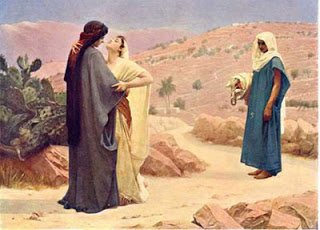
Ruth is set in the time of the Judges and, in a non Hebrew bible, is found directly after the book of Judges. A family from Bethlehem goes to live in Moab, because of a famine in their land. The husband and wife are Elimelech and Naomi. Elimelech dies in verse 3 and his two sons marry Moabite women, Orpah and Ruth. In verse 5, the two sons die, not surprisingly, because their names, Mahlon and Killion mean sickness and vanishing, which does not bode well for either of them.
So, as is the case with the American TV series Mad Men, it looks as if the story will be about the men, but it’s really about the women.
The survivors, as is well known, are Naomi and her Moabite daughters-in-law. Learning that the famine has ceased in Judah, Naomi resolves to go home and, speaking affectionately but firmly to Ruth and Orpah, she urges them to return to their families,
where they may, God willing, marry again and have children.
There is a midrashic tradition that Orpah and Ruth were sisters, the daughters of King Eglon of Moab (Ruth Rabbah 2:9) who, in turn (according to the same midrash), was the son of Balak.
The expression ‘the land of Judah’ in verse 7 is not used very often until the division of the kingdom following Solomon’s reign when Judah became the name of a kingdom. Prior to the time of Ruth, this expression occurs only once1and designates the land occupied by the tribe of Judah. It occurs also in David’s narrative, where Judah becomes important, being David’s own tribe and the centre of his eventual kingdom.
Naomi says ‘Turn back’ three times to her daughters-in-law2 corresponding to the discouragement given to prospective converts who present themselves to the Beth Din.3 We can see why Orpah might go, but why does Ruth stay? She is the template for all converts. Why is she so insistent? Is it about Naomi or about the ephemeral Mahlon, or about Torah?
Midrash claims that Orpah becomes the grandmother of Goliath, and depicts her in a negative light, as exceedingly promiscuous. There is no basis for this in the book of Ruth, but midrashic literature often takes a binary approach; if one of a pair is the hero, the other must be the villain. This is especially noticeable in midrashic narratives about Esau and Jacob.
On arrival in Bethlehem, they become the centre of attention for the women. Naomi expresses her bitterness at the way God has treated her, taking her husband and sons, and tells the women to call her Marah – bitter – instead of Naomi, which means pleasant.
The barley harvest is around the time of Pesach. The narrator emphasises Ruth’s foreignness, not only calling her Moaviyah, a Moabite woman, but adding, perhaps tautologically, that she comes from Moab.
The second chapter introduces a new character: Boaz, a relation of Naomi’s late husband. Boaz is a name associated with strength, and, as any freemason will know, is the name of one of the pillars upholding the porch of Solomon’s temple.
Gleaning the harvest from the corners of a landowner’s field was the right of the poor, in accordance with Leviticus:
When you reap the harvest of your land, do not reap to the very edges of your field or gather the gleanings of your harvest. Leave them for the poor and for the foreigner residing among you.4
It is Ruth who offers to go and glean corn which will be a means of subsistence for herself and Naomi. Naomi’s reply in verse 2 is Go my daughter, lah lechi. This is the feminine of lech lecha, an expression associated with significant events. Naomi calls Ruth biti, my daughter, but we have already seen that she called both Ruth and Orpah her daughters.
How does it happen that Ruth gleans in the field of Boaz, the very person who is related to her father-in-law? The Hebrew is vayyiker mikreyah – ‘it so happened’. Furthermore, Boaz singles out Ruth for attention, but instead of asking ‘Who is this young woman?’ he asks ‘Whose young woman is this?’ To whom does she belong? In Ruth’s particular case, there is no male person to whom she belongs. Husband, father, father-in-law are conspicuously absent. So to whom does Ruth belong?5
The servant’s answer is that she is a girl from Moab. Perhaps the servant’s implicit answer to Boaz’s question is ‘Nobody we know.’
Boaz extends his protection to Ruth, telling her to glean only from his field, and when she asks what she has done to deserve this, Boaz reveals that he knows the story of Ruth and Naomi, and how Ruth left her homeland. His next words are the origin of those traditionally spoken to proselytes:
The LORD repay you for what you have done, and a full reward be given you by the LORD, the God of Israel,under whose wings you have come to take refuge.
Ruth thanks Boaz for treating her kindly, even though she is a foreigner; her exact words being ‘You have spoken kindly to your maidservant, though I am not like one of your maidservants.’
Boaz continues to give her protection and generous opportunities for gleaning. She takes a quantity of barley back to Naomi, who remarks that Boaz is their kinsman and that the situation looks promising.
In the third chapter, Naomi has formulated a plan concerning Ruth and Boaz, who may have obligations to them beyond generosity, namely, the duty of levirate marriage.
The Hebrew for ‘his name should not be blotted out’ is lo yimacheh shemo. The name of Mahlon is interestingly cognate with the verb mem het hé, to blot out.
Naomi’s plan is rather compromising for Ruth. It involves lying down with Boaz in the middle of the night, an action which seems guaranteed to attract his attention.
So what’s the motivation behind Naomi’s cunning plan? Is it Ruth’s happiness, their future security or the fulfillment of the law? And what is Ruth’s motivation in following Naomi’s instructions to the letter?
Ruth goes to the threshing floor where Boaz, who has been drinking, is asleep, uncovers his feet and lies down. It is not certain whether she lies next to him, or, perpendicularly, at his feet. When Boaz wakes, startled, asking who is there, Ruth identifies herself and then says ufarashta kenafecha al amatecha, literally ‘Spread your wing over your handmaiden.’
Note that Boaz has already spoken of Ruth the proselyte as seeking refuge under the wings of the Shechinah. Now she seeks refuge under Boaz’s wing – kanaf – translated as ‘skirt’ in the KJV.
Ruth tells Boaz the reason why she has a claim on his protection: ki goel atah, ‘for you are a redeemer’ or ‘a near kinsman’ or ‘close relative’. The term goel is used in Leviticus in this specific sense of redeeming the property of a relative, so that it remains in the family:
If your brother becomes poor and sells part of his property, then his nearest redeemer shall come and redeem (goel) what his brother has sold.7
Are we looking at a romantic episode, prompted by love or desire or at a halakhic issue, complicated by the fact that Boaz is not Ruth’s brother-in-law, that the property of Elimelech is involved and that Ruth is a convert?
Boaz praises Ruth – in fact he calls her an eshet hayil – much as Judah praised Tamar when she alerted him to his duty towards her as the widow of his sons:
She is more righteous than I, since I did not give her to my son Shelah.8
We will see from the genealogy at the end of Ruth that Boaz is himself a descendant of Judah and Tamar, through their son Perez.
At this point in the narrative, we do not know that there is an inheritance involved, and Ruth’s approach to Boaz seems to be connected with the law of yibbum, or levirate marriage.
When brothers live together, and one of them dies childless, the dead man’s wife shall not be allowed to marry an outsider. Her husband’s brother must cohabit with her, making her his wife, and thus performing a brother-in-law’s duty to her. The first-born son whom she bears will then perpetuate the name of the dead brother, so that his name will not be obliterated from Israel.9
The quandary of Henry VIII was in weighing up this verse against Leviticus:
You shall not uncover the nakedness of your brother’s wife; it is your brother’s nakedness.10
If a man takes his brother’s wife, it is impurity. He has uncovered his brother’s nakedness; they shall be childless.11
The continuation of the Deuteronomy text shows that there is some disgrace attached to the man who refuses to marry his brother’s childless widow.
And if the man does not wish to take his brother’s wife, then his brother’s wife shall go up to the gate to the elders and say, ‘My husband’s brother refuses to perpetuate his brother’s name in Israel; he will not perform the duty of a husband’s brother to me.’ Then the elders of his city shall call him and speak to him, and if he persists, saying, ‘I do not wish to take her,’ then his brother’s wife shall go up to him in the presence of the elders and pull his sandal off his foot and spit in his face. And she shall answer and say, ‘So shall it be done to the man who does not build up his brother’s house.’ And the name of his house shall be called in Israel, ‘The house of him who had his sandal pulled off.’12
There is a great deal of Talmudic and medieval commentary on yibbum and halitzah, which is the loosening of the shoe.
Now, Boaz tells Ruth that she has a kinsman more closely related than himself. This other kinsman must be given the option of performing his duty and Boaz says he will speak with him in the morning. Meanwhile, he asks Ruth to stay the night. Have they slept together? Will they sleep together? Rashi, in his commentary on Ruth, quotes a midrash thus:
Rabbi Judah said: His evil inclination was contending with him, “You are single, and she is single; be intimate with her” ; and he took an oath to his evil inclination, saying ‘As the Lord lives, I will not touch her.13
For the sake of appearances, she left before daylight, so that nobody else would know she had spent the night there. Before she left, Boaz gave her six seahs of barley, to take back to Naomi. This is a large and heavy quantity, a single seah being currently estimated as 7.33 litres. One thinks of Rebecca performing the demanding task of watering Eliezer’s camels.14
When Ruth returns to Naomi, the first thing Naomi says is ‘Who are you, my daughter?’ Ruth answers by telling Naomi everything that has happened and Naomi wisely tells Ruth to wait patiently, as Boaz will attend to the matter that very day.
In Chapter 4, Boaz goes about the business of sounding out the other possible goel. He sees this man at the gate, which was the public area where men of affairs conducted transactions and exchanged news. Curiously, Boaz does not address this man by name; at least, the narrative withholds his name, as Boaz calls him Ploni Almoni. This is the biblical and Talmudic equivalent of John Doe or Joe Bloggs, the designation for an unnamed person. Translations will vary. ‘Friend’ reflects better on Boaz than the KJV ‘Ho such a one!’
Boaz has Ploni Almoni and the elders seated at the gate and explains the following: Naomi has returned from Moab and is selling a piece of land which she inherited from her husband Elimelech. Ploni Almoni has first refusal, but, if he doesn’t want to buy the land, Boaz will
do so. However, Ploni is willing to buy. Boaz then explains that, if he buys the property, he also acquires Ruth the Moabitess, the widow of Elimelech’s son, in order to maintain the name of the dead in connection with his inheritance. Ploni now withdraws from the
purchase.
What is Ploni’s motivation? The targum suggests that he was already married, which seems a very good reason, but his direct speech is ‘I cannot redeem it for myself, lest I impair my own inheritance.’ The suggestion is that he considers marriage to a Moabite transgressive, which seems to be the implication of the verse in Deuteronomy which states:
No Ammonite or Moabite may enter the assembly of the LORD. Even to the tenth generation, none of them may enter the assembly of the LORD.15
Rashi finds this reasoning faulty, commenting:
He should have interpreted: ‘an Ammonite, but not an Ammonitess; a Moabite, but not a Moabitess.’ Yet he said, ‘lest I mar my heritage.’
In fact Rashi believed this error was the reason why the man’s real name was obliterated from the text.
We saw that, according to Deuteronomy 25, a man who refuses to marry his brother’s widow has his shoe loosed in a ritual called halitzah, the ceremonial release from levirate marriage. Rashi explains that what occurs here, which does not correspond precisely to
halitzah, is an act of acquisition. There are of course other views – Rabbi Louis Jacobs, for example, wrote:
Halitzah appears in the biblical book of Ruth in which Boaz, a close relative of Naomi, agrees to marry Ruth and act as redeemer for Mahlon, her dead husband. He may only do so after a closer relative than Boaz formally relinquishes the right of redemption by removing his sandal and handing it to Boaz.16
Boaz confirms before the witnesses that he has bought the inheritance of Elimelech, Mahlon and Chilion from Naomi, including Ruth, whom he will marry to raise the name of the dead on their inheritance.
The witnesses express their blessing, and say ‘May your house be like the house of Perez, whom Tamar bore to Judah.’ Not only are is there a similarity between the union of Judah and Tamar and that of Boaz and Ruth, but also, Boaz, as we will see, is a descendant of
Perez.
Boaz marries Ruth and they have a son. One might expect the people to say this is a son for Mahlon, which would be the form in a levirate marriage. In fact the women say ‘There is a son born to Naomi.’ This does not indicate that Naomi was the biological mother of the child.
The nursing17 of the child by Naomi does not mean that Naomi had breast milk, as omenet can mean foster mother.
Most important is that a redeemer has been found for the entire family of Elimelech, the dead and the living.
The child Obed becomes the father of Jesse who was the father of David. Boaz’s descent from Perez is attested in the final verse of the book. Thus David is a descendant of Judah on one side and, on the other, of Moab. This would be extremely controversial if the book of
Ruth was written in the post-exilic time18 of Ezra and Nehemiah who actively opposed the intermarriage19 of Israelites with Canaanites, Ammonites, Moabites and all the neighbouring peoples. There is a case for considering that the book of Ruth is a subversive anti-Ezra document, supporting intermarriage and making polemical use of David’s putative descent from Ruth.
Vayechi
Posted on: November 27, 2012
Genesis 47:28 – 48:22
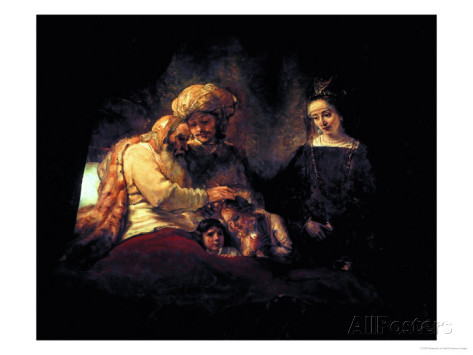
Jacob died at the age of 147. His last seventeen years were spent in Egypt, numerically equal to the seventeen years Joseph lived in Canaan, before his brothers sold him into slavery.
Midrashic and modern number crunchers have found reasons why Jacob didn’t attain the age of Isaac, 180, or Abraham, 175. This usually involves subtracting 17 from 147 to obtain 130, Jacob’s age when he complained to Pharaoh that his years had been few and difficult. After that, it goes beyond GCSE maths, and I won’t touch it.
Jacob makes Joseph swear that his remains will be taken for burial to the cave of the patriarchs in Machpelah, today’s Hebron. As the end of Jacob’s life is drawing near, Joseph takes his boys Ephraim and Manasseh to visit their grandfather.
Jacob tells Joseph that Ephraim and Manasseh will be like his sons Reuben and Simeon; this is a formula of adoption by which these two younger descendants gain equality with the two eldest. Jacob refers to the grief he suffered when Rachel died giving birth to Benjamin. Perhaps his adoption of these two grandsons of Rachel is a way of elevating the influence of her descendants among the more numerous descendants of Leah.
When Ephraim and Manasseh approach Jacob, or Israel as he is called in this verse, he asks ‘Who are these?’ Like his father Isaac in old age, Jacob is barely able to see. Like Isaac, Jacob gives precedence to the younger child, crossing his hands so that his right hand rests on Ephraim and his left on Manasseh, Joseph’s first born. Jacob had taken advantage of Isaac’s blindness to gain the blessing due to Esau and now, for different reasons, he again subverts the custom of primogeniture. Joseph thinks this is a mistake, resulting from blindness or senility but we, who have read Genesis, know this is invariably the way: Cain, Ishmael, Esau, Reuben and now Manasseh are displaced by younger brothers, a theme which will be reflected later on in the kingship of David and Solomon.
Jacob answers that he knows Manasseh is the elder, but Ephraim will be greater. Some people think this story is a retrospective explanation of the fact that Ephraim became the largest tribe of the northern kingdom.
Jacob blesses both the boys in a beautiful poem, asking God who has been Jacob’s shepherd throughout his difficult life to bless the children, multiply their descendants, and identify them as the family of Abraham, Isaac and Israel.
He assures Joseph that God will bring him back to the land of their fathers and expresses his intention to bequeath to Joseph, in preference to his brothers, the land which Jacob took from the Amorites, with his sword and with his bow. What is this inheritance which Jacob seized by force of arms, to give to Joseph? The word shechem means shoulder and there is an ambiguity as to whether shechem here refers figuratively to the portion Joseph is to inherit, or to the place Shechem, which, according to tradition, is the location of Joseph’s tomb.
The verse becomes curiouser and curiouser when we remember that Jacob, who was not a fighter, rebuked his sons Simeon and Levi for attacking the city of Shechem, and there is no mention, in the Torah, of Jacob’s military exploit against the Amorites or any Canaanite tribe.
Nevertheless, there is an account of Jacob’s wars with the Amorites and others, in a text called the Book of Jubilees. This is a reworking of Genesis, comparable to the reworking of biblical texts in midrash. Those who put a date to Jubilees tend to estimate that it originates around the Maccabean period, beginning about 165 BCE. Here are a few verses relevant to our sidra.
Jacob sent his sons to pasture their sheep, and his servants with them to the pastures of Shechem.
And the seven kings of the Amorites assembled themselves together against them, to slay them, hiding themselves under the trees, and to take their cattle as a prey…
And [Jacob] arose from his house, he and his three sons and all the servants of his father, and his own servants, and he went against them with six thousand men, who carried swords.
And he slew them in the pastures of Shechem, and pursued those who fled, and he slew them with the edge of the sword… and he recovered his herds.
This later work develops the idea of a militaristic Jacob, quite unlike the plain man, dwelling in tents, whom we know from Genesis. The last verse of our Torah reading fits in perfectly with the story in Jubilees, so perhaps Jubilees draws on an earlier, now lost tradition about the wars of Jacob.
Even without this warlike aspect, Jacob is an infinitely complex character: passionate, deceitful, astute, loving, long-suffering, pessimistic and devout. It is as if we get to know him more than we know the other patriarchs, and it is his name, Israel, which is our name.
Soul Searching
Posted on: September 23, 2012
Notes for a discussion on Yom Kippur 5773

CG Jung
‘The soul is Yours and the body is Your creation…’ (Machzor p326)
הנשמה לך והגוף פעלך חוסה על עמלך
Many of our prayers refer to the soul: nefesh or neshamah in Hebrew. Are body and soul distinguishable? What is the relationship of nefesh to neurons? How do the prayers of Yom Kippur connect with modern views of human thought?
One of the reasons why I chose this subject is that I think there is an interesting gap between the words we speak when we read the liturgy, and what we believe; for instance there is a great deal of soul talk on Yom Kippur, as in all religious services, but perhaps what we know or believe about the physicality of mind, thought and the emotions is at variance with the way we pray, however sincerely. I would like to know if you think there is that variance between the language of prayer and of belief, and if so, how do we mind the gap?
In philosophy since the twentieth century, the traditional idea of the soul being something apart from the body, no longer prevails. The mind is regarded as incarnate, the activity of the brain. The body is animate, experiencing emotion through hormones and neurons. Particular regions of the brain are associated with sensations, memories, emotions and there are contemporary psychological theories that ground religious belief within evolutionary adaptive cognitive functions.
The neuroscientist Antonio Damasio believes that decision-making and even perceptions are affected by feelings, which are set off by neural and chemical bodily signaling. He uses the term ‘somatic marker’ to describe the kind of gut reaction which often determines our actions.
Emotions, are defined by Damasio as changes in both body and brain states. Physiological changes occur in the body and are relayed to the brain where they are transformed into an emotion that informs the individual’s choice, along with the memory of past experiences. Damasio regards the emotions as adaptive and consistent with evolution.
The truly embodied mind… does not relinquish its most refined levels of operation, those constituting its soul and spirit. From my perspective, it is just that soul and spirit, with all their dignity and human scale, are now complex and unique states of an organism. Perhaps the most indispensable thing we can do as human beings…is remind ourselves and others of our complexity, fragility, finiteness and uniqueness. And this is of course the difficult job, is it not: to move the spirit from its nowhere pedestal to a somewhere place, while preserving its dignity and importance; to recognize its humble origin and vulnerability, yet still call upon its guidance. (Descartes’ Error by Antonio Damasio 1994 p252)
In1999, Tim Radford, the Science Editor of The Guardian chaired a discussion at Westminster Central Hall with Richard Dawkins and Steven Pinker. The topic of the discussion was the question: Is Science killing the Soul? Neither Dawkins nor Pinker believed in the soul as a ghost in the machine, that is to say, separate from the body, but both believed in feelings, sensitivity, creativity and imagination.
Steven Pinker says that we are accustomed to making inferences about other people’s thoughts when we perceive their behaviour, choices and responses. In primitive religions, people observed storms, floods or drought and inferred from them the displeasure of their gods, or God. Although Pinker believes that these inferences were mistaken he sees them as having a positive evolutionary value. Societies created bonding ceremonies or rituals which reinforced their shared beliefs and religious gatherings created a sense of kinship beyond the blood ties of the immediate family. He also maintains that religion has the function of ameliorating existential anxieties about death and suffering.
Pinker connects belief in immortal souls with the human ability to impute invisible minds to other people.
The responses we attribute to God are often based on scripture, from which we can form definite ideas about what God wants from us.
He has showed you, O man, what is good; and what does the LORD require of you, but to do justly, and to love mercy, and to walk humbly with your God?
The sacrifices of God are a broken spirit: a broken and a contrite heart, O God, you will not despise.
There is a view that three Hebrew words for the soul have distinct meanings, representing different aspects or levels of the soul.
Nefesh is used in the bible much more often than the word neshamah. Perhaps as a result of biblical usage, it is also the most frequent word for soul in our prayer books, although the neshamah is mentioned in the Shabbat and festival prayer Nishmat kol hai (which means the soul of all life) and the morning prayer Neshamah shenatata bi tehorah hi, which emphasizes the purity of the neshamah.
In the bible, neshamah is often breath, or spirit.
The spirit of man is the lamp of the Lord, searching all his innermost parts. (Proverbs 20:27)
Neshamah is used also of God’s breath, in Job 32:8
But it is the spirit in man (ruach hi b’enosh), the breath of the Almighty (nishmat Shaddai), that makes him understand.
The Spirit of God (ruach El) has made me, and the breath of the Almighty (nishmat Shaddai) gives me life. (Job 33:4)
In the biblical account, God formed man from the dust of the earth and blew into his nostrils nishmat hayyim, the breath of life so that Adam, the man becomes a nefesh hayyah, a living being.
In one of many midrashim on the creation of Adam, one of the sages says that neshamah and nefesh are the same, because the word hayyim, life applies to both, but other sages differentiate, saying that nefesh is the blood and neshamah the breath.
In the early Greek translation of the Hebrew bible (LXX), nefesh is usually translated as psyche (anima in Latin), and ruach, or the biblically rarer neshamah, as pneuma (spiritus in Latin, as in ‘inspire and expire), which is closer in meaning to breathing than to thinking. The spirit of God is also called pneuma/spiritus.
There are many rabbinic traditions concerning the separate existence of the soul – that it pre-exists the body, is independent of the body and that the dead converse among themselves. After the time of the Talmud, the early medieval philosopher Saadia Gaon, who was head of the Sura Yeshiva in Babylon took the view that the soul is created at the same time as the body and that the body has the potential to become purified by obedience to the commandments. He believed that the soul gives the body its faculties of cognition, reason and will power, and the body is simply the means by which the soul achieves its goal At the moment of death, a blazing angel arrives with sword drawn, and his appearance shocks the soul so severely that it is separated from the physical body. Pure souls are rewarded with a blissful afterlife while wicked souls are punished.
About a century later, the Andalusian poet Solomon Ibn Gabirol, some of whose poetry is in our machzor, expressed the view that the human soul reflects the World Soul, which emanates from God.
Maimonides wrote that the knowledge of God and adherence to the mitzvot gives human beings an immaterial, spiritual nature which endows the soul with immortality.
In the seventeenth century, Spinoza took the view that everything which exists is part of the soul of God, that evil is merely the absence of the good and that the way to attain immortality is through scientific and philosophical knowledge.
In the eighteenth century, R. Hayyim of Volozhin wrote a treatise called Nefesh ha Hayyim, in which he reasoned that God created humanity as the sum of all that went before so that each human being includes in his or her makeup something of everything whose creation preceded his or her own. This view sounds as if it could be developed in a way compatible with evolution. Each human being is a microcosm, representative of the multiplicity to be found in God’s creation. I wonder if this could be compatible with Professor Brian Cox’s poetic explanation of the physical composition of the human body – that it is, in a sense, made of stars.
This human being, says R Hayyim, is linked with God through a three-part soul made up of nefesh attached to ruach above it, while ruach is attached to neshamah above it. Yet the ultimate root of these three intertwined souls rests in God, the neshamah of the neshamah. In this way the lowest level of God’s own soul, as it were, can be said to lie within each separate human being, animating him or her.
A Jewish neurologist called Daniel Drubach writes about the plasticity of the brain, meaning that there is a bilateral relationship between brain and behaviour. An individual’s actions impact and “shape” the self, and the self, in turn, impacts and shapes behaviour. He quotes the Jewish philosopher Moses Hayyim Luzzato, who wrote, in the eighteenth century:
The outer action awakens the inner attitude. And the outer action being certainly more subject to man’s control than the inner attitude, if he avails himself of that which is in his control, he will in time acquire that which is beyond his control. Thus one becomes or changes through means of doing.
Path of the Upright, Moses Hayyim Luzzato
Going back to an earlier source, Drubach also quotes Maimonides, as follows:
We tell the wrathful man to train himself to feel no reaction even if he is beaten or cursed. He should follow this course of behaviour for a long time, until the anger is uprooted from his heart. Also, in his prescription of how to reach the “middle road” of all temperaments: How should one train oneself to follow these temperaments to the extent that they become a permanent fixture of his personality? One should perform, repeat, and perform a third time the acts which conform to the middle road temperament.
Drubach points out that the repetition of a motor sequence will lead to a change in the brain substrate for that sequence. He regards this neurobiological view as compatible with the views of the Judaic sages who believed that patterns of behaviour shape the self.
The prayer that we started with refers to the body as well as the soul; both are considered to be God’s work.
‘The soul is Yours and the body is Your creation; have pity on Your work.’
הנשמה לך והגוף פעלך חוסה על עמלך
When, shortly, we read Jonah, the haftarah for the Yom Kippur minchah service, we will see that these words hus (pity) and amal (created work) occur in close juxtaposition. God reminds Jonah of his pity for the gourd which withered, and which Jonah had not laboured to produce. Should not God have pity on Nineveh, full of human life?
The Witch of Endor
Posted on: August 6, 2012
1 Samuel 28: 3-25
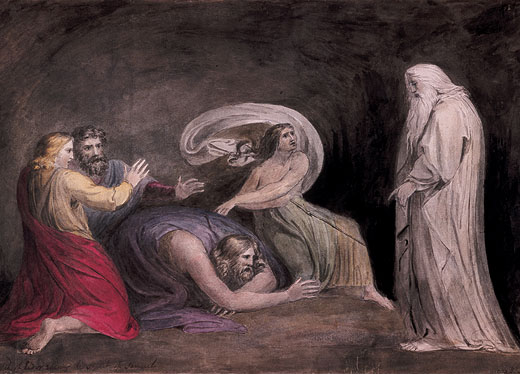
This strange episode is full of drama, mystery and tragedy. Perhaps Saul’s story was in Shakespeare’s mind when he let Macbeth fall under the influence of the witches.
The state of play at the beginning of 1 Samuel 28 is as follows:
Saul is disheartened by the threat of the Philistines, who are mustering their forces for war against Israel. Samuel has died and Saul is no longer able to obtain prophetic counsel regarding the inevitable military engagement. More than that he has lost a father figure, however harsh and critical that father figure may have been.
Saul is pious in his observance of Torah and has banished witchcraft from the land, in obedience to Exodus 22:18, Leviticus 19:3, Leviticus 20:6 and Leviticus 20:27.
You shall not permit a sorceress to live.Give no regard to mediums and familiar spirits; do not seek after them, to be defiled by them: I am the Lord your God.
The person who turns to mediums and familiar spirits, to prostitute himself with them, I will set My face against that person and cut him off from his people.
A man or a woman who is a medium, or who has familiar spirits, shall surely be put to death; they shall stone them with stones. Their blood shall be upon them.
However, Saul now seeks a sorceress, because God does not answer him through the legitimate means of prophecy – dreams, Urim and Tummim and prophets. Unlike David, Saul has no dialogue with God. David is in continual conversation with God, in his Psalms and also in his supplications; it is as if God accompanies David in his daily affairs. Saul never addresses God in this way, and reaches out to God only by using Samuel as an intermediary, even using the expression ‘Your God’ when he speaks to Samuel. 1 The loss of Samuel is therefore all the more devastating for Saul, as the lines of communication with God are now closed to him.
The Urim and Tummim are a divining function of the priestly breastplate. Sumerian literature makes reference to the Tablets of Destinies, objects performing divination in Mesopotamian culture. The priestly passages in the Pentateuch refer to the priests operating Urim and Tummim, but in the post-exilic books, they are conspicuous only by their absence:
The governor told them that they were not to partake of the most holy food, until there should be a priest to consult Urim and Thummim. 2
The silence of the Urim and Tummim at Saul’s time of need may be attributed to his massacre of the priests of Nob who had sheltered David; following this violence against the priesthood, the Urim and Tummin no longer respond to his enquiries.
Saul instructs his servants to find him a Baalat Ov – literally, mistress of ghosts. The Mishnah tells us that, although it is against the halakhah to consult a necromancer, the client, unlike the necromancer himself, is not liable to be executed.3 The Baalat Ov therefore potentially has more to lose than the king.
Saul disguises himself for the visit to Endor, with different clothes. Significant moments in Saul’s kingship have involved the changing or tearing of clothes, always with a negative connotation. He offers David his own armour for the fight with Goliath, unconsciously anticipating the passing of the kingdom from himself to David.4 When he tears Samuel’s cloak accidentally, Samuel says:
The Lord has torn the kingdom of Israel from you this day and has given it to a neighbour of yours, who is better than you.5
When pursued by Saul, David finds Saul off his guard in a cave and cuts off the corner of Saul’s robe.6
Saul’s son Jonathan takes off his garments, in effect the royal garments of the heir presumptive, and makes a gift of them to David:
Jonathan stripped himself of the robe that was on him and gave it to David, and his armor, and even his sword and his bow and his belt.7
Now, Saul sheds his kingly garments for the last time. A midrash says that he divested himself of royalty, reading the sin in vayithappes as a shin, to make the point that, in disguising himself, he made himself free (hofshi) of the kingdom.8 He sets out by night, heading north to Endor in the region of the Jezreel Valley. He is accompanied by two servants, named as Abner and Amasa in Vayyikra Rabbah, where Saul is commended in following the Abrahamic precedent of taking two servants with him.9 Louis Ginzberg in ‘Legends of the Jews’ cites a tradition10 that the witch was Abner’s mother.
Disguised as a commoner, Saul tells the witch of Endor to conjure up a ghost. The woman replies that she is afraid to do so, since King Saul has abolished witchcraft and she fears for her life. Saul assures her ‘As the Lord lives, no blame will befall you through this thing.’
Rabbi Levi, cited in Vayyikra Rabbah, sees the irony of Saul invoking God when he is about to break the law:
He was like a woman who is in the company of her paramour and swears by the life of her husband!11
The woman then asks who is to be summoned and Saul tells her ‘Bring up Samuel.’ What follows is startling – not only because the ghost of Samuel appears, but because the witch screams when she sees him. And she says at once ‘Why did you deceive me, for you are Saul?’ What has happened to make her recognize Saul?
Vayyikra Rabbah has an explanation: ghosts materialize upside down – except in the presence of a king. The witch tells Saul ‘An old man is coming up and he is wrapped in a cloak.’ This is Samuel’s meil, a cloak which he always wears, even from childhood when his mother Hannah made him a cloak, and just such a cloak was torn by Saul in 1 Samuel 15. In Hebrew, old man is ish zaken, but the Septuagint has a different translation: ‘An upright man (andra orthion) ascending out of the earth.’
Besides seeing Samuel, the witch sees elohim ascending: the spirits of elders accompanying Samuel. In Liber Antiquitatum Biblicarum, a Latin rewriting of the book of Samuel by a Jewish author Pseudo-Philo, first century CE and therefore contemporary with Philo of Alexandria, Samuel says to the witch: ‘It is not you that have brought me up, but the precept which God spoke to me while I yet lived.’12 Perhaps we should understand that the witch is a charlatan who is taken by surprise when a ghost really appears, like the medium played by Whoopi Goldberg in the film ‘Ghost.’
As Saul asks the witch what she sees, we may infer that Saul himself does not see the ghost. Vayyikra Rabbah explains:
Three things are said of one who conjures up spirits by enchantment: the one who brings up the ghost sees it but does not hear its voice; the one who requires it hears its voice but does not see it; the one who has no need of it can neither hear nor see it. It was like this with Samuel: the woman who brought him up saw him but did not hear his voice; Saul, who needed him, heard his voice but did not see him; Abner and Amasa, who had no need of him, did not hear his voice and did not see him.13
When Saul hears that the ghost is wrapped in a cloak, he knows that this is Samuel and bows down on the ground.
Samuel’s opening words, expressing characteristic displeasure, are the only biblical instance of speech from beyond the grave. ‘Why have you disturbed me?’ is an understated translation of lamah hirgaztani, ‘Why have you caused me to shake?’ The midrashic rabbis attributed Samuel’s shaking to a fear that he had been roused for the day of judgment, noting that even the holy man and seer, Samuel, regards divine judgment with fear and trembling.
This idea of the afterlife fits Daniel’s description in which the dead sleep, and are woken at the appointed time:
And many of those who sleep in the dust of the earth shall awake, some to everlasting life, and some to shame and everlasting contempt.14
Saul immediately tells Samuel of his problems: the battling Philistines, the estrangement of God and the silence of prophecy. As in Samuel’s lifetime, Saul relies on Samuel, his curmudgeonly mentor. He does not refer to the Urim and Thummim; their priestly connotation may remind Samuel of Saul’s massacre of the priests at Nob.
Samuel’s brusque reply begins with a play on Saul’s name: ‘Lamah tishaleni? Why do you ask?’ Saul’s name of course means ‘asked’ from shin aleph lamed. He is the asked-for king of 1 Samuel 8, whom Samuel provides against his better judgment. Samuel now tells Saul that God has torn the kingdom away from him (a repetition of Samuel’s words in 1 Samuel 15:28) and given it to his adversary, David. Brutally explicit, Samuel drives home the point that this is all Saul’s fault, due to his disobedience over the herem against the Amalekites. Worse still, he prophesies defeat in the forthcoming battle in which Saul and his sons will be slain. The seer who brought royalty to Saul now tells him of his impending death.
Saul prostrates himself or faints, full length on the ground (and we know that he was an exceptionally tall man15) due to fear and physical weakness caused by fasting. If you read the earlier chapters, you will see how fasting has already figured significantly in the lives of Saul and his son Jonathan16 and David.17
The witch now shows a kindly, maternal side and begs Saul to eat. When he refuses, she and his two servants insist until he gets up from the ground and sits on the bed. She then makes him a dinner of veal and flatbread which he and his servants eat, before departing in the darkness of the night.
The most detailed midrash on the Endor episode is an exegesis on the parashah Emor, which begins:
And the Lord said to Moses, “Speak to the priests [my italics], the sons of Aaron, and say to them: No one shall make himself unclean for the dead among his people.18
In this midrash Moses is shown a vision of Saul and his sons, falling in the battle on Mount Gilboa. Moses protests: ‘Ribbono shel Olam, is this the honour due to your children, that the first king you place over them should fall by the sword?’19
The Holy One, blessed be He, answered him ‘Do you ask this of me? Speak to the priests whom he has slain and who are acting as his accusers.’
The midrash therefore links the narrative of the witch of Endor to the exegesis of the opening verse of Emor.
It should be noted that the verse immediately prior in the Torah, namely the last verse of the parashah Kedoshim, is:
A man or a woman who is a medium or a necromancer shall surely be put to death. They shall be stoned with stones; their blood shall be upon them.20
Gillian Lazarus 6 August 2012
footnotes
1 Samuel 15:21
Ezra 2:63; Nehemiah 7:65
Mishnah Sanhedrin 7:7
1 Samuel 17:38-39
1 Samuel 15:28
1 Samuel 24:4
1 Samuel 18:4
Leviticus Rabbah 26:7
Leviticus Rabbah 26:7
Pirke de Rabbi Eliezer 33
Leviticus Rabbah 26:7
Liber Antiquitatum Biblicarum 64:7
Leviticus Rabbah 26:7
Daniel 12:2
1 Samuel 10:43
ibid 14:24-28; 20:34
ibid 21:4
Leviticus 21:1
Leviticus Rabbah 26:7
Leviticus 20:27
3 Enoch (Sefer Hekhalot)
Posted on: June 12, 2012
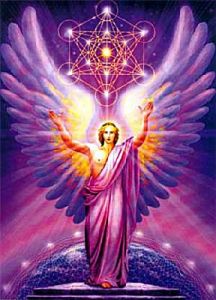
The angel Metatron, whom we shall meet in 3 Enoch, does not appear in the Ethiopic 1 Enoch (which we looked at last month) nor in 2 Enoch which exists only in Slavonic manuscripts, dating from the 14th century to the 18th. 3 Enoch is a Hebrew text, an example of the mystical Merkavah traditions which seem to have originated in the Mishnaic period. The putative author is Rabbi Ishmael ben Elisha, a contemporary of Rabbi Akiva, but attribution to an author from antiquity is the style of Pseudepigrapha. Views on the date of 3 Enoch are: a) Gaonic, ie 7th to 9th century on the grounds that 3 Enoch shows Islamic influences which did not yet circulate in the Talmudic age, b) 1st to 3rd century due to some resemblances to the Talmudic tractate Hagigah, and linguistic affinities with the Babylonian Talmud, c) 5th – 6th century based on a survey of the development of Merkavah mysticism between the first and tenth centuries, d) 10th – 15th century. The controversial late dating is from Milik who perceived Latin and Arabic influences. James Charlesworth gives an overview of the reasoning behind these opinions, dismissing Milik’s arguments, especially Milik’s assumption that it was written in western Europe. Charlesworth is sure the provenance is Palestinian or Babylonian and not post-Talmudic:
…Though 3 Enoch contains some very old conditions and stands in direct line with developments which had begun in the Maccabean era, a date for its final redaction in the fifth or the sixth century AD [sic] cannot be far from the truth.8
Charlesworth points out that the the tractate Hagigah in the Babylonian Talmud attests aspects of mysticism which appear in 3 Enoch; particularly the mystical ascent to heaven of Rabbi Akiva, Ben Zoma, Ben Azzai and Elisha ben Abuyah.9
Metatron
Peter Schäfer has recently added to the discussion about the possible sources and meanings of the name Metatron. In Greek, Metathronios means ‘behind the throne’ or ‘next to the throne.’ In Latin, a metator was an officer in the Roman army acting as some sort of administrator or guide, and Schäfer points out that metator appears as a loanword in rabbinic literature. Odeberg suggests that the name Metatron might derive from the Persian name Mithras. Gershom Scholem, author of defining works in the mid-twentieth century on the subject of Jewish mysticism, rejected these theories about the etymology of Metatron. There is a view that the name Metatron, like many other celestial names, is a made-up name chosen for sound rather than meaning. Scholem, writing in 1946, said:
The fact is that all these etymologies are so much guess-work and their studied rationality leads nowhere. There is no such word as metathronios in Greek, and it is extremely unlikely that Jews should have produced or invented such a Greek phrase. In the Talmudic literature, the word thronos is never used in the place of its Hebrew equivalent.11
The Content
3 Enoch is also known as Sefer Hekhalot or Ma’aseh Merkavah – The Book of Palaces or the Works of the Chariot. There is a reference as early as the Mishnah to the Ma’aseh Bereshit and the Ma’aseh Merkavah:
The Account of Creation may not be expounded before two or more persons, nor the Chariot before even one, unless he is a scholar who understands of his own knowledge.12
Rabbi Ishmael ascends to heaven to view the chariot. He passes into the seventh heaven where he sees HaKadosh Baruch Hu. Rabbi Ishmael asks God to protect him from certain angels who would cast him out of heaven. God summons the angel Metatron, Prince of the Divine Presence, who leads Ishmael into the Divine Presence, permitting a mortal to approach the chariot because,as he explains, Ishmael is an Israelite and a priestly descendant of Aaron. Metatron tells Ishmael that he has seventy names but that God calls him ‘Youth’. He identifies himself as Enoch the son of Jared who was brought up to heaven where he became a ruler among the ministering angels. The other angels object to Enoch’s elevation and the Holy One tells them that this was the only righteous mortal amongst the generation of the flood. Enoch ascends from earth on the wings of the Shechinah, and God bestows on him supernal qualities of wisdom, Torah, mercy and splendour. God reveals to him the secrets of creation and the natural world and adorns him with a robe, a crown on which are inscribed the letters by which the world was created, and a title: ‘The lesser [hakatan] YHWH’.14 The title sounds somewhat shocking, suggesting Gnosticism or polytheism, but the name ofGod is included in the names of many persons in Tanakh whose names have theophoric suffixes, and the majority of the angels bear names which end in ‘El’. Whereas the name of God is, on the one hand, so holy that only the Cohen Hagadol can utter it, in the holy of holies onYom Kippur, on the other hand, forms of El, Yah and even Adonai are incorporated into personal names. Metatron tells Ishmael the names of the angelic princes who guide the world, eighteen names all ending in ‘el’ and that all these prostrated themselves before himself, Metatron. The Talmud relates that Elisha ben Abuyah, the apostate, entered Paradise and saw Metatron sitting down. The rabbis explain that Metatron was allowed to sit because of his function as the Heavenly Scribe, writing down the deeds of Israel. Elishah ben Abuyah therefore assumed Metatron was a deity and said heretically, “There are indeed two powers in heaven!” 15
At first Metatron sat on a throne at the door of the seventh palace and judged the lesser angels, until he was seen by Elisha ben Abuyah, the apostate, who said ‘There are indeed two powers in heaven.’ The angel Anapiel came at the command of the Holy One, struck Metatron with sixty fiery lashes and ordered him to stand.16
Metatron tells Rabbi Ishmael the names of the princes of the seven heavens – only Michael and Gabriel are known from Tanakh – and the seventy-two princes of kingdoms. He describes four heavenly creatures facing the four winds. These resemble the creatures in Ezekiel’s chariot vision.17 Four Watchers reside above the whole celestial assembly.
The Holy One, blessed be He, does nothing in his world without first taking counsel with them; then He acts, as it is written ‘Such is the sentence proclaimed by the Watchers, the verdict announced by the holy ones.’18
Although this sounds as if it would be heretical, it resembles a text from the Babylonian Talmud:
Why were these [two thrones] necessary? To teach R. Johanan’s dictum; viz.: The Holy One, blessed be He, does nothing without consulting His Heavenly Court, for it is written, The matter is by the decree of the watchers, and the sentence by the word of the Holy Ones. Now, that is satisfactory for all [the other verses], but how explain Till thrones were placed? One [throne] was for Himself and one for David.19
The Watchers and the Holy Ones have their source in Daniel 4:14 and the thrones in Daniel 7:9. Rashi, in commenting on Exodus 23:21, identifies as Metatron the angel of whom God says ‘…My name is in him’ and points out that the numerical value of Metatron is equal to that of El Shaddai (the Almighty): 314.
Behold, I send an angel before you to guard you on the way and to bring you to the place that I have prepared. Pay careful attention to him and obey his voice; do not rebel against him, for he will not pardon your transgression, for my name is in him.20
We can see that 3 Enoch is by no means estranged from rabbinic tradition, Metatron being attested in the Talmud and later in Rashi’s commentary. Metatron tells Rabbi Ishmael:
When the Holy One, blessed be He, sits on the throne of judgment, Justice stands at His right hand, Mercy at His left, and Truth stands directly facing Him.22
At the heavenly court, angels of peace, mercy and destruction stand near the Holy One who is seated on the throne of judgment; seraphim and ophanim surround the throne, which is born up by holy creatures and, beneath the holy creatures, flow seven rivers of fire. Metatron describes to Rabbi Ishmael of the myriads of angels. some of whom say ‘Holy’ and some say ‘Blessed.’
When the time comes to say ‘Holy,’ a storm wind first goes out from the presence of the Holy One, blessed be He, and falls on the camps of the Shekhinah, and a great storm arises among the, as it is written, ‘Now a storm of the Lord breaks, a tempest whirls.’23 Thereupon, a thousand thousand of them become sparks, a thousand thousand firebrands, athousand thousand glowing coals, a thousand thousand flames, a thousand thousand males, a thousand thousand females, a thousand thousand winds, a thousand thousand blazing fires, a thousand thousand flames, athousand thousand sparks, a thousand thousand hashmalim24 of light, until they accept the yoke of the kingdom of the High and Exalted One who created them all, in dread, in fear, in awe, with shuddering, quaking, anguish, terror and trembling. Then they return to their original state. Thus the fear of their King is kept before them every hour, so that they should set their hearts to recite the song every hour, as it is written, ‘One called to another and said.’25
The author of 3 Enoch depicts the angels singing the Kedushah, as recited in the Amidah, based on the verse in Isaiah 6:
In the year that King Uzziah died I saw the Lord sitting upon a throne, high and lifted up; and the train of his robe filled the temple. Above him stood the seraphim. Each had six wings: with two he covered his face, and with two he covered his feet, and with two he flew. And one called to another and said: “Holy, holy, holy is the LORD of hosts; the whole earth is full of his glory!”26
When the ministering angels recite the Kedushah, the cherubim, ophanim, seraphim, holy creatures and sparks of light respond: Baruch Shem cavod malchuto le olam va ed. Metatron shows Rabbi Ishmael the letters by which the world was created, the waters above the firmament, thunder, lightning, snow, hailstones; he then shows him the souls of those who have been created and returned as well as the righteous souls who have not yet been created. This predetermined view of the righteousness of the soul can be found also in Midrash and Talmud:
With the supreme King of Kings, the Holy One blessed be He, sat the souls of the righteous with whom He took counsel before creating the world.27 Thou hast created Paradise and thou hast created Gehinnom: thou hast created righteous men and thou hast created wicked men, and who can prevent thee?28
Metatron shows R Ishmael the souls of the wicked and the ‘intermediate’ (benoniyyim) in Sheol, where the intermediate souls are purified. He shows him the souls of the Patriarchs, interceding for humanity and all the generations, from Adam all the way through to the Messiah son of Joseph and the Messiah son of David, the battles which Gog and Magog will fight with Israel, and the generations of the future, both Israelite and gentile, till the end of time.29 He also shows R Ishmael the spirits (ruchan) of the stars which also glorify God, the proof text being: The heavens declare the glory of God, and the sky above proclaims His handiwork.30 When God sees that there is no righteousness in the world, and no remaining righteous intercessors, He will remember His own attribute of mercy and deliver Israel for His own sake. Then the Messiah will appear and bring Israel up to Jerusalem.31
Moreover, the kingdom of Israel, gathered from the four quarters of the world, shall eat with the Messiah, and the gentiles shall eat with them, as it is written, The Lord bares His holy arm in the sight of all the nations, and all the ends of the earth shall see the salvation of God (Isaiah 52:10); and it also says, The Lord alone is his guide, with Him is no alien god (Deuteronomy 32:12); and it says The Lord will be King over all the world (Zechariah 14:9).32
Peter Schäfer finds that the majority of midrashim concerning Metatron are Babylonian, or in later Palestinian works such as Targum Pseudo-Jonathan and Numbers Rabbah, both containing material later than the seventh century. An Introduction to Talmud and Midrash by Strack and Stemberger33 is a definitive work for offering the date and provenance of a very large number of midrashim, minor as well as major. The first edition, published in 1887, was the work ofHL Strack (1848-1922) , a Christian scholar of Judaism, and it is here revised and updated by Gunter Stemburger, born 1940. Stemberger cites Hugo Odeberg’s opinion that 3 Enoch or Sefer Hekhalot dates to the late third century, mentions Josef Milik’s much later estimate of thirteenth century and the rebuttal of Milik by Philip Alexander, who thinks fifth or sixth century CE most likely. Stemberger includes it in the genre of aggadic works known as Merkavah or Hekhalot texts, which appear to have diverse authors and redactors, and many textual additions, so that it is hardly possible to date them precisely, but contemporary scholars tend to consider them roughly contemporary with the Talmudic period.
Gillian Lazarus June 2012<a href=”https://neviimtovim.com/wp-content/uploads/2012/06/


Vayyishlach 5774
Posted by: Gillian Gould Lazarus on: October 27, 2013
“>
There are two monumental episodes in this portion of Genesis.
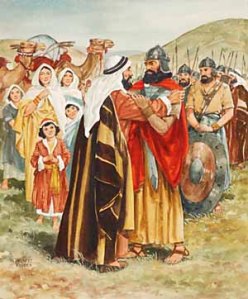
First there is the reconciliation of the estranged brothers Jacob and Esau. Accompanied by his wives and children, and with great trepidation, Jacob crosses the ford into Esau’s territory. He has sent a conciliatory message to Esau and now learns that Esau is coming to meet him, accompanied by four hundred men. Please remember the four hundred men, because we’ll come back to them.
The brothers meet, affectionate Esau and deferential Jacob. It is a touching scene, but midrash puts a different spin on it. The word ‘kissed’ is dotted above each letter in the Torah’s writing.
Rabbi Yannai said ‘…Why is [‘kissed’] dotted? It teaches that Esau came not to kiss [Jacob] but to bite him.’
Talk about putting the worst construction on somebody’s motives – but, in midrash, Esau came to symbolize at least two enemies: the Roman Empire and the Church. Furthermore, he was an ancestor of the Amalekites, a hostile tribe, who have to do with the four hundred men I mentioned.
Jacob offers Esau gifts of livestock, saying ‘Pray, take my blessing,’ an interesting reminder of the time when Jacob took – no, stole – Esau’s blessing, due to him from their father Isaac.
Esau is wealthy himself, refuses at first but then accepts and suggests that he and Jacob should travel together. In a fictionalized version of this episode, the German novelist Thomas Mann shows how desperately Jacob wants to fob Esau off, without giving offence. He gives a variety of excuses: the children are tired, so are the nursing animals, they all need to amble at a leisurely pace. Esau says ‘Let me at least give you some of my military staff, to accompany you,’ and Jacob, seeing possible danger in this set up, swiftly declines the offer. The brothers part and, to the best of my knowledge, they didn’t meet again.
What is it with brothers in Genesis?
Jacob settled in a piece of land he’d bought from Hamor the Canaanite. Hamor’s son Shechem desired Jacob’s daughter Dinah and abducted her. He seduced or perhaps raped her, but then fell in love with her and wanted to marry her. Dinah’s brothers were outraged and wanted revenge on Shechem and his family, but they planned it with Corleone-like care and precision. Their condition for permitting the marriage was that Schechem and his male relations should be circumcised. Shechem readily agreed. While the men were weak, following their circumcision, two of Jacob’s sons, Simeon and Levi fell upon their camp and slew them with swords.
Jacob was beside himself and rebuked his sons for the disproportionate response which could lead to bloody repercussions, but they replied ‘Should our sister be treated like a whore?’
Jacob does not refer to the episode again until he is on his deathbed, addressing each of his sons. He rebukes the eldest, Reuben for sleeping with Jacob’s concubine and he rebukes Simeon and Levi for the Shechemite massacre. This leaves the way clear for the fourth son, Judah, to get a very special blessing, in which Jacob anticipates that the rightful Israelite monarchy will be Judah’s descendants.
In the time of the monarchy, David, Solomon and their descendants are indeed from the tribe of Judah, and their stories are connected with Jacob’s story in several ways. As with Dinah, Tamar, the daughter of David, is the victim of rape and is then avenged by one of her brothers, Absalom. Like Jacob, David has sons who arrogate power to themselves while he grows old. David’s daughter, like one of Jacob’s sons, has a coat of many colours. Absalom and his brother Adonijah, like Reuben, seduce their father’s concubines. As with Simeon and Levi, the kingly inheritance passes to a younger, more suitable brother.
Before becoming king, David fights numerous wars and, on one occasion, attacks a camp of Amalekites, slaying the majority of them, but leaving alive four hundred men. Four hundred Amalekites. One might suppose that these are the descendants of Esau, who came with four hundred men to meet Jacob, and parted from him in peace.
The patriarchs, matriarchs and kings of our bible are flawed human beings and in the book of Genesis, relationships between siblings are problematic, from Cain and Abel to Joseph and his brothers. All the more reason to think that, when Esau and Jacob embrace, this is as good as it gets.
Post Freud, one can discern variants of the oedipal motif in the stories of Noah, Lot, Abraham, Isaac, Jacob, Saul, David and Solomon. Eyleh toledot – these are the generations. No wonder we tell our sons ‘May God make you like Ephraim and Manasseh.’ Those two sons of Joseph seem to have been blameless and he probably got a lot of nachas from them, whereas Jacob was sadly cheated of nachas for most of his life.
GL 28 October 2013<a href="https://neviimtovim.com/wp-content/uploads/2013/10/