- In: Torah
- Leave a Comment

What became of Korach? I’m sure you recall how dramatically he was swallowed up by the earth, because of his rebellion against Moses, when we were reading Numbers 16, six weeks ago. Perhaps you would hold on to that thought and we shall return to it.
The Book of Deuteronomy is essentially the words of Moses, somewhere between a speech and a memoir, including strong theological statements such as the Shema, parts of Birkhat ha Mazon, and the ‘Choose life’ text; Deuteronomy also contains blessings which are familiar to us through our liturgy, and some antithetic curses, which are not quite so familiar.
In this Torah reading, Ekev, Moses speaks of the fertility of the land which the Israelites are about to enter, how it flows with milk and honey, and seasonal rainfall contributes to a plentiful harvest. God’s eyes are upon the land, Moses explains, and, when the people are faithful to God, the earth will be bountiful. If they are seduced by other gods, there will be neither rain nor harvest. These words are to be worn as a sign, by means of tefilin, between the eyes and on the hand and on mezuzot: the doorposts of your house. The part of the Shema which commands tefilin and mezuzot in Deuteronomy 6 is repeated here in Ekev.
The fulfilment of all the promises regarding the land depends on the obedience and fidelity of the people. On the one hand, you have the laws, statutes and commandments, and on the other, the land. This is indeed a contract between two parties: God and Israel.
Coming back to Korach, you may remember that he was from the tribe of Levi and therefore a relation of Moses, Aaron and Miriam. He challenged the leadership of Moses and the priesthood of Aaron, believing them to be less worthy than others, including himself and he picked up a following of 250 men, some of them notable chieftains and dignitaries. Among them were Dathan and Abiram, brothers from the tribe of Reuben. Whereas Korach talked about the holiness of the wider community, Dathan and Abiram, not being Levites, were less interested in sacerdotal rites than in material well-being. They argued that Moses hadn’t delivered the promise of the Exodus and that slavery in Egypt was better than this protracted wandering in the wilderness.
In our sidra, Moses refers to the Reubenite rebellion of Dathan and Abiram, but does not mention Korach, who was apparently their leader. It is believed that the story in Numbers 16 originates from two separate sources, one about the Levite revolt of Korach and the other about a Reubenite rebellion involving Dathan and Abiram. The source of the Korach story is said to be the ‘Priestly’ author who specializes in priestly and levitical functions, whereas the Dathan and Abiram story is generally attributed to a supposed earlier author, sometimes known as the Elohist, often regarded as being responsible for narratives about the Patriarchs and the tribes. The stories get spliced in Numbers, so that all these persons are part of the same revolt. According to the same theory of biblical authorship, the text we’re reading from Deuteronomy is later than the Elohist, who refers to Dathan and Abiram, but a bit earlier than the priestly author who knows about Korach. Naturally, the author of Deuteronomy has knowledge of the fate of Dathan and Abiram, but he doesn’t mention Korach, because he hasn’t had access to the Korach story.
But, if you accept that the words of Moses in Deuteronomy are indeed authored by Moses you may want to look at it another way. The Reubenite opposition may have been less painful to Moses than the rebellion in his own family, from his cousins, Korach and the other Levites.
And there are other possibilities. There are one or two negative portrayals of the tribe descended from Reuben, Jacob’s first born, and Reuben himself gets a raw deal because the mantles of kingship and priesthood are inherited by his younger brothers Judah and Levi. He is one of those firstborn sons, like Ishmael and Esau for whom primogeniture has none of the usual advantages.
Whichever way you want to look at it, Korach is written out of the passage we read today.
One more word about Dathan; if the name sounds familiar, it may be because he is the amoral, self-serving character portrayed by Edward G Robinson in Cecil B Demille’s film, The Ten Commandments. Biblical epics offer their own midrashim, possibly for the most pragmatic of reasons and MGM puts the blame squarely on Dathan, the Reubenite.
- In: Torah
- Leave a Comment

This Torah portion makes reference to three things which are, quite possibly, more ancient than the Torah itself. These are: a Sumerian cult, a quotation from a lost Hebrew book and a fragment of a folk song. There is a recurrent motif in the book of Numbers. The people complain about their seemingly interminable journey through the wilderness and the limited menu of manna, yearning for the remembered comforts of Egypt. We saw that most of the spies sent ahead to Canaan returned with pessimistic and defeatist reports of an unconquerable land. We saw how Korach and other Levites rebelled against Moses and were punished. Rashi explains that the Israelites were discouraged because of the many years travelling and indeed, Google Maps shows that the distance from the Red Sea to Jericho is thirty-eight miles, do-able on foot within a week, in peace time. But there was no peace for the Israelites on their journey through the wilderness.
Today’s Torah reading begins by describing an attack from the Canaanite king of Arad, which ended badly for him, with a herem, the destruction of his towns. Protest, complaints and rebellion within the Israelite camp did not go unpunished, and, as midrash points out, on this particular occasion, the people spoke against God, as well as complaining about Moses’ leadership. God sent fiery serpents – hanehashim haseraphim – which attacked the people and, as so often, Moses interceded with God on behalf of the discontented multitude in his care.
The solution which God commanded and which Moses carried out, was to make a copper serpent – nehash nehoshet – on a pole and, for anyone who was bitten by a serpent, the antidote would be to look on this and live. As we read in the haftarah, King Hezekiah later destroyed the copper serpent, known as nehushtan, because it was being treated as an object of pagan worship. You might think that a snake on a stick is a random object of curative potency but no, it has form in Sumerian, Egyptian and Greek antiquity. Asclepius who, in Greek mythology, was associated with healing and medicine, held a rod entwined by a serpent while Hermes AKA Mercury had a similar staff called a caduceus, with two serpents. The cult of Asclepius might conceivably post-date the Nehushtan, but the Sumerian deity Ningishzida, who held a rod with a snake entwined on it, appears in the second millennium BCE, which is well before the events in the book of Numbers.
To this day the logo of a snake on an axial rod is used by the BMA and internationally, by many medical organizations. After the attack of the serpents and the remedy, the Israelites then continue their journey eastwards in the wilderness, reaching the Arnon, which is the border between the Moabites and the Amorites. We read a citation about the valleys of Arnon, from ‘The Book of the Battles of the Lord’ which is one of the lost books mentioned in the Bible. This is in fact the only reference in the bible to the Book of the Wars of the Lord. Some scholars identify it with The book of Jasher, a book mentioned more than once but now lost, although there is a late midrash of that name. In the Greek translation of the book of Numbers, third century BCE, the words ‘War of the Lord’ are a fragment of a verse, rather than the title of a book and, in the Targum of Onqelos, the book referred to is just called ‘The Book of Wars.’ The bottom line is that we haven’t got it any more and can only speculate about what it was.
The Israelites reach Be’er, which means a well, and God tells Moses to gather the people so that God will give them water. At the well, they sing a fragment of song:
Spring up, O well!—Sing to it!
The well that the princes made,
That the nobles of the people dug,
With the sceptre and with their staffs.
This song raises the possibility of a gap in the narrative, a reference which has been lost. Who are the princes who dug the well? Midrashic and medieval commentators suggest Moses and Aaron dug the well at the beginning of the forty years in the wilderness, and that it accompanied the Israelites, providing water during their wanderings.
Moses is not mentioned in the song. The provision of water, which the people sought repeatedly from Moses, was associated with the problematic waters of Meribah, where Moses angered God by striking the rock with his staff. There are two separate accounts of Moses striking the rock, found in both Exodus and Numbers. In the Book of Numbers, after the striking of the rock, God tells Moses and Aaron that, because of their insufficient trust, both of them would die before entering Canaan.
The song of Moses at the Red Sea begins, Az yashir Moshe – ‘Then sang Moses…’ and the Song of the Well begins Az yashir Yisrael – ‘Then sang Israel.’
Towards the end of the forty years in the wilderness, Moses has just a limited time as the living leader of the children of Israel. Aaron and Miriam are gone and Eleazar, Aaron’s son, is now the high priest. The time is near at hand when the Israelites must come of age, give up their interminable complaining and sing their own song.
And finally, they are on the move, after being held up thirty-eight years in the wilderness of Kadesh Barnea. The next verse, after the song, tells of the continuing journey, on an easterly trajectory, towards the field of Moab by the top of Pisgah, the high location from which Balaam will look down at the Israelite camp. The period in the wilderness has been a cycle of battles, revolt, plague and hardship and has lasted so long that a new generation is emerging. Perhaps these younger people are the ones who sing, in the Song at the Well, of legendary princes – which may be a reference to Moses and Aaron or, as one midrash says, a reference to the Patriarchs. After forty years in the wilderness, still with no land of their own, the Israelites have at least a unifying historical narrative which they carry forward towards Canaan.
Stoning with stones: Leviticus 24
Posted on: April 26, 2015
- In: Torah
- Leave a Comment
Leviticus 24 begins with God’s words to Moses concerning the ner tamid – the eternal flame – and the show bread. It was the duty of Aaron and the priests to keep the lamp burning perpetually. The bread was laid out as a symbolic offering while the priests burned frankincense, and they would eat the bread before the new batch of loaves replaced them on the following Shabbat. These are called everlasting statutes, חקת עלם, an expression not used for every commandment in the Torah. It is said particularly of commandments associated with the priestly offices in the Sanctuary or with the observance of the festivals.
We adhere to them to this day: here is our ner tamid above the aron hakodesh, and, in the Kiddush Hall, the equivalent of the show bread, our challah is waiting for us.
Reading on, we come to the difficult narrative about the son of Shelomith, which involves blasphemy and a stoning.
All I said to my wife was, ‘That piece of halibut was good enough for Jehovah.’
This quotation is from the Life of Brian, the stoning scene, which may owe something to our Torah reading where a certain man gets stoned to death.
In The Life of Brian, the stoning scene was a widely recognized biblical reference, although not everyone will have connected it with the precise verse from Leviticus, in the sidra, Emor:
Whoever blasphemes the name of the LORD shall surely be put to death. All the congregation shall stone him.
The story is this: an Israelite woman called Shelomith had a grown-up son, fathered by an Egyptian. He fought with an Israelite man and, during the fracas, blasphemed, cursing God’s name. No halibut was involved. Moses ruled that the whole community should stone the man to death.
We don’t know the man’s name or exactly what he said; neither do we know the name of his Egyptian father. We do however know that his mother was Shelomith and his Israelite grandfather was Dibri of the tribe of Dan, so it is worth having a closer look at these names. The anthropologist Mary Douglas noticed that Shelomith is connected with the word for retribution, Dibri with law-suits and Dan with judgment. This interpretation treats the story as an allegory, conveying the lesson that there is punishment for cursing God.
Mary Douglas’s interpretation makes good sense when we read the continuation of God’s words to Moses, and see that there are judicial penalties for murder, damage to persons, property and animals, the punishments being of varying severity, depending on the offence; an eye for an eye and a tooth for a tooth.
Midrash offered interesting interpretations of the Shelomith narrative. It was suggested that the Egyptian father was the same Egyptian taskmaster killed by Moses. Shelomith was so called because she was excessively free and easy with passing men, always addressing them with the words ‘Peace to you’ which is a play on the name Shelomith, connected with shalom. Likewise, the meaning of Dibri is associated with speech, and Midrash says that Shelomith was too talkative.
One midrash interprets the fight as being between the son of the Egyptian and members of the tribe of Dan. He wanted to pitch his tent among them, on the grounds that his mother was of the tribe of Dan, but they excluded him. They told him: ‘Scripture says: ‘The Israelites shall camp each with his standard, under the banners of his father’s house’ This puts forward a very negative view of the Danites, isolating the protagonist and driving him to despair. Moses also is depicted in the midrash as siding with the Danites, because the man was considered a mamzer, ie born of an adulterous union.
As it happens, the verb ‘to stone’, רגם, and, in other instances סקל, is not the same as the word for a stone in an non-verbal context, which is אבן. The meaning of the biblical verb to stone is connected with pelting or hurling.
Moreover, there are several different Hebrew words which are translated as blaspheme in English language bibles; they are all connected with cursing, in the transitive sense, where someone or something is being cursed.
In this country, the UK, the offences of blasphemy and blasphemous libel were abolished as late as 2008. You may remember Mary Whitehouse bringing a successful private prosecution against Gay News in 1976. Prosecutions for blasphemy tended to target freedom of expression in controversial literature or plays. Blasphemy as a crime was about words rather than deeds.
In our own time, talk of blasphemy or of stoning is associated with extreme, intolerant and violent penal systems, yet here is an account of it, in our own scripture. What can we do with it? Or what can we take from it? Perhaps just this: that speech is an act which generates consequences, and contemptuous speech, directed against people or against God, can be a potent weapon, causing injury or desecration. This is why we have laws against libel, slander and incitement to violence or hatred.
It goes without saying that the only place for stoning with stones is on the set of The Life of Brian.
Purimspiel 5775/2015
Posted on: March 23, 2015
- In: Purim
- Leave a Comment
Cue: (Esther 1:12) But the queen Vashti refused to come at the king’s commandment by the chamberlains; therefore was the king very wroth, and his anger burned in him.

Newsreader: The following information was obtained through Wikileaks from the Babylonian Talmud (tractate Megillah), the Septuagint, the Apocrypha, the Midrash Rabbah, the first and second Targums to Esther and the Zohar
Visual and sound https://www.youtube.com/watch?v=4TSJhIZmL0A

Edward Hughes: This is Edward Hughes with the News at 10. A storm brews at the castle in Shushan where relations between the King and his consort reach crisis point. We’re going straight over to our royal correspondent, Nicholas Whichway, in Shushan.
Whichway: Well here in Shushan, Persia, a situation is developing as Queen Vashti disobeys the king’s command to appear at his banquet. King Ahasuerus has been wining and dining his guest for many weeks now, sparing no expense. There are dazzling gold utensils which are said to be spoil from the late King Nebuchadnezzar’s military incursions to Jerusalem. Queen Vashti is the daughter of King Belshazzar, also known for his lavish lifestyle. The Queen has often compared Ahasuerus unfavourably with Belshazzar, saying‘My father could down a quart of Jim Beam without get drunk, but Ahasuerus is hammered after half a cider and a tequila sunrise.’
Queen Vashti is known to be a strong-minded woman, severe with her staff of servants and slaves. Our source reported that she forces the Hebrew women who spin her designer caftans to work naked every Saturday. It is perhaps poetic justice that King Ahasuerus has ordered Vashti to appear naked at his banquet.
Another witness from the queen’s apartments has described an unusual supernatural episode, which has yet to be confirmed. It is said that the Queen was in fact preparing to go the King’s banquet wearing nothing but her crown when a winged man calling himself Gabriel appeared in her bedchamber. He was carrying a blindfold, a roll of duck tape and a pair of handcuffs and was seen tying Vashti to the shower rail in the en suite. This may have been the reason why Queen Vashti was detained.
Hughes: Well we’ll be following events in Shushan throughout the evening. And now, as the General Election looms, we ask if the beleagured Lib-Dems would consider entering into a coalition with Justin Bieber.
Cue: (Esther 1:22, last verse of Chapter 1) …that every man should bear rule in his own house, and speak according to the language of his people.

SL: Good evening. I’m Jon Whiterthan, fully recovered from my recent adventure with skunk. Following events in Persia, we ask: Who exactly is King Ahasuerus? We have in the studio the historian Darth Starkley. Darth, just what do we know about the Persian king?

Darth Starkley: We know Ahasuerus by his Hebrew name, Achashverosh, but the Greeks called him Xerxes and the Persians called him Artaxerxes.
Whiterthan: So he’s either Xerxes or Artaxerxes?
DS: It’s not as simple as that. All the Achaemenid kings – that’s ‘Persian’ for the hoi polloi I look down on – were called Artaxerxes or Darius. Now we know Ahasuerus wasn’t called Darius so, by a process of elimination, he must have been Artaxerxes. Or Xerxes. If you’re Greek.
JW: There are some who identify him as King Artaxerxes II.
DS: Yes. But there are others who call him Artaxerxes I. I sometimes call him Artaxerxes III, just to court controversy and draw attention to myself.
JW: What’s this story about the King trying to sit on Solomon’s throne?
DS: King Nebuchadnezzar seized the throne of Solomon when he was despoiling the temple in Jerusalem. This was an elaborate golden throne decorated with mechanical lions. When Nebuchadnezzar tried to sit on the throne, one of the lions snapped at his leg. Ahasuerus once tried to sit on it and the same thing happened…he required a tetanus vaccination. The only king who could sit on that throne, apart from Solomon was Cyrus.
JW: Well thank you Darth Starkley, informative as ever.
Visual and sound: https://www.youtube.com/watch?v=w_2OZu693LA (Channel4)
Cue: (Chapter 2:18) Then the king made a great feast unto all his princes and his servants, even Esther’s feast; and he made a release to the provinces, and gave gifts, according to the bounty of kings.
Visual and sound https://www.youtube.com/watch?v=4TSJhIZmL0A (BBC)

Nicholas Whichway: Queen Esther is a refreshing change from her predecessor Vashti,who was known for love of luxury and her wild parties – considerably more than twelve in three years.. By contrast, Esther lives very quietly in her quarters in the palace, with a small retinue of maids. They are believed to observe an unusual diet and it’s said that Queen Esther chooses simple dishes, such as chopped herring and pickled cucumber, instead of the more usual roast sucking pig or lobster bisque. She is said to bathe in water rather than asses’ milk and her maidservants say she likes to immerse herself every month in her own small water bath.
In spite of these apparent eccentricities, Esther succeeded in winning the heart of his Royal Highness. Many beautiful young women had been entertained at the palace under the supervision of the eunuchs. One of these young women was the daughter of the rising minister Haman, who came to prominence by campaigning for the execution of Queen Vashti. However, Haman’s daughter suffered an unfortunate malady. She was sent home from the palace when diarrhoea resulted in damage to an expensive Persian carpet and the King’s best slippers.
Cue (Chapter 3:1): After these things did King Ahasuerus promote Haman, the son of Hammedatha the Agagite, and advanced him, and set his seat above all the princes that were with him.
Visual and sound https://www.youtube.com/watch?v=p_09tqeOlGE (Russell Brand Trews)

Hustle Bland:
Hello, welcome to the Trews. I’m Hustle Bland, the host of the Trews.
Today I’m bringing you the true news, about our most powerful minister, Haman. The king thinks he’s a cool dude and has let him become a fat cat, except he isn’t fat or a cat…no, he looks like Jaffar from the film of Aladdin, don’t he? He charges a daily fee of 5000 dinars if he’s doing a speech and calls himself a Persian potentate, but he ain’t a Persian at all. He’s an Amalekite and they’ve got a very scurrilous history which Haman don’t want you to know about. Remember to blot out Amalek, mate. So Haman’s the great-great-great grandson of Esau. Some of the Persians call Haman a Macedonian. Don’t forget mate that Alexander the Great was a Macedonian who challenged the Persian hegemony before he got corrupted by colonial, supremacist ambition. So you might think the Persians are calling Haman a Greek upstart, but that ain’t the truth, because they’re calling him Macedoine de Fruits, that’s a Macedonian fruit salad in Francophone Persian. I wouldn’t vote for a fruit salad because there ain’t much difference between a mango, a peach and an apricot and I’m here to tell you that you shouldn’t vote for any of them because I’m the only one who tells the true news!

Visual and sound: https://www.youtube.com/watch?v=p_09tqeOlGE (Russell Brand)
Cue: (Esther Chapter 4:3) …and fasting, and weeping, and wailing; and many lay in sackcloth and ashes.
Visual and sound https://www.youtube.com/watch?v=4TSJhIZmL0A (BBC)

Jeremy Arrow: This is Jeremy Arrow, your Ancient Near East correspondent. There are disturbances in the streets of Shushan this evening, where a high ranking civil servant has covered his head in ashes and called on the Jews of the city to fast for three days. The civil servant, Mordechai, maintains that Minister Haman is planning to destroy the Jewish population of Shushan. Records show that Mordechai is a member of the tribe of Benjamin – that’s Benjamin, not Bibi – and a descendant of Saul, a powerful king of Israel.
Cue: (Chapter 5:8) …let the king and Haman come to the banquet that I shall prepare for them, and I will do tomorrow as the king has said.
Jeremy Arrow: And now we have some breaking news from the palace. It concerns Queen Esther. It seems that the Queen approached the King this evening without his invitation, which is of course a capital offence in Shushan. A witness reports that the Queen was accompanied by her maidservants and by three unusual looking winged men. Another witness says they were winged women. A third said it was difficult to place the gender as they were wearing unisex white tunics. Apparently, the king was enraged by this lese-majesté, but his anger melted as soon as Esther touched his sceptre. All our witnesses report that the sceptre extended miraculously by several cubits. One witness insists it extended by sixty cubits, but he must be exaggerating.
Esther was heard to say ‘This whole thing is so much harder than I expected.’


Visual and sound https://www.youtube.com/watch?v=4TSJhIZmL0A (BBC)
Cue: (Chapter 6:11) …and proclaimed before him, Thus shall it be done unto the man whom the king delights to honour
Jon Whiterthan: This is Jon Whiterthan, bringing you up to date with more breaking news. Mordechai has succeeded in evading the limelight until now, but he is being honoured today by the King for thwarting a coup d’etat which was being planned by courtiers with impossibly silly names. Mordechai is being led on a triumphal parade through the streets of Shushan, on the King’s own horse. The man leading the horse is some kind of servant, with a slight resemblance to Jaffar from the film of Aladdin, but, as far as I can see, no parrot. There are crowds lining the streets, waving Persian flags and carrying placards with slogans: I can see ‘God save the king’ on one placard and ‘Je suis Mordechai’ on another and, on a third placard ‘Shushan Metropolitan University says No to tuition fees.’ Some people in the crowd are chanting ‘Mordechai, Mordechai, Am Yisroel chai!’ and there are also cries of ‘Down with the Macedonian fruit salad!’ This would be a reference to the chief minister, Haman , who is nowhere to be seen… but wait! The man leading the horse…it is the minister Haman himself. And now something’s happening at an upper window. There’s a young woman on the balcony, shouting ‘Long live Haman and death to Mordecai.’ She seems to be armed with a round object. It’s a chamber pot and now – oh no! – she’s emptied it on Haman. The young woman’s shouting something. It seems to be ‘Sorry Dad, I thought you were going to be the one on the horse. My bad.’ Well that’s a very unfortunate turn of events, which are growing increasingly volatile. This is Jon Whiterthan, in Shushan, Persia.

Cue: (Chapter 7:10) Then was the king’s wrath assuaged.

Rula Ringoe: This is Rula Ringoe and I’m in Shushan. The Persian Minister Haman was hanged today for treason, attempted homicide, conspiracy, fraud, corruption, impersonating a Chelsea Pensioner, larceny, felony and double parking. Not only did Haman intend to murder all the Jews of Persia; he also was planning a coup d’etat against King Ahasuerus. It’s being said that Haman was a Macedonian, planning to subjugate the Persians, although it’s more likely that he was an Amalekite with an ancient grudge against the Israelite people.
Mordehcai is now the Prime Minister and the King has bestowed on him many generous gifts: a necklace of gold from Ophir, a purple tunic with birds embroidered on it, a belt set with precious stones, a Median sword, Parthian red socks, tefilin boxes inlaid with gold, a cuddly toy and a Morphy Richards Mix-and-Go blender.

Cue: (Chapter 8:17 last verse in chapter) for the fear of the Jews was fallen upon them.

Paxes: Good evening. This is Paxes the Impaler, and tonight I’m interviewing Bigathan Average, of the Daily Chariot.
Still Paxes: Bigathan, you claim to have knowledge about Queen Esther’s family background, which has not been generally publicized. You claim, for example, that she’s Jewish.
Bigathan: Yes, she is Jewish. There’s no doubt. She keeps kosher and bensches before and after meals. She’s related to Mordecai, the Jew who was given a triumphal parade in Shushan today. And she’s converted two apartments into a through-lounge. QED.
Paxes: This seems a bit far-fetched. The Queen’s entertaining the King and Haman at a private banquet as we speak, and it’s well-known that Haman refuses to banquet with anyone who’s Jewish.
Bigathan: Esther kept her identity hidden. Didn’t you ever notice that Esther is Hebrew for ‘I am hiding.’
Paxes: Oh come off it. This is all speculative.
Bigathan: Esther was raised by Mordecai after her parents died and, when she was grown up, he married her.
Paxes: Are you saying that Esther’s marriage to King Ahasuerus is bigamous? That’s preposterous. Where are you getting your information?
Bigathan: I have it from an authoritative source.
Paxes: Who is the source?
Bigathan: An authoritative person.
Paxes: Are you going to reveal the source?
Bigathan: I’ve seen a document which proves Esther and Mordecai were married.
Paxes: Are you going to reveal the source?
Bigathan: My source tells me that Esther has visited her husband Mordecai since her marriage to the King.
Paxes: Who is your source?
Bigathan: She came out of the King’s chamber, went into her bathroom, got dressed and nipped out to see Mordecai.
Paxes: This is incredible. Who’s the source of your information?
Bigathan: Someone reliable. Besides, that was never Esther in the King’s bedchamber. It was a female spirit. Not Esther.
Paxes: Are you going to reveal your source?
Bigathan: Amazing what you can do with a succubus these days. I’m thinking of getting one myself.
Paxes: Where are you getting your information?
(simultaneously) https://www.youtube.com/watch?v=1SyeqpYdPuk
Cue: (Chapter 9:22) …of sending portions one to another, and gifts to the poor.
Edward Hughes: The new Prime Minister has addressed the nation, beginning his speech with the catchy phrase, ‘I have dreamed a dream.’ In his speech, he recalled having a dream which foreshadowed these turbulent events. He described the dream in which two serpents fight in a time of tumult, with darkness all around them. This, said Mordecai represents his own struggle with Haman. Or possibly Harry Potter’s struggle with Voldemort. Mordecai is a Jungian therapist in his spare time, so he knows about dreams. As it happens, he’s the author of a self-help book called ‘Coping with wife sharing.’ The dedication is ‘To Esther, my anima.’ This may be a misprint for ‘My animal’.
Cue: (Chapter 10: 3 last verse in Megillat Esther) …and speaking peace to all his seed.
DV The Prime Minister intends to commemorate these times with a festival called Purim and has written a letter about it to Ptolemy and Cleopatra, king and queen of Egypt. This isn’t the same Cleopatra who dated Julius Caesar and Mark Antony, but one of the earlier Cleopatras. There were a lot of them, and just as many Ptolemeys. And we know there were a lot of Artaxerxeses. But there’s only one Mordecai as people on the streets are singing:
[song there’s only one Mordechai’ to the tune of Guantanamera]
Words to Guantanamera song:
There’s only one Mordecai
And I’m not gonna lie
He’s a helluva guy
There’s only one Mordecai
There’s more than one Artaxerxes
Two and three, maybe more.
When you’ve done Artaxerxes
It’s like you’ve been there before
And there’s less than one Haman
‘Cause they showed him the door,
He did too much inflamin’
You won’t see him no more…
There was more than just one Ptolemy
Each a Greek-Egyptian wannabee
With a flair for astronomy
So many more than one Ptolemy…
There’s more than one Cleopatra
Sending kisses back atcha
It’s all in Bava Batra*
There‘s more than one Cleopatra.
* Actually it’s Sanhedrin 90b. Who knew?
Joseph: Tears and Bones
Posted on: December 28, 2014
- In: Torah
- Leave a Comment
Vayehi
Genesis 50:1-26 3 January 2015

When I was a child in the nineteen-fifties, there was a stigma associated with men crying. Men, as depicted in all my reading books, were married with two children, a boy and a girl, came home at six and enjoyed a nutritious meal of meat and two veg which the wife had prepared, after wringing the laundry through the mangle and dusting the flying ducks on the lounge wall. Boys learned and men knew that crying was an indulgence more suited to women and girls.
Well in the bible, it is the norm for men to weep. Jacob does it, Saul and David do it and now, I come to think of it, the leading men of the New Testament do it. Joseph, the great Viceroy of Egypt, does it again and again.
Joseph weeps when he hears his brothers speaking among themselves, admitting their guilt; he weeps when he sees Benjamin. When he discloses his true identity to his brothers he weeps so loudly that all the Egyptians in Pharaoh’s house can hear. Then he and Benjamin weep together, and Joseph kisses all his brothers, and weeps. The brothers bring their father Jacob to Egypt so that he can be reunited with Joseph. When Joseph sees Jacob, he falls on his neck and cries a long while, though, as it happens, Jacob does not cry.
Our Torah reading today is the last reading in the book of Genesis,which is the longest of all five books of the Torah. Jacob dies in Egypt, after a long valedictory speech, part blessing, part rebuke, to his twelve sons. Joseph weeps and embraces him, and then gains leave from Pharaoh to take his father’s remains back to Canaan for burial. He and his brothers make the journey and bury Jacob in the Cave of Machpelah before returning to Egypt. The brothers now have a pressing anxiety on their minds. Will Joseph pay them back for their cruelty to him, so many years ago? Now that Jacob is dead, they feel as vulnerable as Fredo Corleone, after the death of his mother. But, fortunately, Joseph does not resemble Michael Corleone. When his brothers – tugging on his heart strings – say ‘Forgive the transgression of the servants of your God and your father,’ Joseph weeps. The brothers declare ‘We are your slaves,’ but Joseph tells them ‘Fear not, for am I in the place of God? You meant evil against me, but God meant it for good, to save many people alive.’
These words of reassurance are very similar to those which Joseph speaks to his brothers after identifying himself to them: ‘Do not be grieved or angry with yourselves that you sold me, because God sent me before you to preserve life.’ This repetition is an instance of the duplication of events or conversations which occurs regularly in biblical narrative, but it also reflects the repetition and duplication of situations in life as we live it. It can happen that we seek reassurance not once but many times, or give the same reassurances more than once, more than twice. A person’s life is not just a straight line of narrative, but circles back on itself in loops of memory, repetition and recurrence; likewise the lives depicted in the bible.
Joseph and his brothers survive to a good old age, yet it seems that Joseph is the first to die, as, on his deathbed, he addresses his older brothers, telling them that God will bring them up from Egypt to the land promised to Abraham, Isaac and Jacob. Lastly he speaks to his extended family, the children of Israel, saying that when that time comes, they should take his bones and bring them home.
The final sentence of the book of Genesis tells us that Joseph dies at the age of a hundred and ten, is embalmed and put in a coffin in Egypt. Why did he not live to a hundred and twenty? The biblical scholar Robert Alter explains that a hundred and ten was the ideal Egyptian life span. Egyptian as well as Hebraic traditions pervade Joseph’s story.
The Egyptian setting will dominate the next book of the Torah: Exodus. Genesis ends with a coffin, Joseph’s, for coffins were part of the elaborate burial practice of the Egyptians. The Hebrew word for coffin is aron, meaning box, the same word we use for the Holy Ark. Robert Alter points out in his commentary on the Pentateuch, that the Exodus story begins with an ark: the cradle of bulrushes which carries the infant Moses downriver. (R Alter on Gen 50:26). This cradle is called tevah in Hebrew, the same word used of Noah’s Ark, the ultimate vehicle of survival and regeneration, and it seems suitable for Moses, who is destined to lead the Israelites out of slavery. As the Israelites depart Egypt, Moses remembers the promise to Joseph and takes with him Joseph’s bones. It falls to a direct descendant of Joseph, Joshua the Ephraimite, to supervise the interment of Joseph’s bones in a piece of land purchased by Jacob from Hamor the father of Shechem, before Joseph was sold into slavery.
Harsh Decrees on this Scepter’d Isle

The prayer Avinu Malkenu is a petition to God, asking Him to give us and our children life, health, peace and forgiveness in the coming year, and also, to spare us from persecution:
Avinu Malkenu, batel me-alenu col gezerot kashot.
Our Father, Our King, abolish all oppressive laws against us.
Does this part of Avinu Malkenu belong only to our history or is it relevant also to the here and now?
It is related of R. Eliezer that once he stepped down before the Ark and recited the twenty-four benedictions for fast days and his prayer was not answered. R. Akiba stepped down after him and exclaimed: Our Father, our King, we have no King but Thee; our Father, our King, for Thy sake have mercy upon us; and rain fell. When the people saw that he was answered with this prayer, they added it to their supplications and petitions.
Ta’anit 25b
One of the questions I’d like us to consider is, Is it safe? That is to say, is the United Kingdom, as it’s still called, a safe place for Jews in 2014, 15, 20, 30?
On August 21st, the Jewish Chronicle published an article by David Aaronovitch titled ‘Now’s not the time to pack the suitcase and leave the UK.’ The article was moderate, tending to allay fears aroused by the backlash to the recent conflict of summer 2014. David Aaronovitch wrote on 21 August 2014 in the Jewish Chronicle:
…most Britons, as measured by all polls, believe Jews are OK. The younger generation, a tolerant lot, would sooner have their mobile phones confiscated than beat someone up because of their race or religion.
Second, however sensitive one might be to the odd Tonge and Galloway, the political classes have set their faces against Jew-hatred. If and when that begins to change (and I don’t think it will) I’ll be the first at the luggage department at John Lewis.
During the recent conflict with Gaza, Operation Protective Edge, there was much discussion, not just in the media but among ourselves and in our families, about a sense of danger, or threat or simply discomfort, in the face of an alleged rise in anti-semitic acts and an almost indisputable rise in anti-Israel sentiment.
Now the other question I would like to ask is connected with this particular day, Yom Kippur, this particular prayer, Avinu Malkenu and this particular supplication to God, ‘Annul all oppressive decrees against us.’
We saw that, in Talmudic times, to alleviate drought, the rabbis turned to God and prayed for rain.
In all the countless gezerot kashot of our history, Jews have turned to God and prayed ‘Hoshienu,’ ‘Save us,’ the last word of the Avinu Malkenu prayer.
Is this a matter for God, or so much between man and man that we hardly expect God to hear our petition?
Our society: British for most of us, and our community: Jewish, are more secular than ever before. Historically, when Jews were persecuted in the diaspora, they prayed – hence the petition in question, batel me-alenu… They recited psalms. There is evidence that they were not equipped to fight back against the pogroms, but meanwhile, there was the dawn of Socialism, Zionism, aliyah, the halutzim – pioneers. Prayer was perhaps not the priority of these ideologists. So, when you say this prayer, is it with hope for God’s intervention, that God will indeed abolish all oppressive laws against us? Is our fate in God’s hands? Can prayer change what happens in the world?
The Jewish Encyclopedia offers some background to Avinu Malkenu. The number and order of the verses vary according to the minhag of different communities. The Sephardi rite differs from the Ashkenazi which is itself heterogeneous. A Gaonic version from the ninth century consisted of 22 verses arranged in alphabetical order. It became the Ashkenazi custom to recite them each morning and evening during the Ten Days of Penitence after the Amidah. The prayer is not found in the prayer books of Saadiah Gaon and Maimonides. The origin of Avinu Malkenu is R. Akiva’s prayer on a fast day proclaimed because of a drought: “Avinu Malkenu, we have no King but Thee; Avinu Malkenu, for Thy sake have compassion upon us” (Ta’anit 25b). The orthodox practice is still that if the Yom Kippur falls on Shabbat, Avinu Malkenu is recited only during the Ne’ilah service.
Anthony Julius, author of ‘Trials of the Diaspora’ distinguishes between enmities and defamations. The book was published in 2010 and it responded to a wave of anti-semitism following operation Cast Lead in 2009. He cites prevalent widespread notions which he calls ‘tropes’ – anti-semitic tropes; examples would be references to a powerful Jewish lobby and/or wealth and influence, and/or conspiracy. A common perception, or misperception, would be that Jews claim anti-Semitism where none exists or exploit Shoah. There is also the revival of the well-attested belief that Jews are childkillers, steeped in blood. No self-respecting, liberal critic of Israel would impute this directly to Jews, but it was commonly stated of Israel in the summer just gone.
It would have been very difficult to go through this summer without hearing the plight of the Palestinians likened to the Holocaust and the Israelis likened to Nazis. The word ‘Zionazi’ trended on Twitter. Swastikas appear on banners embedded in the Israeli flag which of course features the Star of David, a symbol for Jews in the diaspora as well as in Israel.
None of these attitudes are enshrined in the law of our land. On the contrary, we are in no small way protected by law.
How has law treated us since the readmission of Jews to England in 1656?
In 1753, a bill which allowed Jews to become naturalized by application to Parliament was passed, with strong Tory opposition, by a Whig majority who included religious toleration in their party agenda. The Board of Deputies was founded in 1760. The first half of the nineteenth century saw the establishment of The London Board for Shechita, the Jews’ Free School, the Jewish Blind Society, the Marriage Registration Act which recognized the authority of the Board of Deputies. University College London was founded in 1827, the first university in England to admit students regardless of race, class or religion although it was not until 1871 that Jewish students were admitted to Oxford and Cambridge.
Regarding civic life and parliament, it was a long haul between 1847 and 1858., Lionel de Rothschild got elected but couldn’t take his parliamentary seat until parliament dispensed with the requirement to take a Christian oath. David Salomons likewise was elected in the intervening years and was fined £500 for voting after refusing to take the oath. In the case of Disraeli, being a Christian convert made all the difference, though not, of course, where defamation was concerned.
By the time of the massive immigration of Jews from Tsarist Russia, from the 1880s to the 1910s, the nature of anti-Jewish oppression in Britain was not so much constitutional as defamatory. Anthony Julius makes a strong case that casual anti-semitism is endemic in English Literature. In the 1930s, there were the Blackshirts as well as informal, institutional anti-semitism in the Foreign Office and, it would seem, among the aristocracy.
Since the Second World War, numerous acts have been passed for the protection of social and racial minorities, for example the Race Relations Act of 1976.
In 2001, Holocaust Memorial Day was established in the UK and in 2004 The United Nations voted in favour of commemorating the Holocaust. Besides this, The European Commission against Racism and Intolerance, a part of the Council of Europe, called on its member nations to ‘ensure that criminal law in the field of combating racism covers anti-Semitism” and to penalize intentional acts of public incitement to violence, hatred or discrimination, public insults and defamation, threats against a person or group, and the expression of antisemitic ideologies. It urged member nations to “prosecute people who deny, trivialize or justify the Holocaust’. According to the The Racial and Religious Hatred Act of 2006, it is an offence in England and Wales to incite hatred against a person on the grounds of their religion.
The 1999 McPherson report into the Stephen Lawrence case defines a racist incident as ‘… any incident which is perceived to be racist by the victim or any other person,’ yet, when Jews construe a remark or an action as anti-semitic, they are often regarded as over-sensitive, paranoid or manipulative.
Meanwhile, there are social movements of an arguably oppressive nature.
The United Nations General Assembly Resolution 3379, of November 1975 determined that Zionism was a form of racism and racial discrimination. In 1978, UNESCO organized the first World Conference Against Racism, where a resolution (3379) was passed, equating Zionism with racism.
At the 2001 meeting of the World Conference Against Racism, delegates from Israel, the US and Canada walked out over a draft resolution which singled out Israel for criticism and likened Zionism to racism.
At the 2009 WCAR, President Ahmadinejad made a provocative speech, combining holocaust denial with an attack on Israel as racist in concept and practice. The British ambassador to the UN was among those who walked out during this speech.
The critical position of the UN contributes to a perception of Israel as a pariah state, which is now so widespread that it is no longer exclusive to the extreme right wing, the extreme left wing or Islamist, jihadi groups. Opposition to Israel is sometimes taken as axiomatic in Academia, the Arts and Trade unions. The result is that many British Jews suffer some negative affect from such organizations as BDS, the PSC and the sloganizing of The Respect Party. Jewish students are liable to experience hostility within the Students’ organizations. The tendency of media to headline news from Israel is a source of anxiety for many Jews, as is the recent rise in anti-Semitic incidents.
The reason for the sense of danger which haunts many of us can be attributed, disputed, researched and surmised.
My question is, how does it enter into our lives as a community and a congregation and how does it affect the way we, as individuals, feel when we say the words Avinu Malkenu, batel me-alenu kol gezerot kashot, Our Father, Our King, abolish all repressive laws against us.?
.
Troubled by the Deuteronomist
Posted on: August 22, 2014
- In: Pentateuch | Torah
- Leave a Comment
Re’eh Deuteronomy12:29 – 13:19
When I first looked at the Torah reading, Re’eh, with a view to preparing this introduction, it was the day after a ceasefire commenced in Israel and Gaza. All hell was breaking loose in the UK over Baroness Warsi and the Tricycle Theatre. That now seems a long time ago; ceasefires have come and gone; I’m writing this on Wednesday and I feel with pessimistic certainty that there will be further developments by Shabbat.
There was no getting away from the fact that our text begins, “When the LORD your God cuts off before you the nations whom you go in to dispossess, and you dispossess them and dwell in their land…’ and I wondered if it was going to get better as it went on.
The charge against the other nations is that they sacrifice their children to their false gods, particularly a deity called Moloch.
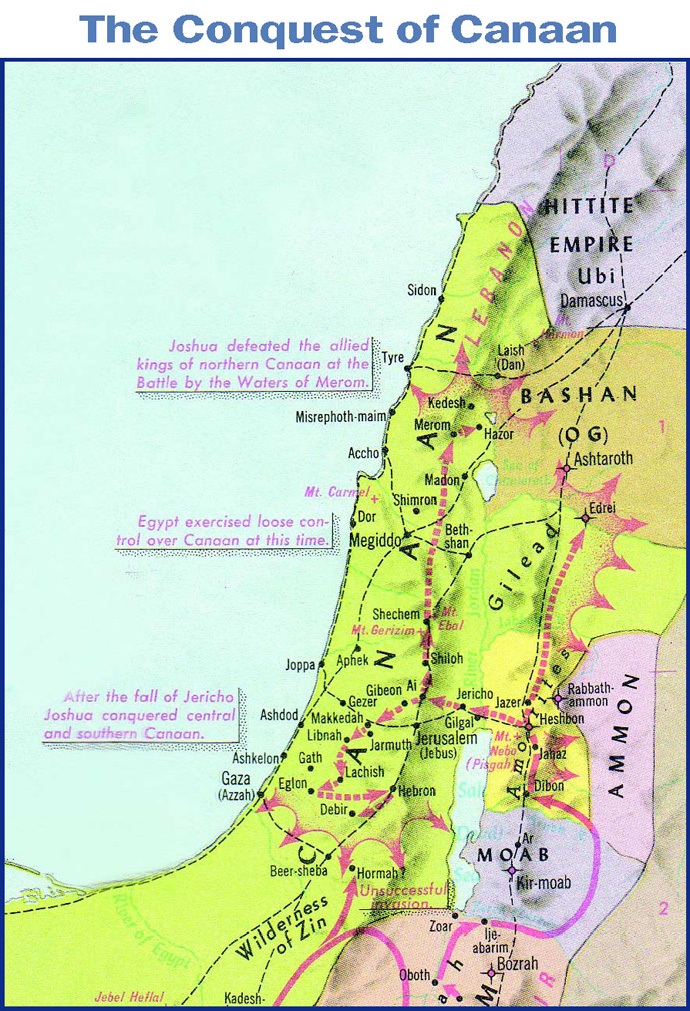
The text goes on to say that, if a false prophet should arise, and promote the worship of other gods by claiming supernatural knowledge of them, this prophet should be rejected and executed. And if members of your family urge you to follow other gods, resist them. Indeed, our text commands that all such people who advocate pagan worship should be put to death. If a whole town turns to paganism, there should be a herem on that town, people, animals and property. The valuables are to be burned and the town is not to be rebuilt. To carry out a herem is translated variously as to ‘ban’ or ‘proscribe’ or ‘totally destroy’. It is used typically of hostile towns, and, in today’s language, signifies ethnic cleansing or genocide. It is a term used very much in the book of Joshua, in which Joshua leads the Israelites into the promised land and battles to displace the Canaanites and other non-Israelite inhabitants.
So what is the agenda of the book of Deuteronomy, and by implication, the book of Joshua, which, according to the documentary hypotheses, has authorship in common with Deuteronomy?
The book of Deuteronomy plays a very significant part in the account, in the second book of Kings, of the reign of Josiah who had ordered repairs at the Temple in Jerusalem. A sefer Torah was discovered, which, by its content, appears to have been Deuteronomy. Josiah had it read aloud to the people and then set about destroying the idolatrous altars which proliferated in Jerusalem and beyond.
Josiah’s zero tolerance of pagan worship may have been influenced by the militancy of the Deuteronomists, or, vice versa; a case has been made (Frank Moore Cross) to say that the book was written to endorse Josiah’s policy. The suggestion that the passage we are going to read was written in a particular, historical context doesn’t sit well with the Torah min shemayyim view, that Moses received Torah on Sinai.
And this, I think, is the difficulty in the present context of synagogue worship. It’s relatively easy for me to explain the parasha by talking about the agenda of the Deuteronomists, but much more difficult to read it as Holy Scripture and then square it with the commandment to love the stranger. It would call for the kind of exegetical contortionism which is beyond me, so all I can say is listen to it yourselves and then, go figure.
It’s because there are passages like this in Tenach, difficult to explain at the very least, that I don’t like to quote other people’s holy books against them. The crimes people perpetrate in the name of scripture are their own crimes, not, as Richard Dawkins would have it, the crimes of religion per se.
And if God did give us the written Torah, he also gave us the world to inhabit. Nothing about our bible gives the impression that this will ever be easy, but then, according to a famous dictum from Pirke Avot, ‘It’s not for us to complete the work, though neither are we free to desist.’ Meaning what, in this context? Let’s say I mean that Torah is always a work in progress, never completed, not unlike the road works in Myddleton Park Road.
BALAK 5774
Posted on: July 1, 2014

This sidra, named Balak after a king of Moab, concerns the more famous Balaam, a pagan prophet and magician who was recruited by King Balak to curse the Israelites. Why did Balak want the Israelites cursed? Well, like Pharaoh in the time of Moses, he felt threatened by a population increase among the Israelites. Balak planned to contain this by getting a reliable and renowned sorcerer to pronounce a curse and stop the demographic expansion.
Archaeological evidence points to a real sorcerer called Balaam son of Beor. An inscription dated to around the eighth century BCE and unearthed in a part of Jordan, which would correspond with Moab, refers to Balaam bar Beor, a visionary. This fragment of an ancient plaster wall was discovered during an excavation in 1967. The eighth century is later than the events in the Wilderness described in our Torah reading, but it shows that Balaam’s name was known and associated with magic.
Balaam’s story in the bible is particularly memorable because he has a talking ass, who sees an angel as they travel to the court of King Balak. The ass opens her mouth to complain when Balaam strikes her with his staff. Then Balaam sees the angel, who tells him to proceed to Moab, but speak only the words which God will put in his mouth. Seeing an angel is probably less surprising than having a talking ass.
In the chapter which we’re going to read, Balaam has arrived at Bamoth-Baal, the high plateau where the Moabites worship their gods and, from there, he can see the encampment of the Israelites spread out below. Balaam tells the king that he requires seven altars, seven bulls and seven rams, which are provided.
God then appears to Balaam and tells him what to say. Balaam utters the first of his oracles – an oracle is a prophetic saying – in which he praises Israel and says ‘How can I curse whom God has not cursed?’
Balak is dismayed but doesn’t give up and tries moving Balaam to another high place, where seven more altars are constructed and more bulls and rams sacrificed.
Balaam then speaks again, a beautiful poem in which he says, ‘I received a command to bless: God has blessed, and I cannot revoke it.’
Twice more, Balak moves Balaam around, installing the requisite altars and supplying the livestock for sacrifice. Each time, Balaam looks upon the Israelite tents below and speaks the benedictions which God puts into his mouth. He says: ‘Mah tovu ohelecha Yaacov, mishkenotecha Yisrael!’ How good are your tents O Jacob, your dwelling places, O Israel.
Yes, these words come from a celebrated pagan sorcerer Balaam, hired by a Moabite king to curse Israel. After delivering the oracles, Balaam goes home, presumably on the same ass as before, and Balak gives up on cursing the Israelites.
Balaam’s oracles are full of archaic language and words uncommon in biblical use. Some scholars believe that these poems predate the narrative, the Balaam story, but there are other opinions, which see in them allusions to later events. Nobody knows.
Balaam has an afterlife in post-biblical writings. He is much discussed in rabbinic literature, mentioned by Josephus and Philo and alluded to in the New Testament and the Qur’an. Midrash offers a divided view, sometimes referring to Balaam as a great gentile prophet and sometimes calling him ‘the wicked Balaam,’ based on another story in the book of Numbers, where Balaam is a subversive figure, inciting the Israelites to idolatry.
Commentators have made a connection between Balaam’s story and Abraham’s role in the binding of Isaac, in Genesis 22. Balaam rose early and saddled his ass taking with him two servants. The same is said of Abraham. Balaam sets out in defiance of God’s command while Abraham journey is an act of extraordinary obedience. An angel appears to Balaam and, reversing the previous commandment, tells him to proceed on his journey to Moab. A heavenly voice calls to Abraham and tells him not to carry out the commandment but to lay no hand on Isaac.
The Akedah narrative ends with the words ‘So Abraham returned to his young men, and they arose and went together to Beersheba. And Abraham lived at Beersheba’. Balaam’s narrative ends: Then Balaam rose and went back to his place. And Balak also went his way.’
Balaam uses certain names of God: Shaddai and Elyon, which are not the most usual names. On the whole, it’s the Patriarchs who call God El Shaddai, God Almighty, and after the Patriarchs, in the Pentateuch, it’s only Balaam who uses it. The name Shaddai appears also on the Balaam inscription found in Jordan. God tells Moses, ‘I appeared to Abraham, Isaac and Jacob as El Shaddai.’ But to Moses He makes himself known by a different name. Regarding the name El Elyon, the Most High God, we hear it in Genesis when we learn that Melchizedek, who blesses Abraham, is the priest of El Elyon.
As for Balak, the Moabite king who plays straight man to Balaam and his talking ass, he is a descendant of Lot, Abraham’s nephew. You may recall how Lot’s narrative was interwoven with that of Abraham. Although that’s another story; it sheds light on the sidra of Balak, Abraham’s distant relation and a descendant of Terach, Abraham’s father.
So maybe the bible’s telling us: you can choose life, but you can’t choose your relations.
GL 5 July 2014
 >
>
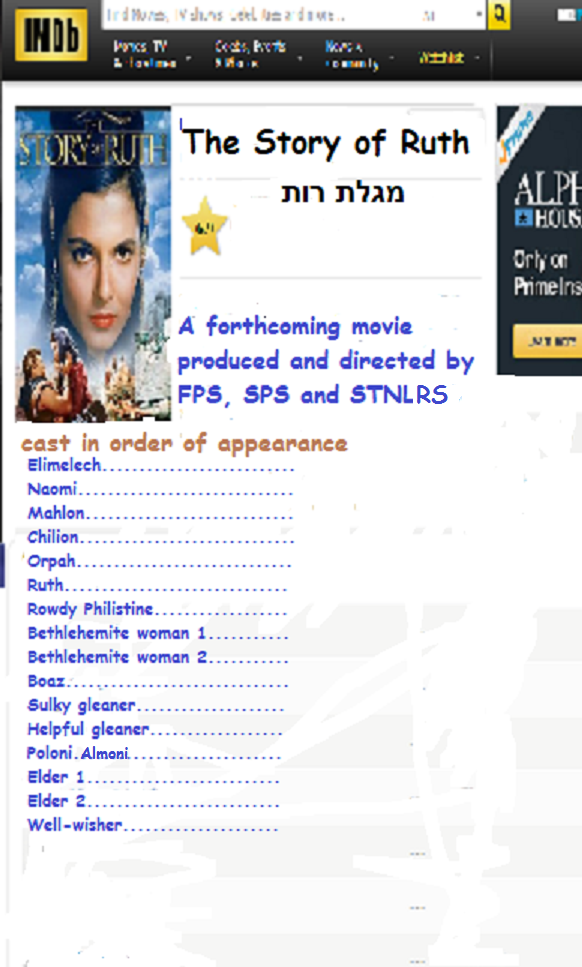
If you were making a movie of the Book of Ruth, how would you spin it?
Characters in order of appearance
Elimelech
It is the period of the Judges, after the Israelites have settled in the land, but before the time of the kings. Elimelech comes from Bethlehem, which makes it likely he’s from the tribe of Judah. This is confirmed when we learn that his relation, Boaz, is from the tribe of Judah.
Elimelech left the Land of Israel because of famine and went to live in Moab which was geographically roughly where Jordan would be today. The Moabites were often hostile to the Israelites, but they had a distant shared ancestry, being descended from Lot, Abraham’s nephew. The Moabites were polytheists and their chief god was Chemosh. According to 2 Kings 3:27, human sacrifice was not unknown.
Chapter I verse 3-4 of Ruth gives the impression that Elimelech died before his two sons married Moabite women.
He was survived by his wife Naomi, and two sons, Mahlon (מחלון) and Chilion (כליון).
Mahlon
Like his brother, he was born in Bethlehem. His name is associated with a Hebrew verb which means ‘to blot out, or erase. Although saddled with this unfortunate name, he survived ten years after his marriage to Ruth the Moabitess, during which time, they continued to reside in Moab. Another view of the name Mahlon is that it derives from mehilah, forgiveness, but I think this may be a Talmudic rather than a biblical word.
Chilion
His name is associated with being completed or finished. He also married a Moabite woman, Orpah, and lived ten years in Moab. Like Mahlon, he died without having children. We do not know his age at death, nor the age of his brother. It seems likely that they the brothers were adults when they got married as it is unlikely their father would betroth them from childhood to non-Israelite women.
The two brothers are something like Rosencrantz and Guildenstern; there is not much discernible difference between them.
The scriptwriter could do what he or she wishes, in order to differentiate their characters.
Naomi
Bereaved of husband and sons and learning that the famine in Judah is over, Naomi resolves to leave Moab and return home. She is well-disposed to her daughters-in-law and wishes them a happy furure, but neither expects nor needs them to accompany her. She is bitterly aware that it is too late for her to have more children, but reminds her daughters-in-law that it is not too late for them. She accepts the situation when Ruth insists on going with her.
When she and Ruth arrive in Bethlehem, she is so changed by time and suffering, that the women say ‘Is this Naomi?’ The name Naomi means ‘pleasant’ and she answers the women: ‘Don’t call me Naomi, call me Marah (bitter), because the Almighty has dealt bitterly with me.’
She encourages (lah lechi biti) Ruth to go to the field to glean corn, which was a means of livelihood for the indigent. It is only when Ruth comes back talking of Boaz that Naomi realizes the positive implications. She knows that Boaz was a kinsman of her late husband, and that he has responsibilities to herself and Ruth. She advises Ruth to glean only in Boaz’s fields.
Before long, Naomi tells Ruth that, seeking her well-being, she has a cunning plan: Ruth should dress up, then go to Boaz in the night and lie down with him. When she says to Ruth ‘He will tell you what to do,’ she may be thinking that Ruth will prompt Boaz to awareness of his duty, as a kinsman to the women, just as Tamar the ancestress of Boaz, prompted Judah to awareness.
Naomi does not, in so many words, tell Ruth to seduce him. The scriptwriter of this film must decide how to write this piece of dialogue between Naomi and Ruth.
The first thing Naomi asks, when Ruth returns from her night with Boaz, is ‘Who are you, my daughter?’ It is an enigmatic question.
Ruth has complete trust in Naomi, and tells her everything.
We learn that Naomi has inherited some land from Elimelech. Whoever buys the land from Naomi must marry Ruth, for this is the duty to Elimelech and his deceased sons.
Boaz buys the land and marries Ruth. When their son is born, the local women rejoice for Naomi, as if this were her grandchild, which, indeed the child is in a way, although they do not have DNA in common. So strong is the connection between Naomi and her daughter-in-law and so strong the obligation of Boaz to the family of Elimelech, that the women say ‘A son is born to Naomi.’
Orpah
Like Ruth, Orpah clings to Naomi and resists going home, yet Naomi’s words persuade her to turn back to her own people.
There’s a midrash which makes Ruth and Orpah sisters, princesses, daughters of king Eglon of Moab. Another midrash makes Orpah very promiscuous, and the mother or grandmother of Goliath.
I suggest that the bible offers enough drama for our film, and that, if we turn to midrashim, the volume of possible sources will complicate matters.
What we see from the biblical account is that Orpah was fond enough of Naomi to want to stay with her, and had sufficient ties with her country and people to want to be with them.
If you think we should use midrash to flesh out Orpah’s story, we can show her liaison with a character who appears in my cast list as Rowdy Philistine.
Ruth
Her significant relationships, as far as we can tell, are with Mahlon, Naomi and Boaz. We do not know if she loved her husband Mahlon, or mourns for him, but we know that she wants to stay with Naomi, until death parts them, living with her, converting to her religion, and being buried near her. During ten years of marriage to Mahlon, she did not convert to Judaism, so why now. If I were writing the film script, I would have a scenario where ruth is in love with Naomi.
In Bethlehem, Ruth wants to glean in the fields for their subsistence. She responds gratefully and modestly when Boaz, the land owner, shows her kindness and generosity. She is frank about being a foreigner.
She goes home, shares the barley she gleaned with Naomi and tells her everything that has happened.
She obeys Naomi without question, going to the threshing-floor where Boaz is asleep.
So honest is Ruth that she explains her presence next to him thus: ‘I am Ruth, your handmaiden. Spread your wing/covering over your handmaiden for you are a redeemer/near kinsman.’ This is a direct reference to a verse in Leviticus:
If your brother becomes poor and sells part of his property, then his nearest redeemer shall come and redeem what his brother has sold
Leviticus 25:25
The wing metaphor recalls Boaz’s words about Ruth taking refuge under the wings of the God of Israel. Alternatively, she may be asking him to spread his covering over her, but, although this is more intimate, the word canaf, meaning wing, is the word Boaz used about God’s protection.
Obeying Boaz, Ruth leaves the threshing-floor early in the morning. She is laden with barley which she takes home to Naomi and tells Naomi, as the bible says, ‘everything the man had done to her.’ (Ruth 3:16)
Ruth does not have a speaking part after this but we learn that Boaz marries her and they have a son, Obed,who will be the grandfather of David. The name Obed means servant. By chance, it resembles the word ‘obedient’ in both sound and meaning, but obedient comes from Latin, obedire (connected with audire, to listen).
The book of Ruth may have been written as a justification of marriage between Israelite men and Moabite women. Ezra and Nehemiah were strongly against such unions, but not everyone agreed, and, if King David’s grandmother was a Moabitess, this consideration would tilt the scales in favour of this kind of mixed marriage.
Rowdy Philistine
This extra-biblical character need only appear if you wish to develop Orpah’s story line.
Bethlehemite Women 1 and 2
These are both single line parts.
First woman: Is this Naomi?
Second woman: No way!
They recognize Naomi, but notice the great change which tragedy has wrought.
Boaz
When casting Boaz, you will need to consider his age and the nature of his interest in Ruth. According to some midrashim, Boaz was elderly (Ruth Rabbah 6:2) and did not even survive his wedding night. So you might want to think twice before casting George Clooney, or an even younger man. I’d quite like to see Sir Ben Kingsley as Boaz.
You could also use dramatic licence to make Naomi rather than Ruth the object of his affection.
The bible describes Boaz as a mighty man of valour or of substance: this could refer to a military past, wealth or personal probity. He certainly owns land and employs reapers, who are in the charge of a servant.
I am picturing Jean Valjean during his period as Monsieur Madeleine, the factory owner.
We see from direct speech Boaz is a devout and kindly man, esteemed by his employees. (Ruth 2:4)
He enquires about Ruth and the servant tells him that she is a foreigner from the land of Moab, specifically a young woman (naarah). So if we think the ten years of marriage have brought Ruth beyond girlhood, this seems not to be the case.
Boaz then tells Ruth to stay in his fields and glean freely, among the other girls, who we assume are Israelite, or Ruth’s foreignness would not have been mentioned by the servant. He tells Ruth he has forbidden the young men, workers or gleaners, to touch her.
Does he single her out because she is foreign (love the stranger), or because he knows of her loyalty to Naomi or because he is attracted to her?
Ruth bows in gratitude and asks Boaz precisely this question, what has she done to deserve his kind attention? His answer is that he knows about her praiseworthy conduct. He says
‘…a full reward be given you by the Lord, the God of Israel, under whose wings you have come to take refuge!”
At meal time, he asks her to sit near him, where she could reach the best things on the table. Ruth, who is modest and unassuming, sits beside the reapers, who pass the food to her. The reapers are Boaz’s staff, while Ruth is one of the poor people gleaning in the corners of the field. A question for the director and scriptwriter: does Boaz sit with the reapers and is Ruth actually sitting close to Boaz, as invited, or has she maintained some distance between them?
Boaz makes sure that Ruth has access to the best of the corn. One could certainly be excused for thinking he was smitten.
Boaz, a hard-working and hands-on land owner, sleeps on the threshing floor where the grain is threshed. He has eaten and drunk and is feeling good as he falls asleep. The authors of a midrash said that he felt good because he’d been studying Torah, not, in case you thought it, because of drink. I couldn’t possibly comment.
His reaction when he wakes to find Ruth beside him does not sound lustful; on the contrary, her presence reminds him of his halakhic duty to his late kinsman Elimelech. By Ruth’s few words, ‘…for you are a near kinsman,’ he understands her purpose and his duty. He praises her because she has not taken an interest in any of the young men, another indicator that he is well past youth and says he will do all she says – although Ruth seems to have said so little.
He explains that there is a nearer kinsman than himself and he will approach this man to see if he will fulfil the duty of the goel. If not, Boaz will marry Ruth. It is hardly a romantic scenario, and although Boaz asks Ruth to remain until morning. Is this to avoid being seen? It seems more likely that she will be seen if she slips away in daylight. Boaz gives her a present of barley, a large, heavy quantity to take back to Naomi.
The same day, Boaz goes to ‘the gate’ where public and commercial affairs are conducted. He finds the nearer kinsman there and calls to him, addressing him as ‘You,’ or ‘So-and-so’ or possibly ‘Yo, dude.’ The Hebrew term is Ploni Almoni, the biblical and Talmudic equivalent of John Smith, Joe Bloggs or Jon Doe. Alternatively, boaz addresses the man by his name, but the scriptural author does not choose to record it.
Boaz explains the situation, an aspect, which we, the readers, did not know: Naomi is selling land which she inherited from her husband. Ploni Almoni has first refusal. Only when Ploni Almoni has jumped at the chance of land acquisition does boaz make it clear that the land comes with marriage to Ruth. You can’t have one without the other.
The kinsman now withdraws and Boaz declares to the elders and witnesses at the gate that he himself will marry Ruth, the widow of Mahlon, so that the name of the late husband will not be lost.
Boaz and Ruth have a son, Oded and the book of Ruth ends with a genealogy which shows David’s descent from Ruth and Boaz. Mahlon’s name is not mentioned in the list of David’s forbears.
Ploni Almoni
This is called a ‘placeholder’ name – according to Wikipedia, most languages use this device, officially or unofficially to denote someone whose name is irrelevant or unknown.
In the Septuagint, Boaz addresses him as ‘Secret one’: Ὠδε κρυφιε.
Rashi, the 11th century commentator on Tanakh and Talmud, had an interesting view. Ploni Almoni’s name was concealed from posterity because he was at fault in rejecting Ruth. When he worried about ruining his heritage by marriage with a Moabitess, he was misinterpreting Torah, which forbids marriage with an Ammonite or Moabite – masculine nouns – but does not forbid marriages with the women of Ammon and Moab.
Ploni Almoni removes his shoe in the presence of witnesses as a sign of renunciation. This became the procedure of yibbum, according to the Mishnah and the Talmud. Boaz now takes command of the situation and redeems the land, Ruth and Naomi, the total inheritance of Elimelech.
Ploni Almoni may be concerned about what people will think, or perhaps he is already married with children. We do not know his reasons, but we know that Ploni Almoni is not a very respectful epithet.
I picture him as a fussy character, worried about appearances, not unlike Mr Collins in Pride and Prejudice. Our script writers however may have other ideas.
The well-wishers (to Naomi) in Chapter 4
Due to budget restrictions imposed by our studios, we have reduced the several well-wishers at the end of Chapter 4 to just one woman. This woman has quite a long speech and I think the rôle should be given to some well-known actress, as a cameo.
The women bless Boaz and Ruth, saying ‘May God make her like Rachel and Leah’; more unusually they say ‘Let your house be like the house of Perez whom Tamar bore to Judah.’
They bless God who has provided a near kinsman for Naomi, in this context, referring to the child of Ruth and Boaz. This baby will be a restorer of Naomi’s nefesh – life, or soul – for Ruth say[s] the women/woman is better to her than seven sons. Strangely enough, it is these women/this woman who name[s] the child, Obed. Stranger still, they/she say[s] ‘A son is born to Naomi.’ Ruth is viewed as a surrogate for Naomi. Remember that Ruth is a Moabitess. Is she regarded as being more acceptable as a surrogate than as a mother?
Epilogue
We will add some text, saying that Ruth was the grandmother of David. I would like to add that Ruth also makes it into the Christian scriptures, in the genealogical list at the beginning of the Gospel According to Matthew. Apart from Mary, only three women are mentioned in the long, mainly patrilinear genealogy. These are Tamar, who disguised herself as a prostitute so that Judah would do his duty by her as a near kinsman; Rahab, the prostitute who helped Joshua and the Israelites at Jericho, and Ruth.
In the illustrious company of these women, who have fallen only to rise, one wonders what really went on between Ruth and Boaz on the threshing room floor.


The Lord, the Lord …translating the tetragrammaton
Posted by: Gillian Gould Lazarus on: September 24, 2015
Notes for a discussion on Yom Kippur afternoon
This prayer, listing the attributes of God’s mercy, comes from Exodus 34, when God passed by Moses on Mount Sinai. The first two attributes are God’s name, which is translated in our 1985 Days of Awe machzor as, ‘The Lord.’ More recent Reform prayer books have dropped the name ‘Lord’ in favour of ‘The Eternal,’ ‘The Almighty,’ ‘Sovereign,’ ‘The Living God,’ or, simply, ‘God.’ Does ‘Lord’ have too many secular and gender associations to be an appropriate way of addressing God in prayer?
This is part of a larger question about the problems of translating scripture and liturgy. In the case of the Torah, there is a history, in the Aramaic targums, of translating freely and explaining or rationalizing the text in the translation. Some targums differ from the Torah text enough to be counted as a kind of midrash. In the case of public prayer, the translator or author has a considerable degree of creative freedom. Our machzor has prayers and texts both ancient and modern and it is currently being revised by the Movement for Reform Judaism. When the new version is published, we can expect a significantly different High Holy Days machzor from the present one.
To narrow down our discussion, I would like us to think about how we translate the name of God, which is represented by orthodoxy as Hashem, except in prayer when it is pronounced Adonai and which appears in the traditional English of the King James Version as Lord.
There are understood to be various problems with the name Lord. It suggests maleness, entitlement, wealth. It has negative associations through literary creations such as Sauron – the Lord of the Rings and Lord Voldemort, or through peerage, as in The House of Lords.
I would like to ask if you have a preference about the name you use for God, and if you have a sense of there being a difference in meaning between the names of God which we read in scripture and in prayer. Is the meaning of the prayer different, if the name is Adonai or Elohim or El Shaddai or Ribon ha Olamim?
I wonder how you would translate the first sentence of the Shema, if asked to do so, without reflection.
In our translations when reading the haftarah in our synagogue, we substitute the name Eternal in texts which otherwise use the translation Lord. This is reasonable as there is only one Eternal and many lords. However, the computer settings result in the name Eternal occurring when someone is addressing a person as ‘My Lord’ which happens particularly often when there are kings involved.
The draft erev Rosh Hashanah machzor produced by MRJ in 2014, has a few solutions: substituting ‘Our Living God’ for ‘Lord’ in the Amidah, or using the translation God, where the prayer or psalm has Adonai in the original Hebrew. The words ‘You’ and ‘Your’, capital Y, are utilised, when they fit the context. A possible problem is that the names Adonai and Elohim are not distinguishable in translation, when both are translated as God.
‘Living God’ is an informed choice, because the tetragrammaton is similar to the verb to be, and because God tells Moses at the burning bush, ‘I am who am.’ Our Living God mostly translates the locution Adonai Elohenu; however, in the Nishmat, this is translated ‘God our Creator.’
Our siddur, published in 2008, has more than one way of translating the tetragrammaton. In blessings, it offers Blessed are You, our Living God. Melech (King) is then translated as Sovereign to avoid gender specificity. Sometimes, the name is just God, which does not distinguish between Adonai and Elohim. ‘Source of existence and of all human strength’ translates ‘Ribon Haolamin v’Adonei haAdonim.’
The kaddish does not name God, although it speaks of His name and refers to God as the Holy One. The grammar referring to God is masculine, which is avoided in translation by saying ‘God’ instead of ‘He’ etc.
In the Shema, Adonai Elohenu becomes ‘the Eternal [is] our God.’
Adonai imloch l’olam vaed becomes ‘God alone will rule forever and ever.’
For Kumah Adonai veyafutzu oyevecha, the siddur has ‘Almighty God, rise up!’
Ki shem Adonai ekra is ‘I call out the name of the One God.’
For the Torah and Haftarah blessings, we say ‘Our Living God,’ as is the usual form for Adonai Elohenu.
In the Aleynu, we say ‘Almighty God’ and ‘the Eternal.’
There is a tradition of substituting Hashem for the tetragrammaton, or HaMakom – ‘the Place’ as in the Omnipresent – or, from Talmudic times, Ha Kadosh Baruch Hu – The Holy One, Blessed Be He.
Yah, short form of the name occurs 50 times in the text of the Hebrew Bible, of which 24 form part of the phrase Halleluyah. In Jewish tradition, there are many names for God. Some developed in the time of the Mishnah and the Talmud, such as Ha Kadosh Baruch Hu and Ha Maqom; a few are Kabbalistic, notably Ein Sof, Without End, and many of them are biblical, such as El Shaddai, El Elyon, Eloah, Yah and simply El which is also the name of a Canaanite god.
The date of the oldest known inscription of the tetragrammaton is 840 BCE, on the Mesha Stele.
In some of the earliest manuscripts of Greek translations of the bible, the Tetragrammaton was written in Hebrew letters; later it was translated as the Greek word, Kyrios, meaning Lord, while Elohim was translated as Theos. There is a view that Kyrios was not used in Greek translations of Hebrew texts until the time of the New Testament, which was written originally in Greek, and used the name Kyrios.
In Latin translations, Deus translates Elohim and Dominus translates the Tetragrammaton.
The first century Jewish philosopher, Philo of Alexandria, said that it is lawful to utter God’s name only in a holy place, which would be the Sanctuary of the Temple, by the High Priest. He said: ‘If any one should even dare to utter the name unseasonably, let him expect the penalty of death.’
According to the Mishnah and the Talmud, the name was pronounced only on Yom Kippur in the Holy of Holies, as we know from our Avodah service, which quotes the rabbinic sources.
The Masoretes, who added vowel points (niqud) and cantillation marks to the manuscripts added the vowels for ‘Adonai’ to the Tetragrammaton, so that the name could be read from the Torah, or in liturgy.
LXX Exodus 34:6
κύριος ὁ θεὸς οἰκτίρμων καὶ ἐλεήμων μακρόθυμος καὶ πολυέλεος καὶ ἀληθινὸς
Deuteronomy 6:4 Shema
’Ακουε Ἰσραηλ, Κυριος ὁ Θεος ὁ ἡμων, Κυριος εἰς ἐστι.
Vulgate Exodus 34:6
Dominator Domine Deus, misericors et clemens, patiens et multae miserationis, ac verax,
Deuteronomy 6:4
Audi, Israel: Dominus Deus noster, Dominus unus est.
French Ex 34:6
L’Eternel, l’Eternel, Dieu miséricordieux et compatissant
Or
Je suis le Seigneur ! Je suis un Dieu compatissant et bienveillant
Deut 6:4
Ecoute, Israël! l’Eternel, notre Dieu, est le seul Eternel.
Or
Écoute, peuple d’Israël : Le Seigneur notre Dieu est le seul Seigneur.
German Ex 34:6
HERR, HERR, Gott, barmherzig und gnädig
Deut 6:4
Höre, Israel, der HERR ist unser Gott, der HERR allein.
Italian Ex 34:6
Il Signore, il Signore, Dio misericordioso e pietoso
Italian Deut 6:4
Ascolta, Israele: il Signore è il nostro Dio, il Signore è uno solo.
Yiddish Ex 34
יהוה יהוה
איז אַ דערבאַרימדיקער און לײַ טזעליקער גאָט
Deut 6:4
הער, ישׂראל: יהוה אונדזער גאָט, יהוה איז אײנער
Outcome of the discussion
Some people said that they found male terminology obtrusive in prayer while others found the avoidance of gender specificity equally jarring. It was noted that the machzor, dating from 1985, used traditional terminology which the translators of the 2008 siddur had avoided. I did not get the impression that preferences regarding the English translation were an impediment to prayer for those in the discussion group. It was noted that the words of the Hebrew text are rarely changed, although the editing of the prayers may vary, due to theological differences. Editors seemed more willing to cut than to change. Those present expressed great esteem for tradition and the sense of being at one with other Jews across space and time, literally singing from the same hymn sheet! Yet they also esteemed enlightened, universalist values and thought it appropriate that these should be expressed in our Reform liturgy. Several people felt that the language of prayer resembled the language of poetry, being to some extent impressionist and euphonic, but not precise, least of all in the language used to and about God.