Archive for the ‘Uncategorized’ Category
Shabbat Shoftim 2013
Posted on: August 4, 2013

Today’s reading, Shoftim, which means ‘judges’ is so-called because the sidra opens with the words ‘You shall appoint judges and officers in all your towns that the Lord your God is giving you, according to your tribes, and they shall judge the people with righteous judgment.’
The verse which follows is repeated in the rabbinic Ethics of the Fathers and in our siddur:
‘You shall not show partiality, and you shall not accept a bribe.’
Devarim 16:19
The expression ‘show partiality’ doesn’t really convey the interesting metaphor in the Hebrew Lo takir panim v’lo tikkach shochad. ‘You shall regard no faces and take no bribe.’
From a previous verse in Deuteronomy, we read that an attribute of God is that He is not partial and takes no bribe, or, in a more traditional translation, ‘God…who regardeth not persons, nor taketh reward.’
Devarim 10:17
Asher lo yissa panim v’lo yikkah shochad, the literal meaning of which is He does not lift up faces and takes no bribe.
In Pirke Avot (4:29), you find the same phrase, V’lo masso fanim, [God] does not lift up faces, and on page 172 of the siddur, again V’lo masso fanim v’lo mikkach shohad, ‘He shows to favour and takes no bribe.’
Respecting persons, acknowledging faces, lifting up the face, showing favouritism is seen as a corrupt practice, which implies a recognition of who might be able to return a favour or who might gainfully be treated as important. This sort of respect works to the advantage of the powerful, influential or rich, who are in a position to return favours.
Masso fanim is part of everyday life and is understandable. The celebrity gets the best table in the best restaurant and the millionaire doesn’t have to wait in line for the bank clerk. Researchers found that, in job interviews, good looks and height are both advantages. You see why Napoleon had to take Europe by force. When Napoleon hadEurope, it was a good thing to be related to him.
Well, Deuteronomy tells us not to be snobbish or sycophantic in dealing with persons, and, in the wider context, it implies that we owe respect to a person for their humanity rather than their status.
There’s a Chasidic story of a certain famous rabbi whose distinction and erudition were belied by his insignificant appearance and ragged clothes. Some yeshiva students encountered him and were disrespectful, even treating him roughly. Afterwards they were mortified to learn it was the great Rabbi Poloni, and went to see him to beg his pardon.’
‘Please accept our apology and forgive our rude behaviour ,’ they begged. ‘We had no idea it was you.’
‘I can’t do that, ‘ said the rabbi, shocking the students who expected him to be kindly and forgiving. ‘I would forgive you,’ he added, ‘but I’m just not in a position to do so. You apologized to me because of who I am. But what about the person you thought I was?’
Shabbat Bemidbar
Posted on: May 13, 2013

This is the opening sidra of the book of Numbers. The reason why Numbers is so called is that, at the beginning of the book, Moses numbers the multitude of Israelites in the Wilderness of Sinai, a census, yielding a result of 603,550. This excludes Levites, women
and children, since the point of the census is to ascertain the numbers of men eligible for military conscription.
Whereas the Greek and Latin names of this book, Arithmoi and Numeri, also refer to the numbers counted, the Hebrew name Bemidbar means ‘In the wilderness.’ The words Bemidbar Sinai, in the wilderness of Sinai, occur in the first sentence, and Numbers does indeed relate the wanderings of the Israelites in the wilderness, their battles and rebellions and Moses’ continuing struggle to control and satisfy the mixed multitude of whom he is the reluctant leader.
Tribe by tribe, the Israelite men are counted, Levites excepted, as their role is to maintain the Tabernacle. A chieftain of each tribe is designated to assist Moses and Aaron in the census.
The Israelites camp in tribes, each tribe under their own banner, like the regiment of an army. The disposition of the tribes as they journey forth from their camp has every appearance of being strategic; essentially they are a fighting force.
Censuses in the bible tend to be discouraged. In Mesopotamian and Israelite cultures, they were considered unlucky, and a verse in Exodus prescribes that, when a census is taken of the people of Israel, each person counted has to pay a half shekel tax to avert plague and, as it happens, the number of half shekels contributed by Israelite men over twenty years of age amounted to 603,550 half shekels.
As you’ll see from the haftarah (1 Samuel 2) David’s unauthorised census resulted in a plague. Why was his census unauthorised? Nachmanides, following a midrashic tradition, said it was because David didn’t count to assess his military force but simply to know the size of the nation he ruled.
When Moses counts the number of potential warriors, he counts them l’gulglotam which means by their heads, or by their skulls, a term used elsewhere in connection with polling, or counting persons, for tax or census purposes.
Our English word polling, used in connection with voting in elections, is similarly based on the original meaning of the word poll, as the top of the head. When it comes to the polling booth, where the anonymous individual casts his vote in secret ballot, we have the same
delicacy about naming the voters as persons. The names are on the electoral register – that is how you get to vote – but the vote has a dynamic life of its own, not traceable to the person who voted.
The Israelite warriors, when counted, also become something other than persons. Their individuality is sunk in the collective noun of the fighting force the zva b’Yisroel, the host of Israel, just as the Israeli Defence Force today is called Zva Haganah L’Yisrael. As the
Israelites cross the wilderness, in danger of attack from many hostile tribes, the counting of the heads seems to be a regrettable necessity. By contrast with Moses, David takes a census, in the security of his kingdom and the plague follows. Numbering the population is adangerous activity, not to be embarked on lightly, perhaps because there is a humanitarian risk when one reduces a person to a number.
Moses and Aaron count the Israelites in units according to their tribe and their fathers’ houses. This creates a record of the relative size of the tribes in the second year after the Exodus. The largest tribe is Judah, being more than twice as populous as the smallest tribe,
Manasseh. In fact the three smallest tribes at that time were Ephraim, Benjamin and Manasseh, all Rachel’s tribes rather than Leah’s. This seems to indicate a lower fertility rate in those tribes, unless, even in the wilderness, they had recourse to what Mark Twain called lies, damned lies and statistics.
5773
Vayechi
Posted on: November 27, 2012
Genesis 47:28 – 48:22
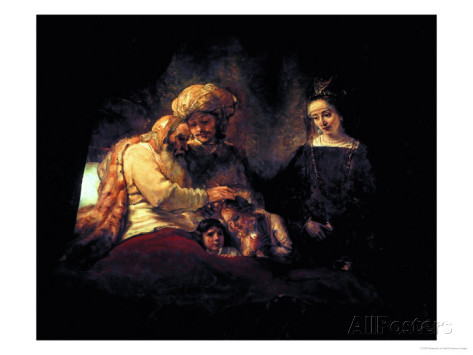
Jacob died at the age of 147. His last seventeen years were spent in Egypt, numerically equal to the seventeen years Joseph lived in Canaan, before his brothers sold him into slavery.
Midrashic and modern number crunchers have found reasons why Jacob didn’t attain the age of Isaac, 180, or Abraham, 175. This usually involves subtracting 17 from 147 to obtain 130, Jacob’s age when he complained to Pharaoh that his years had been few and difficult. After that, it goes beyond GCSE maths, and I won’t touch it.
Jacob makes Joseph swear that his remains will be taken for burial to the cave of the patriarchs in Machpelah, today’s Hebron. As the end of Jacob’s life is drawing near, Joseph takes his boys Ephraim and Manasseh to visit their grandfather.
Jacob tells Joseph that Ephraim and Manasseh will be like his sons Reuben and Simeon; this is a formula of adoption by which these two younger descendants gain equality with the two eldest. Jacob refers to the grief he suffered when Rachel died giving birth to Benjamin. Perhaps his adoption of these two grandsons of Rachel is a way of elevating the influence of her descendants among the more numerous descendants of Leah.
When Ephraim and Manasseh approach Jacob, or Israel as he is called in this verse, he asks ‘Who are these?’ Like his father Isaac in old age, Jacob is barely able to see. Like Isaac, Jacob gives precedence to the younger child, crossing his hands so that his right hand rests on Ephraim and his left on Manasseh, Joseph’s first born. Jacob had taken advantage of Isaac’s blindness to gain the blessing due to Esau and now, for different reasons, he again subverts the custom of primogeniture. Joseph thinks this is a mistake, resulting from blindness or senility but we, who have read Genesis, know this is invariably the way: Cain, Ishmael, Esau, Reuben and now Manasseh are displaced by younger brothers, a theme which will be reflected later on in the kingship of David and Solomon.
Jacob answers that he knows Manasseh is the elder, but Ephraim will be greater. Some people think this story is a retrospective explanation of the fact that Ephraim became the largest tribe of the northern kingdom.
Jacob blesses both the boys in a beautiful poem, asking God who has been Jacob’s shepherd throughout his difficult life to bless the children, multiply their descendants, and identify them as the family of Abraham, Isaac and Israel.
He assures Joseph that God will bring him back to the land of their fathers and expresses his intention to bequeath to Joseph, in preference to his brothers, the land which Jacob took from the Amorites, with his sword and with his bow. What is this inheritance which Jacob seized by force of arms, to give to Joseph? The word shechem means shoulder and there is an ambiguity as to whether shechem here refers figuratively to the portion Joseph is to inherit, or to the place Shechem, which, according to tradition, is the location of Joseph’s tomb.
The verse becomes curiouser and curiouser when we remember that Jacob, who was not a fighter, rebuked his sons Simeon and Levi for attacking the city of Shechem, and there is no mention, in the Torah, of Jacob’s military exploit against the Amorites or any Canaanite tribe.
Nevertheless, there is an account of Jacob’s wars with the Amorites and others, in a text called the Book of Jubilees. This is a reworking of Genesis, comparable to the reworking of biblical texts in midrash. Those who put a date to Jubilees tend to estimate that it originates around the Maccabean period, beginning about 165 BCE. Here are a few verses relevant to our sidra.
Jacob sent his sons to pasture their sheep, and his servants with them to the pastures of Shechem.
And the seven kings of the Amorites assembled themselves together against them, to slay them, hiding themselves under the trees, and to take their cattle as a prey…
And [Jacob] arose from his house, he and his three sons and all the servants of his father, and his own servants, and he went against them with six thousand men, who carried swords.
And he slew them in the pastures of Shechem, and pursued those who fled, and he slew them with the edge of the sword… and he recovered his herds.
This later work develops the idea of a militaristic Jacob, quite unlike the plain man, dwelling in tents, whom we know from Genesis. The last verse of our Torah reading fits in perfectly with the story in Jubilees, so perhaps Jubilees draws on an earlier, now lost tradition about the wars of Jacob.
Even without this warlike aspect, Jacob is an infinitely complex character: passionate, deceitful, astute, loving, long-suffering, pessimistic and devout. It is as if we get to know him more than we know the other patriarchs, and it is his name, Israel, which is our name.
Soul Searching
Posted on: September 23, 2012
Notes for a discussion on Yom Kippur 5773

CG Jung
‘The soul is Yours and the body is Your creation…’ (Machzor p326)
הנשמה לך והגוף פעלך חוסה על עמלך
Many of our prayers refer to the soul: nefesh or neshamah in Hebrew. Are body and soul distinguishable? What is the relationship of nefesh to neurons? How do the prayers of Yom Kippur connect with modern views of human thought?
One of the reasons why I chose this subject is that I think there is an interesting gap between the words we speak when we read the liturgy, and what we believe; for instance there is a great deal of soul talk on Yom Kippur, as in all religious services, but perhaps what we know or believe about the physicality of mind, thought and the emotions is at variance with the way we pray, however sincerely. I would like to know if you think there is that variance between the language of prayer and of belief, and if so, how do we mind the gap?
In philosophy since the twentieth century, the traditional idea of the soul being something apart from the body, no longer prevails. The mind is regarded as incarnate, the activity of the brain. The body is animate, experiencing emotion through hormones and neurons. Particular regions of the brain are associated with sensations, memories, emotions and there are contemporary psychological theories that ground religious belief within evolutionary adaptive cognitive functions.
The neuroscientist Antonio Damasio believes that decision-making and even perceptions are affected by feelings, which are set off by neural and chemical bodily signaling. He uses the term ‘somatic marker’ to describe the kind of gut reaction which often determines our actions.
Emotions, are defined by Damasio as changes in both body and brain states. Physiological changes occur in the body and are relayed to the brain where they are transformed into an emotion that informs the individual’s choice, along with the memory of past experiences. Damasio regards the emotions as adaptive and consistent with evolution.
The truly embodied mind… does not relinquish its most refined levels of operation, those constituting its soul and spirit. From my perspective, it is just that soul and spirit, with all their dignity and human scale, are now complex and unique states of an organism. Perhaps the most indispensable thing we can do as human beings…is remind ourselves and others of our complexity, fragility, finiteness and uniqueness. And this is of course the difficult job, is it not: to move the spirit from its nowhere pedestal to a somewhere place, while preserving its dignity and importance; to recognize its humble origin and vulnerability, yet still call upon its guidance. (Descartes’ Error by Antonio Damasio 1994 p252)
In1999, Tim Radford, the Science Editor of The Guardian chaired a discussion at Westminster Central Hall with Richard Dawkins and Steven Pinker. The topic of the discussion was the question: Is Science killing the Soul? Neither Dawkins nor Pinker believed in the soul as a ghost in the machine, that is to say, separate from the body, but both believed in feelings, sensitivity, creativity and imagination.
Steven Pinker says that we are accustomed to making inferences about other people’s thoughts when we perceive their behaviour, choices and responses. In primitive religions, people observed storms, floods or drought and inferred from them the displeasure of their gods, or God. Although Pinker believes that these inferences were mistaken he sees them as having a positive evolutionary value. Societies created bonding ceremonies or rituals which reinforced their shared beliefs and religious gatherings created a sense of kinship beyond the blood ties of the immediate family. He also maintains that religion has the function of ameliorating existential anxieties about death and suffering.
Pinker connects belief in immortal souls with the human ability to impute invisible minds to other people.
The responses we attribute to God are often based on scripture, from which we can form definite ideas about what God wants from us.
He has showed you, O man, what is good; and what does the LORD require of you, but to do justly, and to love mercy, and to walk humbly with your God?
The sacrifices of God are a broken spirit: a broken and a contrite heart, O God, you will not despise.
There is a view that three Hebrew words for the soul have distinct meanings, representing different aspects or levels of the soul.
Nefesh is used in the bible much more often than the word neshamah. Perhaps as a result of biblical usage, it is also the most frequent word for soul in our prayer books, although the neshamah is mentioned in the Shabbat and festival prayer Nishmat kol hai (which means the soul of all life) and the morning prayer Neshamah shenatata bi tehorah hi, which emphasizes the purity of the neshamah.
In the bible, neshamah is often breath, or spirit.
The spirit of man is the lamp of the Lord, searching all his innermost parts. (Proverbs 20:27)
Neshamah is used also of God’s breath, in Job 32:8
But it is the spirit in man (ruach hi b’enosh), the breath of the Almighty (nishmat Shaddai), that makes him understand.
The Spirit of God (ruach El) has made me, and the breath of the Almighty (nishmat Shaddai) gives me life. (Job 33:4)
In the biblical account, God formed man from the dust of the earth and blew into his nostrils nishmat hayyim, the breath of life so that Adam, the man becomes a nefesh hayyah, a living being.
In one of many midrashim on the creation of Adam, one of the sages says that neshamah and nefesh are the same, because the word hayyim, life applies to both, but other sages differentiate, saying that nefesh is the blood and neshamah the breath.
In the early Greek translation of the Hebrew bible (LXX), nefesh is usually translated as psyche (anima in Latin), and ruach, or the biblically rarer neshamah, as pneuma (spiritus in Latin, as in ‘inspire and expire), which is closer in meaning to breathing than to thinking. The spirit of God is also called pneuma/spiritus.
There are many rabbinic traditions concerning the separate existence of the soul – that it pre-exists the body, is independent of the body and that the dead converse among themselves. After the time of the Talmud, the early medieval philosopher Saadia Gaon, who was head of the Sura Yeshiva in Babylon took the view that the soul is created at the same time as the body and that the body has the potential to become purified by obedience to the commandments. He believed that the soul gives the body its faculties of cognition, reason and will power, and the body is simply the means by which the soul achieves its goal At the moment of death, a blazing angel arrives with sword drawn, and his appearance shocks the soul so severely that it is separated from the physical body. Pure souls are rewarded with a blissful afterlife while wicked souls are punished.
About a century later, the Andalusian poet Solomon Ibn Gabirol, some of whose poetry is in our machzor, expressed the view that the human soul reflects the World Soul, which emanates from God.
Maimonides wrote that the knowledge of God and adherence to the mitzvot gives human beings an immaterial, spiritual nature which endows the soul with immortality.
In the seventeenth century, Spinoza took the view that everything which exists is part of the soul of God, that evil is merely the absence of the good and that the way to attain immortality is through scientific and philosophical knowledge.
In the eighteenth century, R. Hayyim of Volozhin wrote a treatise called Nefesh ha Hayyim, in which he reasoned that God created humanity as the sum of all that went before so that each human being includes in his or her makeup something of everything whose creation preceded his or her own. This view sounds as if it could be developed in a way compatible with evolution. Each human being is a microcosm, representative of the multiplicity to be found in God’s creation. I wonder if this could be compatible with Professor Brian Cox’s poetic explanation of the physical composition of the human body – that it is, in a sense, made of stars.
This human being, says R Hayyim, is linked with God through a three-part soul made up of nefesh attached to ruach above it, while ruach is attached to neshamah above it. Yet the ultimate root of these three intertwined souls rests in God, the neshamah of the neshamah. In this way the lowest level of God’s own soul, as it were, can be said to lie within each separate human being, animating him or her.
A Jewish neurologist called Daniel Drubach writes about the plasticity of the brain, meaning that there is a bilateral relationship between brain and behaviour. An individual’s actions impact and “shape” the self, and the self, in turn, impacts and shapes behaviour. He quotes the Jewish philosopher Moses Hayyim Luzzato, who wrote, in the eighteenth century:
The outer action awakens the inner attitude. And the outer action being certainly more subject to man’s control than the inner attitude, if he avails himself of that which is in his control, he will in time acquire that which is beyond his control. Thus one becomes or changes through means of doing.
Path of the Upright, Moses Hayyim Luzzato
Going back to an earlier source, Drubach also quotes Maimonides, as follows:
We tell the wrathful man to train himself to feel no reaction even if he is beaten or cursed. He should follow this course of behaviour for a long time, until the anger is uprooted from his heart. Also, in his prescription of how to reach the “middle road” of all temperaments: How should one train oneself to follow these temperaments to the extent that they become a permanent fixture of his personality? One should perform, repeat, and perform a third time the acts which conform to the middle road temperament.
Drubach points out that the repetition of a motor sequence will lead to a change in the brain substrate for that sequence. He regards this neurobiological view as compatible with the views of the Judaic sages who believed that patterns of behaviour shape the self.
The prayer that we started with refers to the body as well as the soul; both are considered to be God’s work.
‘The soul is Yours and the body is Your creation; have pity on Your work.’
הנשמה לך והגוף פעלך חוסה על עמלך
When, shortly, we read Jonah, the haftarah for the Yom Kippur minchah service, we will see that these words hus (pity) and amal (created work) occur in close juxtaposition. God reminds Jonah of his pity for the gourd which withered, and which Jonah had not laboured to produce. Should not God have pity on Nineveh, full of human life?
Vayyakhel
Posted on: December 29, 2011
Exodus 35:20 – 36:7
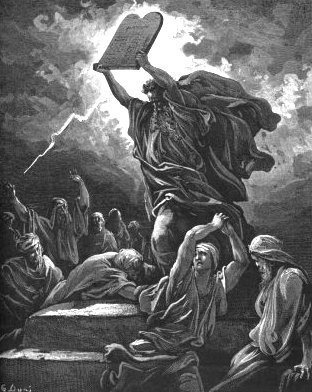
Where are we in the Exodus narrative, which features so many ascents up Mount Sinai, so many conversations between God and Moses, and so many instructions for the building and adornment of the Tabernacle, the portable Sanctuary in the wilderness?
Well, Moses has received the tablets of the law on Mount Sinai and the Israelites have committed the sin of the golden calf. Moses has broken the first set of tablets, and gone back up Mount Sinai, returning with two new tablets.
What happens next? Moses assembles the children of Israel and explains to them the commandment to observe Shabbat. He then charges them to make donations for God, that is to say, for the building of the Tabernacle. He asks for all kinds of precious metals and
valuable textiles, but – and this is repeated several times – the donations are brought only by those with a willing heart. The donors were highly motivated and purposeful, and, besides their valuables, they offered their artistic and creative skills. The women spun fine linen and the goldsmiths Bezalel and Oholiob crafted the treasures of the Tabernacle, with wisdom, understanding and knowledge – chochmah, tevunah and da’at.
For those who were in shul on Shabbat Terumah, just three weeks ago, is there not a sense of déjâ vu? For in Exodus 25, God spoke to Moses, telling him to obtain donations from those of a willing heart: gold, silver, onyx, linen, acacia wood – the whole bag of tricks.
Bezalel and Oholiob were charged with the metalwork, just as in our reading today. After the instructions for the Tabernacle, God told Moses to teach the Israelites the commandment of the sabbath: ‘V’shamru v’nei Israel et ha-shabbat, la’asot et ha-shabbat ledorotam brit olam’.1
Precisely while Moses was receiving these commandments, the children of Israel were making and worshipping the golden calf.
The order of events can be confusing for the reader, even for those who hear these sidrot read every year. In the first instance, Moses goes up Mount Sinai where God commands him concerning the Tabernacle and shabbat, in that order. Moses comes down, sees the calf and breaks the tablets. After punishing the wrongdoers, he obeys God’s command to hew two new tablets of stone, and takes them up the mountain. This time God does not write himself but dictates Torah to Moses. Moses returns from Sinai, numinously radiant and assembles the people. He speaks to them about shabbat and the Tabernacle, in that order.
The kind of literary structure which comes up quite often in the Torah is called chiastic, cross-shaped like the Greek letter chi. The pattern is ABCBA: Tabernacle, Shabbat, Calf, Shabbat, Tabernacle. This literary device is found also in non-Hebrew ancient and epic
literature, for example in Homer’s Odyssey and Iliad.
The passage we are reading today is sometimes seen as describing the repentance of the Israelites, after the sin of the calf, as they bring their treasures so willingly and in such quantities that the wise men tell Moses ‘The people are bringing too much for the work of
the task that the Lord charged to do.’2
But the people are fickle, unreliable. We saw that they donated their jewellery for the molten calf as eagerly as they donate it for the building of the Tabernacle. They are the same multitude of people, changing their opinions and affections, sometimes for Moses and at other times against him; they worship a molten idol and afterwards they worship God.
Moses appears capable of astute political judgment, as he channels the people’s dangerous, volatile energy into building the Tabernacle, governing his unruly nation by involving them in the creation of a Sanctuary where God can dwell among them.
Either Moses knows, or the author of Exodus knows, or God knows that people need sacred objects, sacred space and even sacred land to lead fulfilled religious lives.
A problem may arise if sacredness is seen as residing in the object, rather than in the process where the sacred object plays a symbolic part. Although the children of Israel were more than willing to contribute their gold for the molten calf, their fatal error was in worshipping as a god what was merely an installation. One of the things we hope to learn from these chapters of Exodus is how to call a calf a calf.
26 February 2011
Prayer for the people of Sharon
Posted on: October 9, 2011
Yom Kippur 5772
Do Not Let Their Homes Become Their Graves
href=”https://neviimtovim.com/wp-content/uploads/2011/10/cohen.jpg”>
The prayers of the High Priest
The Avodah service, which takes place during Mussaf on Yom Kippur, is based on the Temple service, as described in the Mishnah and the Gemara. The High Priest – the Cohen Hagadol – said penitential prayers on behalf of himself and the whole community.
When the High Priest emerged from the Holy of Holies, he prayed that the coming year would be fruitful, prosperous and peaceful, and then added the prayer v’al ha anshei Sharon… for those who lived in the region of Sharon, in danger of sudden earthquakes ‘…do not let their homes become their graves’.
Where does the prayer come from?
The source of this prayer is the Talmud Yerushalmi, also called the Jerusalem Talmud or the Palestine Talmud, or the Talmud of the Land of Israel (Tractate Yoma perek 5 hilchot 2).
The Jerusalem Talmud is shorter than the Babylonian Talmud, and was completed earlier, about 429 CE. As the name suggests, it is a product of the Land of Israel, probably from the academies of Tiberias, Caesarea and Sepphoris.
Life in Palestine had been more agriculturally based than amongst the Babylonian communities, so the Jerusalem Talmud pays more attention to agricultural halakhah than the Bavli, and also more attention to the geography of the region, which may be why we find this focus on the Sharon Plain, the northern half of the coastal plain of Israel, running from Jaffa up to Carmel.
What was the problem for the people of Sharon?
Our translation explains that the region was in danger of earthquakes, but the Hebrew words do not refer to earthquakes, or name any specific danger.
It may be that this region was subject to flooding, being on the coast.
There is a geological fault called the Dead Sea Transform, which extends through the Jordan River Valley, and is part of the Great African Rift Valley and this may have caused seismic disturbances. The geography of Palestine in the time of the Jerusalem Talmud shows that the Sharon was a marshy, swampy area, not easily cultivated until deforestation, around the third century.
The Babylonian Talmud has a more oblique reference, when commenting on exemption from military service. Deuteronomy 20:5 states that a man is exempt who has built a new house and not had time to dedicate it. The Babylonian sages considered the exceptions to this rule:
R. Eliezer says: also he who built a brick house in Sharon does not return home. A Tanna taught: [The reason is] because they have to renew it twice in a period of seven years.
Babylonian Talmud, Sotah 44a
Why do the prayers of the Avodah service conclude with this particular prayer, for the safety of a particular section of the population?
Yehuda Kurtzer (President of the Shalom Hartman Institute of North America): ‘The route to a universal vision runs through our particular experience of the world…If we cannot identify with the particular, will we be able to pray for the universal?’ (YK 2010)
Are earthquakes mentioned in Tanakh?
Resh ayin shin means earthquake, from a verb to shake or tremble.
1 Kings 19:11-13
Alone in the wilderness, Elijah sees a whirlwind, an earthquake and a fire, after which God speaks to Elijah in a still, small voice.
Isaiah 29:6
God tells Isaiah that he will bring thunder, earthquake and a tempest, save Jerusalem (Ariel) from her enemies.
Ezekiel 3:12
Ezekiel hears the sound of an earthquake, during a mystical, prophetic vision
Ezekiel 38:19
God tells Ezekiel that He will bring an earthquake and other upheavals on the day of a future, apocalyptic battle.
Amos 1:1
The time of Amos’s ministry as a prophet is said to be during the reign of King Uzziah of Judah and Jeroboam II, king of Israel, two years before the earthquake.
Zechariah 14:4-5
Zechariah prophesies about a future time when God will intervene to defend Jerusalem from her enemies, causing a rift in the Mount of Olives. The people will run away, he says, just as they fled from the earthquake in the days of King Uzziah.
What did the sages say in times of danger?
Rabbi Joshua says:
One who is travelling in a dangerous place should offer a brief prayer, and say: Save, Hashem, Your people, the remnant of Israel; even when they distance themselves through sin, let their needs be before You. Blessed are you Hashem, Who hears prayer.
Mishnah 4:4
The scriptural source for this mishnah is Jeremiah 31:7:
For thus says the Lord, Sing aloud with gladness for Jacob, and raise shouts for the chief of the nations; proclaim, give praise, and say, ‘O LORD, save your people, the remnant of Israel.’
Our Yizkor service includes a similar prayer:
‘Guardian of Israel, Guard the Remnant of Israel, and suffer not Israel to perish who daily declare Hear O Israel.’ p619 Yamim Noraim
The Talmudic sages used to add personal appeals to God following the set prayers and these were standardized in the Middle Ages, a time of danger for the Jewish people.
What is the modern Jewish response to natural disasters?
It is not to view the disaster as a punishment from God. I believe mainstream orthodoxy repudiates such a view as, of course, does Progressive Judaism. The modern Progressive Jewish response emphasizes human agency, regarding divine agency as a source of support rather than punishment. The modern siddurim include prayers where we ask God to make us strong and effective so that we are able to take responsibility, to withstand disaster and act for the good of the community; then as always, we ask God to spare us.
The High Priest prays for the safety of others, in the region of Sharon, but is it ok to ask God to give us things we want?
Hannah, whose story is told in the opening chapters of 1 Samuel, is cited by the rabbis of the Talmud as exemplary in prayer, and she does indeed ask God for the thing she longs for, a child. God answers her prayer.
Said Hannah before the Holy One, blessed be He: Sovereign of the Universe, of all the hosts and hosts that Thou hast created in Thy world, is it so hard in Thy eyes to give me one son? A parable: To what is this matter like? To a king who made a feast for his servants, and a poor man came and stood by the door and said to them, Give me a bite,8 and no one took any notice of him, so he forced his way into the presence of the king and said to him, Your Majesty, out of all the feast which thou hast made, is it so hard in thine eyes to give me one bite?
Berakhot 31b
Ribbono Shel Olam
Rabbi Nachman of Bratslav, a Chasidic master of the eighteenth century, used to address God with one of the many names used in Talmudic times: Ribbono Shel Olam. He used to repeat this name as a mantra to enhance kavanah in prayer. When God is addressed as ‘Master of the Universe’, the person who says it relinquishes their sense of controlling the world. A person can control his response to a situation, but the situation itself may be outside his control. A mantra can be an expression of faith, when words fail, or when we can’t find the right words, or when too many words make excessively difficult demands on faith.
When all else fails, zog tehillim
Psalms are often specially recited in times of trouble or danger. The Yiddish expression, zogen tehillim, refers to the recitation of psalms, when all else fails. Tsadikim of the East European communities used to say:
Rabosai, Mir Ken Zich Mer Nisht Farlozen Oif Nissim, Kum, Laz Mir Zogen
Tehilim.
My friends, we can no longer rely on miracles, come let us recite Tehillim.<a
A Goat for Azazel
Posted on: October 11, 2009
A Goat for Azazel, and Other Scapegoats
Yom Kippur 5770

Who coined the term ‘scapegoat?
The English word scapegoat was coined by William Tyndale who translated the bible into English, and it meant ‘the goat who escapes’. The Hebrew word for goat is seir. In Hebrew, the goat is not exactly called a scapegoat. It is the goat ‘for Azazel’.
What happened in our service on page 471?
And then he would take two goats, marking out one of them for the Lord and marking out the other as a scapegoat for the sins of our people.
Leviticus 16:7
וְלָקַח אֶת־שְנֵי הַשְּעִרִים וְהֶעֱמִיד אותָם לִפְנֵי יְיָ. וְנָתַן עֲלֵיהֶם גּורָלות. גּורָל אֶחָד לַיְיָ וְגורֵל אֶחָד לַעֲזָאזֵל:
At the bottom of page 475 we read:
He shall send the goat away into the desert in the care of a man appointed for the task. The goat will carry on itself all their sins to a solitary place; and the man shall release it in the desert.
Leviticus 16:22-23
וְשִׁלַּח בְּיַד אִישׁ עִתִּי הַמִּדְבָּרָה וְנָשָׂא הַשָּׂעִיר עָלָיו אֶת כָּל עֲוֹנֹתָם אֶל אֶרֶץ גְּזֵרָה וְשִׁלַּח אֶת הַשָּׂעִיר בַּמִּדְבָּר:
What is the origin of this part of the service?
The Mishnah
The source for the our Avodah service is Yoma, a tractate of the Mishnah which deals with matters relating to Yom Kippur. It is quoted at length between pages 469 and 473 of the Machzor. It tells us what became of the scapegoat.
The man designated to lead away the goat was customarily (but not halakhically) a priest.[1] He walked with the goat a distance of twelve miles from Jerusalem to the ravine in the desert.[2] Crowds of people accompanied the man along the way until the last mile or so when he went on alone.
He divided the thread of crimson wool and tied one half to the the rock and the other half between its horns, and he pushed it from behind; and it went rolling down, and was killed before it had reached halfway down the hill[3]
The man then waited till nightfall before returning to Jerusalem. A message that the scapegoat had reached the wilderness was conveyed to the High Priest, by means of sentinel posts from which flags were waved.
Rabbi Ishmael says:
Had they not another sign also? A thread of crimson was tied to the door of the Sanctuary and when the goat reached the wilderness, the thread turned white; for it is written, Though your sins be as scarlet they shall be as white as snow (Isaiah 1:18).[4]
אִם יִהְיוּ חֲטָאֵיכֶם כַּשָּׁנִים כַּשֶּׁלֶג יַלְבִּינוּ
In art
The thread of crimson wool is depicted by William Holman Hunt, the Pre-Raphaelite artist, in his painting The Scapegoat. Hunt wanted to depict an authentically Judean location with a genuinely Middle Eastern goat. He went to Palestine in 1854 and painted the Scapegoat against the background of the Dead Sea. He did not neglect his homework where Jewish writings were concerned so his goat has red wool between its horns.
Around the frame of the painting, which now hangs in the Lever Museum in Liverpool, Hunt inscribed two biblical quotations, one from Leviticus and the other from Isaiah:
And the Goat shall bear upon him all their iniquities unto a Land not inhabited. (Leviticus 16, 22)
Surely he hath borne our griefs, and carried our sorrows, yet we did esteem him stricken, smitten of God, and afflicted.’ (Isaiah 53, 4)
Juxtaposed in this way, the quotations suggest that the scapegoat represents a human being, burdened with problems offloaded by others. Hunt regarded the scapegoat as a Christological symbol, whose punishment and suffering enables the guilty to make atonement, without themselves suffering the punishment and this view was probably in keeping with mainstream Christian opinion.
Who was Azazel?
A non-canonical work called the Book of Enoch dating from around the late Second Temple period developed a mythology of fallen angels, with Azazel prominent among them. Enoch appears briefly in Genesis in the pre-flood genealogies:
When Enoch had lived 65 years, he became the father of Methuselah. And after he became the father of Methuselah, Enoch walked with God three hundred years and had other sons and daughters. Altogether, Enoch lived 365 years. Enoch walked with God; then he was no more, because God took him away.[5]
Azazel is represented in the Book of Enoch as one of the rebellious angels who came to earth in the time preceding the flood.
And Azazel taught men to make swords and knives and shields and breastplates; and made known to them the metals [of the earth] and the art of working them; and bracelets and ornaments; and the use of antimony and the beautifying of the eyelids; and all kinds of costly stones and all colouring tinctures. And there arose much godlessness, and they were led astray and became corrupt in all their ways.[6]
When God punishes the fallen angels, he has Raphael ‘bind Azazel hand and foot and cast him into the darkness: and make an opening in the desert and cast him therein’.
Rashi and Ibn Ezra suggested that Azazel was a place name, a rugged mountain from whence the goat was pushed.
Nachmanides commented on Leviticus 16:8 that Azazel belongs to the class of seirim, goat-like demons of the desert. The name Azazel appears in Mesopotamian mythology as one of the goat-demons, who were believed to haunt the desert. At least one scholar[7] has made a connection with the mischievous Greek deity Pan, who was half goat, to show the prevalence of belief in supernatural goat entities in Mediterranean culture.
Propitiation of the seirim existed among the Israelites to the extent that it was accommodated by King Jeroboam:
[Jeroboam] appointed his own priests for the high places and for the goat and calf idols he had made.[8]
וַיַּעֲמֶד לוֹ כֹּהֲנִים לַבָּמוֹת וְלַשְּׂעִירִים וְלָעֲגָלִים אֲשֶׁר עָשָׂה.
In a later work – perhaps first century CE – the Apocalypse of Abraham, Azazel appears as a bird of prey which came down upon the sacrifice which Abraham prepared, with reference to Genesis 15:11 “Birds of prey came down upon the carcasses, and Abram drove them away.”[9]
When Isaiah foretells desolation in Babylon , he speaks of the land being overrun by wild goats and birds of prey.[10]
But desert creatures will lie there, jackals will fill her houses; there the owls will dwell, and there the wild goats will leap about.
In the mythological background of the region there seems to be an association of the ideas of dry and desolate places with wild goats, birds of prey and possibly minor demons, such as Azazel.
Another suggestion is that the spelling עזאזל is a defective version of עזז אל, which sounds the same, and means ‘strong God’ or ‘fierce God’. This interpretation is more in keeping with Jewish monotheism.
The Scapegoat in Psychology
In 1997, a group of therapists formed the Scapegoat Society, as a resource for people who have experienced being a scapegoat, and for people working professionally to resolve scapegoat problems.
They defines scapegoating thus:
Scapegoating is a hostile social – psychological discrediting routine by which people move blame and responsibility away from themselves and towards a target person or group. It is also a practice by which angry feelings and feelings of hostility may be projected, via inappropriate accusation, towards others. The target feels wrongly persecuted and receives misplaced vilification, blame and criticism; he is likely to suffer rejection from those who the perpetrator seeks to influence. Scapegoating has a wide range of focus: from “approved” enemies of very large groups of people down to the scapegoating of individuals by other individuals. Distortion is always a feature.
The act of scapegoating involves a separation of good and bad, just as the two goats are separated and sent each to its own destiny. The badness is projected onto a scapegoat person or group, so the one who is doing the scapegoating can feel they are in the right and the scapegoat is in the wrong, the guilty one, the troublemaker.
Aaron Esterson, a colleague of RD Laing, wrote a book called The Leaves of Spring: Schizophrenia, Family and Sacrifice in 1970. Like Laing, he believed that so-called insanity was a rational response to extreme problems in the family, and he made a study of a Jewish family of five, where the parents projected negative feelings on to one of their daughters, aged 23. This was a family where hostility was covered up so that the family should appear united and well-regulated in the eyes of other people. When the daughter undermined this united front, preventing the parents from ‘keeping up appearances’ in the way that seemed normal and right to them, they considered that she must be mentally ill and brought her for psychiatric evaluation.
According to the Laingian school of psychiatry, schizophrenia was a construct used to explain away the patient’s reaction to an intolerable family situation. Members of the family failed to acknowledge existing problems among themselves and acted as if the problems would disappear if the so-called patient, the scapegoat, was removed.
Subsequently, trends in biological psychiatry and genetics detracted from Laing’s reputation and his views were widely rejected. It was thought that he scapegoated the families of patients, particularly the mothers whom he blamed for their children’s dysfunction. In recent years there has been some rehabilitation of Laing’s approach, his validation of patients and their experiences being considered by many a valuable contribution to psychiatry.
In literature
Disturbing families
In her novel The Elected Member, Bernice Rubens wrote about a Jewish family in which the gifted adult son is driven to mental breakdown by the burden of his family’s expectations. Writing in 1969, she quotes Laing’s soundbite: ‘When patients are disturbed, families are often disturbing.’ Notice that Bernice Rubens uses the term ‘the elected member’ to designate the scapegoat of the family, as if the requirement for the rôle of scapegoat existed before someone was chosen to play the part.
The controversial American feminist Andrea Dworkin wrote a book called Scapegoat: The Jews, Israel, and Women’s Liberation, published in 2000, in which she links misogyny and anti-semitism, pointing out parallels between these two forms of scapegoating through history. Dworkin argues that while Jews are scapegoated by non-Jews, Palestinians are scapegoated by Israelis, and women are scapegoated by men.
In anthropology
A pair of goats, a pair of birds and a pair of brothers
Mary Douglas, the anthropologist, writes about the scapegoat in her book Leviticus as Literature. She sees the pair of goats as an example of a binary pairing which occurs elsewhere in Leviticus: for example, in a ritual involving two birds where one is sacrificed and the other released.
The priest shall order that two live clean birds and some cedar wood, scarlet yarn and hyssop be brought for the one to be cleansed. Then the priest shall order that one of the birds be killed over fresh water in a clay pot. He is then to take the live bird and dip it, together with the cedar wood, the scarlet yarn and the hyssop, into the blood of the bird that was killed over the fresh water. Seven times he shall sprinkle the one to be cleansed of the infectious disease and pronounce him clean. Then he is to release the live bird in the open fields.[11]
Mary Douglas relates this ritual pairing in Leviticus to the narratives of the book of Genesis, where the narratives are concerned with pairs of brothers. Isaac, who was prepared as if for sacrifice on Mount Moriah, has a brother Ishmael who is sent out into the desert, to survive and become the father of a nation. Jacob has a brother Esau who is so unloved by his mother Rebecca that she conspires to have him dispossessed of his inheritance by Jacob.
James George Frazer’s The Golden Bough was first published in 1890, a defining work of anthropology, examining cultic myths and magic in places which were at that time accessible only to intrepid explorers. He found scapegoat-type rituals in the East Indian islands, in China, in Central and South America, East Africa, India and New Zealand. Frazer considered the rituals primitive, saying:
The notion that we can transfer our guilt or sufferings to some other being who will bear them for us is familiar to the savage mind.[12]
In some societies, where human sacrifice was practised, the scapegoat figure may have been a person, who was put to death, to ensure fruitful harvests. Some of you may remember the film The Wicker Man, on this theme. Human scapegoats were sometimes believed to have divine status. Consider the symbolism of Hunt’s scapegoat.
Frazer noticed that scapegoat rituals usually occurred on a yearly basis ‘…and the time of year when the ceremony takes place usually coincides with some well-marked change of season.’[13] The onset of dangerous conditions such as drought or flooding may be behind seasonal acts of propitiation.
In Midrash
Who was the prototype for the scapegoat?
לָקַח אֶת־שְנֵי הַשְּעִרִים
Midrash identifies the scapegoat (seir) with Esau who was called Seir, meaning hairy, and whose descendants lived in territory called Mount Seir, named after him. The connection with the seir for Azazel is unmistakable. Midrashic legend treats Esau unkindly, describing him as wicked, even from the womb and weaving many stories where Jacob represents goodness while Esau represents evil.
Rebecca tells Jacob to put the hairy skin of a kid on his hands in order to pass himself off more credibly as Esau and obtain the blessing from his blind father Isaac. With a mother like Rebecca, Esau really fits the Laingian view of the scapegoat.
Scapegoats and brothers
Ishmael and Esau are not the only scapegoats to be found in the Genesis narrative. Why was Cain’s face fallen?[14] Why did God accept Abel’s sacrifice and not that of Cain? We should remember that Abel died and Cain was sent away to become a wanderer on the earth.[15]
Staying with Genesis, we might consider the twelve brothers who became the twelve tribes of Israel – Joseph and his brothers. All the tribes flourished and, after the slavery in Egypt and the years in the wilderness, each tribe held territory in the promised land, so you might think there is not a scapegoat among them. However, we all remember how Joseph was roughly treated by his brothers and cast into a pit, to be sold to Ishmaelites.[16] When they returned to their father Jacob, how did they account for Joseph’s disappearance?
וַיִּקְחוּ אֶת כְּתֹנֶת יוֹסֵף וַיִּשְׁחֲטוּ שְׂעִיר עִזִּים וַיִּטְבְּלוּ אֶת הַכֻּתֹּנֶת בַּדָּם
Then they got Joseph’s robe, slaughtered a goat and dipped the robe in the blood.[17]
Jacob, who used the skin of a goat to deceive Isaac, is himself deceived by the skin of a goat.
A goat is slaughtered by Joseph’s brothers, but Joseph is brought alive to Egypt.
There is a Christian tradition of identifying Joseph with the suffering servant of Isaiah 53 and of reading Christological symbolism into the Joseph narrative of Genesis.
Religions as well as families require scapegoats so that sins may be expiated, but the scapegoat plays a vital rôle in the ritual and is by no means an object of hatred.
We should note that only in the Mishnah is the scapegoat pushed over a cliff. According to Leviticus …the goat shall bear upon him all their iniquities unto a land not inhabited: and [they] shall let go the goat in the wilderness.[18]
The scapegoat may be burdened, symbolically, with the transgressions of the Israelites, but once it reaches the wilderness, it is home free.
[1] Yoma 6:3
Yoma 6:4
[3] Yoma 6:7
[4] ibid 6:8
[5] Genesis 5:21-24
[6] 1 Enoch 8:1-3a
[7] The High Places of PalestineW F Albright
[8] 2 Chronicles 11:15
[9] Apocalypse of Abraham 13:4-9
[10] Isaiah 13:21
[11] Leviticus 14:3-6
[12] The Golden Bough OUP p557
[13] ibid p587
[14] Genesis 4:6
Genesis 4:12
[16] Genesis 37:27
[17] Genesis 37:31
[18] Leviticus 16:22
Mikketz
Posted on: August 14, 2009
Mikketz 2008
Genesis 43:15-44:17
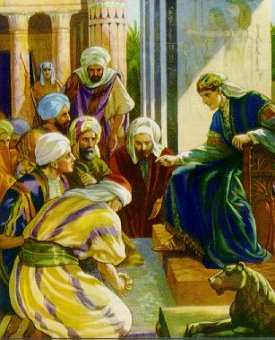
There are parts of Joseph’s story which most people remember: for example that his jealous brothers sold him into slavery and that his personal qualities and clairvoyant skills resulted in him becoming Pharaoh’s right hand man. You may recall that years later, Jacob sent Joseph’s brothers to Egypt to obtain grain, because there was famine in the land of Canaan. When the brothers arrived in Egypt, they failed to recognize Joseph, now the Viceroy or Prime minister, and Joseph showed what must have seemed an odd and threatening interest in these Hebrew brothers from Canaan. He accused them of being spies, demanded that they bring their brother Benjamin to Egypt and meanwhile held Simeon as a hostage to settle the matter. Finally, as the brothers travelled home, they found that the money they had paid for the grain had been returned to them, placed inside their sacks.
Today we read that, when the famine continued, Jacob sent his sons again to Egypt. This time they brought with them Benjamin, much against Jacob’s wishes, for Benjamin, like Joseph, was the son of Rachel, and Jacob favoured the sons of Rachel above the sons of Leah.
Besides Jacob and his twelve sons, there is another player with a speaking role in this part of the Joseph narrative. This is Joseph’s house steward whose name is not recorded so he is called simply הָאִישׁ אֲשֶׁר עַל בֵּית יוֹסֵף, the man over Joseph’s house. This character appears benign but unexpectedly well-informed, knowing some things which he could have learned only from Joseph.
To him, the brothers confide their fears, that they will appear as thieves, because their money had reappeared in their sacks, and that the Viceroy will deal harshly with them, perhaps even take them as slaves. It is an ironic turn of events that the brothers who sold Joseph into slavery now fear being enslaved by him; ironic also that they are wrong in one way and right in another, for Joseph will not enslave them yet their descendants are destined of course to become slaves in Egypt.
Joseph’s house steward says: ‘Do not fear; your God and the God of your father has given you treasure in your sacks.’ He then reunites them with Simeon who had been held hostage and brings them to Joseph’s house, where they receive five star hospitality.
I am curious about this steward and the way he is just called ‘the man,’[1] combined with the fact that the brothers refer to Joseph as ‘the man’[2] and the brothers, if you look closely at this chapter, are not called ‘the brothers’ but ‘the men.’[3] They are called Joseph’s brothers only at the moment when he reveals to them his true identity, which is not yet, not this week.
At last Joseph appears and the brothers bow before him, just as in the dream, which Joseph, as a teenager, related to them, causing them to hate him. They dine with Joseph and get drunk with him, but Joseph never lets down his guard. The next day, he tells his steward to put the men’s silver in their sacks, as before, and to plant in Benjamin’s sack a valuable silver goblet. Years before, the brothers were paid in silver when they sold Joseph to Midianite traders, and now silver keeps coming back to them, an unwanted reminder of a matter they must have hoped was closed.
Joseph gives his steward the job of pursuing the men and accusing them of theft. Although they protest their innocence, the goblet is of course found, to their horror, in Benjamin’s sack. It is, we learn, a ‘divining cup,’ which Joseph uses for divination, a common practice in Egyptian society, and Joseph in particular has a tendency towards the psychic, in his own prophetic dreams and the dreams which he interprets.
The men return to the city and now Judah begins to play a prominent role, acting as a spokesman for his brothers and attempting to protect Benjamin from punishment.
Joseph however declares his intention of keeping Benjamin as a slave and says ‘The rest of you go back in peace to your father.’ The traditional interpretation is that he is testing his brothers, to see if they will abandon Benjamin, as he himself was abandoned, or if they have repented and changed.
The themes of identity theft and deception are part and parcel of the Joseph story. They begin in the previous generation, when Jacob disguises himself as Esau and continue when Laban puts Leah in Jacob’s tent instead of Rachel. Then Joseph’s brothers lie to their father, telling him that Joseph had been killed by a wild beast. Now Joseph withholds the truth from his brothers, exercising his power over them to create fear and revive guilt.
We await the moment of revelation and reconciliation, which will come in the next sidra, with the whole family together in Egypt and the stage set for slavery, exodus and nationhood.
Stay tuned.
[1] see also Genesis 37: 15-17
Genesis 43: 3, 7, 14
ibid vv 15, 17, 18, 24


Shabbat Chazon 5769 (2009) and 5775 (2015)
Posted by: Gillian Gould Lazarus on: July 26, 2009
When I wrote this, in 2009, Tisha b’Av did not seem the most relevant of our festivals. I have no desire to see a third Temple on the Temple Mount, only to see peace there, an idea now as remote as that of rebuilding the Temple. Tisha b’Av, six years ago, seemed a conduit to historical troubles and tragedies, which, b’ezrat Hashem, we would remember but not relive. Now the year is 5775 (2015): antisemitism is present in Europe, America and of course in the Middle East. Our detractors even wish to deny us the word ‘antisemitism’, saying that we are not Semites – as if to say that antisemitism is culpable but hatred of Jews is acceptable. Some of us are critical of Israel’s present governmant, but our fate is nevertheless intertwined with it, bound like tefilin round the left arm. This year, we are truly bein hametzarim – between a rock and a hard place, between Israel and the diaspora. The coming shabbat will be Shabbat Chazon, the Sabbath of Vision, and the evening will be the onset of Tisha b’Av. I pray that we are all delivered safely through it, towards Shabbat Nachamu the following week: the shabbat of comfort.
Torah introduction at ******, 5769:
There’s an old joke to the effect that Jewish festivals can be summarized as follows: ‘They tried to kill us. We survived, let’s eat.’ I can’t tell you where this originated but it’s short, sweet and contains an element of truth. Many of our holy days commemorate historical occurrences outside our control, for example the slavery in Egypt or the wandering in the wilderness, or Haman’s plot. Then we celebrate our deliverance from the event through rituals of remembrance and sanctification: the seder, the succah, the reading of the Megillah. This doesn’t apply only to Jewish notable days. Armistice Day on 11 November works in the same way. A catastrophe comes at us from outside and we give it pattern and meaning and, in our case, a place in the Jewish calendar.
Today is Shabbat Chazon, named after the first word of the haftarah, the first word in fact of the book of the prophet Isaiah. It means ‘vision’. When you see Shabbat Chazon on our haftarah sheet, you know that the ninth day of the month of Av will occur in the coming week.
It might seem that Tisha b’Av barely registers on the radar of most Reform Jews. However, anyone who has attended a shabbat service during the last three weeks will have heard one of the three haftarot of rebuke which fall in the three week period between 17 Tammuz and 9 Av.[1] Even if you don’t notice Tisha b’Av on the day itself, the season wafts past like a ripple in the air, every summer during the dog days.
Tisha B’Av was a day of destruction for both the first and the second Temples in Jerusalem. The first was destroyed by the Babylonians under Nebuchadnezzar; the second by the Romans under Titus. It is a day associated with many disasters from Jewish history: the defeat of Bar Kokhba’s rebellion in 135, the expulsion of the Jews from England in 1290 and from Spain in 1492. Many tragedies also befell the Jews on 9 Av in the twentieth century, especially during the Shoah.
The 17th of Tammuz, three weeks earlier, is the day when the Babylonians breached the walls of Jerusalem and later so did the Romans, give or take a day or two. The rabbis of the Mishnah set aside these days, to mourn and to fast. For their own reasons, the Babylonians also observed 9 Av as a day of sorrow, perhaps because the height of summer in that region is naturally a time of drought with its attendant dangers. This too may have encouraged the Israelites exiled in Babylon to look on the season as a time of mourning.
The Babylonian exile lasted only fifty years and was followed by a return and a restoration, but the Roman triumph in 70 CE exiled the Jews until 1948.
The Crusaders, the Inquisition, the Cossacks, the Nazis have all been likened to the Romans, doing their worst on Tisha B’Av.
Sometimes, in Rabbinic literature, Rome was called Edom – Esau’s other name – a code which enabled the rabbis to refer to the Romans without alerting Roman censorship.
The historian Martin Goodman suggests in his book Rome and Jerusalem that it was not so much Roman policy, as a series of uncontrollable developments which propelled events towards catastrophe. After the death of the emperor Nero, Vespasian and his son Titus became major contenders in the competition for power and, in this cause, much depended on a conclusive victory in Judea, their theatre of war. According to Josephus, Titus was reluctant to destroy the Temple in Jerusalem because he considered it a magnificent work and an ornament for the Roman empire.[2]
Josephus reported that the burning of the Temple came about when a Roman soldier, without orders, snatched up a burning brand and threw it into the Temple.[3] When the Temple was destroyed, Titus’s only option was to proclaim a triumph and demonize his enemy, the people of Judea.
The war with Rome is a history of attrition, ambition, chaos and expediency but it has also a religious significance, representing Jewish tragedies, both ancient and relatively recent, recalled through our modern understanding.
The Jewish calendar is like a lens through which patterns in history come into focus and are more clearly visible and Tisha b’Av, for all its darkness, helps us to see the pattern when we hold the lens before our eyes.
Gillian Lazarus July 2009
[1] Bein haMetzarim, ‘between the straits’.
[2] Rome and Jerusalem Martin Goodman Penguin 2007 pp440-444
[3] Jewish Wars Josephus 6,4