Through much of August, the present month, a neonazi whom I’ve assumed to be one person has been a feature of my daily experience on the social media platform formerly known as Twitter. Excuse me if I don’t screenshot their work for you to see. Their posts are mainly cartoons of the ‘happy merchant’ a cartoon figure on social media representing Jews according to Nazi iconography: a bearded man wearing a kippah, always rubbing his hands while wearing a cunning yet fearful expression. As with the illustrations of Der Stürmer in Nazi Germany and its forerunners elsewhere in Europe and America, the Jewish character is always shown engaged in some act of deception or exploitation. These cartoons, along with idealized photos of Hitler, pictures of gas canisters and references to what he calls the ‘Shoax’ – elision of Shoah and hoax, obviously – appear regularly in my notifications and those of other Jewish people active on X as we must now call Twitter.
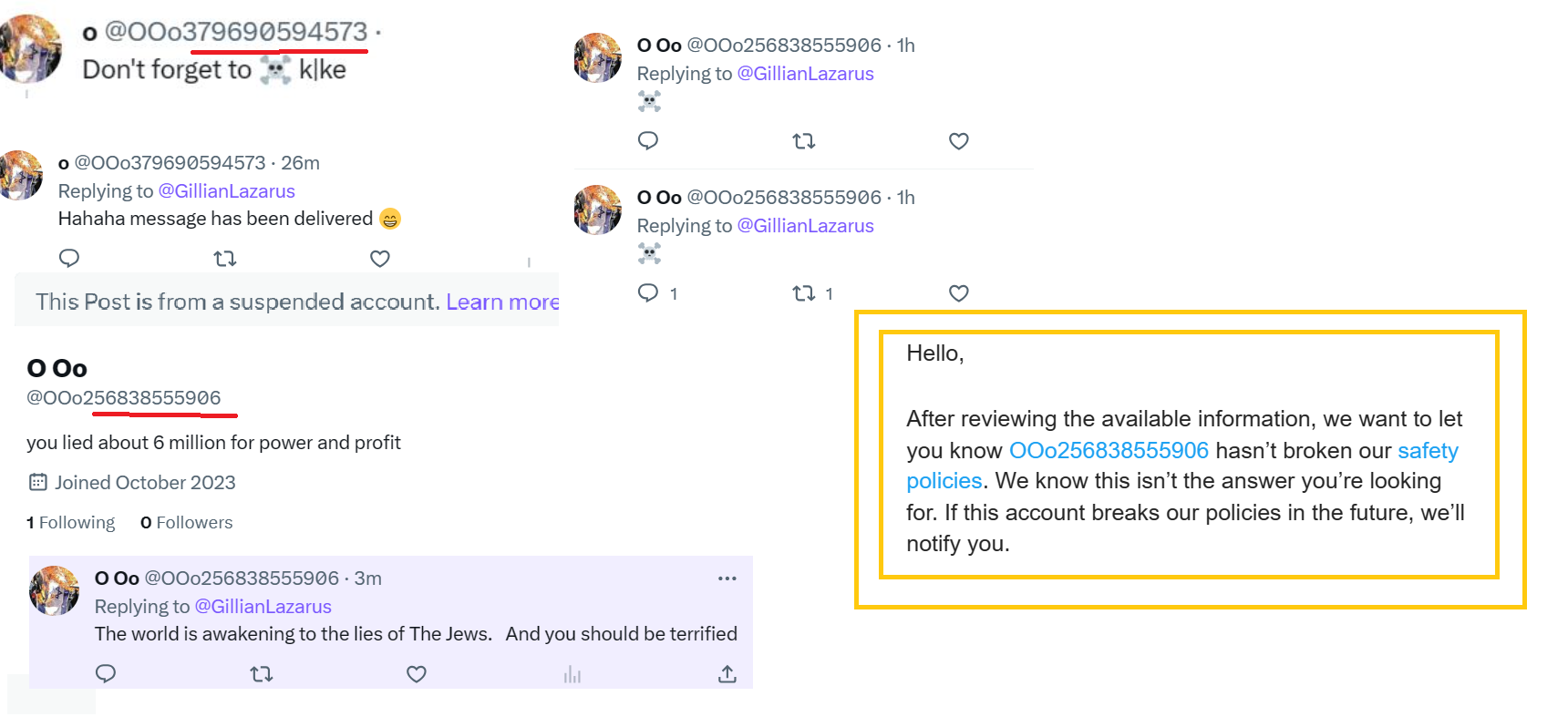
It has become a grotesque game in which I call for the neonazi account to be reported; it gets reported; after a day or several days, it gets locked or suspended by Twitter Support; within a few hours it reappears with a new user name, sometimes just a minimally tweaked version of the previous name. For their user name, they opt usually for a letter of the alphabet followed by a string of digits. Being created anew so to speak every day, they have zero followers, sometimes acquiring one or two followers during the ephemeral Twitter life of each of their accounts. Clearly, they are present not to win friends and influence people but to show individual Jews, eg myself, that they can express open and violent racism and neither I not Twitter can stop them doing so. I have likened their tweets to me as the jump scare moment in horror films: they appear when I think they have gone.
Of course I no longer think they are gone. I know they will be back every day.
When Twitter locks an account, the tweets remain visible, unless the person complies with Twitter requirements by deleting the offensive posts. An account may be locked and kept on the back burner, so to speak. If suspension occurs, the account will be gone, except that, in the present case, they have a new one ready to go, with a new user name. As far as I understand it, they would need to create a new email address for each new account. As for IP numbers by which a user theoretically might be identified, there are ways of getting round this which I can’t get my head round.
I imagine that it should not be beyond the wit of Twitter or X to have a system less hospitable to aggressive neonazis and racists. I am always hoping that someone might work out how Twitter could manage this and that Twitter/X itself would be willing to invest in a support system which would act more stringently against hate speech. Some say it is in the interests of social media to promote adversarial content. I am inclined to think it would just be too difficult and time consuming for them to attempt to contain it.
Otherwise I shall have to look at Julius Streicher type cartoons and fan pics of Hitler whenever I click on my notifications or alternatively, to Jexit at last from the platform.
Post script
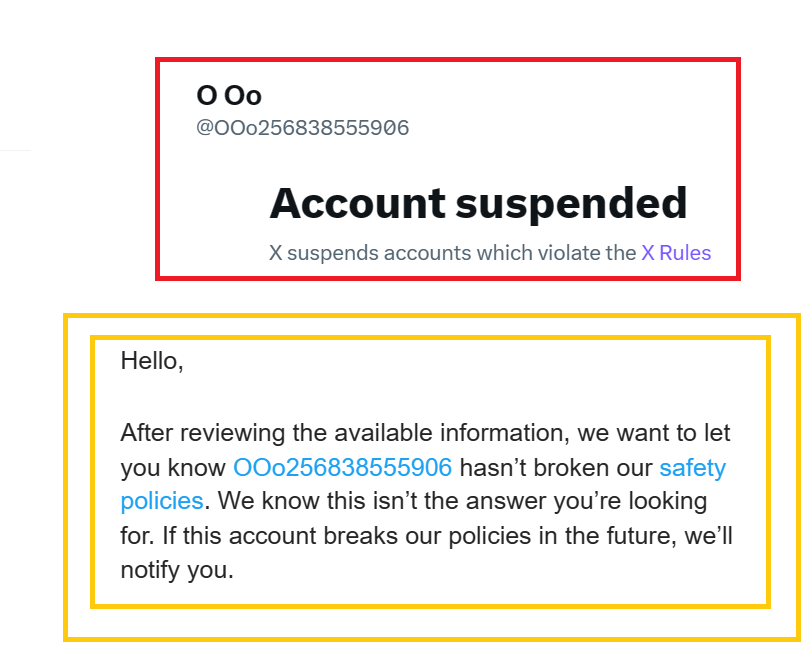
Since I wrote the piece above, the person has been suspended and returned many times. I say ‘the person’ because of the modus operandi, the linked Twitter handles, adjusted by a sequential letter or a change of digits, but of course it may be several persons, unconnected by anything other than their steadfast Hitlerphilia. The person who tweeted to me ‘Don’t forget to die Kike,’ did not go against Twitter’s safety rules I was informed and yet, minutes later, I was pleased to see the account has been suspended. Minutes after that, the Hitlerphile returned with an adjustment to their user name, to assure me that there is no seeing them off of the Twitter platform.
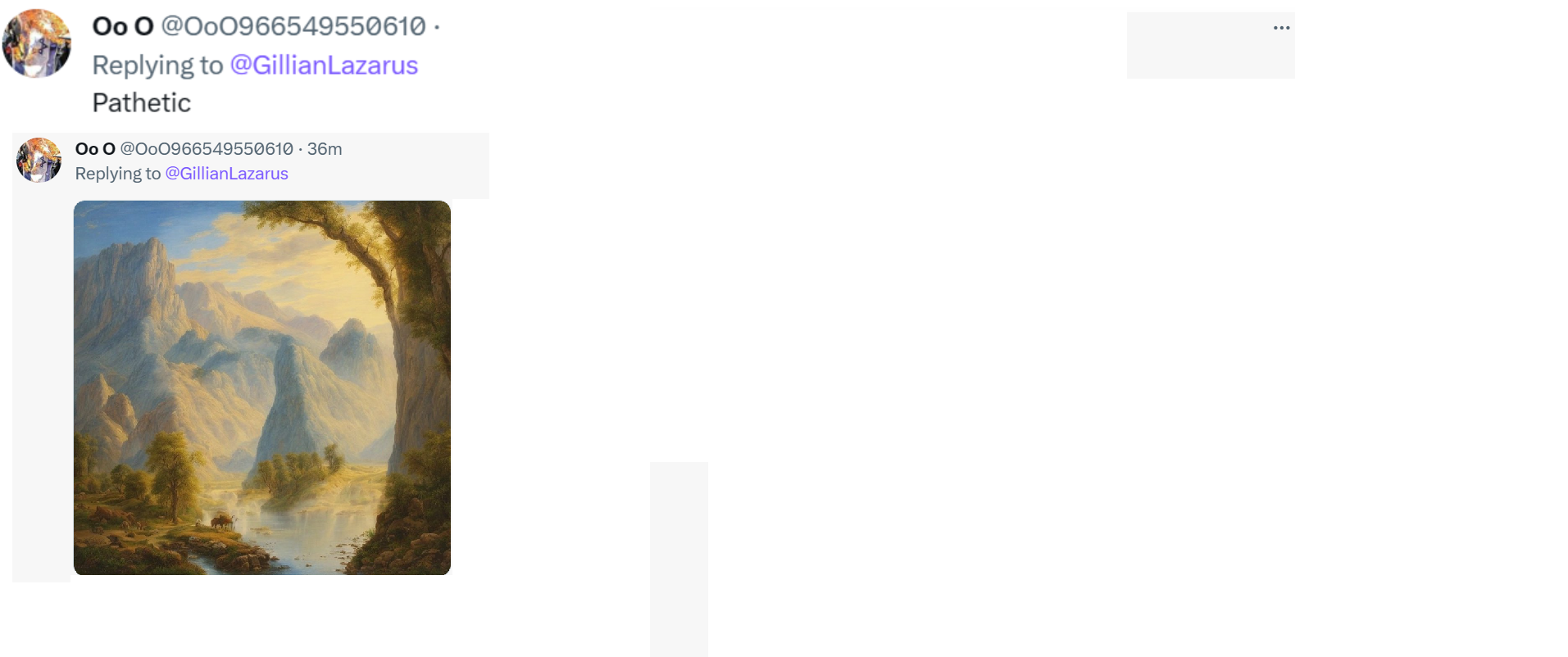
They have left their calling card again. They must consider it a win that they can carry on tweeting to Jews, with their Holocaust denial and Holocaust threats.
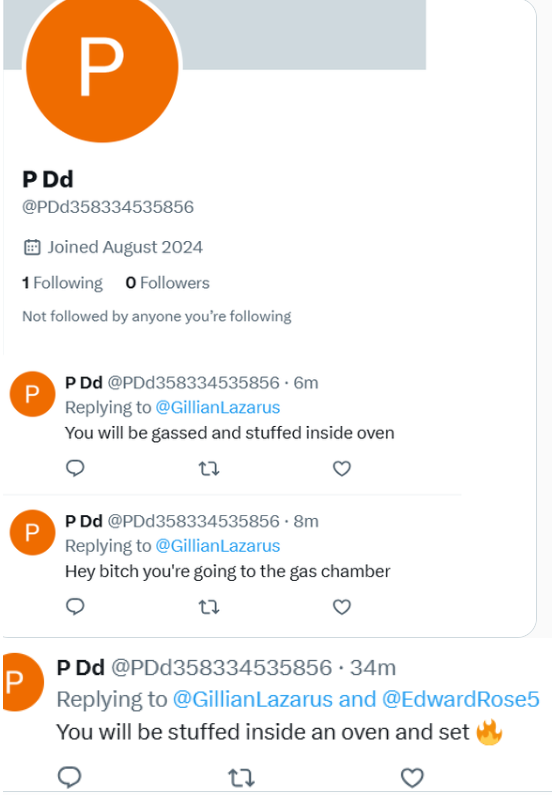
One year later, August 2024, they tweet to me as follows:
To another Jewish woman, they send these messages:
Are they a danger to their community in Colorado? I don’t know. I don’t know who they are.
Walking the mile to the local M&S, I had an annoying earworm of ‘Second Hand Rose,’ as sung by Barbra Streisand channeling Fanny Brice:
Everyone knows I’m just Second hand Rose From Second Avenue
I could not imagine why this song was so persistent in my head and, only on the return, as I approached my front door, did I recall that I had received this tweet, in regard to Israel uncovering arms caches in Jenin and killing ten young Palestinian men in gunfights.
This is not unusual, and even the intensifying ‘Everyone knows’ is not unusual, but I do tend to hover doubtfully over this assertion of universal knowledge, which I believe occurs when the speaker wants to amass notional support for their personal point of view. I would be inclined to say that everyone knows a triangle has three sides, a tautological truth, but one might find some rogue individual who does not know the meaning of triangle, or reasons that its meaning is other than a three sided, two dimensional shape. And ‘Everyone knows’ is often used of non-tautological statements.
If someone argued ‘Everyone knows that Boris Johnson is a liar,’ they might be ascribing universal knowledge on the basis of the findings of the House of Commons Privileges Committee against Johnson, in tandem with a popular perception. ‘Everyone knows that Corbyn is a terrorist sympathizer’ could be said by someone who is is so sure this is self-evident that they think there can be no disagreement on the matter.
But we know that there is always disagreement, especially about political judgments.
It is many years since I first read Descartes and was convinced by him that the beginning of certain knowledge is Cogito ergo sum; Sum res cogitans, ‘I think therefore I am; I am a thinking thing.’ He did not generalize this so far as to pluralize it into ‘We think therefore we are,’ which was beyond his direct experience, although Descartes did untangle himself from solipsism by reasoning the reality of a benevolent Creator.
Everyone knows solipsism is false – that I am not the only sentient being – or maybe not everyone. I am inclined to suppose that ‘Everyone knows’ is psychological rather than epistemological – not a view about knowledge so much as a need to identify with a group, the larger the better. In a political statement, one may want to marshall a hypothetical crowd, marching in step behind the speaker.
Shelley’s ‘We are many, they are few,’ was adapted as a tagline to suggest multitudes of Labour supporters during election campaigns resulting, as it happened, in Conservative governments. Those who believed the literal truth of the tagline claimed that the elections were rigged, similarly to Donald Trump’s judgment on losing a Presidential election to Joe Biden.
How many are ‘the Many’? Are they outnumbered by ‘the Few’?
‘Everyone knows’ may mean ‘everyone I know’. In the General Election campaign of 2015, I began to think that Labour would see off the Lib-Con Coalition and that Ed Miliband would be Prime Minister. This was my hope, but my growing confidence in the outcome was informed by the fact that I didn’t know anyone who admitted to voting Conservative, in real life or in social media circles. The Lib-Dems support was scattered and depleted. Everyone I knew wanted Ed for PM.
Everyone knows it didn’t happen. I put the words ‘Everyone knows’ into Twitter search and see it is widely employed on a variety of subjects. It signifies ‘I know and most people agree with me’ or ‘This information is available to the majority of people.
It is a truth universally acknowledged, that a single man in possession of a good fortune, must be in want of a wife.
Pride and Prejudice, Chapter 1
Did Jane Austen mean that it was universally acknowledged or was she speaking as Mrs Bennet, for whom this was the guiding principle during the course of Pride and Prejudice? I think she was introducing us to Mrs Bennet’s world, where wealthy bachelors signified the chance of advantageous marriages for her five daughters.
I knew someone who favoured the first person plural when recounting any personal anecdote from the past. He was neither monarch nor Pope, and I thought the reasoning was that he liked to present himself as being a member of a group, justified by consensus.
There is indeed such a thing as consensus, although it falls short of unanimity. When I was a child, the consensus was belief in God, admiring Winston Churchill and standing up for the National Anthem. These now seem more particular than consensual.
The biblical psalms are mostly written in the first person, the psalmist alone with his thoughts and with God. Even kingship does not encroach on David’s solitude and, on the cross, Jesus invokes the loneliness of King David in Psalm 22: ‘My God, my God, why hast Thou forsaken me?’
The desire to identify as a group was noted by Martin Heidegger who, in Sein und Seit coined the expression ‘Das Man’ – usually translated as ‘The They’. The individual is tempted to flee from his solitary condition and become one among others, as in ‘…they say’ – an undefined plurality, not bounded by finitude and whose mortality is nothing other than the mortality of the species.
‘Everyone knows’ is too all-encompassing for my taste although there are certainly verified facts widely known, eg the approximately spherical shape of the planet Earth. Nevertheless Flat Earthers still exist. One might adopt Nigel Molesworth’s phraseology in his accounts of life at Saint Custard’s School.
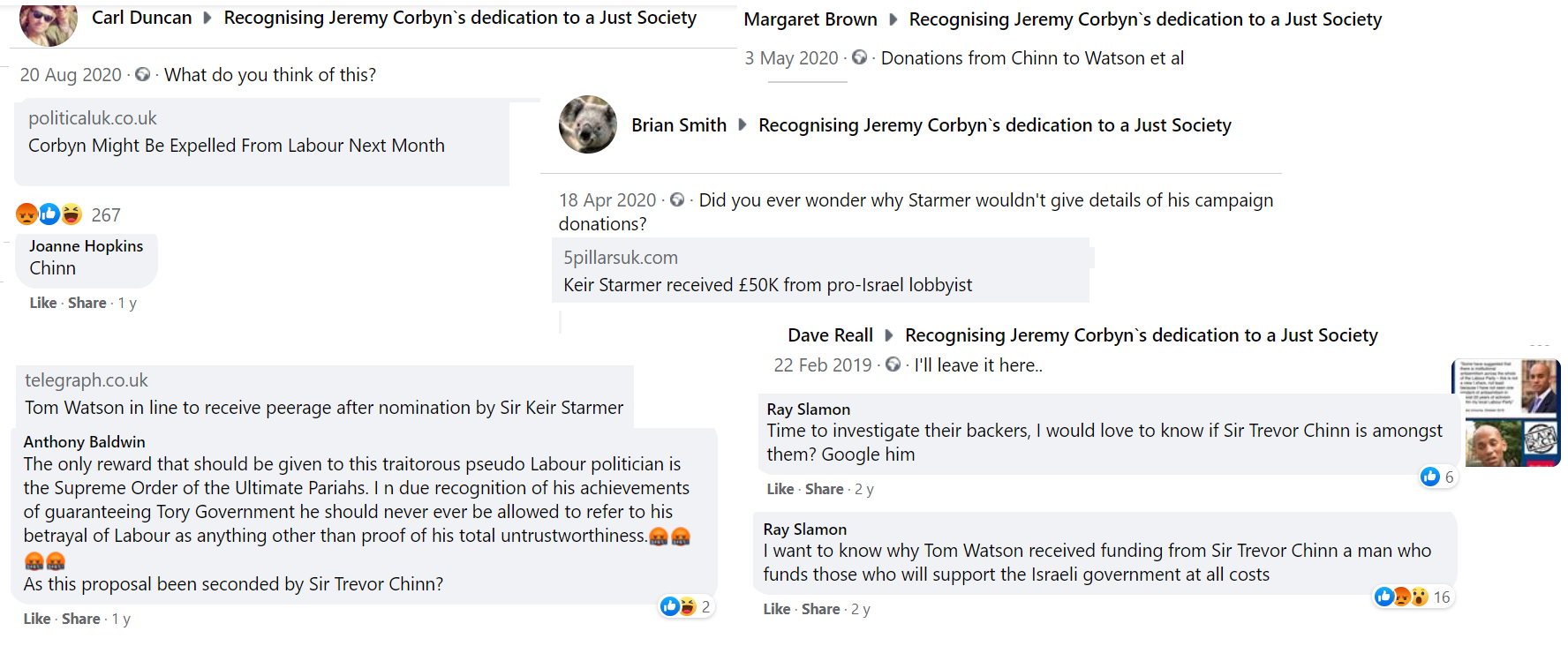
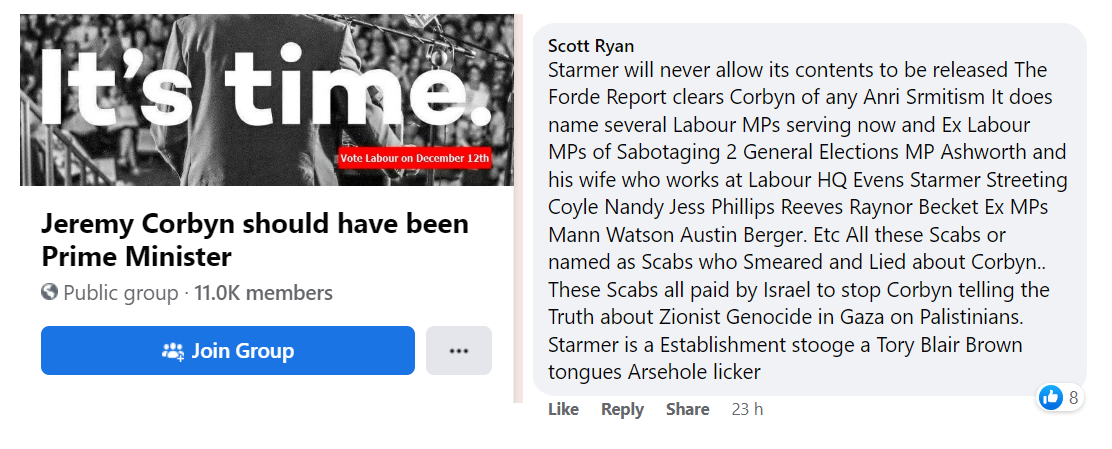
The current situation regarding the Corbynist groups on Facebook from which I have not been expelled:
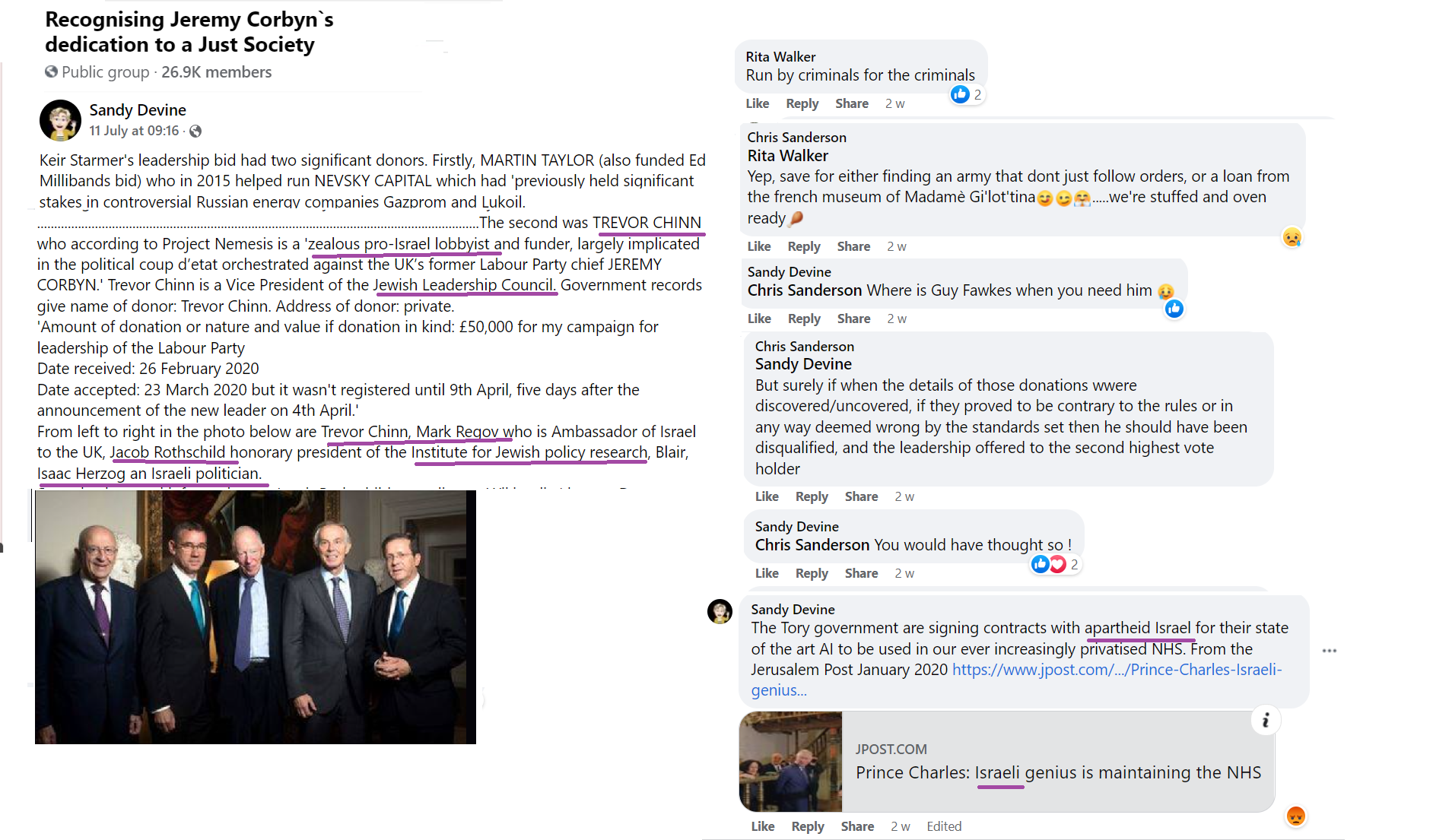
Understandably, their wrath is turned against the Conservative Party, expressed predominantly through memes, but if any comrade should call for a General Election, the replies come thick and fast, asserting that Starmer’s Labour is worse than the Conservatives. Sir Keir is spoken of as being affiliated to the Trilateral Commission, the Bilderberg Group and as a ‘puppet’ of the State of Israel. There are several memes which communicate the association of Starmer and the PLP with Israel, usually displaying the donations they have received from British Jewish supporters. The only way to assuage the anger of these comrades is to post a photo of Jeremy Corbyn, either en famille as a benevolent husband and father, or in a photoshop, where the former leader is gussied up as a lion, a superhero or a boxing champion.
There was a time when nearly every post in these groups concerned Israel or some kind of Jewish malfeasance, but I am glad to say, this seems to have abated. Offensive comments about Israel are usually in connection with Israel’s supposed influence over Keir Starmer. Obviously, if Margaret Hodge’s name is in the news, there is a great outpouring of disgust as Dame Margaret was always a favourite topic, producing some of the longest threads, with hundreds of replies (whereas a post about Afghanistan might get no replies, except for the brief assertion that Israel was worse).
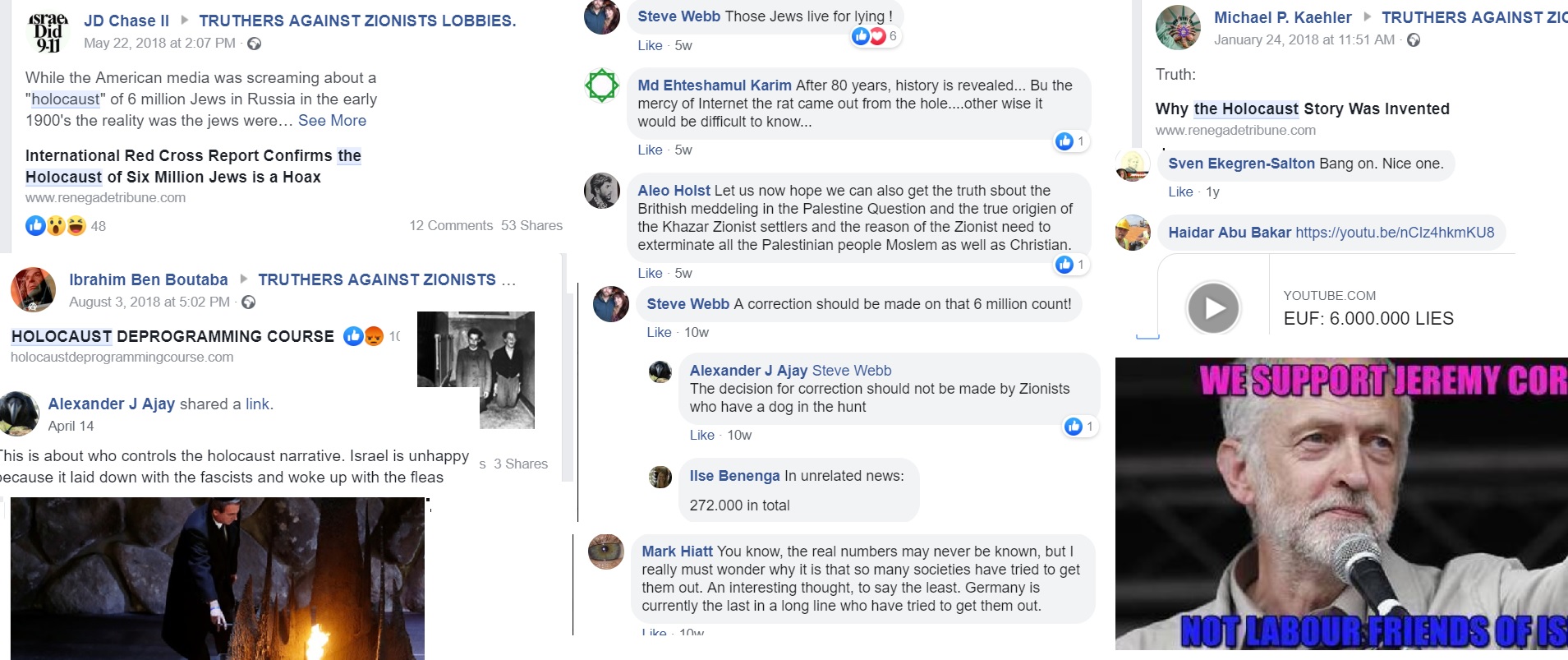
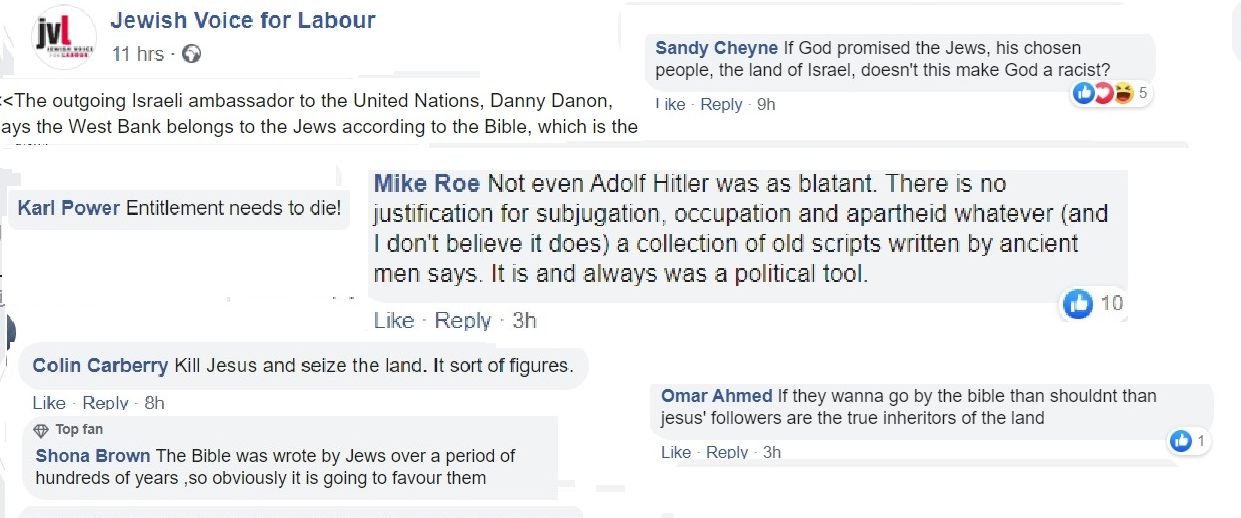
Groups which define themselves by opposition to Israel and Jewish community organizations in the UK progress along a slightly different track. In this sense, JVL bears some resemblance to Truthers Against Zionist Lobbies and its sister group, Friends of the Middle East Against Israel. In these groups, negative reportage about Israel is meat and drink and, with some very right wing members in the current Israeli government, they have a wealth of material. There is a preference for drawing on reports from Jewish authors who are either reasonably critical of Israel or unambiguously hostile.
JVL naturally have great animus towards UK Jewish organizations who regard them as a sham group set up to defend antisemitism on the left, and many of their posts defend individuals or groups who have been perceived as antisemitic. Recently they strongly defended Roger Waters after his controversially politicized concerts and, only yesterday, attacked the Campaign Against Antisemitism who successfully dissuaded some venues from showing the film called Oh Jeremy Corbyn – the Big Lie. Today, they take issue with the EHRC report of three years ago, for faulting Ken Livingstone.
The result of this monomania (excuse the word – I am quite monomaniacal myself) is that comments on the JVL page very often dwell on the perceived duplicity and dictatorial nature of Jewish organizations in the UK, including the Jewish press. I long ago gave up expecting that the JVL administrators would remonstrate with their supporters whose enthusiasm became a bit too Sturmabteilung but this does not happen. Sometimes a person from outside the group takes issue with an error or a classical antisemitic trope but in the milieu of such groups, any outsider is always the Few and soon dismissed as a ‘hasbara troll’.
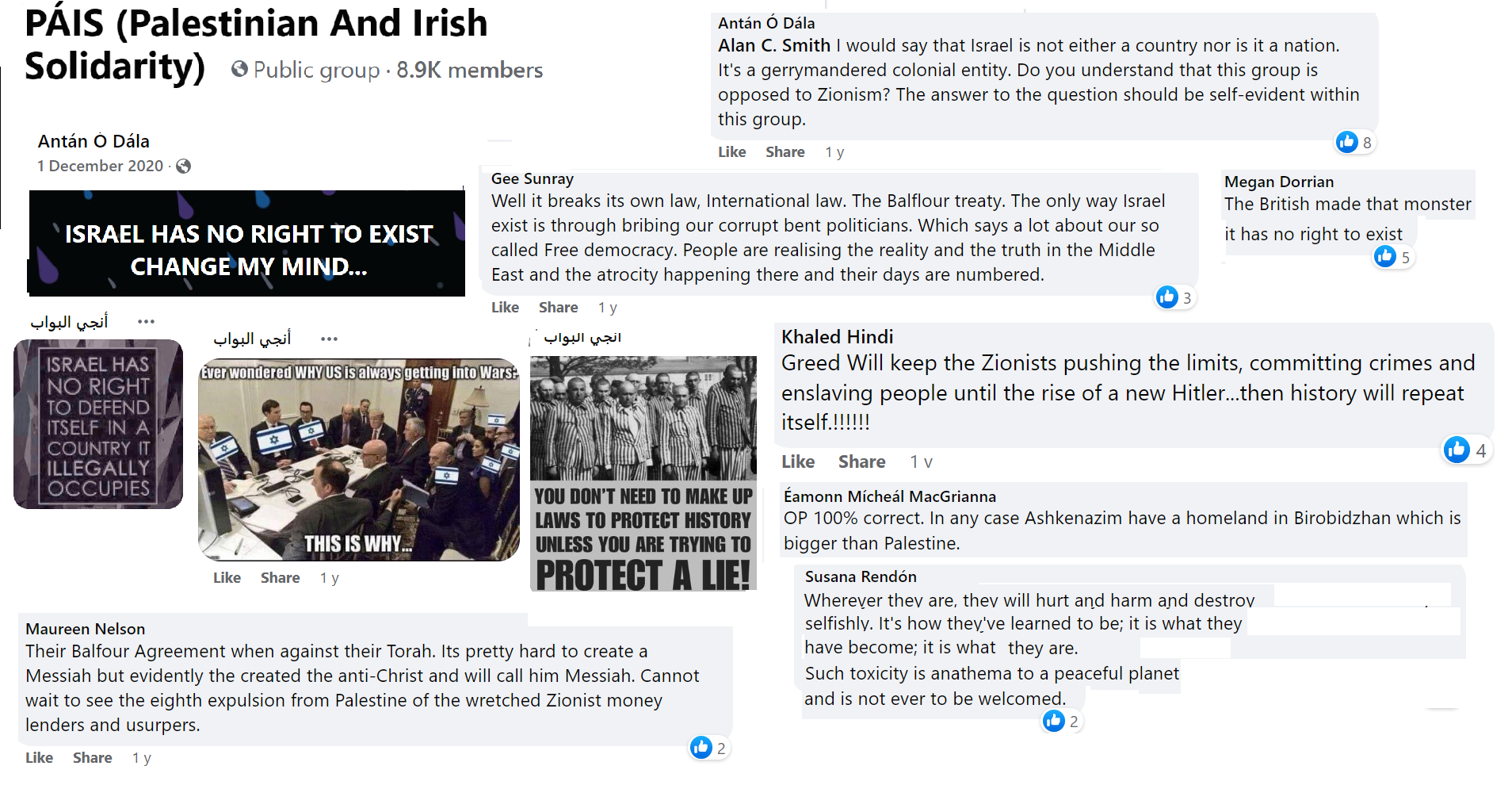
The group called PAIS, Palestinian and Irish Solidarity, where much happiness was expressed whenever Israelis were killed, went from public to private on Facebook. I tried to get back in, but they did not accept my application. I was not using my own name but, had somehow allowed suspicion to fall on my alias.
Engaging verbally in any of these groups is not a viable option. If you intend to look at them, stay shtumm, shtumm wie a shteyn.
Gifs and memes are very much part of online altercations, the more bitter the disagreement, the more insouciant the gif. Typically a gif shows a good looking person, often a celebrity, behind a brief quotation from one of their performances. Sometimes they merely shrug, wink or laugh. They may be intended as a projection of the person who posts the gif. Some gifs are amusing but others are triumphalist. When Jeremy Corbyn was Labour leader, there was a gif which displayed a winning boxer, fist raised to show ascendancy, Corbyn’s head photoshopped on the body. This was deployed whenever Labour gained a point in the polls but, as far as I know, they have not made a similar gif for Keir Starmer.
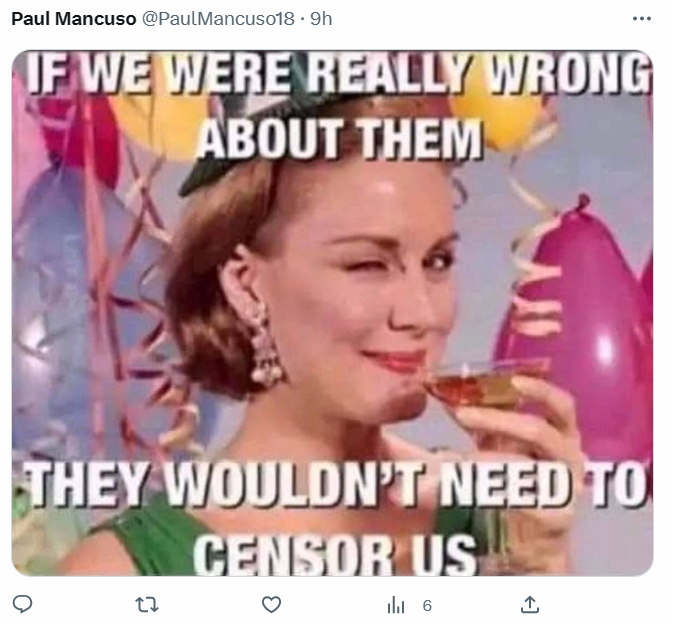
Some memes perform the same work as gifs, for example, the image below, from an account who tweets disobligingly about Jews, essaying an appearance of enjoyment. The meme depicts an attractive woman, partying, while the superimposed words intend to justify the account’s negative statements about Jewish people and Israel.
Another meme shows a confident looking man with the appearance of a 1950s model advertising shaving cream and the words, ‘Imagine if you will a group so disgusting, they have to make laws making it illegal to hate them.’ I have seen this innumerable times from hardcore antisemites. I say hardcore but perhaps it is the meme itself which testifies to them being hardcore.
In antisemitic groups online, some members participate with nothing but memes, even posting the same meme every day. There are many ready-made memes available for antisemitic uses: groups of people in or close to government with the Star of David superimposed on each of them, to denote powerful Jewish influence and, from Holocaust deniers, images of Anne Frank or the entrance to Auschwitz, inscribed with a Shoah denying message.
I’m not altogether averse to using gifs on Twitter and have often posted an image of a sea lion if I believe someone is trying to waste my time with questions, the answers to which they will always reject. I have also used Claude Rains as Captain Renault saying ‘I’m shocked!’ and Al Pacino as Michael Corleone, saying ‘…they pull me back in.’
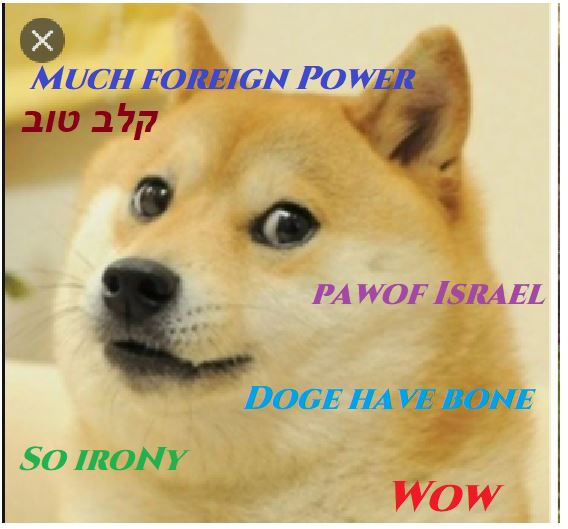
The word gif, I learn, stands for Graphics Interchange Format and was coined in the 1980s. The coinage of the word meme is attributed to Richard Dawkins in The Selfish Gene, writing about cultural imitation, the spreading of an idea by mimesis. I was fond of the Doge memes which abounded some years ago, depicting a Shiba Inu expressing thoughts by means of limited literacy, in brightly coloured comic sans font.
Certain phrases are copied like memes and become ubiquitous in confrontational language. The screenwriter Lee Kern referred to the ubiquity of ‘Rent-free in your head,’ as a riposte to someone making a deleterious comment about a public figure. ‘Toys out of pram’ and ‘Spitting out your dummy’ have been similarly overworked.
There is no harm essentially in the shorthand communication of gifs and memes, the pictogrammar of our age, except when used to convey a thought which would appear intolerable if written down in words, or to confuse the torpid censors of social media platforms.
No doubt I will see many more before the day ends, some friendly, some not.
I got into a spot of bother on Twitter – nothing new there; it happens every day. What made this different is that it was a subject in which I had never invested much interest: the recently deceased Rolf Harris.
I replied to a minor celebrity I hadn’t heard of and my reply got viewed by more people than usual as he has a large following. He had tweeted that he was glad Rolf Harris had died – fair enough, I thought – and added that he hoped Harris suffered pain and anguish at the end of his life. I replied that I thought this wish was rather sadistic: an act of folly on my part as I am now being called ‘imbecile,’ ‘crone’ and ‘nonce’ by a whole new set of Twitter accounts.
‘Would you not want him to suffer if you (or someone close to you) was his victim?’ I am asked. I expect I would. This is why the victims of an accused criminal do not sit on the bench or on the jury.
One gentleman tells me that he would gladly watch paedophiles burn and I wonder, are there any othe people he would want burned? How about those who annoy him on Twitter?
I do understand that people hate those who cause suffering. I do too. I hate numerous individuals, sorry to say, not that I know any of them personally: they have public voices which they use to spread hatred and, the more effective they are, the more I dislike them. But of course I am perceived as spreading hatred, on the grounds of my Zionism, often informed by some Tweeter Furioso that I have a racist antipathy to Palestinians or worse, that I am a killer of Palestinian children. This is how Twitter works: hyperbole, rage, incomprehension. What is the good of it, I often wonder.
‘I said paedophiles not people, learn to read,’ is the brusque reply of an interlocutor this afternoon.
The fact is, it’s unpleasant to be abused, even for an opinion one does not hold strongly. I never watched Animal Hospital or much else in the way of Rolf Harris entertainment. I may have seen him paint, asking his audience, ‘Can you tell what it is yet?’ as I, when painting, often ask this question.
Some years ago, I tweeted something sympathetic about Kevin Spacey when he fell from grace but I deleted it because of the volume of rancour which came my way, sometimes from reasonable people. Another time, I got into trouble for sending an amicable tweet to someone who happened to be a friend of Amber Heard. I had known nothing about the ex wife of Johnny Depp or the court case which came to dominate the news in the following weeks. Protesting my neutrality or, still worse, ignorance, about conjugal matters chez the Depps did not excuse me.
‘What kind of person are you?’ asked a pro Johnny partisan. It was a rhetorical question. No answer I could give would have cut any ice.
The royal wars of attrition between the Waleses and Sussexes continue from year to year but I have the sense not to express an opinion about them. One can almost imagine a civil war caused by online disputes concerning celebrities.
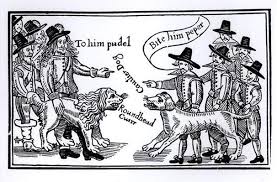
‘To him Pudel,’ cry the royalists to their cavalier poodle in a cartoon from the English Civil War while the Parliamentarians urge ‘Bite him Pepper,’ to their roundhead dog.
Perhaps we should be grateful for online wars, if they keep people off of the battlefield.
Those who want to see painful punishments, would they really watch them with enjoyment, as one imagines the crowds jostling for the best view of a public execution? Or are they simply making a virtue of their righteous indignation?
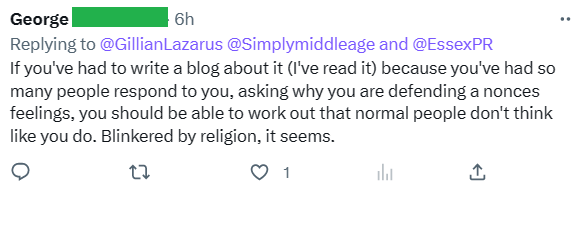
Someone else tells me that I’m the troll which is not unreasonable as I got myself into this argument and should have seen how it would develop. Less reasonable is their ‘concern’ that an opinion in favour of leniency is some kind of deviation or even an endorsement of child abuse.
Who knows if this spat will be over in a few hours or drag on for days? Next time, I won’t express a controversial view unless it’s a matter of significance to me but, after all, it is of some significance that we should talk with moderation about the fate of our enemies, whether public or personal.
It’s standard on discursive social media to be contemptuous of religious belief and I’ve been told, ‘It doesn’t matter what sky fairy you believe in; it doesn’t give you the right to do x, y or z.’ When mention of the ‘sky fairy’ comes my way, the antagonist tends to be referring to the God of Judaism, who has seventy-two names, none of which is ‘sky fairy’.
The number seventy-two has special but disputed significance in Islam also: the reward of seventy-two virgins for righteous men in Paradise, a concept sometimes mocked by unbelievers.
Seventy-two is the number of putative translators of the Hebrew bible into the Greek Septuagint, commissioned by Ptolemy II of Egypt in the third century BCE. The number, being divisible by twelve, allows for equal representation from each of the tribes of Israel. According to TheLetter of Aristeas, cited by Josephus, the translators arrived independently at word for word identical translations, a miracle which conferred authority on the Septuagint.
Miracles no longer impress non-believers and, when one reads of the apostasy with the golden calf, it seems that miracles did not even make a lasting impression on those who witnessed them, during the Exodus from Egypt.
The belittling of religion does not always come from confirmed atheists. I have recently had sightings online of anti Jewish posts expressing an archaic Christian view, calling Jews ‘Christ killers’ and ‘the Devil’s spawn’. Someone replied that Pope Benedict XVI repudiated the concept of Jewish guilt for deicide. They received a surprisingly sectarian response asserting that Pope Benedict had no authority and was presently in hell.
The Coronation looms of King Charles III, an Anglican Christian who has expressed determination to be the defender of the diverse faiths of the British Isles.
It is our duty to protect the diversity of our country, including by protecting the space for Faith itself and its practice through the religions, cultures, traditions and beliefs to which our hearts and minds direct us as individuals.
King Charles, September 2022
Ten years earlier, in 2012, Queen Elizabeth addressed a gathering at Lambeth Palace, saying that Anglicanism ‘has a duty to protect the free practice of all other faiths in this country’.
It was not inevitable that a monarch would take this enlightened view, which brought the UK into the twenty-first century with the toleration of diversity as an ideal, incorporated into the status quo. For centuries, people were executed by the State for religious differences and, in parts of the world, are still condemned as heretics against the prevailing secularity or religion. The particularity and exclusivity of each religion appalls the others, who find themselves written off as diabolical, unsaved or unchosen.
A midrash in the Babylonian Talmud tells that Moses saw God adding tagim – a calligraphic flourish used by Torah scribes – to letters of scripture.
When Moses ascended on High, he found the Holy One, Blessed be He, sitting and tying crowns on the letters of the Torah.
Menachot 29b
Anthropomorphisms occur frequently in midrash and regularly even in Tanakh. In this instance, God is engaged in the meticulous work of a scribe, writing in the Hebrew language. It is said, also in the Talmud Bavli, that God puts on tefilin, like an orthodox Jewish man.
Rabbi Avin bar Rav Adda said that Rabbi Yitzḥak said: From where is it derived that the Holy One, Blessed be He, wears phylacteries? As it is stated: “The Lord has sworn by His right hand, and by the arm of His strength” (Isaiah 62:8). Since it is customary to swear upon holy objects, it is understood that His right hand and the arm of His strength are the holy objects upon which God swore.
Berakhot 6a
Imitatio Dei, the imitation of God, is a precept in both Christianity and Judaism. The Sermon on the Mount includes the words:
Be ye therefore perfect, even as your Father which is in heaven is perfect.
Matthew 5:48
and from Saint Luke:
Be ye therefore merciful, as your Father also is merciful.
Luke 6:36
The imitation of God tends to involve postulating something about God which is often imitatio hominum. In the second paragraph of the daily Hebrew prayer, the Amidah, we say of God:
You support the falling and heal the sick. You free prisoners and keep faith with those who sleep in the dust.
Seder Ha T’filot, Reform Judaism
This can work as a to do list to inspire ethical behaviour, but it is behaviour we are fortunate enough to witness, among other people.
Consensuses – of religious authorities or of a crowd – can determine the nature of belief and the language of prayer but still each person has a lone voice. Particularism can have more appeal than universalism because the person at prayer sometimes wants to be alone with God, for God to hear their voice and attend to their particular needs.
This is seen in the Psalms where the first person singular predominates, in I – Thou discourse, the authorship of which is attributed to King David and, in the later psalms, the Levites of the Second Temple.
The Hebrew hymn Adon Olam, which is often the concluding song of a service, begins by citing the ineffable and infinite nature of the Master of the Universe but pivots from transcendence to immanence in the penultimate verse:
This is my God, who saves my life,
The Rock I grasp in deep despair,
The flag I wave, the place I hide,
Who shares my cup, the day I call.
Seder HaT’filot, Reform Judasim
I am struck by the intimacy of the Almighty sharing my cup, drinking from the same cup as any of us, even when the brew is bitter, which is when we need God most.
I avoided saying ‘Him’ in the previous sentence, to get out of capitalizing the word or ascribing gender.
Tomorrow the coronation takes place and I am looking forward to seeing the participation of various faith leaders, the Archbishop of Canterbury and others. It is an important development, to value the way faiths other than our own bring the faithful into a relationship with heaven and to value our own, where the situating of our lives has placed us.
Arbitrarily, I called this post ‘Seventy-two’ but alas, that it not my age. At the time of writing, I am seventy-three and not that for very much longer.
I had a couple of run-ins with neonazis on Twitter. One of them got his account closed down; the rest continue to post their anti Jewish, anti black, anti LGBT opinions. Some are Holocaust deniers; others celebrate the gas chambers and hope to see us Jews exterminated. One would think that Twitter would get the lot of them off of their platform but that isn’t how it works out.
When I see these keyboard warriors of the far, far right, I can hardly imagine that anyone who wasn’t of their persuasion would strike me with quite so much horror. Yet, when I turn from them to the assailants of the left, the thrust of their attack, while different, is not experienced as more tolerable.
In the intersection of Ramadan and Passover, Israel’s Iron Dome is deployed again against rocket attacks from Lebanon and Gaza. Mr Corbyn does one of his anti Israel tweets, as familiar to his supporters as ‘The Little Red Hen’ to an infant who joins in with the words.
Videos are posted on Twitter showing riotous young men setting off fireworks in the Al Aqsa Mosque. Israeli police dragged them out, an action reported as ‘beating peaceful worshipers’.
Does the antagonistic left feel more menacing than the homicidal, racist neonazis? They seldom claim an intention to kill us but the reverse: stating that we, being Zionists, are the killers. Those who call us nazis – are they more reachable, more amenable to reason, than those who proudly declare themselves as neonazis and Hitler fan accounts?
The danger of the antisemitic left and right intensifies when they encroach upon the centre, gaining influence by repetition, familiarizing their audience with the names they call us, for example ‘apartheid lovers’.
Occasionally, one is tempted to reply to abusers of the left but seldom to those on the right. Replying to Twitter trolls is a performance art. The right-wingers convict themselves with their own words and find support only from like minded racists. The left use more judicious phrases.
Today, some prominent activists against antisemitism are themselves being called antisemites by Corbynist Twitter accounts, due to criticism, overt or implied, of a prominent and much admired Jewish Corbynist. Subjectively, such tweets are as shocking to read as the far right obscenities, in the sense that a wolf in sheep’s clothing is not less dangerous than a wolf in wolf’s clothing. Mercifully, it isn’t feasible to remember and keep track of all hostile accounts.
Today is Good Friday and the second day of Passover; Ramadan is also underway. Feelings run high, in the real world and in the online world. It was TS Eliot who said ‘April is the cruelest month’ and I don’t think he was wrong but being the same Eliot whose poetry included overt, classic antisemitism, I wouldn’t consider him reliable.
The toxicity of diverse Corbynist groups on Facebook, in terms of antisemitism and hate speech, is fluid rather than static, depending often on personnel: the moderators and the frequent contributors. A group called Supporting Active Socialism displayed many antisemitic posts by a contributor who wrote as John Bernard or John Spannyard Indaworks. When Keir Starmer became Labour leader, the founder and moderator of the group, a Mr Smith, stated that the forum would now support the new leader rather than Jeremy Corbyn. The ambience changed and Mr Indaworks was no longer seen in that group. I had some exchanges with Mr Smith about what counted as antisemitism, which he seemed reasonably keen to avoid, although he must have had some suspicions of me as a Zionist infiltrator.
Many of the Corbynist groups focus on the iniquities of the Conservative and Labour Parties,with particular animus against Keir Starmer. In the posts and threads about Sir Keir, the accusation of Zionism is usually raised, as well as speculation about the receipt of shekels. The individuals posting these comments do so again and again, revealing a level of obsession which may not be shared by other members of the group. In a group of 20,000, fewer than a hundred are likely ever to contribute to the discussion and perhaps half a dozen do so several times a day.
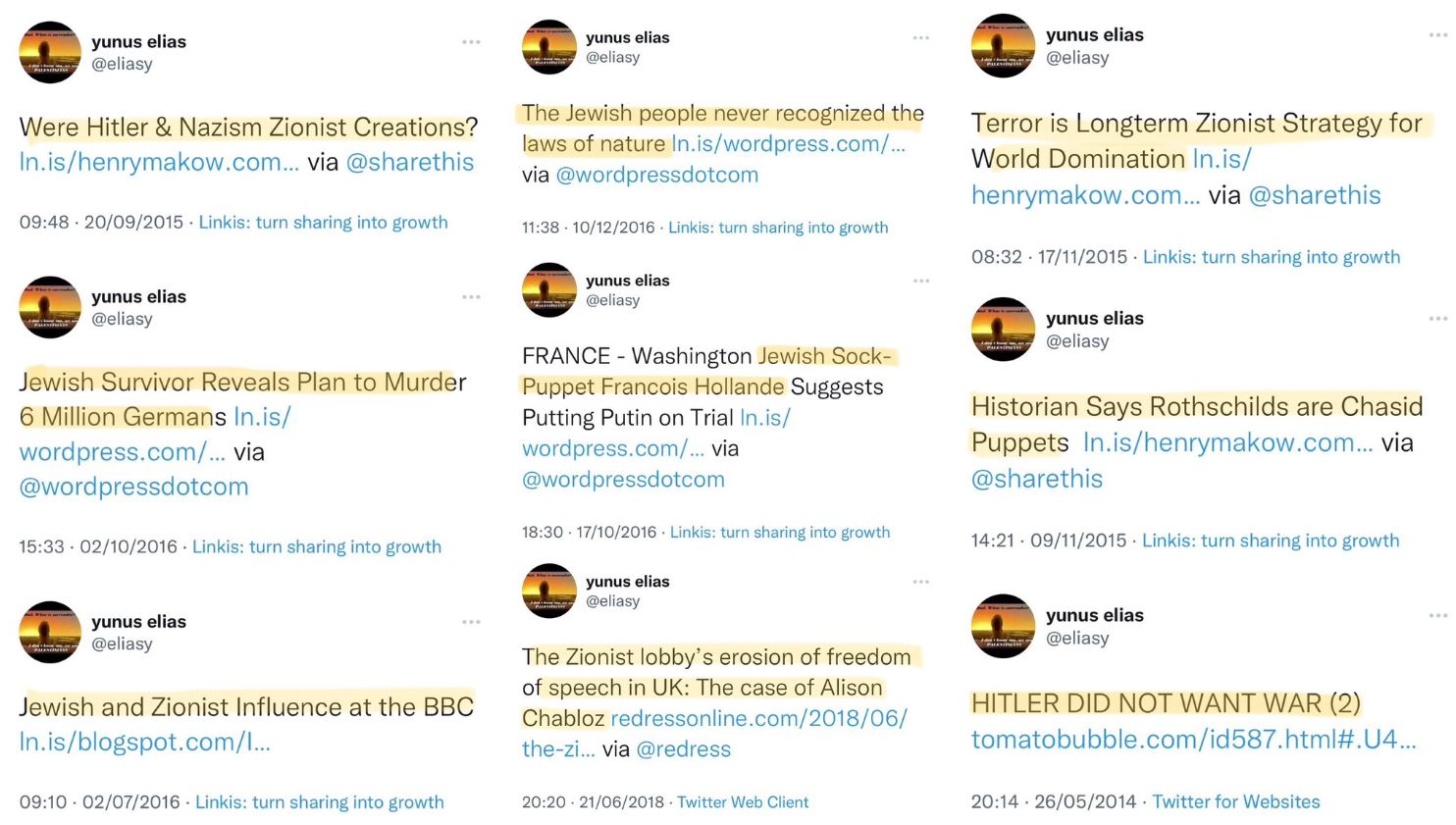
The private group ‘Just Socialism the Corbyn Way’ currently features daily, sometimes hourly, posts from Yunus Elias whose memes are usually taken from Middle Eastern presses and blogs hostile to Israel. Mr Elias’s name has been attached to overt Holocaust denial but this seems to predate his activism on left wing forums.
Another private group, ‘We Support Jeremy Corbyn,’ had moderators who were unusually alert to antisemitic comments which they often confronted, even banning at least one person when he responded with verbal aggression. Nevertheless, they were not able to contain all the antisemitism of their members. It was a pillar on which support for Mr Corbyn rested.
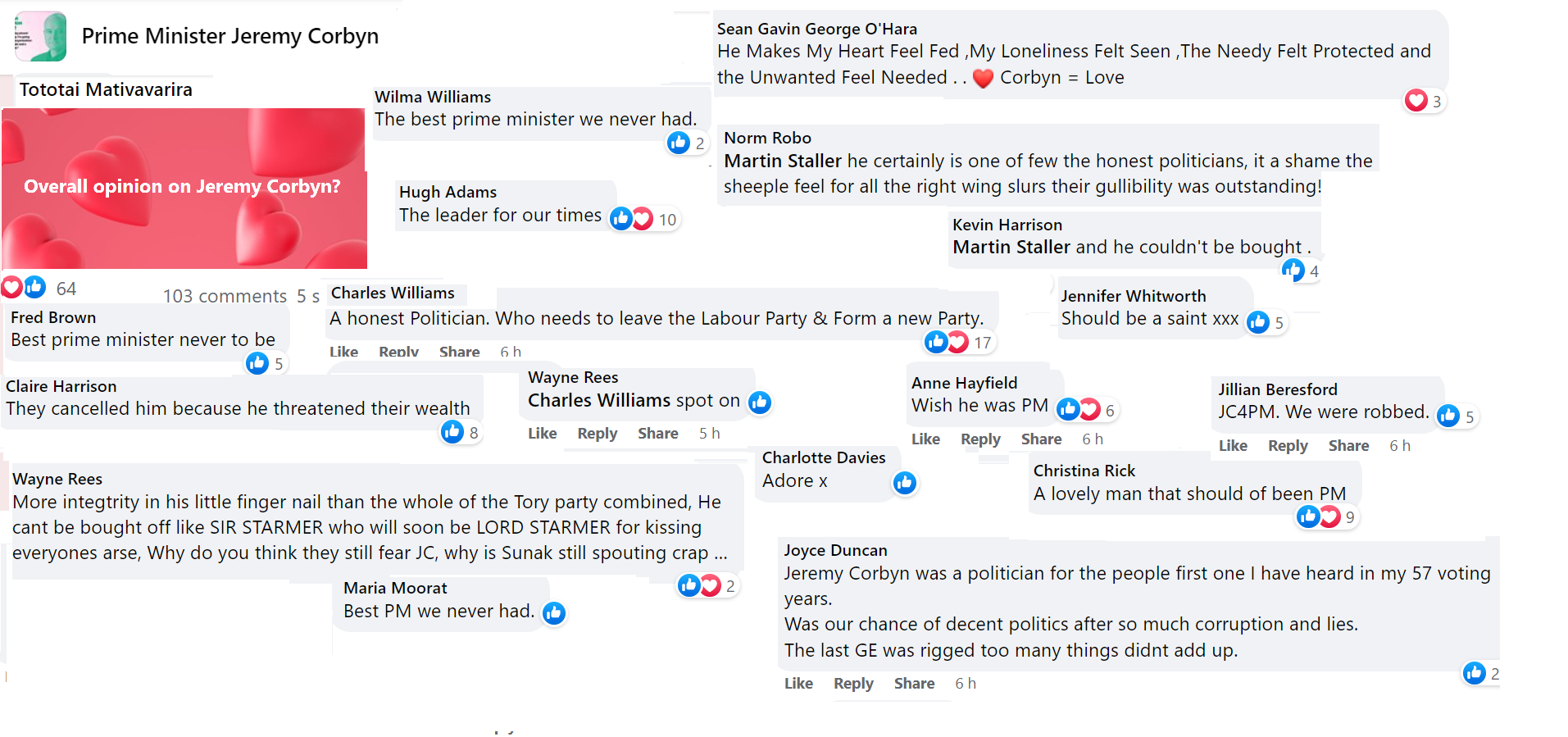
In some groups, ‘Prime Minister Jeremy Corbyn’ for example, rage and sentimental devotion jostle for prominence. On some days, posts about evils of the UK, the USA and Israel predominate while a photo of Mr Corbyn produces a hundred or more declarations of love and loyalty, generally couched in repetitive terms such as ‘The greatest Prime Minister we never had,’ ‘They fear him because he cannot be bought,’ and ‘Ohhh Jeremy Corbyn!’ As I never tire of pointing out, parallels are often made with Corbyn and the life of Jesus, the crucifixion and the resurrection. Mr Corbyn’s initials are regarded as an uncanny indication of godliness although nobody has suggested that Jesus’s middle name was Bernard. Instead of the annunciation,we have Mrs Corbyn Senior’s presence at Cable Street in 1936.
One of the most offensively antisemitic groups, ‘PAIS: Palestinian and Irish Solidarity’ went from public to private after being reported frequently for hate speech. They posted a meme showing rats with an apology that ‘Zionist trolls’ were present. On going private, they clamped down on membership and I was not able to gain access. PAIS, founded by an activist in County Down, was not particularly in thrall to Jeremy Corbyn but their antisemitism was virulent, including some Holocaust denial and many expressions of joy when Israelis, civilian or otherwise, were killed.
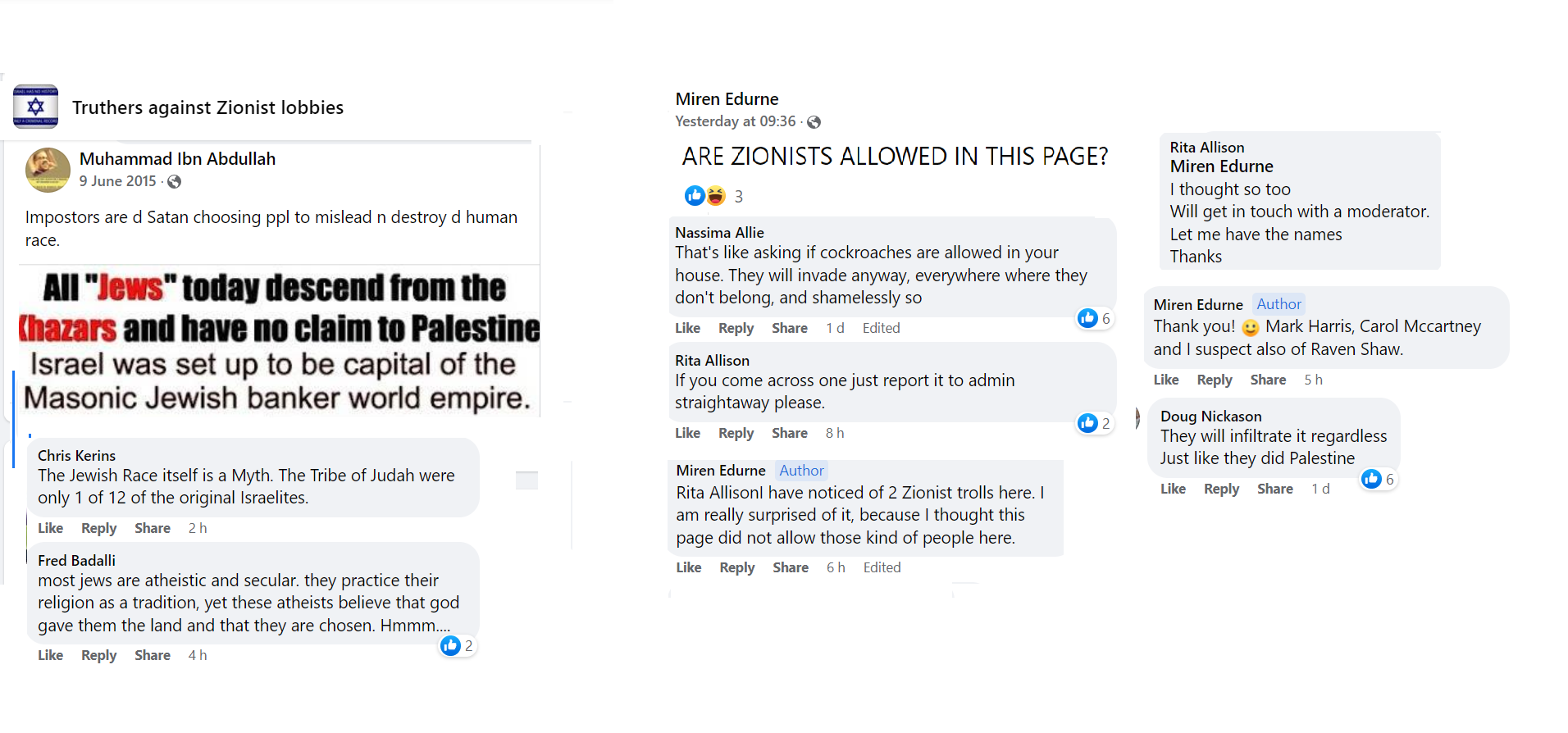
‘Truthers Against Antisemitism’ has been run for several years by Marino Robles, Rita Allison and Mahmoud Tashvishi, all of whom are active in various other Corbynist groups on Facebook. Originally, their header photo displayed Mr Corbyn pointing with a baleful finger but there was some Facebook intervention and the group closed, reappearing after a few months with a new header, a mock up of the Israeli flag displaying the words ‘Israel has no history, only a criminal record.’ Marino Robles and Rita Allison are both cited in the ‘Leaked Report’ of April 2020, as being expelled from Labour for antisemitism while Jennie Formby was General Secretary.
The JVL group on Facebook posts almost exclusively about Israel or the raw deal JVL members receive from Keir Starmer’s Labour. For any given post, the supporters’ comments tend to be markedly and crassly anti Jewish, in excess of the original post. It is a mystery that the JVL moderators allow some of the material. I speculate they may understand that people with such opinions are a load bearing wall of their own organization, just as they are for Mr Corbyn.
Participants in Facebook political groups are likely to be older than those who post on TikTok and Instagram and this demographic is evident in the Corbyn groups, where participants declare themselves very often to be septuagenarians or octogenarians. One can infer this too from their phraseology, their photos and even their names.
The more static these groups, the more closed they are to differences of opinion but I have seen changes which have turned the ambience around, generally when a Labour supporting group has ceased to campaign for Corbyn and thrown in their lot with Keir Starmer’s Labour. From his first day as Labour leader, Starmer took a stand against antisemitism and many Corbyn loyalists left the party or were expelled from it.
Tony Benn used to say ‘Look at policies not personalities,’ and Corbyn has sometimes quoted this but politicians gain and lose power on the basis of personalities and this is even true in Facebook groups, in microcosm.
The screen shots below are representative of many more in similar vein.
When I was a schoolgirl in the International Socialism group, later called SWP, there were certain doctrinal principles, some of which now seem to me counter-intuitive, but half a century has passed and a lot of water has flowed under the bridge.
Always support a strike
Even in the event of the strike having a racist impetus as sometimes happened when the work force opposed immigrant labour, one should join the picket line and argue the case against racism then and there.
Always support the armed struggle against imperialism
If the insurgent movement is autocratic and tyrannical, one should nevertheless give it full support and then wage revolution against the leadership when they come to power. ‘Permanent revolution’ may be mentioned here.
Participate in local tenants’ associations, colleges, workplaces and clubs
Make recruits
Join the Labour Party
The parliamentary Labour Party is counter revolutionary. One joins in order to recruit for the revolutionary cause.
Expose the failures of Parliamentary social democracy
Expose the failures of State Capitalism
The Soviet Union
Expose the doctrinal errors of rival Trotskyist groups
SLL/WRP, IMG, Militant
Tea or coffee to be prepared by the women in the group
This was fifty-five years ago. Women’s liberation had not quite penetrated the left, although Betty Friedan’s The Feminine Mystique was published in 1963. I am willing to be corrected on the chronology of feminist consciousness in the UK left.
Anti monarchism
Obviously
Unilateral nuclear disarmament
Obviously
Temporary support for North Vietnam
Revolution against Ho Chi Minh to occur after the Americans had been seen off
Against South African Apartheid
Against the National Front
Against racism, literally in all its forms
It was not until the Six Day War that Israel received significant negative attention.
‘VIETNAM – OUR SPAIN!‘ flashed a headline on the SWP paper, then called Labour Worker. My generation wanted a cause that would resemble the Spanish Civil War, although Orwell had shown the mortal fracturing of the left in the fight against Franco.
On the demos, some chanted ‘Ho, Ho, Ho Chi Minh,’ like a mantra. ‘Wilson: Johnson’s poodle’ was crayoned on many placards. It was thought that Labour Prime Minister Harold Wilson colluded with Lyndon B Johnson, implicitly supporting his war in South East Asia.
Thirty-five years later, in February 2003, there was what was said to be the biggest ever demo in London, against war with Iraq. I did not attend, but I knew many who did. In the Gulf War of 1991, Iraq’s reaction to a large coalition of nations responding to their aggression in Kuwait was to bomb Israel with eighty-eight scud missiles over a period of seven weeks. I did not know what to think about Blair and Bush’s proposed war on Saddam Hussein but I had no doubt that Saddam Hussein was an evil tyrant..
I attended innumerable demos when I was young, the last that I recall being against the all white South African Springboks – the rugby team, I think it was – when I was an undergraduate in Manchester.
Later on, I noticed that all demos involved some unpalatable slogans, however progressive the cause.
‘Khaybar, khaybar ya Yahud’ is now heard, threatening death to Jews.
‘From the river to the sea,’ threatening death to Israelis, is a staple of progressive demos in the UK.
Stop the War UK, which organized so effectively in 2003 against war with Iraq now opposes what they regard as Ukrainian militarism. Are they as emphatically against Russian militarism? Possibly but it is a false equivalence.
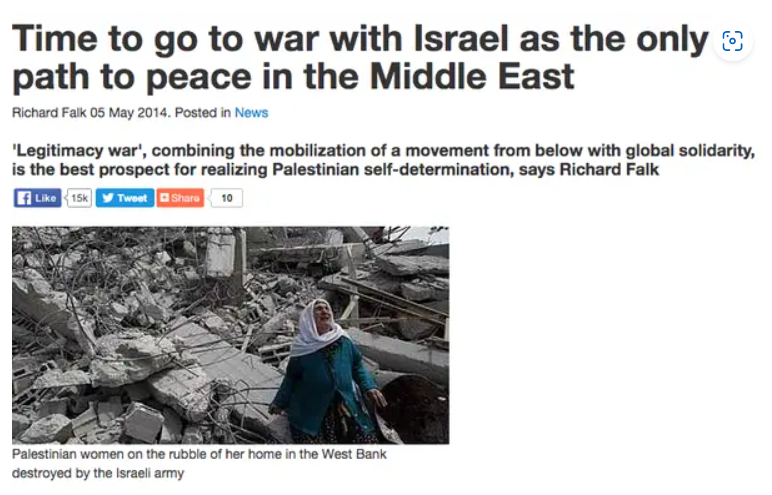
For a while they headlined a Richard Falk article, advocating war with Israel. This was taken down eventually as it was seen as compromising their anti-war ethos; likewise a headline suggesting that the western powers were to blame for the terrorist attacks in Paris in November 2015.
So long ago that it seems like another life, my sister marched from Aldermaston to London with the Campaign for Nuclear Disarmament, joined on the third day by my parents and me, still a child. When the time came, I too marched with CND from High Wycombe to London, Easter after Easter.
My marching days have long been over. It isn’t a question of septuagenarian debility. It’s a question of the slogans, the left’s answer to tabloid headlines. Slogans of left and right, peace and war, can speak with peleucid simplicity to a multitude and send them down the road looking for trouble.
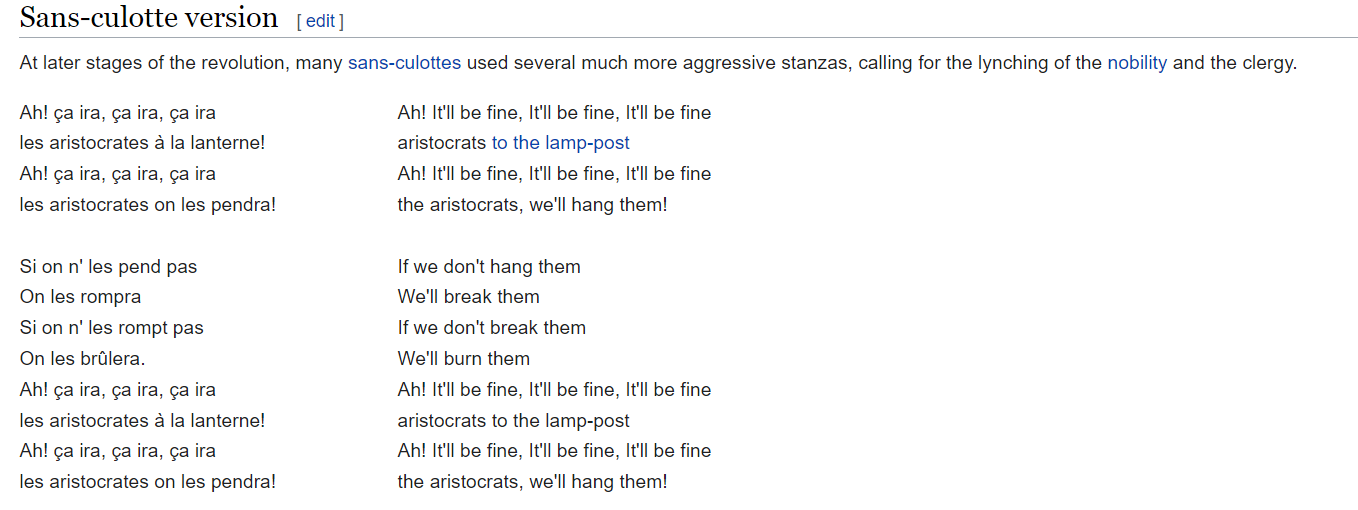
Ça ira, ça ira was an exhortation to terror which followed the French Revolution.
Beware the catchy slogan and the rousing song. I like anthems as much as anyone, at the Proms or the Olympics or on the football pitch, but when they are accompanied by marching feet and bloodlust, I generally prefer to cast a cold eye.
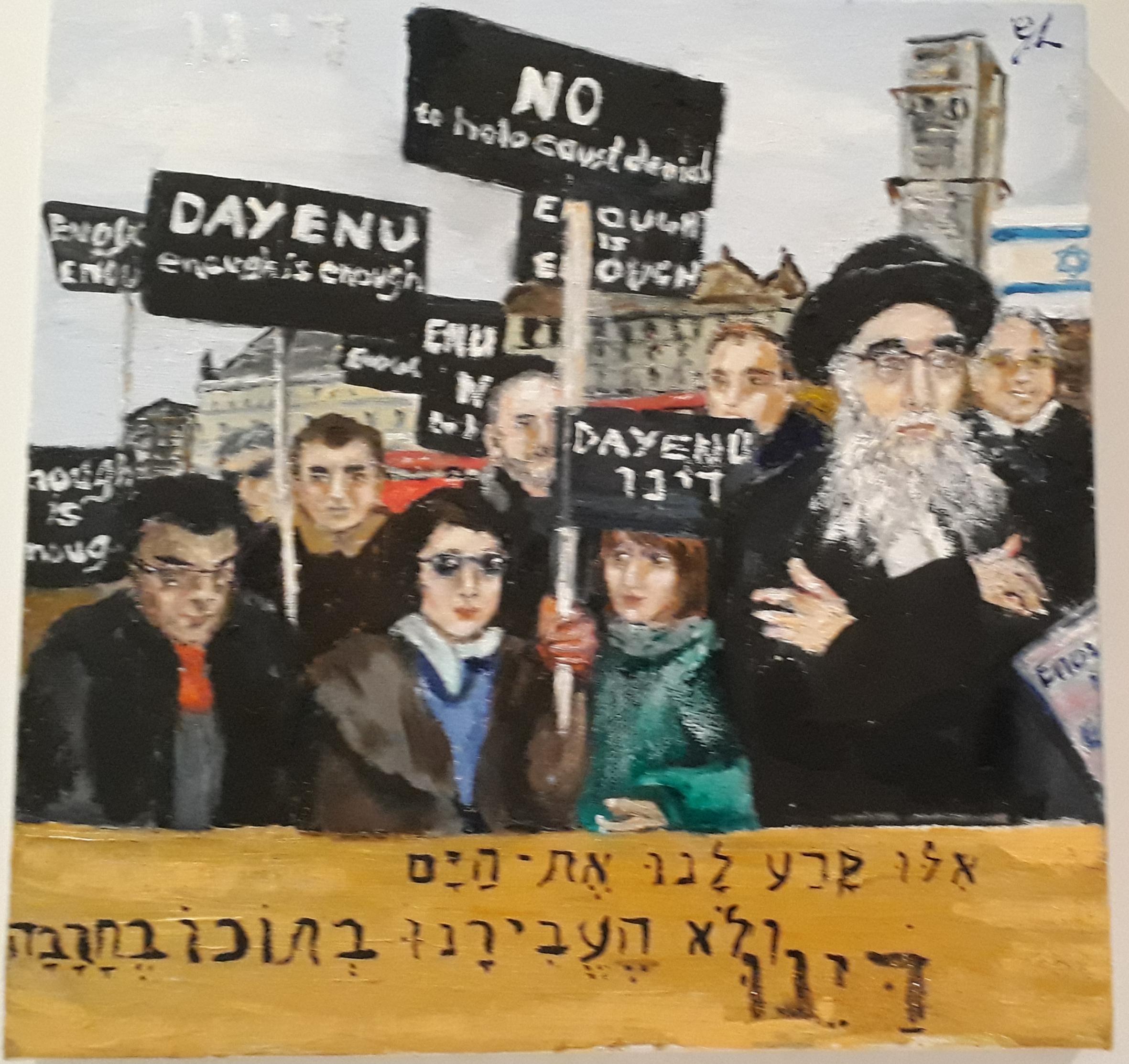
Post script. I forgot that I attended two demos in 2018, in Westminster, against Labour Party antisemitism. Desperate needs cause desperate measures and indeed, this is why people resort to demonstrations and rallies. After what was called the Enough is Enough demo or the Dayenu (an allusion to the Passover seder) demo, I painted an impression of the event.
More than a year after writing this piece, with Israel at war with Hamas in Gaza, the invective of last year seems relatively mild. Whereas ‘ApartheidIsrael’ was deployed like a compound noun, the word now is genocide, to be applied to anyone openly against the Hamas atrocities of 7 October. Who could have guessed that Stephen Fry would devote a broadcast to the problem of resurgent antisemitism, or that he would be called ‘Genocidal thug’ by the self-styled many. Opposition to antisemitism in the west is treated as the equivalent of a bomb on Khan Yunis. The far right have cannily adopted the lingo of the far left and Islamist anti Zionism. The most all-purpose term is lying or liar, used to negate anything said about the hostages still in Gaza or the victims of the Hamas pogrom.
When I wrote the blog post below, Corbynism was a fertile source of online antisemitism. A year on, it strikes me that Corbyn has become redundant to the cause. The pro Palestinian marches in London, the graffiti on the walls of Jewish schools, museums and synagogues, the tearing down of posters showing the faces of hostages, all these would go ahead without him,. Neither can one lay all the virtue signaling hatred at the door of the right or the left or the jihadists. More likely it is down to historical necessity, as the Marxists might say.
2022
There’s nothing easier than listing the names I am called by hostile accounts on Twitter: racist, white supremacist, apartheid apologist, liar, child killer.
In the sunlit uplands of the past, I may have been told ‘Go and join the Tories’ but the invective is stronger now, just as the dosage of a medicine is increased when the body is desensitized to the original dose.
But who are they and who are we?
When the names are applied to me, I infer that they are due to to the fact that I’m Jewish, a Zionist, opposed to Corbynism and active on Twitter in connection with these issues.
The same names are thrown at most members of Keir Starmer’s Labour Party, with the additional appellations: backstabber, frontstabber, traitor, puppet.
I have never seen – and one can’t see everything – anyone who calls me, Jewish community organizations and the Labour front bench ‘racist’ confronting any of the far right accounts, which target black people, Jews and LGBTQ people. When these accounts with 88 or 18 in their Twitter handles show up on my timeline, the first responders to confront them are accounts I follow or like, but naturally Twitter works this way, showing the tweets of people we follow. Perhaps the Corbynist left really do confront neonazis on Twitter and, due to some algorithm beyond my understanding, I never get to see it.
In the case of Kanye West, Ye as we must now call him, the UK accounts calling out his antisemitism were the usual activists against antisemitism – in all its forms, as Mr Corbyn might say.
The more attention given to any particular tweet in likes and retweets, the more it will garner negative attention.
In the world of Twitter, the battle lines are drawn. A sceptical reply to a known Corbynist can produce a pile-on and no doubt this works in reverse.
How can one learn to be indifferent to the names one is called on Twitter, particularly those tweets which call us/me far right? The insults which come my way from the actual far right are often nearer the truth as they tend to mention that I’m Jewish. And they don’t mistake me for one of themselves.
The names I am called – by the left, sorry to say, which can now be called the Corbynist left, regardless of whether their support is agreeable to Corbyn himself – are bestowed also on the journalists I read, the broadcasters I watch and the entertainers I follow. It is worse to see luminaries or friends being insulted, as I am then tempted to go in with virtual fists flailing, and this does not always help.
I avoid the use of insulting terms in my tweets but the same can be said sometimes of adversaries, who end their barbs with ‘Enjoy your day’. The art of incivility is to accuse the other of what they hate. Sometimes, if I query being called ‘white supremacist,’ I am told that now I know how Corbyn felt, being called ‘antisemite’ when he doesn’t have an antisemitic bone in his body. So I am called these names as a punishment for what I say about Corbynists?
Tit-for-tat is as prominent as rebuttal in a Twitter altercation. If someone posts a photo of Corbyn with a terrorist from Hamas or the IRA, a reply may come in the form of a photo of Tony Blair or the late Queen standing next to a tyrant or a crook. Monarchs and Prime Ministers are obliged to meet all sorts, so these photos are not hard to find.
The most prominent UK activists against antisemitism are routinely called far right, so much so that those of our number who are left-leaning sometimes buy into the disinformation.
In the course of writing this short post, I find I have two new hostile notifications, one telling me that I know I’m wrong and, as for the other, I can’t make out exactly what they’re saying but I know I’m not supposed to like it.
I blocked both accounts. Blocking is an action one never regrets. It is harder to block when it seems compromising to leave a libel hanging out there without an answer, but one of the rare positives in online altercations is that one can switch them off.
Muting is a gentler option. ‘I’ve had Mrs Hudson on semi-permanent mute,’ said Sherlock.