Archive for the ‘Uncategorized’ Category
Foreword
Last night, a woman in the BBC Question Time audience in Cheltenham held forth, reproaching the Labour MP on the panel for what she called ‘friendship with Israel’. Gaining confidence as she heard the gathering applause, she spoke of Israel ‘targeting babies, children, hospitals and schools’. ‘Enough of this rhetoric about antisemitism,’ she proceeded, to a perceptible rise in audience sympathy, ‘if you support Palestinian babies.’
Her warning against ‘the rhetoric about being antisemitic for supporting Palestinian babies’ clearly struck a chord with the audience and I reflected that perhaps some of them had been called antisemitic or knew people who were called antisemitic and thought it was unfair and untrue. It could be said that it takes a Jew to know what is antisemitic, but then we are likely to disagree among ourselves and, mercifully I have encountered many non-Jews who understand very clearly the difference between criticism of Israel and antisemitism. If they see it so clearly, I wonder, why are others so myopic?
Dear Friends
I get the impression that people of good will are often perplexed by the term antisemitism. They don’t want it fired at them like a poison dart but are not sure if we are unreasonable, aiming it at persons you think are merely making points, about war and peace, wealth and poverty, vengeance and forgiveness. You have watched the news on BBC and Sky; read the Guardian and the Independent, heard the Pope and Gary Lineker, and you want to take up a position against Israel’s wars, but you don’t want to give offence to your Jewish friends, colleagues and, possibly, relations. You’ve been told that comments about Israel are distinct from statements about Jews but noticed that diaspora Jews seem to believe we have a horse in Israel’s race. You’ve seen that some Jews call some other Jews antisemites and thought that hardly seems reasonable. And perhaps someone told you that Jews look down on non-Jews, calling them goyim which sounds like a bad name.
Last point first: the Hebrew word goy means nation, and goyim is the plural. If you look at a biblical concordance, you’ll see that it occurs many times; 560 times, according to Google’s counting and, every time, it refers to a nation or nations, including the Israelite nation. In post biblical times, the word has been used to ‘other’ non-Jews, rather as the word ‘foreigner’ has an othering stratum, separate from its essential meaning. The far right, in our own time, refer to ‘the goyim’ intending always to say it is what we Jews call non Jews whom, they claim, we exploit and enslave. The far right are almost the only people who admit to being antisemitic, and even then, not always.
You may want to know how it happens that a Jewish person might be called an antisemite, either fairly or unfairly. Every nation has its traitors and, in this, we are no different. I would say that a Jewish antisemite is someone who not only separates themself from the community but intends harm towards the community – or identifies with people who intend to do us harm. When I was young, there was animosity between proponents of traditional, orthodox Judaism and Progressive Judaism, where women were ordained as well as men and certain laws, such as driving on Shabbat, were relaxed. Now a graver animosity is between those who care for Israel and others who suppose that they must dissociate and condemn it. Undoubtedly, this makes for very bitter hostility and draws into the argument non Jews who have strong opinions for or against Israel, an extension of the argument which probably helps to perpetuate it some of the time. This is not to deny that I’m infinitely grateful to Israel’s friends and the non-Jewish warriors against antisemitism who instinctively recognize it when they see it.
The present government of Israel has critics within the country, so numerous that demonstrations of many thousands filled the streets every week, fearing that the authority of the Supreme Court would be eroded by policies of the Netanyahu administration. Now there are demonstrations by those who think more could be done to bring the hostages home. Others believe that the government should make long term security a priority above all other issues and that the Iranian proxies can be given no quarter.
I don’t expect you to have the answers to geopolitics and wars. I understand that your hearts are moved by the suffering of children, continually depicted on our news stations as the reporters devote themselves to showing the human cost of war. In my opinion, they understate the human cost for Israelis who have suffered bombardment from Gaza, Lebanon, Iran and Yemen. Israel has invested in effective defences and shelters so the numbers of the dead are not as great as those in the countries which attacked it.
You may have heard that antisemitism does not, contrary to dictionary definitions, mean hatred of Jews but persecution of people who speak languages cognate with Hebrew, predominantly Arabic. There are some who say they are not remotely antisemitic as, although they dislike Jews, they have nothing but love and compassion for Arabs, particularly Palestinians. There is even a fad, around Christmas time, for claiming that Jesus was Palestinian as he was born in Bethlehem, now in the West Bank. This might have worked when the name ‘Palestinians’ signified Jews resident in the British Mandate of Palestine, but the implication that Jesus was an Arab is a curious rewriting of the New Testament and you may be sure that, when Easter comes around, the same people will not be arguing that Judas and Caiaphas were Palestinians.
I can see how complicated are all these matters to people who were not born knowing the word ‘antisemitism’ and I have one message in this letter which I want to convey.
After the Holocaust in the Second World War, certain terms were coined to apply to the murder of the six million, not on the battlefield, but by the intentional use of bullets, gas, starvation and scientific experimentation: such terms as genocide, war crimes and crimes against humanity, planned by the Nazi leadership and carried out by civil servants, army personnel and grunt level workers. It has become a popular device to adapt the terminology, making us Jews the perpetrators of genocide, calling us Nazis, telling us ‘You have become what you hated’ and posting cartoons on social media showing German stormtroopers morphing into IDF soldiers or Jewish children in the deathcamps redrawn as Gazan infants.
My message to you is – don’t do this. Why would anyone want to depict us as our most bestial persecutors? It is like the delight some people take in speaking of the existence of slavery in Africa before millions were captured and shipped away in the transatlantic slave trade. If it was done to you, your enemies will want to say you do it to another.
Most days on X, someone will anathematize me as a ‘genocidal maniac’. It is simply a thing to say to a Jewish person who is deeply – or even shallowly – connected with Israel, to cause maximum pain, to give greater offence than any F word or C word can communicate – although they generally give these words a whirl alongside the rest of it.
If you really don’t want to give offence, don’t use the inaccurate shorthand of hatred but use moderate, considered language.
To those who already do so, many thanks, and to those who stand with us without being asked, a blessing on your heads.
Post script: There’s something I forgot to mention but was reminded of when I saw it in progress today.
Antagonist: Israelis all come from Poland and like killing babies and stealing land; plus they are sexual perverts.
Our guy: That’s an antisemitic generalization.
Antagonist: Antisemitism is being against Jews. I’m just against Zionists and you’re an antisemite for conflating Israel with Jews.
The fact is, most of the antagonists who post ludicrous errors about Israel do appear to be motivated by an animus which preceded Israel’s present wars. They do not understand the connection between diaspora Jews and Israel. It is an empirical connection, which they might understand better if they visited Israel or talked to more Jews. Such conversations on social media usually lead to the DARVO * moment when the antagonist calls our guy an antisemite. When the antagonist follows the template of centuries old anti Jewish discourse, but substituting ‘Zionists’ or ‘Israelis’ for ‘Jews’, the chances are that they will harm us if they can, even if we live in Stamford Hill, Salford, Golders Green or Barnet, rather than Haifa, Tel Aviv, Sderot or Jerusalem.
And it is already happening.
*DARVO: Deny, Attack, Reverse Victim and Offender
Lost Knowledge
Posted on: December 9, 2024

A reliable informant (one of my daughters) told me that the 1979 television film of Jack Rosenthal’s The Knowledge was available on Youtube and that it had stood up well to the ravages of time. I found it and watched. The Knowledge refers to the qualification required of London taxi drivers, knowledge of topography and routes from any one place in London to any other. The story concerns half a dozen hopeless hopefuls, learning the Knowledge and being examined by a sardonic and bullying instructor gloriously portrayed by Nigel Hawthorne.
One of the candidates, Ted Margolis (Jonathan Lynn) from a Jewish family of cab drivers, is eager, borderline sycophantic and blessed with a retentive memory. Highly motivated, he is the first of the group to qualify as a cabbie by completing the Knowledge. When he breaks the news to his fellow candidates, they share his euphoria. They want to take him to the pub to celebrate but Ted tells them that he doesn’t drink. The worldly Gordon finds this difficult to believe and Ted says, ‘What do you want, I’m a Yiddisher boy. Cards, yes; women, certainly; drinking – one small [sounds like ‘eggnog’ but the sound isn’t quite clear] at Christmas.’
Nevertheless, they go off to the pub together and subsequently Ted loses his new green badge for being drunk in charge of a motor cycle. He is later seen applying his photographic memory to Hebrew phrases, and finally is in Tel Aviv, wearing a tembel hat and studying a road map of the city.
1979. I tried to imagine these scenes being written and screened today: Jewish references in a bitter-sweet comedy and, more than this, the fearless, unself-conscious way in which Ted reminds his friends, ‘I’m a Yiddisher boy.’ Didn’t we all do this: make humorous references to our Jewish lives to offer our non Jewish friends a bit of metaphorical chren, a spicy, tasty condiment daubed on the side of the conversation? Maybe we didn’t. In any case, who would do that now? Who would write it into their comedy?
The author of The Knowledge, Jack Rosenthal, who died twenty years ago, was married to Maureen Lipman. She was herself well loved by the public at that time and it was much later, particularly during her opposition to Jeremy Corbyn’s Labour, that she was vilified on Corbynist social media. It happened often to Jewish women who spoke against Corbyn, whether they were politicians or entertainers: Margaret Hodge, Maureen Lipman, Rachel Riley, Tracy Ann Oberman, Luciana Berger, Ruth Smeeth, Louise Ellman were reviled but Miriam Margolyes who was anti Israel was considered exemplary as a Jewish celebrity.
The bile against Maureen Lipman was staggering in Corbynist groups on Facebook, as you see here:
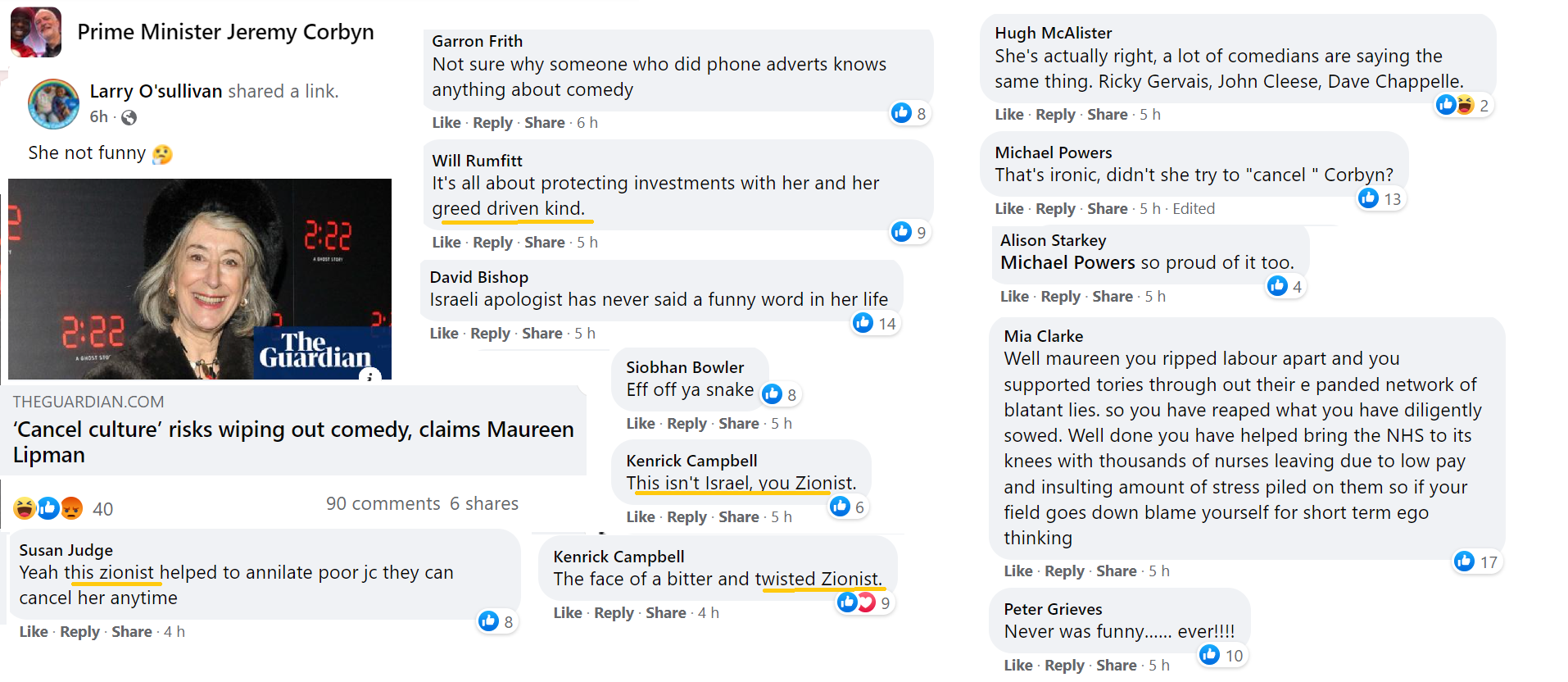

Notwithstanding being Jewish, Maureen Lipman had come close to being a National Treasure. Jews can still hold this position if they repudiate Israel, unless, like Stephen Fry, they speak out against the renaissance of antisemitism. Then they become persona non grata in certain circles.
The United Kingdom seemed one of the safest places on earth to be Jewish, for most of my life. Ted Margolis, in The Knowledge, made aliyah before it was strictly necessary.
Syncretism and Me
Posted on: December 5, 2024
I love everything about Christmas: angels, shepherds, fairy lights, dazzling trees in public squares, carols, old movies, good will to all men, a family get together in which kosher turkey is served, a vegan Christmas pudding and – as the first night of Chanukah falls this year on 25 December – doughnuts.
I have fairy lights in my flat, sometimes even out of season and exquisite glass baubles, each one different from the other, hang insecurely from wires across my ceiling. I have no Christmas tree apart from a naked pine tree which grows in the garden. I am extremely fond of Christmas trees but it seems to me a bridge too far to have one in the house and decorate it, although I know I would enjoy doing so.
Last week, when I picked up some Chanukah candles in a Jewish gift shop, I noticed that crackers were on sale, Chanukah crackers with little dreidels and no doubt chocolate coins inside them. I felt a moment of disapproval but then thought, ‘Who am I to talk?’ I did not buy them and went for transparent dreidels with sweets inside them, for my grandchildren.
I like to go to midnight mass at a beautiful church just ten minutes away. Seven years ago, late on Christmas Eve, my youngest daughter gave birth, after a long labour, to a little girl. An hour later, turning up for midnight mass, I said excitedly to the shammas, I mean the usher, ‘My daughter just had a baby!’
His eyes swiveled anxiously round the lobby, and I explained ‘Not here! In a hospital.’
I do not speak the prayers, obviously, but I shake hands with the people around me when the congregation is called upon to exchange a sign of peace. I don’t mind being a stranger there, although there was one time when a vicar, in his sermon, said that Israel would have stopped Mary and Joseph going into Bethlehem. What did he suppose was meant by ‘Once in royal David’s city…?’
I have been a little apprehensive since then, though not enough to stop me going, and there have been other vicars, preaching on other themes. I like the scent of candles as I enter the church. When the congregants line up for communion, I remain unperturbed in my seat. I feel good will.
That is really the essential thing, the season of good will, Luke 2:14:
Glory to God in the highest, and on earth peace, good will toward men.
It’s nice in Latin too:
Gloria in altissimis Deo et in terra pax in hominibus bonae voluntatis
…and, since you ask, in the original Greek:
Δόξα ἐν ὑψίστοις θεῷ καὶ ἐπὶ γῆς εἰρήνη ἐν ἀνθρώποις εὐδοκίας.
I will include here a photo I took of the tree in Muswell Hill, just outside the Everyman cinema, because I liked it.

Altogether on a Smoke
Posted on: November 3, 2024
Years ago, my shul used to hold Rosh Hashanah and Yom Kippur services in the hall of an Edmonton sports centre. It was a way for the community to be together rather than separated into two or three halls which were too small to seat everyone in the synagogue building we had at the time.
Once a janitor’s voice broke through in the middle of a morning Amidah, asking a Mr Jenkins to come to the boiler. It was an imperfection of the venue that ordinary life, work and sports continued outside the doors of our hired hall with the portable ark and scrolls of Torah in their white yomtov covers. In front of the pulpit was a white cloth on which Pamela had embroidered the words בהרת בחיים, ‘Bacharta bachayyim’ – ‘Choose life.’
Another time, an aspiring terrorist phoned in to say that a bomb had been planted in the building. This was not necessarily on our account as the IRA was quite busy at the time and they had their own fish to fry. An announcement broke through the loudspeaker system in the ad hoc synagogue hall, requesting everyone to leave the building. I was six months pregnant at the time, always ready to make a swift exit if danger threatened and I shot out of the building, waiting outside for the community to emerge, Torah scrolls carried aloft while, from another part of the sports centre, swimmers appeared wrapped in towels, against the cool September air.
I thought about the speed I had put on to get away from possible peril. I considered that I had such an acute sense of danger that I was always ready for flight. Indeed, it wasn’t my first rodeo with a bomb threat and I had been fleet of foot the previous times too.
The unborn baby I carried then is now a woman of forty-three, with a child of her own.
I used to think that if I had been so unfortunate as to be alive and living in Germany when Weimar came to an end, I would have been among the first to leave the country. My sense of danger, I thought, would have told me what was coming and to get out, now.
My sense of danger and my leaning towards pessimism tell me that the renaissance of antisemitism in the west is not likely to dissipate any time soon and my relations in Israel believe they are safer there, in a time of war, than they would be here, although the UK government and the police do say that they have our backs. The thing is this: I have children here in England and my children have partners; furthermore my children have children, jobs, in-laws, mortgages, Oyster cards and the Disney Channel. None of these people would be up for aliyah and I am not going to leave them, to go by myself. We are a tribe and at the same time a mixed multitude.
Despite this, I am learning modern Hebrew on Duolingo, in which I am currently on a 136 day streak and, according to the green cartoon owl which accompanies all Duolingo activity, have completed more lessons this week than 95% of learners. Be that as it may, I am finding the hardest part is translating from the spoken word. Understanding the audio is harder than understanding the printed words which suggests that I would not fare well in a modern Hebrew speaking environment. I can understand biblical Hebrew but would never have been able to catch what Moses was saying, especially with the background noise of Mount Sinai being altogether on a smoke (Exodus 19:18).
One of my cousins, older than me, went to live in Israel about five years ago, but he has children living there as well as children living here. It seems likely that I will end my days in the country of my birth, England, but my Duolingo practice is like the suitcases other people say they keep packed. One readies oneself, in case of a more significant deterioration in our fortunes.
Two, four, six, eight, we don’t want no police state.
One, two, three, four, something something something war.
The chants on marches and demonstrations are always pretty much the same – not the words, but the tune which passes from generation to generation. When young, a teenager, I chanted with the rest of them: ‘We don’t want a nuclear war,’ and all I can remember from the innumerable demos outside the US embassy in London is ‘Hey, hey, LBJ, how many kids did you kill today?’ One could also hear ‘Hey, hey, Ho Chi Minh, how many kids have you done in?’ but this would not have been far left orthodoxy.
I watch news footage of the ‘pro Palestinian’ marches. The marchers have a soft spot for the Houthis whose flag is emblazoned with the words, ‘Curse the Jews.’ One wonders how many Yiddisher people the Houthis encounter in present day Yemen. ‘Operation Magic Carpet’ rescued 49,000 Yemenite Jews from persecution in 1949 -1950 and most went to live in Israel.
The staple chants of the current marches are of course ‘From the river to the sea, Palestine will be free’ – a favourite as it marries a call for the genocide of Israeli Jews with plausible deniability – and ‘We don’t want no two state, we want 1948.’ In point of fact, the United Nations voted in favour of the partition of the British Mandate of Palestine into Israel and Jordan in November 1947 so one assumes the marchers really want to return to 1947 but the rhymes for seven are limited.
Such is the audio of the marches. Visually, there is the constant comparison of Jews with Nazis, an image of the Israeli flag with a swastika instead of a six pointed star or a drawing of Netanyahu feasting on children while blood drips from his mouth. You truly don’t have to like Netanyahu to see this as the objectionable antisemitic trope which it is.
JW3 is a Jewish Cultural Centre on Finchley Road, a large modern building opened in 2013, a project of the Clore Duffield Foundation. Classes are held there, films are shown, lectures and conferences take place. There is a cafe/restaurant. Last time I was there, I had a beer and a tuna sandwich, before entering an auditorium to hear four illustrious speakers discuss the reawakening of western antisemitism after 7 October.
The name JW3 is an allusion to the postcode, NW3 and the fact that it is a Jewish cultural centre.
Yesterday, the demonstrators came to JW3. The stood in front of the entrance, yelling ‘Yemen, Yemen, make us proud, turn another ship around.’ Some, who were over-excited, made grotesque, contemptuous gestures at people arriving for a conference. One elderly woman was seen crying as she struggled past them to get into the building; another had her hands over her ears. Ironically, the conference was put on by Haaretz, an Israeli newspaper so critical of the the government that it is often cited on anti Israel social media. Among the speakers were Palestinians, including a former Member of the Knesset. Ehud Olmert, a former Prime Minister of Israel, was also a speaker.
It made no difference to the demonstrators that the conference was substantially critical of Israel. Whatever the politics, JW3 is a Jewish centre and there were Israelis inside the building. We have seen similar demonstrations when Israelis, however left leaning, are invited to speak at UK universities. The presence of progressive Hen Mazzig at a London college provoked rage no less than events addressed by the undoubtedly right wing Israeli ambassador, Tzipi Hotovely.
Thanks to Alex Hearn for this video where the demonstrators screech ‘In our thousands, in our millions, We are all Palestinians’ while people run the gauntlet past them to enter the building.
‘Intifada, revolution,’ was also shouted but it is the second half of a couplet, usually, ‘We don’t want no Two State Solution, Intifada revolution.’
There are many snippets of film showing bestial abuse from the demonstrators but a feature present in all of them is the excitement of roaring in the street as if the volume could carry the day – and, in a close second place to the volume, the rhymes. Just south of Swiss Cottage, outside a centre for Jewish culture, discussion and learning, they shout ‘Yemen, Yemen make us proud; Turn another ship around.’ The shouting is climactic, accompanied by the bodily movements which accompany the production of maximum decibels.
The chanting drowns out reflection as the person loses themself in the crowd, like a Heideggerian Das Man who reassures himself by being one of a consensual many, freed from the burdens of individuality.
The video below was something I filmed outside Wood Green Library, earlier this year. It was not connected with the JW3 demo, but I noticed the intensity and the way the woman moved her body to help her produce the loudest possible shrieks as she cried ‘Yemen, Yemen, make us proud…’
George Orwell said that the point of the goosestep used by the armies of authoritarian regimes was to communicate, ‘We look absurd but you dare not laugh.’ So it is with the chanting.
The popularity of havoc
Posted on: October 14, 2024

In the years, the months, even the weeks after 9/11, I noticed how an anti-Americanism seemed to pervade popular consciousness, an opinion that they had it coming and that the villain of the piece was George W Bush. In a sense, 9/11 brought down Tony Blair who, until then, was not generally perceived as a lackey of the Washington administration. The global flare up of anti Jewish discourse and action since the massacres of 7 October has reminded me of this unexpected phenomenon, the lionisation of those who carry out political murder.
As if to compensate consciences for the cruelty of approving the murders, critics of the USA and of Israel express themselves in terms of compassion for the beleaguered people of Iraq, Afghanistan, Gaza and Lebanon. In the UK and the USA, many thousands took to the streets early in 2003, to oppose the invasion of Iraq. Since 7/10, there are huge marches every other Saturday across the cities of Europe, the UK and the USA, against Israel, often stridently supporting Hamas and Hezbollah.
I do not recall Sadaam Hussein being admired, except by George Galloway; neither is the Ayatollah Khameini a role model for many, although there is certainly a degree of sympathy for the Islamic Republic of Iran in the anti Zionist clamour.
In the early 2000s, I worked in a bookshop which belonged to a well known chain of stores selling books, stationary and newspapers. By Christmas 2002, the shelves headed ‘Humour’ filled with new books satirizing the ‘special relationship’. One which I remember took the form of juvenile and misspelled letters purporting to be a correspondence between Bush and Blair, in which Tony was the acolyte of George, apparently a bigger, older boy.
Bush was known for his malapropisms and admitted ‘Sometimes I misspeak’. Small books of ‘Bushisms’ appeared, amusing verbal slip ups. ‘Misunderestimate’ was Bush’s own coinage, much mocked yet, compared to Donald Trump, Bush was indeed misunderestimated. Blair was less often the butt of jokes. His intellect and fluency meant he was portrayed by some as consciously evil, a Jaffar to Bush’s Sultan. His religiosity was held against him.
‘You don’t pray together?’ Paxman asked Blair, referring to the fact that Bush and Blair both identified as Christian believers, in the course of a hostile interview where Paxman emphasized the death of innocent civilians in Iraq. Blair, always a master of self control, was clearly irritated by the question, which he answered with a negative. What was behind the question? Was it that the western leaders used Christianity as a justification for wars against Muslim peoples; that they used it to indicate probity as a cover for warmongering; that they were crusaders? What put it into Paxman’s head to ask the question? It was likely already in popular discourse.
Any reproach against Blair and Bush has been magnified a thousandfold against Netanyahu since 7 October and he is often seen as encapsulating the people of Israel more than Bush was regarded as representing Americans, or Blair as representing British people. In the mix is the lightly somnolent virus of antisemitism, now fully awake and wanting breakfast. Opponents of Israel’s wars think they have not the slightest hostility to Jews but that Israel’s wars are monstrous and that Zionists the world over are the cause of all ills, even the vagaries of severe weather. The language born out of the Nuremberg trials, of war crimes and genocide, is applied to Israel so feverishly that, if one is not called a genocidal maniac, one feels the interlocutor is pulling their punches.
On the marches, they chant: ‘Yemen, Yemen, make us proud; turn another ship around,’ ‘All Zionists are racists,’ ‘We don’t want no two state, we want 1948,’ ‘Khaybar,Khaybar ya Yahud,’ all chanted to – so to speak – the same tune.
Daily on X, formerly Twitter, I see people calling for the extermination of Jews while speaking compassionately of Palestinian suffering. The horror lies in the fact that they are not all the usual suspects, the neonazi right wing, but come also from the left and, still more disturbingly, the centre.
The question is this: if Israel had gone to war without the trigger of the 7 October pogroms, would the hatred be any greater? If America had made war on Iraq without the impetus of 9/11, would the vilification have been the same?
If Guy Fawkes had not been discovered in the cellars of Parliament and if King James and his government had been sent to kingdom come, would children still have said ‘Penny for the Guy’ and put Fawkes’s effigy on bonfires, almost to the present day?
A month after 9/11, I heard schoolboys chanting ‘Osama bin Laden’ on the streets of Edmonton in North London. They were expressing approval – of what? The glamour of terrorism? The win of wreaking havoc?
I could not say. I do not know.
The Galut in the Galut
Posted on: August 8, 2024
Galut is the Hebrew word for exile. It mean the Jewish diaspora outside the Land of Israel and, in the bible, it is used of the captivity in Babylon from about 587 BCE until about 537, when the Persian emperor Cyrus permitted the return of the exiles.
This article, however, is about Finchley and the anti racist demonstration which took place there last night.
It is August, when even the supposedly placid Brits have been known to take to the streets and riot, last time in the dog days of 2011. The trigger in the present case is the tragedy of a murderous rampage by a teenager in Southport, killing three small children and injuring many others. The falsehood that the perpetrator was a Muslim immigrant was circulated on social media and the riots began, populated by self-styled patriots who set fire to vehicles and attacked mosques. Even when the identity of the killer was made known, and he was revealed to be neither a Muslim nor an immigrant, the riots persisted, spreading to many cities in the UK, including Belfast. There was a clearly racist impetus against Muslims and it put at risk all people of colour.
In Southport, residents gathered together after the riot to clear up the mess and to repair damage to the mosque, and the other cities followed, attempting to repair not just the physical but also the civic and social wreckage.
This became a moment for the left to formulate their response and assemble their activists. Professor David Miller was not alone in asserting that Zionists had caused and directed the anti Muslim riots. The far right Nick Griffin, former leader of the British National Party, took exactly the same view. Tommy Robinson, in recent years more at the forefront of the far right than Nick Griffin, has designated Islam and immigration as the enemy but he is not anti Jewish. On the contrary, he wanted to participate in a march against antisemitism but was turned away by the organizers, rightly in my opinion, as his presence would have been used to characterize the march as Islamophobic. Boris Johnson’s presence among the marchers was hardly remarked on, but Tommy Robinson would have damaged the brand of the Campaign Against Antisemitism, which had brought out a hundred thousand people, marching to Westminster.
Yesterday was Wednesday. It was widely reported by social media that the far right were going to attack specific immigration centres and other vulnerable targets, related to asylum seekers. The anti racists swiftly organized counter demonstrations and, in the event, many thousands gathered to defend the designated locations, while there was no show from the far right. In almost every way, it was a good outcome.
However, this leaflet was distributed concerning the anti racist assembly in Finchley, just a mile or two from where I live.
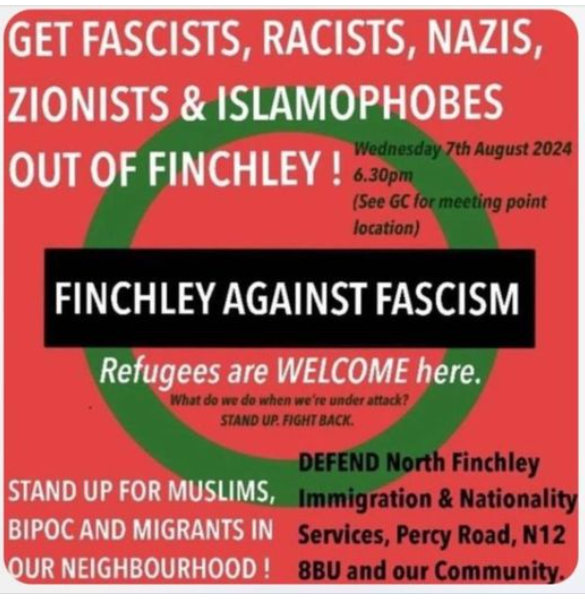
The inclusion of Zionists among the categories of the far right was a racist solecism. I am only too familiar with the argument that Zionism is separate from Jews and Judaism, which is invariably the response of those accused of antisemitism on the basis of a fanatical or violent anti Zionism. And yet, it is often the same people who substitute the word Zionists for Jews in highly anachronistic ways, claiming that ‘Zionists’ killed Jesus, sank the Titanic, were readmitted to England by a malfeasant Oliver Cromwell and -one I saw for the first time yesterday – had King Charles I beheaded.
In practice, most Jews I know hold liberal Zionist views, severely tested for some by reports of right wing bigotry among members of the Knesset or delinquent behaviour from some West Bank settlers. Where their Zionism is not crushed into non existence, they tend to repose hope still in the Two State Solution and the cessation of settlements in the disputed territories. They excoriate Prime Minister Netanyahu without reserve although some, like myself, have too often seen Netanyahu portrayed in antisemitic iconography as a blood soaked monster to want to add my voice to his demonization. Those of my generation tend to have histories of activism with the Anti Nazi League and to have demonstrated in the past against the National Front, the BNP and South African apartheid.
I can tell you that when I was on a counter demonstration against dockers who marched in support of Enoch Powell in 1968, the antisemitism I heard that day came from some of the Powellite dockers, not from the counter demonstrators.
Be that as it may, it appears that Zionists are now not welcome at anti racist demonstrations, so I count myself as excluded.
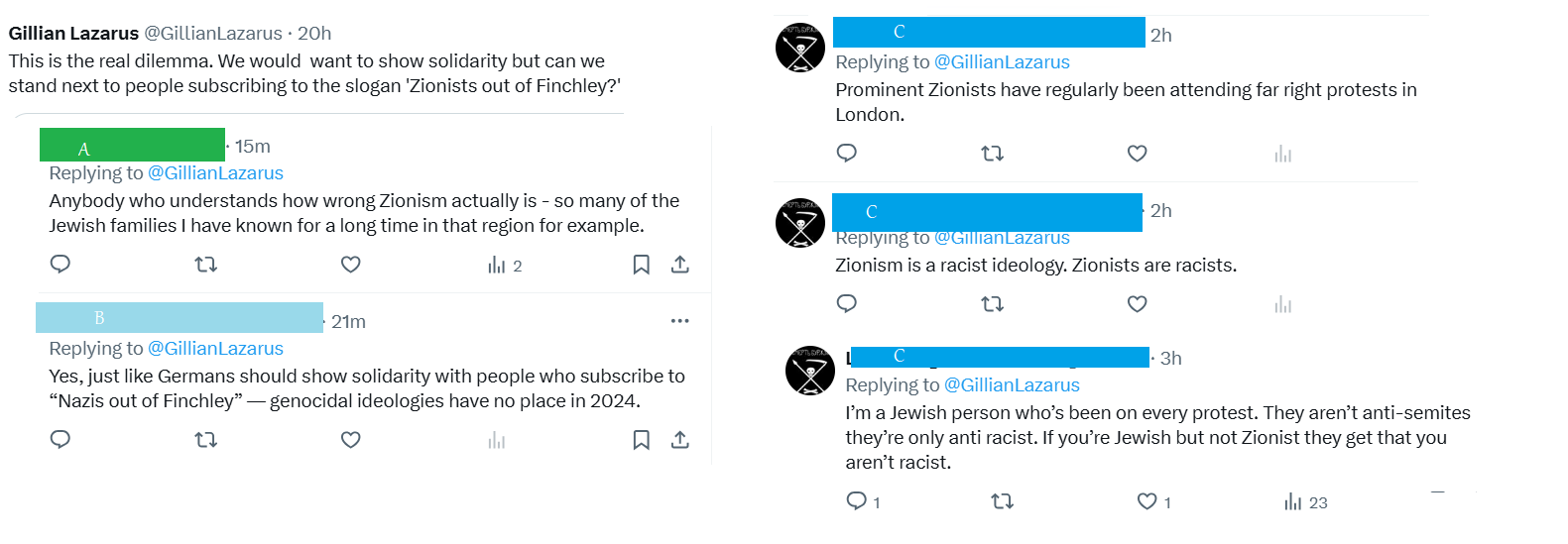
The CEO of a Jewish organization posted on X, formerly Twitter, that he had attended the Finchley anti racist demo, feeling bound to show solidarity with the Muslim community. When I replied that I would not feel welcome with my Star of David and yellow ribbon pin, which alludes to the Israeli hostages still captive in Gaza, he replied that he had worn these signs and not encountered hostility. So far so good, but others appeared on my timeline, thus:
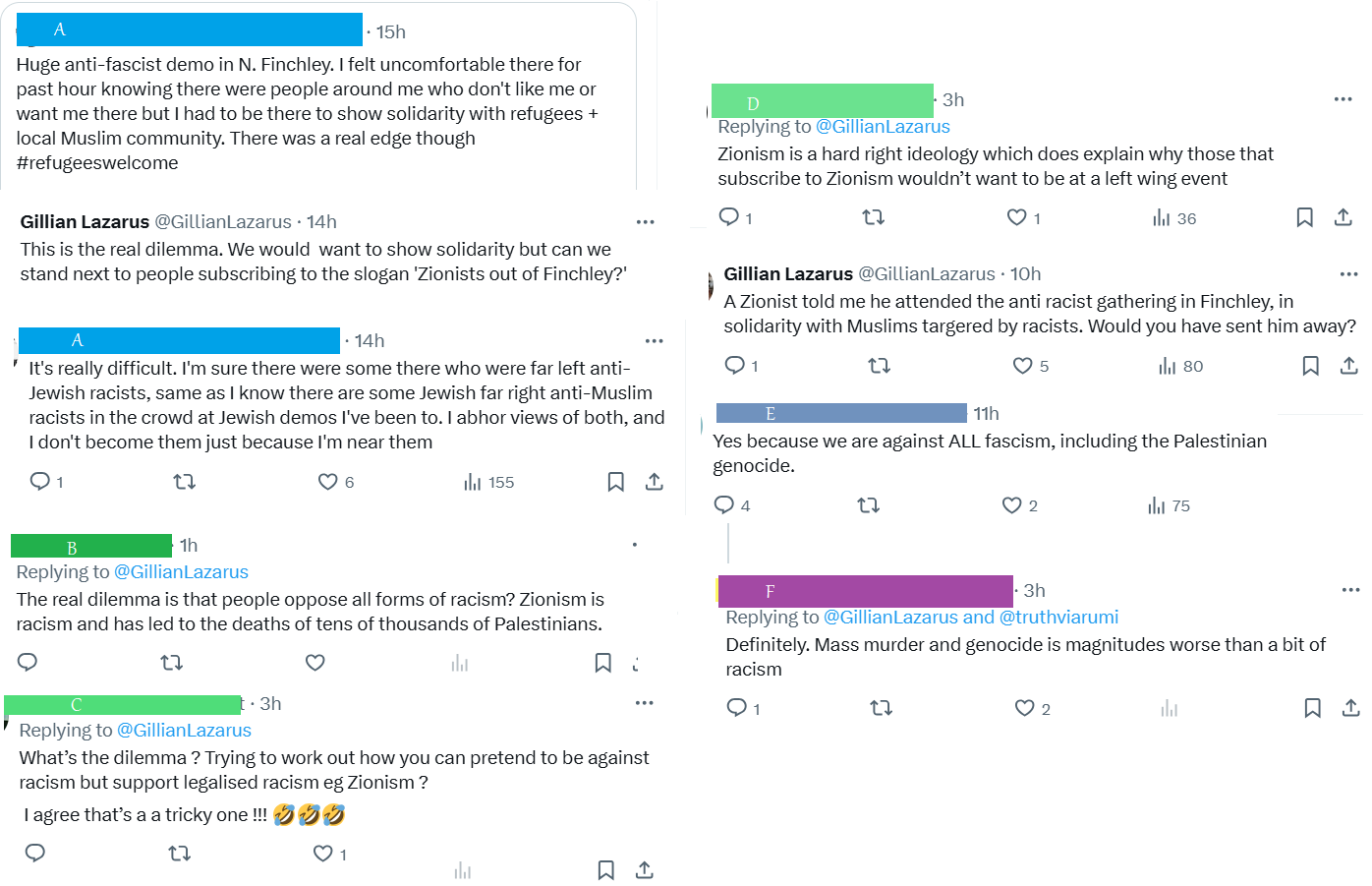
I have concealed the names, apart from my own, but ‘A’ is the Jewish man who was at the demo.
I read statements from some Jews who are anti Zionist activists, saying that they found nothing but goodwill on the anti racist demos, but they say the same about the weekly pro Palestinian marches and indeed failed to spot a shred of antisemitism in the Labour Party under Jeremy Corbyn’s leadership.
It has often seemed to me, perhaps wrongly, that Jews – my family and my friends – are Zionists unless they state otherwise. These days, more state otherwise than used to. They may be unhappy with Israel’s part in the wars it has to fight or they may simply not want to be excluded from political movements which they and I have always supported: anti racism, Gay Pride, civil rights, women’s rights.
It is not a pleasant thing to be exiled from political activity which has always been part of one’s life. It is this feature of the present day UK which makes England exilic for me as never before.
There is a new video of a Labour councillor making a speech from the midst of one of the demos. He calls for fascists and racists to have their throats cut and the crowd cheers wildly. Visibly powered by adrenalin and serotonin, he then roars ‘Free, free…’ and the crowd chants back, ‘Palestine!’
Election Nights Remembered
Posted on: July 5, 2024
All the UK General Election nights of my lifetime stand out in my memory, but they have rarely made me happy. Even when Harold Wilson won in 1964 after – as he phrased it – ‘thirteen years of Tory misrule,’ his majority was no more than four, barely workable for government. Two years later, he achieved a substantial majority but his special relationship with the United States during their pursuit of the war in Vietnam tarnished his reputation in the eyes of the left, among which I counted myself. However, I was not yet old enough to vote and, when I was of voting age, in 1970, Edward Heath knocked Labour off its perch, so the sun rose on a desolate summer morning.
In ’74, Wilson was back but with a tiny majority and he resigned two years later, Jim Callaghan taking over in Downing Street. 1979 was the beginning of the Thatcher years. Initially it was interesting that a woman was Prime Minister but still depressing that it was Margaret Thatcher, whose winning streak continued until her party forced her resignation. John Major, known as ‘The Grey Man’ was now PM. He had a reputation for being dull and eating peas although, to be fair, peas are an underrated vegetable. Whereas Spitting Image depicted him as terminally unremarkable, the more recent Netflix series, The Crown, portrays him as a man of integrity, not without glamour. Either way, I cried in 1992 when Neil Kinnock, expected to carry the day, lost to the grey legumephage.
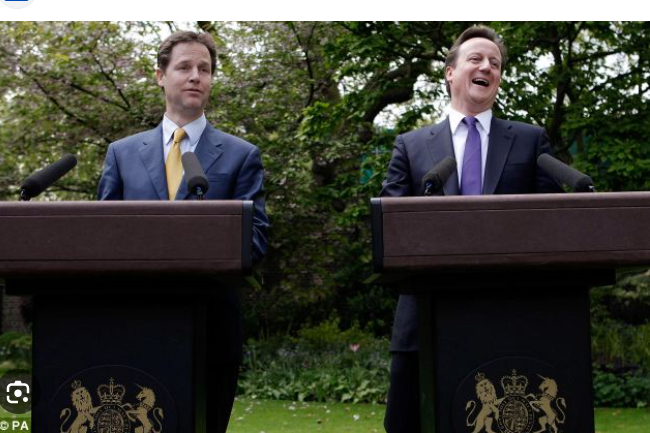
1997 was the first really happy election night. Blair shone in those early years of his premiership, perhaps less in 2001 than in 1997, but he got the second term. Then, while the country raged against him over the Iraq war, he won a third term, the first Labour Prime Minister to do so. Labour’s majority was down to sixty-six which was a big drop, but seems perfectly adequate compared to subsequent General Elections. Then Blair was out, with his future behind him and Gordon Brown stepped up but did not have much of a future in front of him. Neither Labour nor Conservatives had won the 2010 election as there was no overall majority, but Nick Clegg, the LibDem leader, was in the role of a kingmaker and opted to go with the Tories. He and Cameron gave a press conference in the Downing Street rose garden. It was like a buddy movie in which Nick Clegg was the straight man or, certainly, the junior partner.
I was sad when Gordon Brown made his valedictory speech. Perhaps I cried; I can’t remember.
Although I preferred David Miliband to his brother Ed, I rejoined Labour during the 2015 election campaign and it seemed to me that Ed was going to make it. This was because I didn’t know anyone who admitted to voting Conservative. Like a spectator at the Grand National, I was saying ‘Come on Ed. COME ON ED!’ but Ed had fallen at the bacon sandwich and the Edstone, and Cameron romped home, so that was another bad night.
The Brexit referendum came and went, leaving disaster in its wake. Cameron resigned, striking me as oddly sympatique in his parting speech. I was sorry for him too, as he had experienced tragedy in his family life. By this time Jeremy Corbyn was in situ as Labour leader, which brought the horrors of antisemitism in my own party, combined with aggressive cult-like behaviour from the demographic known as Corbynists. I left the Labour Party, not precisely when Corbyn became leader, but when he was nominated to run for the leadership by a sufficient number of Labour MPs. I thought they were irresponsible and that, contrary to their expectation, he might win the leadership contest, which of course he did.
Theresa May was now Prime Minister and I quite liked her; felt as if I wanted to go for a drink with her. If my allegiance to Labour hadn’t come to a stop, I would probably have cast a colder eye on the second woman PM of the UK. Her 2017 General Election was a disaster. Expected to win, the Tories lost their majority. Expected to do badly, Corbyn did relatively well and became a Capraesque hero: the honest man who stands tall among the venal and the corrupt; hence the chants of ‘Oh Jeremy Corbyn’ at Glastonbury. But – although the Corbynists denied this furiously – he had a problem with Jews, which aroused a new kind of fear among British Jews, self included, while many on the left accused us of lying in order to protect Israel.
Boris Johnson was chosen to succeed Theresa May. ‘Get Brexit done.’ Was this a good thing or a bad thing? He was perhaps the most likely to beat Corbyn but his brexiteering and louche persona counted against him. Nevertheless, when the election came in 2019, I voted Conservative, as I had done in 2017. Not only could I not vote for Corbyn’s Labour, I wanted to use my vote to their detriment, as far as possible, and that was Tory, not LibDem.
When the exit poll predicted a big Tory majority, I sent up a prayer of thanksgiving. It is, as far as I recall, the only time that I prayed in response to an exit poll. And it was one of the few election nights during which I was happy as the results came in.
Then, last night, General Election 2024. Starmer had done so much to change Labour for the better that I resolved to vote for them again. Then I found that boundary changes meant that my Labour candidate was now Kate Osamor, to whom I did not like to give my vote for a few reasons, involving Holocaust Memorial Day and – a separate thing – something to do with baseball bats. I voted LibDem but I still wanted Labour to win and Keir Starmer to be PM, and so it happened.
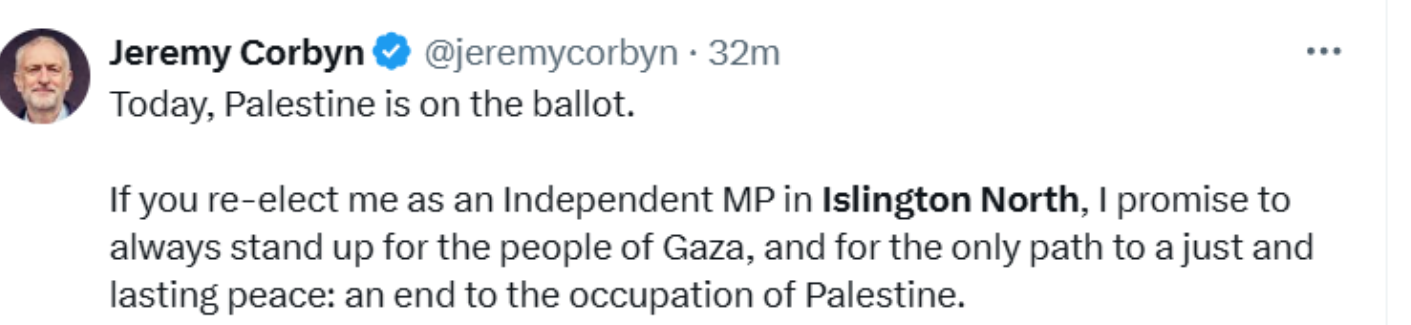
Was it a happy night? Not really. Reform under Nigel Farage was up and coming, often achieving second place in Labour voting constituencies, while Tories came third or lower. Candidates identifying themselves as ‘standing for Gaza’ gained about four seats in constituencies described as having a high concentration of Muslim voters. Corbyn swept back into Islington North as an Independent, also for Gaza, this being his tweet on Election Day:
My hope is that Starmer will be a good and effective Prime Minister but I ask myself, ‘What is up with the UK?’ There is a loss of faith in the democratic process, a loss of civility in public life and a loss of safety on the streets. If Keir can go some way towards fixing this, I will vote Labour next time, if I live.
Your God, My God
Posted on: June 16, 2024
Polly was my cousin by marriage. Her mother had died while she was a teenager, likewise my cousin who was her bridegroom had lost his mother, and while still teenagers, they were married. I was a bridesmaid, obliged to wear a turquoise blue dress which was ruched from the neck to the knees, a bad choice for an overweight twelve year old. Within a few years, they had three children.
Later in their marriage, they engaged in rackety diversions: wife swapping parties. An ongoing accommodation with neighbours led to Polly and the husband next door going off together, leaving an abandoned husband and an abandoned wife.
Polly engaged in philanthropic works. She did not enjoy robust good health and seemed often to undergo medical procedures. She had a serious operation and, when I saw her afterwards at a family gathering, she told me that Jesus had appeared to her while she was under anaesthetic. Not without a sense of humour, she seemed aware of something absurd in this assertion and giggled when she reported that she had said to Jesus, ‘But I’m Jewish!’
‘It doesn’t matter,’ Jesus replied, which is the most memorable thing I ever heard Polly say, although in point of fact it may have been Jesus not Polly who said it.
Don’t sweat the small stuff. When God appears to you, it doesn’t matter if He’s wearing tefilin, a turban or a feathered fascinator.
I wasn’t immune myself to the attractions of Christianity but realized when I was about twenty-one, that the shortest route to God was the path of my forefathers, Abraham, Isaac and Jacob, and my grandfathers, Yitzhak and Yaakov. I studied my religion during my early married life, later in academia and still, haphazardly, to this day. After retirement, I attended classical Greek classes, hoping to be able to read the Septuagint and, as a bonus, The New Testament; however I quickly forgot how to recognize the aorist tense or decline τριηρης, meaning trireme.
When we reach our limits in theology and the languages of antiquity, we have to hope that God will appear to us in our time of need, like Jesus to Polly.
There is a war at the present time where God is invoked by opposing sides, one side calling Him Allah and the other, Hashem as well as many other names, such as Shaddai, Ha Makom, Ha Kadosh Baruch Hu (the Almighty, the Omnipresent, the Holy One, blessed be He). I believe ‘The All Merciful’ is one of the Islamic names for God, a beautiful concept. It is the depiction of God at His least merciful which drives this secular generation away from faith, to which enlightenment is considered the antidote.
The Abrahamic faiths, Judaism, Christianity and Islam, share the belief that there is one God. After Abraham’s funeral, Ishmael goes back to the house/tent of Isaac his half-brother. I imagine that they drink tea in china cups and eat sponge cake and, sitting with crossed legs, marvel at the memory of Abraham circumcising himself when he was ninety-nine years of age.
‘He had a steady hand right to the end,’ Isaac tells Ishmael, but Ishmael, who has not seen his father for many years, does not want Isaac to be the maven on all things Abraham. They have the same father and the same God but, if their perceptions of their father are at odds, how much more so, the perception of their God?
I am moved by a multi-season streamed drama, The Chosen, about the life of Jesus, directed by a Christian film-maker, Dallas Jenkins. The Jewishness of the Judean and Galilean environment is evident in every scene. There is a modern aspect to the expressions of emotion yet it adheres to the narrative of the gospels and conveys numinosity which Hollywood biblical epics so often aspired to and so rarely achieved.
Our lives are a mystery; we can hardly doubt this, but they are not all the same mystery. Each of us lives their own mystery, just as each of us dies our own death, alone. Slavoj Žižek joked (or simply said!) that the light at the end of the tunnel comes from another train on the track, heading straight towards us.
Notwithstanding, don’t we all hope to see the light?
The Vagaries of X Support
Posted on: May 23, 2024
‘This time it will be total extermination,’ a hubristic neonazi assures me on X, formerly known as Twitter.

Neonazis do not appear every day in my notifications and Triple C may even be a former acquaintance who used to send me pictures of gas cannisters and promises of another Shoah. I thought of the person as Colorado Adolf, due to his obsessive trolling of a Jewish politician in Colorado as well as his constant praise for Hitler who, as you see, appears in his profile picture.
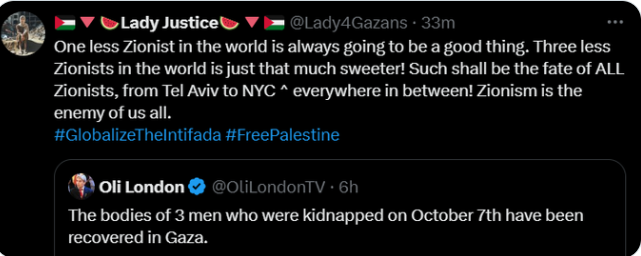
Triple C has one follower, currently tweeting as Lady4Gazans. ‘Lady Justice’ as she calls herself in all her numerous Twitter accounts remembers always to say ‘Zionists’ when she calls for global extermination.

It is her habit to refer to the young Israeli women killed or taken hostage on 7 October as ‘whores’ and she often expresses the thought that ‘they should have stayed in Poland.’
The neonazi Triple C has no difficulty in referring to Jews as Jews. His Hitler fandom spurs him to repeat the aims of the Third Reich, which he insists will soon be realized.
Both Triple C and Lady Justice utilize the ‘Happy merchant’ meme, a Streicherish cartoon of a cunning, grasping Jew, persecuting the world yet fearful of retribution. Lady Justice admires Hamas but not the Nazis who she believes were Jews, offering the word Ashkenazi in support of this theory. They are a match for each other, but her longevity as an X account is likely to exceed his by far. When she tweets anachronistically that Zionists killed Jesus, besides being behind various historical disasters, one can infer that she means Jews but the word Zionists serves to keep her in business, as far as X adjudicators are concerned. Both are adept at alternating their accounts, with minimal changes in the name.

Triple C combines letters and numerals, often simply adding a number to create a new account from one which has already been penalized. I believe this was one of his accounts last year – at least, Triple O shared Triple C’s hatred of Jared Polis, the Governor of Colorado.

I know I am not the only person to report these accounts. Anything gruesomely offensive will be reported many times over, but it takes dedication to get a response from X and sometimes there are mixed messages.

There is a skill to staying on X. One has to be careful, in quoting something outrageous, not to have it attributed to oneself, as hate speech. A friend who referred to a country which hanged gay people was banned from Twitter for many months as the words [they] ‘hang gay people’ was taken to be an instance of homophobic hate.
I have been many years now on Twitter/X and must assume that I am often reported, for the offence of Zionism. Nevertheless, I have not undergone a suspension, although I was advised early on by Twitter not to use profane language.
What can one hope for from X Support? A little, I hope, but not very much. X remains an information exchange and locus of mutual support for people of good will, which is what I supposed it would be when I joined Twitter in 2009. ‘People of good will’ begs the question – who are these people? The X wars are founded on disagreement over precisely this question.
I would have supposed that a person who tweets to me that I am going to be gassed would be an open and shut case for X discipline but it ain’t necessarily so.
One day after I wrote the above:
@CCc149139 has been suspended.
@CCc1491398 has deleted all their posts and replies and is kept in reserve.
@ZZz1397870 is active and abusive.
@Lady4Gazans continues in the same vein, always remembering to say Zionists rather than Jews, however anachronistically.

And tonight, when the bodies of three more hostages have been retrieved from Hamas tunnels, Lady Justice rejoices in their death and wishes it on all Zionists, everywhere. Her tweet gets reported by many but we are ghosted by X, as is so often the case.
Now, in the dog days of August, Lady Justice and Colorado Adolf make new accounts, after days or weeks of silence, and they both take care to tag me, so that I know they are back in town.


