Author Archive
What to Watch Tonight
Posted on: March 19, 2026
For a movie lover, I’m strangely reluctant to watch new films, especially the nominated films lauded and awarded for the performances of actors, the insight of scriptwriters and the magical vision of directors.
And yet, I want to watch films more than ever, to divert myself from the world of wars, politics and proud bigotry. I have recourse to the films noirs of the immediate post war era, any Hitchcock except Psycho, the British kitchen sink dramas of the late fifties and early sixties, the liberated vision of the seventies and satirical takes of the eighties – and so on until reaching the products of perhaps the last ten years. As for the awards ceremonies, although I register the names of the nominated films, I cannot bear the self-congratulatory speeches by thespians for Palestine adorned with shiny pins depicting bloodied hands and received with roars of approval from the crème de la crème of the movie industry.
When Vanessa Redgrave made her ‘Zionist hoodlums’ speech at the 1978 Academy Awards, it was considered by many to be in bad taste, to use one’s garlanded moment at the microphone, to push one’s politics. How this has changed! It is now almost a requirement to show one’s pro Palestinian cred, and if the artistes are not so fortunate as to be nominated for awards, they have the opportunity to put their name to one of the letters, forswearing interaction with Israel and declaring solidarity with the Gazans, in their suffering and in their resistance.
So many fine actors stand up habitually to be counted as opponents of Israel, or even as ill-wishers favouring the elimination of the Jewish State, that one would have to pick one’s way carefully through Amazon Prime Video and Netflix to avoid their vehicles. Once upon a time, it was only Mel Gibson, whom I could manage easily without; now it seems to be the majority of British and American acting or directorial talent. Even Jonathan Glazer, accepting an Oscar for best international picture earned by the unwatchable ‘The Zone of Interest’ was moved to say that he ‘refuted his Jewishness and the Holocaust being hijacked by an occupation’. Refuted? I won’t pretend I don’t know what he was saying – that Jews have special privileges which we use to carry out indefensible strategies and stratagems against Arabs and against our critics. This argument is very popular with anti Israel activists and deniers of antisemitism. To have a Jew subscribe to it on one of the most viewed platforms in the world was a great boost to the above-mentioned deniers, who usually rely on Neturei Karta or JVP to back up their non racist bona fides.
I rarely go to the cinema now although I still appreciate a large screen and the atmosphere of the picture house, mainly because it is a shlep when one can obtain most films through a streaming service sooner or later – these days, sooner. The last films I saw in the cinema were ‘Conclave’ which I liked and ‘Oppenheimer’ which I didn’t. The brilliant stars of both films have since found themselves unable to remain silent when it comes to condemning Israel.
Sky Arts recently showed Otto Preminger’s 1960 film Exodus, from Leon Uris’s book about displaced Jews struggling to reach Israel in the last days of the British Mandate of Palestine. It was adapted for screen by Dalton Trumbo, using his own name at last after the McCarthyite blacklist. It would be impossible to make such a film now which, while not altogether neglecting the rights of Arabs, foregrounds the urgency of reaching Israel for the Holocaust survivors held in a Displaced Persons camp in British Cyprus. There is even a satirical swipe against the kneejerk antisemitism of an upper class British officer portrayed by Peter Lawford.
What would Otto Preminger, Leon Uris, Paul Newman (Jewish) or Dalton Trumbo (not Jewish) do in today’s climate? Would they succumb to the pandemic of condemning Israel? Or were they made of sterner stuff, those luminaries who lived through the Hollywood blacklist and emerged intact on the other side?
My Beef With Laertes
Posted on: December 20, 2025
Imagine an adaptation of Pride and Prejudice in which a cash-strapped Mr Bennet is resolved to get his five sons married to rich heiresses, to improve the family’s diminishing fortunes. The lively and intelligent second-born, Elliott, takes against arrogant, wealthy Phyllis Williams-Darcy but the undoubted chemistry between them flourishes into love. I don’t like it. Do you?
Gender blind casting can work, more feasibly in Shakespeare than in Arthur Miller, Samuel Beckett or George Bernard Shaw although it depends on the play: ‘Waiting for Godette’ (instead of Estragon, Oestrogen) is easier to envisage than ‘Saint John’ or ‘Woman and Superwoman’.
Just after lockdown, I took one of my grandsons to see ‘The Kids’ Hamlet’ at the National Theatre. Laertes was not only played by a young woman but depicted as Ophelia’s older sister, so the patriarchal nature of Polonius’s household was subverted and Ophelia’s predicament not quite as usual. Some years earlier, I took a different grandson to see ‘Treasure Island’, also at the National. Jim Hawkins, played by a young girl, had been made over into a female character, as had some of the pirates. I can’t remember the gender of Long John Silver. As you would expect, the portrayal didn’t hold a candle to Robert Newton. Did they call Jim called ‘Jim lad’ or ‘Jim lass’? Couldn’t tell you. If the casting was gender blind, neither would have been appropriate.
It is classics of theatre, particularly Shakespeare’s plays, which are most vulnerable to gender switches, and it offends almost nobody when great actresses are cast as Hamlet, Lear, Prospero and Richard II, but in some plays, it would subvert the plot beyond recognition. Could a female general, Othella, ‘put out the light and then put out the light’ of her beloved spouse Desdemonus? Should Romy climb up to the balcony of Julius, whose beauty teaches the torches to shine bright? I have no doubt that such productions are underway. As Shakespeare’s plays were performed in his lifetime by men and involved gender disguises in some of the comedies, there is an appropriate hinterland to, for example, the all male Twelfth Night at the Globe Theatre in 2012. Mark Rylance played Olivia as a woman, so the narrative was not mislaid. The late, lamented Tom Stoppard in his script for ‘Shakespeare in Love’ showed the limitations of performances when women were barred from acting.
I have seen a version of Terence Rattigan’s ‘Separate Tables’ in which ‘The Major’ has been arrested for importuning not young girls in the cinema, but young men. When the play was first written in 1954, the episode which inspired it had to be rendered acceptable to a theatre-going public and the Major’s homosexuality was firmly closeted. ‘The Deep Blue Sea’ would also have been a love story about three men, if the zeitgeist had not demanded a woman protagonist. In my opinion, it works very well as Hester Collyer’s story, but a production in which the main character is a man would also be worth seeing.
As for Lear, one could have a Queen Lear and the daughters still be daughters; there would be no need to switch the genders of Goneril, Regan and Cordelia. Changing them to sons would cause needless complications but worse than this would be casting them as two brothers and a sister, or two sisters and a brother. There would then be issues between the siblings different from those set out by Shakespeare.
This was my beef with the female Laertes. As Shakespeare wrote it, Ophelia is pushed around by all the men, with the notable offenders slugging it out on her grave. Sorry about the spoiler. Perhaps there will be a revision where Ophelia lives, to see off Hamlet, Polonius, Laertes and Claudius. She could then walk off happily into the sunset, hand in hand with Osric.
Not Being Afraid
Posted on: December 9, 2025
On Sunday, I was at the annual LCSCA conference, the London Centre for the Study of Contemporary Antisemitism, a flourishing organization conceived, brought to birth and nurtured by Professor David Hirsh of Goldsmith’s, University of London. Professor Hirsh emphasized the urgency of working against an antisemitic ethos which he said is now found ‘at the highest levels of sophisticated thinking…and that’s something which hasn’t been the case since the Holocaust, I think.’
Certainly, when I encounter the opinions of certain academics, journalists, ambassadors , lawyers and politicians, often of international repute and with a significant activist and social media following, and they say that Israel should not exist, should never have existed and that we who are Zionists should be penalized by law as accessories to every imaginable crime, then the world itself seems to me less safe than it ever was in my lifetime, even at the height of the Cold War. Our own warfare and lawfare against these grandees of antisemitism is waged most potently by academics, writers and lawyers.
In writing about the LCSCA conference, my intention is not to record what was said, even by the astute and experienced keynote speaker Dr Dave Rich, but about the subjective experience of an almost permanent anxiety being relieved, in a public space among a large number of trusted people. For me, everyone there was a trusted person.
When one visits a gallery, theatre or nearly any public venue, security staff will search the bags of visitors. This is reassuring but it does not mean that some ballet dancer will not unfurl to scattered applause a Palestinian flag or that a monomaniacal visionary of Palestine Action will not empty a can of green paint over the Wilton Diptych. Although this would not cause physical harm to persons, it would, for me, resemble being in the cafe in ‘Cabaret’ when a lad from the Hitler Youth sings ‘Tomorrow Belongs to Me.’ I used to reflect, when watching this unforgettable scene, that tomorrow did not belong to him, but now there is the chill of wondering if perhaps it does.
On any given day, news breaks of anti Jewish activism and exclusion, especially in culture and academia but beyond that, in NGOs, in medicine, even in the hospitality industry. I understand the thrill for the anti Israel activists of being one of so many, drumming and shouting their way through city streets. I therefore appreciate the feeling of safety in public, for example at the AJEX remembrance parade back in November, wearing my father’s war medals among Jewish servicemen and servicewomen of the UK armed forces, ex servicemen and the children and grandchildren of servicemen.
I remember hearing a Shoah survivor recollect how, as a boy in Germany in the 1930s, he thought the Nazi parades looked stirring and exciting, the way parades often are.
As at the AJEX parade, the LCSCA Conference felt safe, not only the physical space but one could imagine a safe future. With so many people dedicated to the continuation of Jewish life here in the UK, the survival of Israel and the safeguarding of enlightenment, it no longer felt that we were on the brink of losing all of these desiderata.
I used to feel a similar security in the synagogue and it is only occasionally diminished when I wonder if there exists on the outer reaches of Progressive Judaism a view that the abrogation of the State of Israel would be a price worth paying for the purchase of tikkun olam, ‘the repair of the world,’ a phrase overladen by constant repetition.
Not being afraid in public spaces depends only in part on the presence of effective security. More than that is the sense of being in well-meaning company where one is out of harm’s way. Not only shall I not be called ‘genocidal maniac’ but the people with me know exactly what it is like, to be called such names but to carry on campaigning.
On completing this post, such as it is, I turn to X where I find that I and other activist women have multiple messages from an individual who counsels us to stop killing innocent people, saying that only then will our troubles cease. I have told her this is on my to do list. Sometimes I can’t help snapping back.
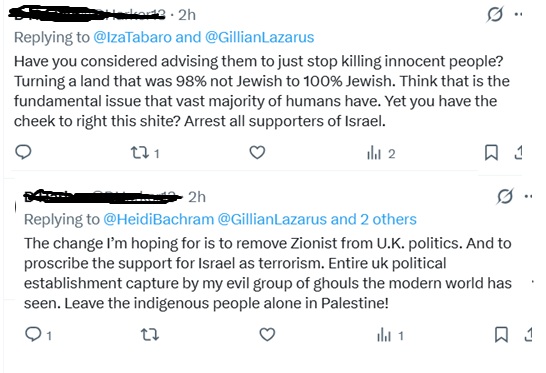
A popular though counter-intuitive urban legend is that, notwithstanding dictionary definitions and an extensive library of literature on the subject, the word antisemitism does not mean hostility to Jews.
The purpose of this truque is to imply that any complainant about Jew hate is either lying or ignorant. An anti Jewish extremist, Dr Rahmeh Aladwan, often asserts that she, being an Arab, is a Semite, whereas Jews are not. Indeed, we are often invited to ‘go back to Poland,’ as so many of our forefathers lived there and perished there during the Shoah. My own grandparents came from Poland and Russia but spoke Yiddish, not Polish or Russian, apart from a few spicy words. They left due to anti Jewish persecutions and pogroms. Were these events antisemitic, according to the revisionists? Or were Arabs spared? Certainly Hitler was on excellent terms with Mohammed Amin al-Husseini, the Mufti of Jerusalem so, according to the newly developed meaning of the word, you could not call Hitler antisemitic.
I will spare you details of the word anti-semitism [sic] being coined by Wilhelm Marr who founded the League of Antisemites in 1879. Strangely enough, Marr married Jewish women, consecutively not concurrently, which goes to show that some of his best friends really were Jews.
Do we think the League of Antisemites objected to the presence of Arabs being absorbed into German professions and society? If you say so.
A person who argues that there is an identity called ‘Semitism’ may be referring to the speakers of semitic languages, which include Hebrew, Arabic, Amharic, Maltese and Aramaic. In antiquity, Akkadian , Ugaritic and Syriac were written and, presumably, spoken. Aramaic, which is found in the Hebrew bible in parts of the books of Daniel and Ezra, is still a living language in Syria. Aramaic is also the language of much of the two Talmuds and is presumed to be the language of Jesus, with some Aramaisms absorbed into the Greek of the New Testament.
Arabic is the most widely spoken of the semitic languages, since the Muslim conquests of the 7th century CE.
Those who want to change the meaning of antisemitism to anti Arabism, islamophobia or, more often, anti Palestinianism, are avoiding the charge of Jew hate which comes their way, most often under the name antisemitism. Indeed, they turn it around, saying, ‘I am the semite so you (usually a Jewish person) are the antisemite.’ You would not think such an argument had legs, but it does. I see it every day on social media, where the popular but erroneous platitudes are promulgated, insisting that Jews are not Jews (we are Poles), Palestinians are Hebrews (the Bnei Israel of the bible), Jesus was a Palestinian (born in Bethlehem, you see) and King David, second king of Israel and also born in Bethlehem was…well they haven’t said, as far as I know.
You may think there is too much silliness in these inversions of history and religion for them to gain traction but there is also a widespread desire to point out that Santa Claus and St George were both Turkish as also is Boris Johnson, simply to confound popular belief.
Personally, I have no attachment to the word antisemitism but I would not want to lose all the insightful books and articles which have been written about it. When leaders of the nations speak about it, they are not concerned with the social media argument that it is a misnomer.
When I am called ‘kike,’ ‘chosenite’ or ‘babykiller’ on social media, I do not suppose that they are saying I am Polish, even though they so often want me back in Lodz, whence my grandparents made their own Lech Lecha.
Have you stopped?
Posted on: October 5, 2025
There’s a trick sometimes used on adversarial social media wherein one person tries to get another to seem to admit to something.
Tarquin @Horace Have you stopped beating your wife?’
Horace @Tarquin I’m not married.
Tarquin @Horace Don’t try to change the subject. Have you stopped beating your wife, yes or no.
Horace @Tarquin: I can’t say I’ve stopped beating my wife as I haven’t got a wife and, if I did have one, I wouldn’t beat her.
Tarquin @Horace You can’t say you’ve stopped. So you still beat your wife. Thought so.
My horse enters this race when I am accused of genocide, which is quite often. I regret that I used a profanity in the conversation shown, but it indicates how tiresome it is when someone uses this line of argument. I had shared an article in The Times by Emma Barnett who wrote about attending Heaton Park shul as a child, Heaton Park being the synagogue in Manchester which was attacked by a terrorist on Yom Kippur, resulting in the death of two people and the injury of several others. My adversary on X has the avatar of a baby and makes reference to Peace in their X handle. However, their words to me ‘You commit genocide,’ are not particularly pacific; neither is their suggestion that the synagogue had it coming, for being ‘pro-Zionist’. Does one explain that it’s possible to be a Zionist without supporting the settlements? Does one say that the word genocide is misused in the context of Israel’s war with Gaza? That could lead to a very long and bitter conversation, each side citing different authorities and rejecting the other’s citations. Should one point out that people residing in the settlements may not wish for civilian deaths in Gaza – and probably do not. Why would they?
I take a risk, using the phrase ‘our blood’ which the pacific baby may think smacks of race supremacism; however they come back with the direct ‘So you support a GENOCIDE??’ [sic] It has to be capital letters, unlike the mere genocide which killed six million Jews in World War Two. I then swear and you see their reply, ‘Is that a YES. So you accept that its a GENOCIDE.’ [sic] This being the end of the conversation, they appear to enjoy an X win, by pretending that I called the war a genocide. They have forgotten only to add the words, ‘Thought so.’

It is not enough for the pacific baby to call me genocidal; they must also assert that I agree with this proposition.
I may as well take the opportunity to say here, I desire peace above all things; I will not even say that the hope of a Two State Solution has vanished for ever. Certainly I do not fancy it with Hamas in control of the neighbouring state, or of Mohammed Abbas resuming pay-to-slay in what is currently called the Palestinian Authority.
Well, following the terrorist attack on a Manchester shul, covered extensively by the BBC and arousing words of sympathy even from Jeremy Corbyn and Richard Burgon, normal service has been resumed. Corbyn is planning a big Palestine rally next weekend to mark what he calls two years of genocide. For us, this week is the second anniversary of 7 October 2023 and it is Sukkot. The rage of the pro Palestinians is exacerbated by the death of two Jewish men in the terrorist attack. They chanted in Whitehall on the night of the killings, for Greta Thunberg to be released from custody in Israel, although the Swedish campaigner opted out of instant deportation. A cadre of antisemitic doctors continue to post about ‘global Jewish supremacy’ which they think is to blame for all ills, including the Manchester terrorist and the time spent reporting on the event on UK news channels.
These are hard times but the year, 5786, is young. There is talk of the hostages being released in a peace deal. May it be God’s will.
Gaza and the Pulpit
Posted on: September 24, 2025
For a long time, the synagogue felt to me like the safest place in the world, so much so that I thought I wouldn’t be frightened, even if I had a sudden heart attack during the service. I have not had that feeling of safety in the synagogue for some years although I have sometimes experienced it elsewhere, in Israel for example, or on a march in London, for the hostages or against antisemitism.
My synagogue is the denomination now called Progressive, formerly Reform. Ethics, Tikkun Olam, B’tzelem Elohim are the watchwords: the aspiration to do right, repair the world, stand up for humanity, every person created in the image of God. Universality counts for more than particularity: interfaith, outreach and diversity trump insularity, whether religious or social.
We still say a prayer for the release of captives, with the hostages in mind, but the terrible war which started after 7 October 2023 gnaws away at the spirit of the services and the clergy are troubled by the suffering of the enemy, whom they would not usually call ‘enemy,’ I think, because who is to say one side is us and the other, not us? In the liturgy, the words ‘and all the world’ are added to the English translations of prayers which particularize God’s relationship with Israel, as in, ‘Make peace upon Israel and upon all the world.’ Instead of saying ‘Give Israel peace,’ we say ‘Give Israel the strength to make peace.’ Would it be too much to petition the Almighty to give the Palestinians the strength to make peace? Is it only Israel which has the potency and the duty to make peace?
I am accustomed to the language of our translations; of referring to God with ungendered terms such as the Eternal in the translation of biblical texts, but I wonder, does anyone in prayer address God as ‘The Eternal’? It’s so cumbersome. If alone, I tend to say ‘Avinu shebashamayim,’ which exactly matches the opening words of the Christian Pater Noster prayer, ‘Our Father which art in Heaven.’
On this second day of Rosh Hashanah, the New Year, 2025, our elderly and experienced emeritus rabbi is leading the service. Over the years, he has been an intelligent and inspirational leader, as supportive in pastoral matters as anyone could wish but, in recent years, has been a regular signatory of letters protesting about Israel’s policies in the protracted age of Netanyahu. If I put my mind to it, I can recall his sermons from the time of Menachem Begin, being extremely dismissive of the Prime Minister, who was probably then Israel’s most conservative Prime Minister to date. Meanwhile, generations were growing up in the Reform and Liberal synagogues, as contemptuous of reactionary Israeli politicians as they were of Margaret Thatcher and Ronald Reagan, if not more so.
Today, with homiletic brilliance, the rabbi begins his sermon by referring to the ‘Invisible Gorilla’ experiment conducted by psychologists Christopher Chabris and Daniel Simons. This experiment showed that viewers asked to concentrate on a video of students playing basketball tended to miss the fact that a person in a gorilla suit strolled past the players. With attention focused on the game, they missed something which seems unmissable, when you are prepared to see it. I suspect that the rabbi is hinting to the congregation that we fail to see the suffering in Gaza because our attention is on Israel’s plight, the rocket attacks from Gaza, Lebanon, Yemen and Iran, the terrorist attacks and the massacre of 7 October. Eventually he becomes explicit in saying that we fail to see what is happening or to feel compassion for the Gazans. We care too much, too exclusively about our own people, is the message, and not enough about the agony of the enemy, although he would not use the word enemy.
When he speaks of Gaza, saying that human decency requires compassion from us, not indifference, I do not think this is wrong as a thought, but that it is inappropriate as a sermon. Why suppose that wanting Israel to win its wars means we are indifferent to the Palestinians?
At that moment, I removed my prayer shawl – which was exclusively a male garment until some of us women in Progressive synagogues started to wear them in the 1980s – and folded it into my tallit bag. I put on my jacket and, when the sermon was finished, I walked out. I would miss the mussaf service with the blowing of the shofar. All right, I heard it yesterday, on the first day of Rosh Hashanah, and will hear it again at the end of Yom Kippur. But still, it hurt me to leave and miss the additional prayers. I knew it would hurt me, but still I did it.
It was just too predictable that on this holy day, this holy congregation would be treated to a discourse similar to a report from BBC, Sky News or Channel 4; a front page of The Guardian, or a Parliamentary debate; Question Time , Any Questions, the Academy Awards, Glastonbury, the UN and any number of NGOs. So I walked. Somebody had to.
Being an Apikoros
Posted on: August 15, 2025
I grew up in Upper Clapton, on the north side of Hackney, considered a little more bourgeois than Hackney Central, where my maternal grandparents, aunts, uncles and cousins resided, in a house in Amhurst Road. Each floor was home to a family and the basement was converted into a flat for the widowed and remarried Uncle Simy. One of my cousins, zichrona livracha, once said, ‘It wasn’t a house, it was an institution.’
In our house in Upper Clapton there were just my parents, my sister, me, and my paternal grandmother, Booba Malka. Booba used to light the shabbat candles and occasionally went to shul, I knew not where.
Cazenove Road, off of Upper Clapton Road, was inhabited almost entirely by haredim whom the mainstream non-orthodox Jews called ‘frummers’ – meaning devout people. My parents were not actually mainstream as they were atheists and socialists and my father was a school teacher, which meant he had a higher level of education than anyone else in the family at that time. Lest you imagine that their socialism stood in the way of their Zionism, it did not. They were proud of Israel, Ben Gurion and the kibbutz system.
I sometimes heard my father called ‘Jack the teacher’ by visitors to the Amhurst Road house, a hub for card games, delicatessen and – to a lesser degree- political talk, but only for the men. If we had lived in Wales, would my Dad have been ‘Yankel the School’? At Amhurst Road, all the adults smoked. My parents did not smoke and I must say they were blessed with greater longevity than any of their siblings, or their parents. The smokers did not drink, but my father had respect for alcohol and chose wine and liqueurs carefully. In our cocktail cupboard were bottles of Benedictine, Kirsch and lime green Chartreuse, and, in the fridge, Aquavit from Denmark.
Sometimes, from beyond the end of our garden, behind the shed, came the sound of riotous male singing. These, said my mother, were the frummers, who had a shul or a yeshiva opposite our back fence. Was it Simchat Torah or perhaps the Hallel sung at some other festival? I was an Apikoros* and did not know.
At my primary school, about a third of the pupils were Jewish and about the same at the girls’ grammar school I attended but there I met girls from orthodox families – girls who had attended a Jewish primary school and now, remarkably, were allowed by their parents to enter secular education, a prize no doubt for passing the Scholarship aka the 11 Plus. Some were friendly and talked and joked with everyone; others kept their distance. My best friend and I made an atheistic, argumentative twosome. What did they make of us? Not much. One girl showed me a photo of her brother, a grown up man, bearded with peyos and a streimel.
The frummers were sometimes resented by the non-frum. It was as if their enclaves and haredi dress code might bring the rest of us into disrepute. In the 1950s and 60s, some degree of assimilation was considered desirable. Our very names were secular: Gillian, Jacqueline, Angela, Sylvia, Melvyn and Howard. It was the aunts and uncles who were called Rae, Issy, Hymie, Manny, Leah and Esther. I did have a cousin, born about 1930 (he had been a Bevin Boy in the war), whose name was Judah, but he was universally called Jack. His surname also was changed to something more English than the original. Why call your boy Judah and then give him an English-sounding surname?
It is easy to sneer at the anglicisation of names but these were people who had fled from pogroms and would rather be safe than sorry. Great Britain allowed us to be British, so we grasped the opportunity and were gefruntzled to see the haredim passing it by.
We used the word ‘hasids’ rather than haredim. I had no idea of the different sects. A Lubavitch House was opened in Stamford Hill in the late sixties, after we had moved out of the area. Everyone was moving out, to Ilford, Redbridge, Southgate, Hendon or Finchley. Meanwhile, the frummers remained. ‘Hackney is all cowboys and Indians now,’ was a popular waggery. The ‘Indians’ were Asians and the ‘cowboys’ were haredim in their wide-brimmed hats.
I sometimes wonder why there was such a pervasive impulse among the Jews of Hackney to regard the ultra-orthodox as separate from ourselves. Did it cut both ways? No doubt they regarded the women of our families with uncovered hair and short sleeves as being not properly Jewish, despite the mezuzot on our doors.
Everything was driven by a sense of danger. What was divisive was the perception of danger, where it would come from, what trigger would activate it. The sense of danger is no less in 2025 and neither are the differences among us of how best to weather the storm. What would we have to do, to weather it?
I think of Rabbi Akiva’s parable, related in the Talmud Bavli, Berakhot 61b.
The Sages taught: One time, after the Bar Kokhba rebellion, the evil empire of Rome decreed that Israel may not engage in the study and practice of Torah. Pappos ben Yehuda came and found Rabbi Akiva, who was convening assemblies in public and engaging in Torah study. Pappos said to him: Akiva, are you not afraid of the empire?
Rabbi Akiva answered him: I will relate a parable. To what can this be compared? It is like a fox walking along a riverbank when he sees fish gathering and fleeing from place to place.
The fox said to them: From what are you fleeing?
They said to him: We are fleeing from the nets that people cast upon us.
He said to them: Do you wish to come up onto dry land, and we will reside together just as my ancestors resided with your ancestors?
The fish said to him: You are the one of whom they say, he is the cleverest of animals? You are not clever; you are a fool. If we are afraid in the water, our natural habitat which gives us life, then in a habitat that causes our death, all the more so.
- ‘Apikoros’ is a term within Jewish discourse, signifying a departure from established religious beliefs and practices, its most emphatic meaning being something like ‘heretic’.
Please read the small print.
- ‘ANTISEMITIC’ MEANS ANTI-ARAB
This is not correct. The opposite of antisemite is not semite but philosemite. However the interpretation of antisemitism as anti-Palestinianism has great popularity as it enables the antagonist to accuse Jews of antisemitism while denying it in himself. There are also those who, as in Tiktoker Fiona Ryan’s song, ‘wear their antisemite’s badge with pride,’ but they tend to be fanatical Jew haters rather than moderately hostile.
2) JEWS ARE POLISH (OR KHAZARS)
The demography of Israel is such that Mizrahi Jews from Arabic speaking lands comprise more than half the Jewish population. As for the Beta Jews whose antecedents came from Ethiopia, there is no going back to Poland for them. The maternal grandparents of the present writer were born in Poland but they spoke Yiddish not Polish and migrated to England in the early twentieth century. If they had remained in Poland, they likely would not have survived the Shoah. Curiously, anti Zionist Jews ranging from right to left such as Neturei Karta (a minority group even among haredim), JVL or JVP are rarely considered Polish. It is perceived by the accuser as a slur, so intended for Zionist Jews and Israelis.
3) ZIONISTS COLLUDED WITH THE NAZIS
I find it difficult to print these words as they are such a grotesque misunderstanding of the Holocaust. The Nazis did not quiz Jews about their politics before selecting who would go to the gas chambers and who would be put to work. Those who looked capable of slave labour survived longer than those who did not. As for collusion, it is a word which overhadows anyone in a position of leadership in the ghettos who thought they could save more Jews from death if they provided the German occupiers with a productive workforce. There was often a terrible calculus in which saving some was weighed against saving none. Hence Rudolf Kastner and Chaim Rumkowski got accused of collaboration.
4) NON JEWS KILLED IN THE HOLOCAUST ARE FORGOTTEN
Roma, Sinti, Gays, Communists and people with disabilities were also killed by the Nazis but anti Jewish rhetoric, legislation, dispossession and murder were driving forces during the Third Reich and it is difficult to see why anyone would need to have this explained to them.
5) JEWS WERE EXPELLED FROM 109 COUNTRIES
I assume that the people who post this canard can name the 109 countries. I would expect also that they can explain why so many countries wanted to expel Poles (or Khazars).
6) ZIONISTS ARE WORSE THAN NAZIS
This is a very popular canard. The source of imminent or present danger always seems worse than other dangers. Thus I have seen people claiming that Hamas are worse than the Nazis, which is meaningless and unhelpful. The reason why such a grotesque comparison is made concerning Zionists (among whom I count myself) and Nazis is that it suggests the Nazis were in some way vindicated in their attempt to eliminate the ultimate evil. Neonazis are less bothered by Zionist/Jewish distinctions and want us all exterminated, but they do not fall within the middle-of-the-road mainstream.
7) JEWS ARE WHITE SUPREMACISTS
This applies likewise to black or Mizrahi Jews. Grist to the mill is the non Jewish perception of Chosenness and what they think Jews mean by it. I would say it refers to Jews being chosen for certain jobs in the world, in fulfilment of the 613 commandments. Saint Paul was the first to say that gentiles were under no compulsion to circumcise, keep kosher or recite the Shema twice daily. Contemporary Jews have laws and customs, culture and folklore, as do all peoples. As to whether national consciousness is supremacism, it is often suggested that this applies to English but not Scottish or Irish nationalism.
8) JEWS DOMINATE GOVERNMENTS AND MEDIA
This is difficult to insist on as so many western governments are now antagonistic to Israel while the broadcasting companies sometimes get themselves into trouble over their passionately anti Israel point of view. Yet I know this is not how it is perceived by people who want the government to desist from putting difficulties in the way of anti Israel action. They would want the government to cease all commerce and exchange of intelligence with Israel, to emphasize that Israel is an outcast among the nations. I don’t think they will achieve this as the UK needs Israel’s cooperation and they have already compromised trust by their anti Israel rhetoric and sanctions.
9) ZIONISTS ARE PRONE TO INFANTICIDE
I wondered if this belonged with a different list of principles, belonging to the fanatical far right or fanatical far left but I see it so commonly, it must have its place in the middle of the road. If we say this is malignant nonsense, we are shown images of children’s corpses, said to be Gazan, and given horrific statistics of the deaths of children, as estimated by the ‘Hamas run Health Ministry’. If we say that children are killed in all wars, they will say ‘No!’ as emphatically as Dawn French in her notorious video. It is indeed a horrible war when the military and the civilians are entwined in the over-crowded debris of Gazan cities and towns. Whether the war could have been fought differently without the devastating death toll, I do not know. All I know is that I and other Jews on social media are called ‘baby killers’ most days and I know it is a gross insult, informed by a medieval hinterland of which they may not even be aware.
10) KEIR STARMER IS/JEFFREY EPSTEIN WAS – A MOSSAD AGENT
As Naftali Bennett recently said in reply to the Epstein rumour, he wasn’t. And neither is Keir Starmer, nor his Jewish wife. We are not all Mossad agents.
*
Would that there were only ten of these commandments but I know that the popular misunderstandings, clichés and libels vastly exceed those I have mentioned. We Jews have not 10 but 613 commandments, codified by Maimonides in his Mishneh Torah (Repetition of the Torah) in the twelfth century. The Ten Commandments of Exodus 20 are called the Aseret Hadibrot – the Ten Sayings, very important but by no means the totality of the commandments.
The extremists and hysterics who suffer from a fanatical hatred of Jews have other sets of commandments, including those above but tending towards cosmic and apocalyptic perceptions of the place of Jews in the world. It would not surprise me if they had more than 613 statements which have ebbed and flowed through the ages.
Narrow Bridge
Posted on: June 24, 2025
I’m never afraid when some keyboard warrior tells me that I am soon to die; for one thing, they are usually in the United States and I am in England. I do get annoyed that X Support doesn’t find it breaks their rules. If the person tells me that I will be gassed, because they are hoping for another Shoah, the algorithm probably does not identify ‘gassed’ as a threat. As for those who tell me my death is imminent, they may simply have noticed that I have three-quarters of a century behind me and decided that it’s even stevens they’ve got it right.
The things I fear are different from anything which alarmed me in time gone by, such as nuclear bombs, flying or the London underground.
This is what I fear:
award ceremonies such as the Academy Awards or BAFTA.
arts festivals and music festivals
the Labour Party Conference
the TUC
doctors and teachers, particularly when they gather for policy making conferences
BBC News and Sky News
The Guardian and the Independent
Holocaust Memorial Day because the trolls get hyper-active
stand up comedians, apart from Yohay Sponder.
any festival or conference where the great and good are gathered together
As David Hirsh has said, we Zionists are excluded from the so-called ‘communities of the good’. How easily can we even drop into casual conversation the fact that we are Jewish? We are cautious.
In his first days at his Jewish secondary school, my grandson asked, ‘Who are those people?’ indicating the security guards. By now he will be accustomed, like all the children at the school, to the fact that the watchful guards are always in place, for their protection, just as they are always present at my synagogue.
My children used to have a song book, in which a famous quotation from Rabbi Nachman of Bratslav was set to music: ‘The whole world is a very narrow bridge, but the main thing is not to be afraid at all.’
כל העולם כולו
גשר צר מאוד
והעיקר, והעיקר
לא לפחד, לא לפחד כלל
The biggest fear is fear of the future -the auspices don’t look promising – but I suppose all fear is fear of the future as it is always orientated towards something which hasn’t yet happened.
We have a psalm which tells us: ‘You shall not be afraid of the terror by night, nor of the arrow that flies by day.’
לא תירא מפחד לילה מחת יעוף יומם
That’s Psalm 91. It doesn’t mean that we should be foolhardy, cross the road when the traffic light is green or refuse the covid vaccine when it’s offered, but it does encourage confidence.
The Dawn of the Actor-Activists
Posted on: June 6, 2025
Like most people in this country, the United Kingdom, I watch television and I watch films. I marvel at the ability of actors to convey, with a blink of the eye or a single word, an entire narrative of inner life. I used to think such skills must run on a motor of wisdom and intelligence, but then I heard Vanessa Redgrave ranting at the 1978 Academy Awards about ‘Zionist hoodlums’ and thought she had performed better speeches when they were penned by more profound authors than herself.
Now that it is almost mandatory for actors to express themselves forcibly against Zionists, there are further disappointments, most notably seeing the sublime Ralph Fiennes and Benedict Cumberbatch add their names to a letter signed by many of their colleagues, expressing their opposition to Israel’s war in Gaza. I can hardly blame them. They have watched and heard BBC and Sky News, informing them that Israel lures Gazan innocents with promises of food and safety to gather them together and fire on them. The broadcasters know this, or think they know it, or decide to say it, because Hamas – the Gazan Health Authority, as they like to be called – has told them so.
National treasures and less cherished public personalities find their voices against Israel, in the case of Piers Morgan to shout ‘Bullshit’ at a lawyer, Natasha Hausdorff whom he had invited on to his show, ‘Piers Morgan Uncensored.’ So many times did he stop her answering questions by bellowing ‘Bullshit’ that it seemed to be he who was doing the censoring. When viewers expressed surprise at his adamantine refusal to let his guest finish a sentence, he replied that Israel had gone too far, see above, and threw in a few more ‘bullshits’ on his X account.
Today, I find that Dawn French – unlike Piers Morgan, an actual National Treasure – has made a hideously hurtful video in which she mocks those who refer to 7 October 2023 as the reason Israel went to war. Grimacing and deploying a whiny infantile voice, she says ‘Yes but they did a bad thing to us,’ and then, by way of counterpoint, utters a deep and resonant ‘No!’ Again putting on the baby voice, she says something about history, which I suppose is meant to be us Jews talking about persecutions in our history and again, the emphatic ‘No!’ I think I understand what she wants to say. The predicament of the Gazans is so catastrophic that no rationale of the war or of the longer conflict can justify what is happening now. That is how Dawn, presumably, wants us to interpret her comic video. The faces and the silly voices she puts on to represent Israeli and Jewish perspectives – they are badly judged. Or are they? Will she find, like the band Kneecap, that the more seriously you oppose Israel, the better the audience likes it?
Yesterday, a neighbour joined me for coffee. She is a nice lady even older than me but equally as vigorous. She spoke about a nasty landlord who owned her first marital home: ‘A Jewish man,’ she said, ‘a big fat Jewish man so of course he…’ I went temporarily deaf at that point so didn’t hear her account of his machinations. We were in my flat with mezuzot on all the doorposts, a menorah on the cabinet and a Star of David visible round my neck. How could she not know? Is it possible that she did know but still thought her words would be acceptable, that it was common knowledge that Jews did this or that and I could hardly be offended? Within seconds I realized I would not say ‘Do you know that I’m Jewish?’ It would be too awkward, too much like bad manners. Our conversation continued smoothly and amicably. I thought of Kim Philby, always having to guard his reactions, and of the spy I most admire, Eli Cohen who posed as Kamel Amin Thabet among the upper echelons of the Syrian Ba’ath Party.
A spy is like an actor. The raised eyebrows, the eye rolls, the half smile can only appear in character. My neighbour’s remark was the kind of relatively mild, commonplace antisemitism which one heard occasionally before ‘anti Zionism’ became de rigueur for aspirational entertainers, academics and Members of Parliament. Now one expects to be called ‘baby killer’ every day, not by our neighbours I hope but by the online activists who have sight of our posts against antisemitism.
Why do I say ‘one’ and ‘our’ instead of ‘I’ and ‘mine’? It is because I have seen it happens to all of us. On Wednesday, Lord Ian Austin was abused and jostled by pro Palestinian demonstrators outside Parliament because he said, ‘Free the hostages.’ I can imagine Dawn French repeating ‘Free the hostages’ in the mocking, baby voice she used in her video.
Really, it is a miracle that anyone, public figure, online activist, teacher, doctor, journalist, clergy or politician dares to speak out against the Zionist-exclusionary mania for the Palestinian cause.
But we have always relied on miracles.
 Neviim Tovim, blogs by Gillian Gould Lazarus