Archive for the ‘Uncategorized’ Category
Mikketz
Posted on: August 14, 2009
Mikketz 2008
Genesis 43:15-44:17
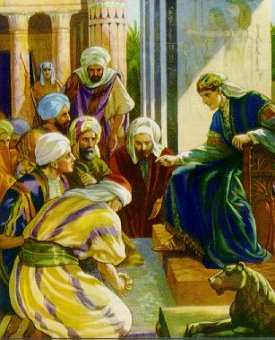
There are parts of Joseph’s story which most people remember: for example that his jealous brothers sold him into slavery and that his personal qualities and clairvoyant skills resulted in him becoming Pharaoh’s right hand man. You may recall that years later, Jacob sent Joseph’s brothers to Egypt to obtain grain, because there was famine in the land of Canaan. When the brothers arrived in Egypt, they failed to recognize Joseph, now the Viceroy or Prime minister, and Joseph showed what must have seemed an odd and threatening interest in these Hebrew brothers from Canaan. He accused them of being spies, demanded that they bring their brother Benjamin to Egypt and meanwhile held Simeon as a hostage to settle the matter. Finally, as the brothers travelled home, they found that the money they had paid for the grain had been returned to them, placed inside their sacks.
Today we read that, when the famine continued, Jacob sent his sons again to Egypt. This time they brought with them Benjamin, much against Jacob’s wishes, for Benjamin, like Joseph, was the son of Rachel, and Jacob favoured the sons of Rachel above the sons of Leah.
Besides Jacob and his twelve sons, there is another player with a speaking role in this part of the Joseph narrative. This is Joseph’s house steward whose name is not recorded so he is called simply הָאִישׁ אֲשֶׁר עַל בֵּית יוֹסֵף, the man over Joseph’s house. This character appears benign but unexpectedly well-informed, knowing some things which he could have learned only from Joseph.
To him, the brothers confide their fears, that they will appear as thieves, because their money had reappeared in their sacks, and that the Viceroy will deal harshly with them, perhaps even take them as slaves. It is an ironic turn of events that the brothers who sold Joseph into slavery now fear being enslaved by him; ironic also that they are wrong in one way and right in another, for Joseph will not enslave them yet their descendants are destined of course to become slaves in Egypt.
Joseph’s house steward says: ‘Do not fear; your God and the God of your father has given you treasure in your sacks.’ He then reunites them with Simeon who had been held hostage and brings them to Joseph’s house, where they receive five star hospitality.
I am curious about this steward and the way he is just called ‘the man,’[1] combined with the fact that the brothers refer to Joseph as ‘the man’[2] and the brothers, if you look closely at this chapter, are not called ‘the brothers’ but ‘the men.’[3] They are called Joseph’s brothers only at the moment when he reveals to them his true identity, which is not yet, not this week.
At last Joseph appears and the brothers bow before him, just as in the dream, which Joseph, as a teenager, related to them, causing them to hate him. They dine with Joseph and get drunk with him, but Joseph never lets down his guard. The next day, he tells his steward to put the men’s silver in their sacks, as before, and to plant in Benjamin’s sack a valuable silver goblet. Years before, the brothers were paid in silver when they sold Joseph to Midianite traders, and now silver keeps coming back to them, an unwanted reminder of a matter they must have hoped was closed.
Joseph gives his steward the job of pursuing the men and accusing them of theft. Although they protest their innocence, the goblet is of course found, to their horror, in Benjamin’s sack. It is, we learn, a ‘divining cup,’ which Joseph uses for divination, a common practice in Egyptian society, and Joseph in particular has a tendency towards the psychic, in his own prophetic dreams and the dreams which he interprets.
The men return to the city and now Judah begins to play a prominent role, acting as a spokesman for his brothers and attempting to protect Benjamin from punishment.
Joseph however declares his intention of keeping Benjamin as a slave and says ‘The rest of you go back in peace to your father.’ The traditional interpretation is that he is testing his brothers, to see if they will abandon Benjamin, as he himself was abandoned, or if they have repented and changed.
The themes of identity theft and deception are part and parcel of the Joseph story. They begin in the previous generation, when Jacob disguises himself as Esau and continue when Laban puts Leah in Jacob’s tent instead of Rachel. Then Joseph’s brothers lie to their father, telling him that Joseph had been killed by a wild beast. Now Joseph withholds the truth from his brothers, exercising his power over them to create fear and revive guilt.
We await the moment of revelation and reconciliation, which will come in the next sidra, with the whole family together in Egypt and the stage set for slavery, exodus and nationhood.
Stay tuned.
[1] see also Genesis 37: 15-17
Genesis 43: 3, 7, 14
ibid vv 15, 17, 18, 24
Moses and the rays of light
Posted on: May 17, 2009
Torah portion Ki Tissa Exodus 34:29-35

If you get the opportunity to go to Rome, you might visit the church of San Pietro in Vincoli where you can see Michelangelo’s famous statue of Moses. The rays of light on Moses’ head are represented by two marble horns. That is the problem with a medium like marble. How could even Michelangelo convey the radiance of light which transfigured Moses as he came down from Mount Sinai, carrying the second set of the tablets of the Covenant?
The Hebrew phrase קָרַן עור פְּנֵיו – suggests that Moses had a luminous appearance and that his skin was radiant. The verb קָרַן resembles keren, the Hebrew word for a horn, so it was not entirely unreasonable for Michelangelo to represent this incandescence as horns, although, in my opinion, a halo would have done the trick.
When the bible was translated into Latin, early in the fifth century, קָרַן עור פְּנֵיו was interpreted as meaning that Moses face was horned, cornuta esset facies sua, since you ask. This launched a tradition which obviously influenced Michelangelo, although the Jewish commentators dismissed the idea of a horned Moses as foolishness[1] or heresy.[2]
The Hebrew word עור in this text sounds like the word אור which means ‘light’ but the spelling is different – with an ayin instead of an aleph – and it means skin. It could be connected with עֶרְוָה, nakedness, and it should be noted that Moses covers his face with a veil, to conceal from the Israelites the naked radiance which they might view with consternation.
A medieval Jewish interpretation[3] is that Moses covered his face with a veil ‘…out of respect for the rays of majesty.’ The majestic nature of the rays, which is not explicit in the text, was inferred also by the Jewish scholars who translated the Hebrew bible into Greek in the third century BCE: the Greek Septuagint says that Moses’ face was glorified.[4]
There is a clue to the meaning of this word karan in the book of the prophet Habakkuk[5] who experienced a vision of God and said that God’s splendour was like the sunrise, with rays flashing from God’s hand:
קַרְנַיִם מִיָּדוֹ karnayim miyado
Karnayim, a plural form of keren, is much more intelligible as radiance than as horns. It is the only similar use of the word in the bible, but that is enough for it to offer evidence of linguistic meaning.
Sigmund Freud wrote an essay on the subject of Michelangelo’s Moses.[6] He noted that Michelangelo represented Moses as fiercely angry, and Freud therefore associated the statue with the narrative of the golden calf, which, as it happens, occurs earlier in this same sidra, Ki Tissa. Moses was indeed angry when he saw the Israelites dancing round the calf, so much so that he broke the first set of tablets. We see from our sidra that Moses received a second set of tablets, in place of those which were broken, and his face shone when he descended with these, the second luchot ha brit. Freud would have known this if he had gone to shul more often.
The word for a veil, מָסְוֶה, is not found elsewhere in the bible, so its exact meaning can be known only from the present context and from a small number of similar words which mean cloak, cover or curtain. The author Richard Elliott Friedman suggests that Moses’ veil has something in common with the curtain which covered the Holy Ark in the Tabernacle. The Ark had a holiness which could be dangerous to those who came close to it, and so did Mount Sinai, ablaze with fire which no one but Moses could approach. God said to Moses: You cannot see my face for no one can see me and live, and it is as if Moses’ face may not be seen, because it reflects his encounter with God. It is interesting that Moses himself was unaware of the rays which were observed at once by Aaron and the Israelites.
וּמשֶׁה לֹא יָדַע כִּי קָרַן עוֹר פָּנָיו
Moses knew not that the skin of his face sent forth beams.
Moses had so little thought for his appearance in the eyes of others that it was only when he saw their reaction that he thought to cover his face with a veil. We know from a verse in the book of Numbers:
וְהָאִישׁ משֶׁה עָנָו מְאֹד מִכֹּל הָאָדָם אֲשֶׁר עַל פְּנֵי הָאֲדָמָה
The man Moses was very meek, above all the men that were upon the face of the earth.[7]
This seems an apt description for a man who had no idea that his face reflected his meeting with God, and who, learning that this was so, covered it with a veil so as not to be an object of wonderment to those waiting at the foot of the mountain.
[1]Rashbam cf N Leibowitz, Studies in Shemot vol 2 p632
Ibn Ezra ibid p643
[3]Rashi on Exodus 34:33
δεδοξασμενη
[5]Habakkuk 3:4
[6]Der Moses des Michelangelo Sigmund Freud 1914
[7]Numbers 12:3
[8]Genesis 28:16
 Neviim Tovim, blogs by Gillian Gould Lazarus
Shabbat Chazon 5769 (2009) and 5775 (2015)
Posted by: Gillian Gould Lazarus on: July 26, 2009
When I wrote this, in 2009, Tisha b’Av did not seem the most relevant of our festivals. I have no desire to see a third Temple on the Temple Mount, only to see peace there, an idea now as remote as that of rebuilding the Temple. Tisha b’Av, six years ago, seemed a conduit to historical troubles and tragedies, which, b’ezrat Hashem, we would remember but not relive. Now the year is 5775 (2015): antisemitism is present in Europe, America and of course in the Middle East. Our detractors even wish to deny us the word ‘antisemitism’, saying that we are not Semites – as if to say that antisemitism is culpable but hatred of Jews is acceptable. Some of us are critical of Israel, but our fate is nevertheless intertwined with it, bound like tefilin round the left arm. This year, we are truly bein hametzarim – between a rock and a hard place, between Israel and the diaspora. The coming shabbat will be Shabbat Chazon, the Sabbath of Vision, and the evening will be the onset of Tisha b’Av. I pray that we are all delivered safely through it, towards Shabbat Nachamu the following week: the shabbat of comfort.
Torah introduction at STNLRS, 5769:
There’s an old joke to the effect that Jewish festivals can be summarized as follows: ‘They tried to kill us. We survived, let’s eat.’ I can’t tell you where this originated but it’s short, sweet and contains an element of truth. Many of our holy days commemorate historical occurrences outside our control, for example the slavery in Egypt or the wandering in the wilderness, or Haman’s plot. Then we celebrate our deliverance from the event through rituals of remembrance and sanctification: the seder, the succah, the reading of the Megillah. This doesn’t apply only to Jewish notable days. Armistice Day on 11 November works in the same way. A catastrophe comes at us from outside and we give it pattern and meaning and, in our case, a place in the Jewish calendar.
Today is Shabbat Chazon, named after the first word of the haftarah, the first word in fact of the book of the prophet Isaiah. It means ‘vision’. When you see shabbat Chazon on our haftarah sheet, you know that the ninth day of the month of Av will occur in the coming week.
It might seem that Tisha b’Av barely registers on the radar of most Reform Jews. However, anyone who has attended a shabbat service during the last three weeks will have heard one of the three haftarot of rebuke which fall in the three week period between 17 Tammuz and 9 Av.[1] Even if you don’t notice Tisha b’Av on the day itself, the season wafts past like a ripple in the air, every summer during the dog days.
Tisha B’Av was a day of destruction for both the first and the second Temples in Jerusalem. The first was destroyed by the Babylonians under Nebuchadnezzar; the second by the Romans under Titus. It is a day associated with many disasters from Jewish history: the defeat of Bar Kokhba’s rebellion in 135, the expulsion of the Jews from England in 1290 and from Spain in 1492. Many tragedies also befell the Jews on 9 Av in the twentieth century, especially during the Shoah.
The 17th of Tammuz, three weeks earlier, is the day when the Babylonians breached the walls of Jerusalem and later so did the Romans, give or take a day or two. The rabbis of the Mishnah set aside these days, to mourn and to fast. For their own reasons, the Babylonians also observed 9 Av as a day of sorrow, perhaps because the height of summer in that region is naturally a time of drought with its attendant dangers. This too may have encouraged the Israelites exiled in Babylon to look on the season as a time of mourning.
The Babylonian exile lasted only fifty years and was followed by a return and a restoration, but the Roman triumph in 70 CE exiled the Jews until 1948.
The Crusaders, the Inquisition, the Cossacks, the Nazis have all been likened to the Romans, doing their worst on Tisha B’Av.
Sometimes, in Rabbinic literature, Rome was called Edom – Esau’s other name – a code which enabled the rabbis to refer to the Romans without alerting Roman censorship.
The historian Martin Goodman suggests in his book Rome and Jerusalem that it was not so much Roman policy, as a series of uncontrollable developments which propelled events towards catastrophe. After the death of the emperor Nero, Vespasian and his son Titus became major contenders in the competition for power and, in this cause, much depended on a conclusive victory in Judea, their theatre of war. According to Josephus, Titus was reluctant to destroy the Temple in Jerusalem because he considered it a magnificent work and an ornament for the Roman empire.[2]
Josephus reported that the burning of the Temple came about when a Roman soldier, without orders, snatched up a burning brand and threw it into the Temple.[3] When the Temple was destroyed, Titus’s only option was to proclaim a triumph and demonize his enemy, the people of Judea.
The war with Rome is a history of attrition, ambition, chaos and expediency but it has also a religious significance, representing Jewish tragedies, both ancient and relatively recent, recalled through our modern understanding.
The Jewish calendar is like a lens through which patterns in history come into focus and are more clearly visible and Tisha b’Av, for all its darkness, helps us to see the pattern when we hold the lens before our eyes.
Gillian Lazarus July 2009
[1] Bein haMetzarim, ‘between the straits’.
[2] Rome and Jerusalem Martin Goodman Penguin 2007 pp440-444
[3] Jewish Wars 6,4