Author Archive
Daniel, chapters 1 – 3
Posted on: May 15, 2011
Daniel, Chapters 1 – 3
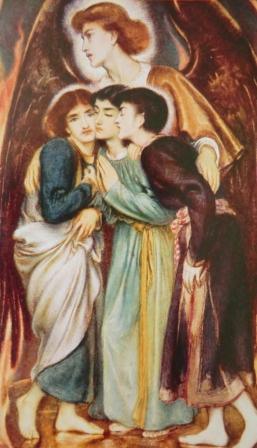
Daniel is written partly in Hebrew and partly in Aramaic. It begins with narratives about Daniel and his friends, in a genre called ‘court tales’ (chapters one to six). Esther also belongs to this genre; as does Bel and the Dragon from the Apocrypha.
The Book of Daniel is in the Ketuvim, but in a non-Jewish bible it will be found in the Prophets, after Ezekiel and before Hosea. Daniel, a Judean exile at the court of Nebuchadnezzar II (605 to 562 BC), the ruler of Babylon, becomes a prominent official in the government. As the author appears to have knowledge of Alexander the Great and the Seleucid and Ptolemaic empires which followed him, there has been a consensus in bible criticism to date the book to the Maccabean period, about 165 BCE, shortly before the death of Antiochus IV Epiphanes.
In particular, the vision in Chapter 11, which focuses on a series of wars between the “King of the North” and the “King of the South”, is generally interpreted as a record of Levantine history from the time of Alexander the Great down to the era of Antiochus IV, with the “Kings of the North” being the Seleucid kings of Syria and the “Kings of the South” being the Ptolemaic rulers of Egypt.
However, Daniel prophesies about Alexander and subsequent events:
And as for me, in the first year of Darius the Mede, I stood up to confirm and strengthen him. 2 “And now I will show you the truth. Behold, three more kings shall arise in Persia, and a fourth shall be far richer than all of them. And when he has become strong through his riches, he shall stir up all against the kingdom of Greece. 3 Then a mighty king shall arise, who shall rule with great dominion and do as he wills. 4 And as soon as he has arisen, his kingdom shall be broken and divided toward the four winds of heaven, but not to his posterity, nor according to the authority with which he ruled, for his kingdom shall be plucked up and go to others besides these.
In Josephus’s account of Alexander’s visit to Jerusalem, Alexander was presented with a copy of the book of Daniel, which would make the work extant around 330 BCE.
The period of Antiochus IV Epiphanes is 175 – 164 BCE, when the Hellenization of Judah was advanced, with the complicity of a high priest called Jason. The religious opposition to Hellenization took the name Hasidim. Antiochus attacked the Egyptian army of Ptolemy VI in 168, but was forced back by Roman intervention, under the direction of a consul called Popilius. Meanwhile Antiochus began to suppress Jewish resistance to his policies in Jerusalem, which led to the Maccabean revolt.
The identification of Antiochus in the prophetic passages in Daniel is reinforced by Josephus in the Antiquities:
Indeed it so came to pass that our nation suffered these things under Antiochus Epiphanes, according to Dasniel’s vision, and what he wrote many years before they came to pass.
While there seems to be a consensus among scholars that the legendary stories of chapters 1-6 are older than the visions in chapters 7-12, there is considerable support for the view that Chapter 7 and following were written as a message of encouragement to the hasidim suffering for their faith under the oppression of Antiochus IV Epiphanes.
The name Daniel is attributed to a son of David and Abigail , to a priest who returned with Ezra to Jerusalem and, without the letter yod, to a legendary hero whom Ezekiel compares with Job and Noah. The name Daniel occurs also in Nehemiah, as a signatory to a written pledge, against intermarriage and concerning shemitta, sacrifice and tithing.
The Talmudic view of Daniel is that it was written by ‘the men of the great assembly’ – ie the leaders during the restoration of the Temple. Rashi said that the reason Daniel did not write the book himself is the prohibition against prophecy outside Eretz Israel. This tradition which dates the book to the fifth or fourth century BCE accounts for the fact that much of the book is written in Aramaic, the language of the Persian empire.
Daniel was present at Belshazzar’s feast, and interpreted the writing on the wall. He surrvived the Babylonian Empire, which fell that night, and achieved prominence in the Persian Empire, under Darius. This enables Daniel to be present, according to some midrashim, at the court of King Ahasuerus. Daniel resembles Joseph, a wise and esteemed foreigner, called to the royal court when the kings’ advisers fail to come up with the goods.
The three chapters we are looking at on 30/03/2011 are in Hebrew up to Chapter 2 verse 4a, and in Aramaic from 2:4b.
Chapter 1 recapitulates the siege of Jerusalem by Nebuchadnezzar, and the abduction of king Jehoiakim to Babylon, called here Shinar, along with the créme de la créme of Jerusalem society, especially good looking and intelligent young men.
The young men are prepared to be presentable to the king, for a period of three years. One trusts they did not pay tuition fees. In the case of Ahasuerus, the maidens were prepared for the king in the course of just one year.
Verse 6 introduces Daniel and his companions, Hananiah, Mishael and Azariah. They are all given Babylonian names, respectively: Belteshazzar, Shadrach, Meshach and Abed-nego.
Daniel did not want to eat the unkosher food and wine which the king provided and ‘God granted Daniel mercy and compassion in the sight of the chief and the officers,’ who provided him and his companions with pulses and water, on which they thrived. The word translated as pulses or vegetables is זרעים , literally seeds.
When they were brought before King Nebuchadnezzar, the surpassed in appearance and learning all the magicians and enchanters of the kingdom.
The Hebrew expression החרטמים האשפים (ha-hartummim ha-ashafim) is particular to the Book of Daniel. Hartummin without ashafim occurs with the meaning of Egyptian magicians in the Egyptian narratives of Joseph and Moses. BDB makes a connection between hartummim and heret, to engrave, suggesting the knowledge of occult writing, perhaps comparable to the runes of Europe. Ashaf is considered a loan word from Assyrian asipu.
Chapter 2
This is reminiscent of Joseph called before Pharaoh to interpret his dreams. Besides the hartummin and ashafim, the king sends for mekashevim. – this term for a sorcerer is not unusual in Tanakh or in the Talmud – and Casdim, that is to say Chaldeans the generic name for Babylonians ruled by Nebuchadnezzar. The connotation here is that sorcery is a significant element of Chaldean scholarship.
It is explained that the Chaldeans speak Aramaic and, from this point, not only the direct speech but the narrative continues in Aramaic. Notice the formula ‘O king, live forever’ – מלכּא לעלמין חיי. We are reminded of Bathsheba’s words to David: ‘May my lord King David live forever.’ ‘O king, live forever’ is used also by Nehemiah to King Artaxerxes and on several subsequent occasions in the book of Daniel. It seems to be a Persian formula for addressing the king.
The sorcerers of King Nebuchadzezzar work under pressure, as the king tells them he will have them cut up if they do not interpret the dream. furthermore, he suspects they will collude to save themselves, by coming up with an agreed answer. To their credit, the sorcerers reply ‘Pass’, for which they receive the due death sentence.
Daniel and his companions may be under this death sentence themselves, being among the wise men of the court. Daniel sought an audience with the king, but before the appointed time, he prayed with Hananiah, Mishael and Azariah that God would be merciful and save their lives. That night, the meaning of the king’s dream was revealed to Daniel in a vision. Daniel utters a hymn of praise, in Aramaic.
Arioch, the captain of the king’s guard, brings Daniel before the king with the words ‘I have found a man of the captives of Judah, that will make known unto the king the interpretation’. You will remember that Joseph was described to Pharaoh by his cup beare who had done time with Joseph: ‘There with us a young man, a Hebrew, servant to the captain of the guard; and we told him, and he interpreted to us our dreams.’
When Daniel speaks to the king, he makes it clear that his interpretation of the dream comes from God and not from his own wisdom. He then describes the image in the king’s dream, of a statue whose head was gold, its chest and arms of silver, middle and thighs of brass, legs of iron and feet of iron and clay. A stone then struck at the feet of clay and the whole statue broke into pieces,which were carried away by the wind while the stone became a mountain that filled the earth.
In Daniel’s interpretation, the gold represents the king and the silver represents the kingdom that will come after him. This would be the kingdom of the Medes and the Persians, or possibly the Medes with the Persians represented by brass. Alternatively, brass refers to the empire of Alexander the Great. The fourth kingdom has been interpreted as the Seleucids and the Ptolomeys, or as the Romans and the Nabatean Arabs. The kingdom of brass will rule the earth – which supports the identification with Alexander. The kingdom of iron will have great oppressive strength. ‘…They shall mingle themselves by the seed of men, but they shall not cleave one to another, even as iron does not mingle with clay.’
When all these kingdoms had run their course, God would set up His own Kingdom, די לעלמין לא תתחבל which would never be destroyed.
On hearing this, Nebuchadnezzar bows down before Daniel and commanded that an offering be made to him, as if he were a god. This evokes an episode described by Josephus, where Alexander the Great, arriving in Jerusalem, bows before the High Priest.
Alexander then gave the high priest his right hand, and went into the Temple and “offered sacrifice to God according to the high priest’s direction,” treating the whole priesthood magnificently. “And when the Book of Daniel was shown him [see Dan. vii. 6, viii. 5-8, 20-22, xi. 3-4], wherein Daniel declared that one of the Greeks [] should destroy the empire of the Persians, he supposed that he was the person intended, and rejoiced thereat.
Nebuchadnezzar now affirms that God is God, saying to Daniel ‘Truly, your God is God of gods and Lord of kings, and a revealer of mysteries, for you have been able to reveal this mystery.’
Like Joseph and like Mordecai, Daniel becomes the king’s highest minister, and he gets top jobs also for Shadrach, Meshach and Abed-nego.
Chapter 3
Nebuchadnezzar reneges almost immediately, erecting a golden image and callig on all the officers of the kingdom to worship it. The term achashdarpnim is essentially the Persian word for a satrap, mentioned also in Esther and Ezra.
The signal to worship the statue is sounded by musical instruments: note סומפּניה, sumponiah. The instruments are translated into Greek as σαλπιγγος, συρινγγος, κιθαρας, σαμβυκης, ψαλτηριου, and παντος γενους μουσικων – ‘all kinds of music’.
The penalty for disobeying the signal to worship was to be cast into the fiery furnace.
We should remember that midrash offers a legend about Abraham and a fiery furnace. Nimrod persecuted Abraham whom he had thrown into a furnace, which Abraham miraculously survived unscathed.
Certain Chaldean men now brought accusations against Shadrach, Meshach and Abed-nego, for not complying with the idol worship, and they were summoned by an irate Nebuchadnezzar. Note that they are referred to by their Babylonian names, not their Hebrew names, perhaps in keeping with the Aramaic narrative, which offers a non Hebrew perspective on the story. The king gave them a chance to worship the idol, on the prompting of the musical instruments; if they refuse, they will be thrown into the furnace, ‘and who is the god that shall deliver you out of my hands?’
The three companions are by no means certain that God will rescue them, but state plainly that they will not worship Nebuchadnezzar’s gods or the golden image he has set up.
Nebuchadnezzar now orders that the furnace be heated to an intensity seven times greater than usual: this conveys his extreme anger and the extremity of the punishment; it enhances the courage of the heroes and provides the circumstance which caused the king’s men at arms to die from exposure to the heat.
They are thrown fully clothed, including hats (כּרבלות) according to some translations, and bound, into the furnace.
The Quaker George Fox reports the following in his Journal of 1656:
When we were brought into the court, we stood a while with our hats on, and all was quiet. …”Why do you not put off your hats?” said the Judge to us. We said nothing. “Put off your hats,” said the Judge again. Still we said nothing. Then said the Judge, “The Court commands you to put off your hats.” … I replied, “Thou mayest read in the third of Daniel, that the three children were cast into the fiery furnace by Nebuchadnezzar’s command, with their coats, their hose, and their hats on.”
The LXX adds that they sang praise and blessings to God as they walked unharmed in the furnace: υμνουντες τον θεον και ευλογουντες τον θεον.
The Apocrypha includes a book called ‘The Song of the Three Children,’ which is the song of praise attributed to Azariah, not called Abed-nego in the Greek of the Apocrypha but Αζαριας. This takes the form of Azariah’s prayer, followed by a brief description of the young men’s delivery from the furnace, and a psalm spoken by Azariah, Mishael and Hananiah, ending with a quotation from Psalm 118: ‘Give thanks to the Lord for his mercy endures forever’.
The Benedicite, used in the Roman Catholic liturgy, is a Latin translation of verses 35ff of The Song of the Three Children and the hymn is used also in Lutheran and Anglican worship.
These verses are not included in the canonical Daniel. There, the young men fall into the furnace and the narrative suddenly focuses on Nebuchadnezzar in film it would be called a POV shot – his perception, his alarmed reaction, and his words: ‘Did we not cast three men bound into the midst of the fire?’
when the ministers reply ‘True O king,’ Nebuchadnezzar announces in his own words the dramatic development:
He answered and said, “But I see four men unbound, walking in the midst of the fire, and they are not hurt; and the appearance of the fourth is like a son of the gods.”
The ESV pluralises אלהין but the KJV has:
He answered and said, Lo, I see four men loose, walking in the midst of the fire, and they have no hurt; and the form of the fourth is like the Son of God.
Elohin having the plural suffix, like the Hebrew equivalent Elohim, the translations seem equally viable, though ‘the son of God’ naturally reflects the theology of a Christian translator. As the words are spoken by Nebuchadnezzar, it is reasonable to think the intention of the words is polytheistic. The fourth person is also referred to, in some translations, as an angel, a translation of Elohim attested in Psalm 8:6.
In his next utterance, Nebuchadnezzar refers to God with a monotheistic usage,אלהא עליא, the equivalent of ‘El Elyon’, because he has witnessed the miracle in the fiery furnace. He calls the men out of the fire, addressing the three by name, and they emerge, unhurt, with no traces of smoke on their clothes.
Nebuchadnezzar then blesses the God of Shadrach, Mesach and Abed-nego, referring to the fourth person as an angel (מלאך) sent by God, and affirming the events which led to the miracle. He declares that no one is to talk against God; the punishment for those who do is to be cut to pieces, and have their houses destroyed. The reason he gives for this decree is that other gods are not able to deliver comparable miracles.
As with Daniel, Mordecai and Joseph, the three are promoted by the king.
Nebuchadnezzar makes a declaration, praising God. The reference to God’s signs and wonders is allusive to the miracles of the Exodus, and Nebuchadnezzar is cast in the role of Pharaoh – the Pharaoh who knew Joseph (Hebrew courtier) and the Pharaoh who knew Moses (signs and wonders). The language makes a connection between exile in Egyptian and exile in Babylon.
In the last verse, the word שלטן, dominion, from ש ל ט, ‘to rule’ is interesting as one can suppose that the word sultan is cognate; shiltun appears in the Yom Kippur liturgy (uvecheyn teyn pachdecha ), and it is more common to Talmudic usage than biblical.
The Apocrypha contains three books which are additions to the biblical Daniel; the first of these, which we noted, is The Song of the Three Children, concerning Hananiah, Mishael and Azariah; in the second, the History of Susanna, a youth called Daniel intervenes in a case of false testimony, and in Bel and the Dragon, set at the court of King Cyrus of Persia, Daniel shows that an idol called Bel is not, as supposed by Cyrus, a living god. Bel appears to eat and drink copious quantities, but this is really a scam by the priests of Bel, to get provisions for themselves and their families. There was also a dragon which the king believed to be a god, but which expired when Daniel poisoned it. This made Daniel so unpopular that the king, under pressure, had Daniel thrown in a lions’ den. However, God sent the prophet Habakkuk with packed lunches for Daniel, and when the king looked in the lions’ den after seven days, Daniel and the lions were all in good health.
This of course resembles chapter six of the canonical Daniel, where envious courtiers tell Darius the king that Daniel persists in worshipping God, illicitly.Daniel is then thrown in the lions’ den; but we shall read of this in our next session.
A Goat for Azazel
Posted on: October 11, 2009
A Goat for Azazel, and Other Scapegoats
Yom Kippur 5770

Who coined the term ‘scapegoat?
The English word scapegoat was coined by William Tyndale who translated the bible into English, and it meant ‘the goat who escapes’. The Hebrew word for goat is seir. In Hebrew, the goat is not exactly called a scapegoat. It is the goat ‘for Azazel’.
What happened in our service on page 471?
And then he would take two goats, marking out one of them for the Lord and marking out the other as a scapegoat for the sins of our people.
Leviticus 16:7
וְלָקַח אֶת־שְנֵי הַשְּעִרִים וְהֶעֱמִיד אותָם לִפְנֵי יְיָ. וְנָתַן עֲלֵיהֶם גּורָלות. גּורָל אֶחָד לַיְיָ וְגורֵל אֶחָד לַעֲזָאזֵל:
At the bottom of page 475 we read:
He shall send the goat away into the desert in the care of a man appointed for the task. The goat will carry on itself all their sins to a solitary place; and the man shall release it in the desert.
Leviticus 16:22-23
וְשִׁלַּח בְּיַד אִישׁ עִתִּי הַמִּדְבָּרָה וְנָשָׂא הַשָּׂעִיר עָלָיו אֶת כָּל עֲוֹנֹתָם אֶל אֶרֶץ גְּזֵרָה וְשִׁלַּח אֶת הַשָּׂעִיר בַּמִּדְבָּר:
What is the origin of this part of the service?
The Mishnah
The source for the our Avodah service is Yoma, a tractate of the Mishnah which deals with matters relating to Yom Kippur. It is quoted at length between pages 469 and 473 of the Machzor. It tells us what became of the scapegoat.
The man designated to lead away the goat was customarily (but not halakhically) a priest.[1] He walked with the goat a distance of twelve miles from Jerusalem to the ravine in the desert.[2] Crowds of people accompanied the man along the way until the last mile or so when he went on alone.
He divided the thread of crimson wool and tied one half to the the rock and the other half between its horns, and he pushed it from behind; and it went rolling down, and was killed before it had reached halfway down the hill[3]
The man then waited till nightfall before returning to Jerusalem. A message that the scapegoat had reached the wilderness was conveyed to the High Priest, by means of sentinel posts from which flags were waved.
Rabbi Ishmael says:
Had they not another sign also? A thread of crimson was tied to the door of the Sanctuary and when the goat reached the wilderness, the thread turned white; for it is written, Though your sins be as scarlet they shall be as white as snow (Isaiah 1:18).[4]
אִם יִהְיוּ חֲטָאֵיכֶם כַּשָּׁנִים כַּשֶּׁלֶג יַלְבִּינוּ
In art
The thread of crimson wool is depicted by William Holman Hunt, the Pre-Raphaelite artist, in his painting The Scapegoat. Hunt wanted to depict an authentically Judean location with a genuinely Middle Eastern goat. He went to Palestine in 1854 and painted the Scapegoat against the background of the Dead Sea. He did not neglect his homework where Jewish writings were concerned so his goat has red wool between its horns.
Around the frame of the painting, which now hangs in the Lever Museum in Liverpool, Hunt inscribed two biblical quotations, one from Leviticus and the other from Isaiah:
And the Goat shall bear upon him all their iniquities unto a Land not inhabited. (Leviticus 16, 22)
Surely he hath borne our griefs, and carried our sorrows, yet we did esteem him stricken, smitten of God, and afflicted.’ (Isaiah 53, 4)
Juxtaposed in this way, the quotations suggest that the scapegoat represents a human being, burdened with problems offloaded by others. Hunt regarded the scapegoat as a Christological symbol, whose punishment and suffering enables the guilty to make atonement, without themselves suffering the punishment and this view was probably in keeping with mainstream Christian opinion.
Who was Azazel?
A non-canonical work called the Book of Enoch dating from around the late Second Temple period developed a mythology of fallen angels, with Azazel prominent among them. Enoch appears briefly in Genesis in the pre-flood genealogies:
When Enoch had lived 65 years, he became the father of Methuselah. And after he became the father of Methuselah, Enoch walked with God three hundred years and had other sons and daughters. Altogether, Enoch lived 365 years. Enoch walked with God; then he was no more, because God took him away.[5]
Azazel is represented in the Book of Enoch as one of the rebellious angels who came to earth in the time preceding the flood.
And Azazel taught men to make swords and knives and shields and breastplates; and made known to them the metals [of the earth] and the art of working them; and bracelets and ornaments; and the use of antimony and the beautifying of the eyelids; and all kinds of costly stones and all colouring tinctures. And there arose much godlessness, and they were led astray and became corrupt in all their ways.[6]
When God punishes the fallen angels, he has Raphael ‘bind Azazel hand and foot and cast him into the darkness: and make an opening in the desert and cast him therein’.
Rashi and Ibn Ezra suggested that Azazel was a place name, a rugged mountain from whence the goat was pushed.
Nachmanides commented on Leviticus 16:8 that Azazel belongs to the class of seirim, goat-like demons of the desert. The name Azazel appears in Mesopotamian mythology as one of the goat-demons, who were believed to haunt the desert. At least one scholar[7] has made a connection with the mischievous Greek deity Pan, who was half goat, to show the prevalence of belief in supernatural goat entities in Mediterranean culture.
Propitiation of the seirim existed among the Israelites to the extent that it was accommodated by King Jeroboam:
[Jeroboam] appointed his own priests for the high places and for the goat and calf idols he had made.[8]
וַיַּעֲמֶד לוֹ כֹּהֲנִים לַבָּמוֹת וְלַשְּׂעִירִים וְלָעֲגָלִים אֲשֶׁר עָשָׂה.
In a later work – perhaps first century CE – the Apocalypse of Abraham, Azazel appears as a bird of prey which came down upon the sacrifice which Abraham prepared, with reference to Genesis 15:11 “Birds of prey came down upon the carcasses, and Abram drove them away.”[9]
When Isaiah foretells desolation in Babylon , he speaks of the land being overrun by wild goats and birds of prey.[10]
But desert creatures will lie there, jackals will fill her houses; there the owls will dwell, and there the wild goats will leap about.
In the mythological background of the region there seems to be an association of the ideas of dry and desolate places with wild goats, birds of prey and possibly minor demons, such as Azazel.
Another suggestion is that the spelling עזאזל is a defective version of עזז אל, which sounds the same, and means ‘strong God’ or ‘fierce God’. This interpretation is more in keeping with Jewish monotheism.
The Scapegoat in Psychology
In 1997, a group of therapists formed the Scapegoat Society, as a resource for people who have experienced being a scapegoat, and for people working professionally to resolve scapegoat problems.
They defines scapegoating thus:
Scapegoating is a hostile social – psychological discrediting routine by which people move blame and responsibility away from themselves and towards a target person or group. It is also a practice by which angry feelings and feelings of hostility may be projected, via inappropriate accusation, towards others. The target feels wrongly persecuted and receives misplaced vilification, blame and criticism; he is likely to suffer rejection from those who the perpetrator seeks to influence. Scapegoating has a wide range of focus: from “approved” enemies of very large groups of people down to the scapegoating of individuals by other individuals. Distortion is always a feature.
The act of scapegoating involves a separation of good and bad, just as the two goats are separated and sent each to its own destiny. The badness is projected onto a scapegoat person or group, so the one who is doing the scapegoating can feel they are in the right and the scapegoat is in the wrong, the guilty one, the troublemaker.
Aaron Esterson, a colleague of RD Laing, wrote a book called The Leaves of Spring: Schizophrenia, Family and Sacrifice in 1970. Like Laing, he believed that so-called insanity was a rational response to extreme problems in the family, and he made a study of a Jewish family of five, where the parents projected negative feelings on to one of their daughters, aged 23. This was a family where hostility was covered up so that the family should appear united and well-regulated in the eyes of other people. When the daughter undermined this united front, preventing the parents from ‘keeping up appearances’ in the way that seemed normal and right to them, they considered that she must be mentally ill and brought her for psychiatric evaluation.
According to the Laingian school of psychiatry, schizophrenia was a construct used to explain away the patient’s reaction to an intolerable family situation. Members of the family failed to acknowledge existing problems among themselves and acted as if the problems would disappear if the so-called patient, the scapegoat, was removed.
Subsequently, trends in biological psychiatry and genetics detracted from Laing’s reputation and his views were widely rejected. It was thought that he scapegoated the families of patients, particularly the mothers whom he blamed for their children’s dysfunction. In recent years there has been some rehabilitation of Laing’s approach, his validation of patients and their experiences being considered by many a valuable contribution to psychiatry.
In literature
Disturbing families
In her novel The Elected Member, Bernice Rubens wrote about a Jewish family in which the gifted adult son is driven to mental breakdown by the burden of his family’s expectations. Writing in 1969, she quotes Laing’s soundbite: ‘When patients are disturbed, families are often disturbing.’ Notice that Bernice Rubens uses the term ‘the elected member’ to designate the scapegoat of the family, as if the requirement for the rôle of scapegoat existed before someone was chosen to play the part.
The controversial American feminist Andrea Dworkin wrote a book called Scapegoat: The Jews, Israel, and Women’s Liberation, published in 2000, in which she links misogyny and anti-semitism, pointing out parallels between these two forms of scapegoating through history. Dworkin argues that while Jews are scapegoated by non-Jews, Palestinians are scapegoated by Israelis, and women are scapegoated by men.
In anthropology
A pair of goats, a pair of birds and a pair of brothers
Mary Douglas, the anthropologist, writes about the scapegoat in her book Leviticus as Literature. She sees the pair of goats as an example of a binary pairing which occurs elsewhere in Leviticus: for example, in a ritual involving two birds where one is sacrificed and the other released.
The priest shall order that two live clean birds and some cedar wood, scarlet yarn and hyssop be brought for the one to be cleansed. Then the priest shall order that one of the birds be killed over fresh water in a clay pot. He is then to take the live bird and dip it, together with the cedar wood, the scarlet yarn and the hyssop, into the blood of the bird that was killed over the fresh water. Seven times he shall sprinkle the one to be cleansed of the infectious disease and pronounce him clean. Then he is to release the live bird in the open fields.[11]
Mary Douglas relates this ritual pairing in Leviticus to the narratives of the book of Genesis, where the narratives are concerned with pairs of brothers. Isaac, who was prepared as if for sacrifice on Mount Moriah, has a brother Ishmael who is sent out into the desert, to survive and become the father of a nation. Jacob has a brother Esau who is so unloved by his mother Rebecca that she conspires to have him dispossessed of his inheritance by Jacob.
James George Frazer’s The Golden Bough was first published in 1890, a defining work of anthropology, examining cultic myths and magic in places which were at that time accessible only to intrepid explorers. He found scapegoat-type rituals in the East Indian islands, in China, in Central and South America, East Africa, India and New Zealand. Frazer considered the rituals primitive, saying:
The notion that we can transfer our guilt or sufferings to some other being who will bear them for us is familiar to the savage mind.[12]
In some societies, where human sacrifice was practised, the scapegoat figure may have been a person, who was put to death, to ensure fruitful harvests. Some of you may remember the film The Wicker Man, on this theme. Human scapegoats were sometimes believed to have divine status. Consider the symbolism of Hunt’s scapegoat.
Frazer noticed that scapegoat rituals usually occurred on a yearly basis ‘…and the time of year when the ceremony takes place usually coincides with some well-marked change of season.’[13] The onset of dangerous conditions such as drought or flooding may be behind seasonal acts of propitiation.
In Midrash
Who was the prototype for the scapegoat?
לָקַח אֶת־שְנֵי הַשְּעִרִים
Midrash identifies the scapegoat (seir) with Esau who was called Seir, meaning hairy, and whose descendants lived in territory called Mount Seir, named after him. The connection with the seir for Azazel is unmistakable. Midrashic legend treats Esau unkindly, describing him as wicked, even from the womb and weaving many stories where Jacob represents goodness while Esau represents evil.
Rebecca tells Jacob to put the hairy skin of a kid on his hands in order to pass himself off more credibly as Esau and obtain the blessing from his blind father Isaac. With a mother like Rebecca, Esau really fits the Laingian view of the scapegoat.
Scapegoats and brothers
Ishmael and Esau are not the only scapegoats to be found in the Genesis narrative. Why was Cain’s face fallen?[14] Why did God accept Abel’s sacrifice and not that of Cain? We should remember that Abel died and Cain was sent away to become a wanderer on the earth.[15]
Staying with Genesis, we might consider the twelve brothers who became the twelve tribes of Israel – Joseph and his brothers. All the tribes flourished and, after the slavery in Egypt and the years in the wilderness, each tribe held territory in the promised land, so you might think there is not a scapegoat among them. However, we all remember how Joseph was roughly treated by his brothers and cast into a pit, to be sold to Ishmaelites.[16] When they returned to their father Jacob, how did they account for Joseph’s disappearance?
וַיִּקְחוּ אֶת כְּתֹנֶת יוֹסֵף וַיִּשְׁחֲטוּ שְׂעִיר עִזִּים וַיִּטְבְּלוּ אֶת הַכֻּתֹּנֶת בַּדָּם
Then they got Joseph’s robe, slaughtered a goat and dipped the robe in the blood.[17]
Jacob, who used the skin of a goat to deceive Isaac, is himself deceived by the skin of a goat.
A goat is slaughtered by Joseph’s brothers, but Joseph is brought alive to Egypt.
There is a Christian tradition of identifying Joseph with the suffering servant of Isaiah 53 and of reading Christological symbolism into the Joseph narrative of Genesis.
Religions as well as families require scapegoats so that sins may be expiated, but the scapegoat plays a vital rôle in the ritual and is by no means an object of hatred.
We should note that only in the Mishnah is the scapegoat pushed over a cliff. According to Leviticus …the goat shall bear upon him all their iniquities unto a land not inhabited: and [they] shall let go the goat in the wilderness.[18]
The scapegoat may be burdened, symbolically, with the transgressions of the Israelites, but once it reaches the wilderness, it is home free.
[1] Yoma 6:3
Yoma 6:4
[3] Yoma 6:7
[4] ibid 6:8
[5] Genesis 5:21-24
[6] 1 Enoch 8:1-3a
[7] The High Places of PalestineW F Albright
[8] 2 Chronicles 11:15
[9] Apocalypse of Abraham 13:4-9
[10] Isaiah 13:21
[11] Leviticus 14:3-6
[12] The Golden Bough OUP p557
[13] ibid p587
[14] Genesis 4:6
Genesis 4:12
[16] Genesis 37:27
[17] Genesis 37:31
[18] Leviticus 16:22
Mikketz
Posted on: August 14, 2009
Mikketz 2008
Genesis 43:15-44:17
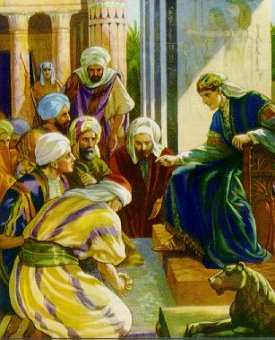
There are parts of Joseph’s story which most people remember: for example that his jealous brothers sold him into slavery and that his personal qualities and clairvoyant skills resulted in him becoming Pharaoh’s right hand man. You may recall that years later, Jacob sent Joseph’s brothers to Egypt to obtain grain, because there was famine in the land of Canaan. When the brothers arrived in Egypt, they failed to recognize Joseph, now the Viceroy or Prime minister, and Joseph showed what must have seemed an odd and threatening interest in these Hebrew brothers from Canaan. He accused them of being spies, demanded that they bring their brother Benjamin to Egypt and meanwhile held Simeon as a hostage to settle the matter. Finally, as the brothers travelled home, they found that the money they had paid for the grain had been returned to them, placed inside their sacks.
Today we read that, when the famine continued, Jacob sent his sons again to Egypt. This time they brought with them Benjamin, much against Jacob’s wishes, for Benjamin, like Joseph, was the son of Rachel, and Jacob favoured the sons of Rachel above the sons of Leah.
Besides Jacob and his twelve sons, there is another player with a speaking role in this part of the Joseph narrative. This is Joseph’s house steward whose name is not recorded so he is called simply הָאִישׁ אֲשֶׁר עַל בֵּית יוֹסֵף, the man over Joseph’s house. This character appears benign but unexpectedly well-informed, knowing some things which he could have learned only from Joseph.
To him, the brothers confide their fears, that they will appear as thieves, because their money had reappeared in their sacks, and that the Viceroy will deal harshly with them, perhaps even take them as slaves. It is an ironic turn of events that the brothers who sold Joseph into slavery now fear being enslaved by him; ironic also that they are wrong in one way and right in another, for Joseph will not enslave them yet their descendants are destined of course to become slaves in Egypt.
Joseph’s house steward says: ‘Do not fear; your God and the God of your father has given you treasure in your sacks.’ He then reunites them with Simeon who had been held hostage and brings them to Joseph’s house, where they receive five star hospitality.
I am curious about this steward and the way he is just called ‘the man,’[1] combined with the fact that the brothers refer to Joseph as ‘the man’[2] and the brothers, if you look closely at this chapter, are not called ‘the brothers’ but ‘the men.’[3] They are called Joseph’s brothers only at the moment when he reveals to them his true identity, which is not yet, not this week.
At last Joseph appears and the brothers bow before him, just as in the dream, which Joseph, as a teenager, related to them, causing them to hate him. They dine with Joseph and get drunk with him, but Joseph never lets down his guard. The next day, he tells his steward to put the men’s silver in their sacks, as before, and to plant in Benjamin’s sack a valuable silver goblet. Years before, the brothers were paid in silver when they sold Joseph to Midianite traders, and now silver keeps coming back to them, an unwanted reminder of a matter they must have hoped was closed.
Joseph gives his steward the job of pursuing the men and accusing them of theft. Although they protest their innocence, the goblet is of course found, to their horror, in Benjamin’s sack. It is, we learn, a ‘divining cup,’ which Joseph uses for divination, a common practice in Egyptian society, and Joseph in particular has a tendency towards the psychic, in his own prophetic dreams and the dreams which he interprets.
The men return to the city and now Judah begins to play a prominent role, acting as a spokesman for his brothers and attempting to protect Benjamin from punishment.
Joseph however declares his intention of keeping Benjamin as a slave and says ‘The rest of you go back in peace to your father.’ The traditional interpretation is that he is testing his brothers, to see if they will abandon Benjamin, as he himself was abandoned, or if they have repented and changed.
The themes of identity theft and deception are part and parcel of the Joseph story. They begin in the previous generation, when Jacob disguises himself as Esau and continue when Laban puts Leah in Jacob’s tent instead of Rachel. Then Joseph’s brothers lie to their father, telling him that Joseph had been killed by a wild beast. Now Joseph withholds the truth from his brothers, exercising his power over them to create fear and revive guilt.
We await the moment of revelation and reconciliation, which will come in the next sidra, with the whole family together in Egypt and the stage set for slavery, exodus and nationhood.
Stay tuned.
[1] see also Genesis 37: 15-17
Genesis 43: 3, 7, 14
ibid vv 15, 17, 18, 24
The Servant in Isaiah 52-53
Posted on: June 24, 2009
ISAIAH 52, 13 – 53, 12
Deutero-Isaiah
In Deutero-Isaiah (chapter 40 and following), the prophet is not named as Isaiah.
Bernard Duhm wrote in an 1892 commentary on Isaiah that the book should be divided into three (chapters 56 – 66 forming the third division) rather than two parts, to include a Trito-Isaiah, and Duhm believed that the four Servant Songs had separate authorship from the rest of Isaiah.
These were the four songs: Isaiah 42, 1 – 4, the second: 49, 1 – 6,the third: 50, 4 – 9, and then there is the song which is in our machzor in the YK mussaf service, 52, 13ff.
The Substitute King
Assyrian texts of the seventh century BCE, 200 years before Deutero Isaiah, refer to a ritual of the Substitute King, which is relevant to the imagery of Isaiah 53. If the king was threatened by ill-omens, for example an eclipse, a substitute would be chosen to sit on the king’s throne for a designated period of time, in order that the expected misfortune should fall on the substitute and not on the king. John H Walton of Wheaton College, Illinois has written on the parallels between these texts and Isaiah 52 – 53. He mentions seventh century Assyrian texts from the time of Esarhaddon and Ashurbanipal. The royal substitute was not intended to rule but to act as a decoy, to draw misfortune away from the true king. There is some resemblance to a scapegoat or a whipping boy, but the ritual here serves to avert a perceived danger. Of interest in the Assyrian account is that the substitute had to wear the king’s crown, sceptre and robes and, if the substitute was put to death, to avert the perceived danger to the king, he was given a royal funeral. As John Walton points out, there is no king is involved in the Isaiah text. However, the servant is considered a lowly person who becomes exalted and, in verse 9 as we shall see, his tomb is among the wealthy. Walton suggests that the prophet is promulgating an ideal image of kingship
…portraying the ideal king as a Servant who functions as a humble instrument of God’s will.
Walton contends that the language of the servant songs is consistent with this imagery and contains:
…elements that were reminiscent of other kingship-focused observances from the ancient Near East. [1]
Isaac Avishur, the author of the EJ entry on Isaiah, [2] mentions the view that the prophet has utilised and customised liturgy in respect of the Mesopotamian god Tammuz.It is interesting that pagan Mesopotamian tradition, Hebrew prophecy and Christian theology all seem to idealise a paradoxical figure who is both afflicted and exalted, lowly and elevated. No doubt this figure is an archetypal reflection of human sorrow and aspiration in the context of religious striving.
‘The Apologetic Impulse’
As the subject of second Isaiah is the return of the Jewish people from Babylonian exile; not merely the return but the exaltation of the people through the intervention of God, there is a good case for regarding the Servant as a representation of Am Yisrael, rather than an individual.
Gershom Scholem suggests that the tendency to interpret this passage in terms of the destiny of the Jewish people is a sign of:
…an apologetic impulse at work which must not be underestimated. The representatives of the rational tendencies stood in the forefront of the theological defences mounted against the claims of the Church.[3]
If Scholem is right, it would explain why Talmud and Midrash were so much more willing to believe in an individual Messiah than the medieval biblical commentators, who were operating in the face of the hostility of medieval Christianity.
Hyam Maccoby commented on the earlier development of the representation of the Messiah in folkloric aggadic literature, believing that this altered significantly after the failed rebellion of Simon Bar Kokhba:
The modern view of the Suffering Servant passage, interpreted as referring to the Messiah, is that this interpretation is not found in the earliest aggadic material, which regards the Messiah as a happy, triumphant figure. It was not until the defeat of the Bar Kokhba rebellion (135 CE) and the resulting miseries of the Jewish people that the idea of a suffering Messiah entered Jewish thought and was reflected in aggadah.[4]
Chapter 52, verse 13
Ibn Ezra and Redak took the view that the Servant refers to the Jews in exile. Rashi explains: ‘Behold, at the end of days, My servant Jacob, ie the righteous among him, shall prosper.’
The verb יַשְֹכִּיל is translated variously as he will be prudent, he will be wise, he will prosper, he will be successful. It appears in 1 Samuel 18, 14, in the present tense:
וַיְהִי דָוִד לְכָל דְּרָכָו }דְּרָכָיו{ מַשְׂכִּיל וַיהֹוָה עִמּוֹ
And David was successful in all his ways, and the Lord was with him.
Targum Jonathan uses a synonymous word, צ ל ח, for ‘prosper;’ the Targum has הָא יַצְלַח עַבְדִי מְשִיחָא which is ‘Behold my servant, the anointed, shall prosper.’
שֹ כ ל is often used in the sense of behaving wisely, especially in the book of Proverbs; Ibn Ezra therefore explains the verse: ‘My servant shall understand that he will be exalted and lifted up,’ which is found also in the Septuagint.
Verse 14
ש מ ם can be translated as ‘astonished,’ ‘appalled’ or ‘desolate.’ The Servant arouses a negative reaction which is neither hatred nor pity. Note the shift in this verse from second person to third person. Yamim Norayim has ‘Many were appalled at him,’ but the Hebrew and many translations say ‘Many were apalled at you…’ before switching to the third person.
Mishhat מִשְחַת is often translated as ‘marred’ and BDB has ‘disfigured’. This usage is a hapax legomenon. It comes from a verb ש ח ת meaning ‘to corrupt’ or ‘to destroy’ and connected also with bowing down. Perhaps this is linked with ש ח ח, the root for bowing down in worship, or with ש ח ט, as in shechita.The mem is a prefix so the root is not linked with מ ש ח, to anoint. The Targum has a word meaning ‘lean,’ ‘poor,’ ‘reduced’: חֲשִיךְ which is related to חֹֹשֶךְ, ‘darkness’.
There can be no doubt that the appearance of the servant is the very opposite of all those described as having a fair countenance: Sarah (Genesis 12, 14); Rebecca (Genesis 24, 16); Rachel (Genesis 29, 17); Joseph (Genesis 39, 6); David (1 Samuel 16, 14); also Absalom (2 Samuel 14, 25); and not forgetting Esther(Esther 2, 7), Vashti (Esther 1, 11), the daughters of Job (Job 42, 15) and both male and female speakers in the Song of Songs. Good looks are attributed mainly to good characters – matriarchs, kings etc but also to Vashti and the dubious Absalom.
Why then is the Servant’s appearance insignificant at best and disfigured at worst?
We are familiar with the convention in film of a flattering depiction of a physically unprepossessing character, whereby the heroine is depicted by a beautiful actress, given thick eyebrows to denote plainness, or where a male superstar is cast as an historical personage who was not very good looking in real life (eg Richard Harris plays Oliver Cromwell). Portrait artists also are said to have flattered their subjects, not only to be paid by them but because art is enhanced by depicting beauty.
A literary depiction loses less by failing to create an image of physical beauty because, if there is beauty, it resides in the language rather than the image.
The Servant, being unprepossessing, does not arouse compassion but appalled astonishment, which impedes the ‘many’ from identifying with him. He is therefore particularly isolated.
Verse 15
In this verse, Rashi’s identification of the Servant with Am Yisroel seems more plausible. Rashi interprets: ‘So now, even his hand will become powerful and he will cast down the nations who scattered him.’
The word י ז ה interested the commentators. The root is נ ז ה, to sprinkle or spatter; perhaps scatter, as in the Targum rendering: ‘He will scatter the peoples…’ The kings are silenced because they have never experienced anything like this; the verse does not say what exactly silences the kings, but it seems to convey their astonishment at the transformation of the Servant
Ibn Ezra and Redak both explain that the other nations did not expect to see Israel’s redemption, and are now astonished by their reversal of fortune.
Chapter 53, verse 1
The rhetorical question in 53, 1 emphasises that the elevation of the Servant must be seen to be believed, but what this change reveals is God’s power, the זְרוֹעַ יי which has redeemed Israel before, especially in the Exodus from Egypt.
Verse 2
What do the metaphors of the sapling and the root from dry ground suggests about the rise of the Servant? That it is unexpected, as we have seen, perhaps relatively quick, that it has taken place in discouraging circumstances (dry ground) but that it is nevertheless deeply rooted in these circumstances. One could say that this refers to the Exile, which is in fact the interpretation of Redak, who added that the growth of the sapling in dry ground is miraculous.
The next part of the verse, which alludes again to the Servant’s unimpressive appearance, is interpreted by Redak as still referring to the Exile: ‘As long as he was in exile, he did not have a beautiful appearance.’ בּעוד שֶהיה בְּגלות לא היה לו תאר ולא הדר
The last word in this verse is וְנֶחְמְדֵהוּ ‘And shall we desire him?’ or ‘[no beauty] that we should desire him’ – ‘…nothing drew us near,’ in the Days of Awe machzor. The word ח מ ד occurs in the ten commandments, as ‘Thou shalt not covet…’ (Exodus 20, 14): לֹא תַחְמֹד.
To whom does ‘we’ refer? If the Servant is Israel, then ‘we’ must refer to the other nations.who are shocked at Israel’s redemption.
A comment from Maimonides (Letter to Yemen, 12th century)
“What is to be the manner of Messiah’s advent, and where will be the place of his appearance? . . . Isaiah speaks …of the time when he will appear, without his father or mother or family being known, He came up as a sucker before him, and as a root out of the dry earth, etc. But the unique phenomenon attending his manifestation is, that all the kings of the earth will be thrown into terror at his fame of him… and so confounded at the wonders which they will see him work, that they will lay their hands upon their mouth; in the words of Isaiah, when describing the manner in which the kings will hearken to him, At him kings will shut their mouth; for that which had not been told them have they seen, and that which they had not heard they have perceived.”
Verse 3
The word ‘despised,’ here in the passive נִבְזֶה is not unusual; it is the word used when Esau despised his birthright (Genesis 25, 34), when Michal despised David in her heart (” Samuel 6, 16) and when David says that he is ‘less than human, scorned by men, despised by people.’ (Psalm 22, 7) לֹא אִישׁ חֶרְפַּת אָדָם וּבְזוּי עָם:
חָדֵל is connected with ceasing or lack so could be translated a forsaken.
The Servant is a lonely figure. He does not have disciples or followers. A man of sorrows: אִישׁ מַכְאֹבוֹת.
In Jeremiah 15,18) Jeremiah’s use of כְאֵבִי ‘my pain,’ is from the same root as מַכְאֹבוֹת.
Why is my pain unceasing, my wound incurable, refusing to be healed?
More than once, Jeremiah stood in the courtyard of the Temple, denouncing corrupt and unethical practices. He became an outcast and was punished and later banned from the Temple area.He was beaten and put in the stocks (Jeremiah 20:1–6) and later imprisoned (Jeremiah 37, 15 – 16) at least twice (Jeremiah 38, 4ff).
I am not contending that Jeremiah was personally the model for the Suffering Servant, but that his narrative attests the ideal of a righteous and persecuted prophet in Hebrew prophecy. However, there is a precedent for linking the Servant with Jeremiah.
Saadiah Gaon (882-942 CE) regarded Jeremiah as a fulfillment of these verses, not the only person to fulfil them but as a representative of many righteous servants.
Perhaps there are thirty-six in every generation: the lamed-vavniks.
The bible often speaks of God hiding his face, in the sense of punishing someone, eg the Psalmist, or punishing the people, Israel, by withdrawal. It is less often that a person hides his face, although Moses does so in Exodus 3, 6 at the burning bush, and Job, who is most certainly a man of sorrows and acquainted with illness, speaks of hiding his face from God and of God hiding His face from Job:
Only grant two things to me, then I will not hide myself from thy face: withdraw thy hand far from me, and let not dread of thee terrify me. Then call, and I will answer; or let me speak, and do thou reply to me. How many are my iniquities and my sins? Make me know my transgression and my sin. Why dost thou hide thy face, and count me as thy enemy? Wilt thou frighten a driven leaf and pursue dry chaff? (Job 13, 20 – 24)
Verse 4
This verse develops a theology of vicarious suffering and atonement. Rashi said ‘…he was chastised with pains so that all the nations be atoned for with Israel’s suffering.’
According to this view, ‘we’ are the nations, and ‘he’ is Israel.
Ezekiel took a different view, that each individual bears responsibility only for his own deeds:
The soul that sins shall die. The son shall not suffer for the iniquity of the father, nor the father suffer for the iniquity of the son; the righteousness of the righteous shall be upon himself, and the wickedness of the wicked shall be upon himself. (Ezekiel 18, 20)
Redak says that the view expressed in Isaiah 53, 4 does not contradict this, since, if ‘we’ refers to the other nations, it is the other nations who impute vicarious suffering to Israel.
Ibn Ezra and Abravanel take this a step further, explaining that the Servant Israel bore the pains and sorrows inflicted on him by other nations.
The words חֲשַׁבְנֻהוּ נָגוּעַ מֻכֵּה אֱלֹהִים , ‘[We thought him] plagued, stricken by God,’ are often used in connection with leprosy. This words emphasise that the Servant is an outcast, as we might, in modern usage, use the word ‘leper’ as a metaphor for someone shunned by society.
“The Rabbis said:
His name is “the leper scholar,” as it is written, Surely he hath borne our griefs, and carried our sorrows: yet we did esteem him a leper, smitten of God, and afflicted. [Isaiah 53:4].” [5]
Abraham Joshua Heschel wrote:
As a rule we reflect on the problem of suffering in relation to him who suffers. The prophet’s message insists that suffering is not to be understood exclusively in terms of the sufferer’s own situation. In Israel’s agony, all nations are involved. Israel’s suffering is not a penalty, but a privilege, a sacrifice; its endurance is a ritual, its meaning is to be disclosed to all men in the hour of Israel’s redemption.
Verse 5
This verse continues the theme of vicarious suffering but adds that we were healed by his wounds. A burden of guilt falls on ‘us,’ whoever ‘we’ may be. The theme of the righteous making atonement for the unrighteous is a feature of rabbinic literature. Even in the Avodah of the Yom Kippur mussaf service, the High Priest makes atonement for the people.
The possible meanings of the word מְחֹלָל according to BDB are profaned, defiled, pierced and there is a possible link with ח ל ה to be ill.
Verse 6
While the verse builds on theme of ‘our’ guilt, born by the servant, the sheep metaphor suggests that ‘we’ are essentially, innocent, ignorant, and easily led. Rashi, Redak and Ibn Ezra all interpret the first person plural as referring to the other nations.
In the Christian interpretation, ‘we’ refers to Israel which makes a neater metaphor but there is also the Jewish tradition in Talmud and Midrash of regarding the Servant as a person, variously identified as David, Hezekiah, Zerubbabel and the post biblical Bar Kochba, whom Rabbi Akiva believed to be the Messiah.
Verse 7
Note the use of רחל which means ewe, but does not occur often as a common noun – only in Genesis (31, 38), in connection with Laban’s sheep, and in the Song of Songs (6, 6). Midrash attributes to Rachel the virtue of silence and discretion, because she did not reveal to Jacob Laban’s deception regarding the marriage to Leah, and this verse may be used as a prooftext. Certainly the silence of the Servant is regarded as a virtue. The sheep metaphor is applied differently as the sheep is not wandering away, but is here the unprotesting victim.
There is another connection with Jeremiah in this verse:
But I was like a gentle lamb led to the slaughter. I did not know it was against me they devised schemes, saying, “Let us destroy the tree with its fruit, let us cut him off from the land of the living, that his name be remembered no more.” (Jeremiah 11, 19)
Verse 8
Rashi says that ‘the land of the living’ refers to Eretz Israel, and ‘cut off’ means exiled. The medieval commentators (Ibn Ezra, Redak, Rashi) believed that the speakers are the other nations, confessing that Israel was afflicted, or stricken with plague because of the sins of the other nations, particularly in this case the Babylonians.
Verse 9
Consistently, the medieval rabbis explain that the grave among the wicked was the grave in exile, in Babylon. Rashi also suggests that the grave among the wicked and the tomb among the wealthy means that the Servant was willing to let the ruling power take his life rather than deny the Torah.
Now if the prophet’s imagery was influenced by knowledge of the pagan practice of the Substitute King, the grave among the wealthy could refer to the practice of killing the Substitute King and burying him in a king’s tomb. ‘Among the wicked’ fits in with this too. The wicked and the wealthy seem to be linked together and the Servant submits in some way to be martyred by them.
Jeremiah’s grave was, as far as anyone knows, in Egypt, perhaps Tahpanes,where he was taken with other refugees, as Nebuchadnezzar advanced on Judah. There is a midrash that he was stoned to death (Midrash Aggadah to Numbers 30, 15).[6] This is also attributed to Tertullian (ca. 155 – 230), a patristic writer who said that the Jews stoned Jeremiah, a hostile interpretation of the Jews being par for the course in early Christian writings.
Nachmanides, who was forced to enter into a disputation with the Christian authorities of Barcelona in 1263, repudiated the view that the Suffering Servant refers to the Messiah, or that the Messiah would be put to death and buried among the wicked:
Friar Paul claimed: “Behold the passage in Isaiah, chapter 53, tells of the death of the messiah and ho he was to fall into the hands of his enemies and how he was placed alongside the wicked, as happened to Jesus. Do you believe that this section speaks of the messiah?
I said to him: “In terms of the true meaning of the section, it speaks only of the people of Israel, which the prophets regularly call ‘Israel My servant’ or ‘Jacob My servant.’ ”
Friar Paul said: “I shall prove from the words of your sages that it speaks of the messiah.”
I said to him: “It is true that the rabbis in the aggadah explain it as referring to the messiah. However, they never said that he would be killed ,at the hands of his enemies. For you will find in no book of the Jews, neither in the Talmud nor in the Midrash, that the messiah, the descendant of David, would be killed or would be turned over to his enemies or would be buried among the wicked. Indeed even the messiah whom you made for yourself was not buried. I shall explain for you this section properly and clearly, if you wish. There is no indication that the messiah would be killed, as happened to your messiah. They, however, did not wish to hear. [7]Verse 10
This difficult use of ד כ א to crush occurs also in Job (6, 9 and 19, 2). How are we to understand this verse, unless by comparing the servant with Job, who was blameless and upright. (Job 1, 1)? The crushing of the Servant, according to the verse, serves a Utilitarian purpose: that God’s purpose would be fulfilled by him; that he would see offspring and prolong his days. What does the Servant need to do to achieve this purpose? He has to offer his soul as a guilt offering: א ש ם – and the asham was one of the Temple offerings prescribed in Leviticus.
Verse 11
To whom does tsadik refer? Some translations say ‘The Righteous One,’ meaning that the Servant, through his knowledge, brings many people to God; other translations make ‘righteous’ apply to the Servant. The word order is:
He will justify/ the righteous one/My servant
It could be translated as ‘The Righteous One will justify my servant,’ or ‘My servant will justify the righteous.’ According to the rest of the verse, the Servant is the subject of the verbs. ס ב ל means ‘to bear a heavy load.’ The Servant sees, justifies and bears a burden. The Judaica Press translation seems to me better than some others:
From the toil of his soul he would see, he would be satisfied; with his knowledge My Servant would vindicate the just for the many, and their iniquities he would bear.’[8]
The servant song in Isaiah 42,1 ff throws light on this verse, by its use of the motifs of ‘servant,’ ‘righteousness’ and being silent.
1 Here is my servant, whom I uphold, my chosen, in whom my soul delights; I have put my spirit upon him; he will bring forth justice to the nations. 2 He will not cry or lift up his voice, or make it heard in the street; 3 a bruised reed he will not break, and a dimly burning wick he will not quench; he will faithfully bring forth justice. 4 He will not grow faint or be crushed until he has established justice in the earth; and the coastlands wait for his teaching. 5 Thus says God, the Lord, who created the heavens and stretched them out, who spread out the earth and what comes from it, who gives breath to the people upon it and spirit to those who walk in it: 6 I am the Lord, I have called you in righteousness, I have taken you by the hand and kept you; I have given you as a covenant to the people, a light to the nations, 7 to open the eyes that are blind, to bring out the prisoners from the dungeon, from the prison those who sit in darkness.
These words are addressed to ‘You, Israel My servant, Jacob whom I have chosen, the seed of Abraham who loved me’ (Isaiah 41, 8).
Note that it is through knowledge that the servant justifies:
‘for Torah will come out of Zion and the word of the Lord from Jerusalem.’ (Isaiah 2, 3)
Verse 12
The traditional medieval view, also found earlier in the Targum, is that the nation of Israel will intercede for the welfare of the other nations.
Rashi says ‘Because he did this, I will allot him an inheritance with the Patriarchs.’
Ibn Ezra and Redak said that although Israel suffered at the hands of their oppressors, they prayed for their welfare, giving as prooftext Jeremiah 29, 7: ‘Seek the peace of the city to which I have brought you.’
‘He poured out his soul to death’ seems to be the figure of speech which often translates הֶעֱרָה לַמָּוֶת נַפְשׁוֹ but Yamim Noraim has ‘he exposed his soul to death,’ taking into account the connection of ע ר ה with nakedness.
The last image in this text is a familiar paradigm: one who is martyred and dishonoured but takes on the role willingly while striving for the welfare of his oppressors. Clearly this is at the heart of Christianity but it originates in a Hebrew context. As Jews suffered martyrdom so many times under the various oppressive empires, it became a frequent subject of discussion in rabbinic literature. It is not chance that this text appears in the martyrology section of the Yom Kippur mussaf service.
It does not conform to an ideal of the heroic that appeared later in Greek literature, is the opposite of tyranny or hubris, but is consistent with many aspects of Hebrew scripture, especially the Psalms, as in Psalm 113, 7 – 8 for example:
מְקִימִי מֵעָפָר דָּל מֵאַשְׁפֹּת יָרִים אֶבְיוֹן
לְהוֹשִׁיבִי עִם נְדִיבִים עִם נְדִיבֵי עַמּוֹ:
He raises the poor from the dust, the beggar from the dunghill, to sit them with princes, the princes of his people – or Psalm 22, אֵלִי אֵלִי לָמָה עֲזַבְתָּנִי , My God, my God, whu hast Thou forsaken me?attributed to David, and used famously in the New Testament but readily applicable to Job, Jeremiah and all the Suffering Servants across the generations.
*
Gillian Lazarus Ellul 5767
August 2007
1] The Imagery of the Substitute King Ritual in Isaiah’s Fourth Servant Songby John H Walton (Journal of Biblical Literature, Vol. 122, No. 4, 734 – 743)
[2] Encyclopedia Judaica 1971 Vol 9, p 66
[3] The Messianic Idea in Judaism, Gershom Scholem, Schocken Books NY 1971 p33
[4]Judaism on Trial by Hyam Maccoby Associated University Press 1982 p43
[5]Talmud, Sanhedrin 98b
R. Joshua b. Levi met Elijah standing by the entrance of R. Simeon b. Yohai’s tomb. He asked him: ‘Have I a portion in the world to come?’ He replied, ‘if this Master desires it.’ R. Joshua b. Levi said, ‘I saw two, but heard the voice of a third.’ He then asked him, ‘When will the Messiah come?’ — ‘Go and ask him himself,’ was his reply. ‘Where is he sitting?’ — ‘At the entrance.’ And by what sign may I recognise him?’ — ‘He is sitting among the poor lepers: all of them untie [them] all at once, and rebandage them together, whereas he unties and rebandages each separately, [before treating the next], thinking, should I be wanted, [it being time for my appearance as the Messiah] I must not be delayed [through having to bandage a number of sores].’ So he went to him and greeted him, saying, ‘peace upon thee, Master and Teacher.’ ‘peace upon thee, O son of Levi,’ he replied. ‘When wilt thou come Master?’ asked he, ‘To-day’, was his answer. On his returning to Elijah, the latter enquired, ‘What did he say to thee?’ — ‘peace Upon thee, O son of Levi,’ he answered. Thereupon he [Elijah] observed, ‘He thereby assured thee and thy father of [a portion in] the world to come.’ ‘He spoke falsely to me,’ he rejoined, ‘stating that he would come to-day, but has not.’ He [Elijah] answered him, ‘This is what he said to thee, Today, if ye will hear his voice.’
[6]Legends of the Jews, Louis Ginzberg, vol 6 p399 Johns Hopkins UP 1998
[7] Nachmanides’ report of The Barcelona Disputation, 1263
[8]Translation by Rabbi A J Rosenberg
Malachi 1
Posted on: June 6, 2009
In the book of Ezra, the king is called אַרְתַּחְשַׁסְתְּא הַמֶּלֶךְ.
After 424, the Achaemenid kings were Xerxes II, Sogdianus, Darius II, Artaxerxes II (423-359), Artaxerxes III, Arses, Darius III and after that, Alexander the Great defeated the Persian Empire in 330.
Jerusalem was in the Persian province of Trans-Euphrates (west of the river), called בַּעֲבַר נַהֲרָא , ‘Beyond the river,’ in Ezra and Nehemiah. The prophets who were active at this time, Haggai, Zechariah and Malachi, were concerned with the restoration of the the Temple and its cult, according to the law of Moses. There is not a consensus of academic opinion as to whether Malachi is earlier, later or contemporary with Ezra and Nehemiah.In the book of Ezra, the king is called אַרְתַּחְשַׁסְתְּא הַמֶּלֶךְ.
Although the Temple had been rebuilt, it was not a panacea for the problems caused by bad harvests and heavy taxes imposed by the Persians.
The subjects addressed in the three chapters which make up the book of Malachi are: God’s love for Judah and His hatred of Edom; Malachi’s accusations against the priests for neglecting the sacrificial cult, his rejection of divorce and of mixed marriages and his condemnation of the people for their lack of social justice and inadequate payment of tithes. He is concerned for the upkeep of the Temple, because the Temple practices represent the relationship of the people to God. In Malachi 2, 11, the prophet denounces husbands who divorce their wives to marry ‘the daughter[s] of a strange god.’
Chapter 1, verse1
The identity and the name
As for Malachi’s identity, there is a question of whether Malachi is a proper name or simply ‘My messenger. In Malachi 3:1, the usage seems to imply that Malachi is not a proper name:
הִנְנִי שֹׁלֵחַ מַלְאָכִי וּפִנָּה דֶרֶךְ לְפָנָי
Behold I send My messenger, and he shall clear the way before me.
If Malachi means ‘My Messenger,’ the prophet’s anonymity encourages the midrashic interpretation that he is the same person as Ezra.[2] Targum Jonathan to Malachi says, for verse 1, ‘By the hand of my messenger, whose name is Ezra the scribe.’ Jerome, in his preface to the commentary on Malachi, mentions that in his day the belief was current that Malachi was identical with Ezra (“Malachi Hebræi Esdram Existimant”). The LXX translates his messenger, rather than my messenger, referring to Malachi as αγγελου, ‘his angel,’ which has the same angel/messenger ambiguity as the word מַלְאךְ. The Hebrew noun is derived from the root ל א ך which means to be sent, or to minister.[3]
Midrash also describes him, with Haggai and Zechariah, as the last of the prophets and a companion of Ezra.[4] A Talmudic tradition identifies him with Mordecai, punning on the name Malachi and the ‘kingliness’ of Mordecai in Esther:
כִּי מָרְדֳּכַי הַיְּהוּדִי מִשְׁנֶה לַמֶּלֶךְ [5]
This is the passage from the Bavli:
R Nahman said: Malachi is the same as Mordecai. Why was he called Malachi? Because he was next to the king. The following was cited in objection to this: Baruch the son of Neriah[6] and Serayah the son of Mahseyah[7] and Daniel and Mordecai, Bilshan, Haggai, Zechariah and Malachi all prophesied in the second year of Darius.[8]
The names in this passage are associated with the return to Judah in the time of Ezra and Nehemiah but the rabbis also interpreted Bilshan as Mordecai’s surname.[9]
Now these are the people of the province who came up from the captivity of the exiles, whom Nebuchadnezzar king of Babylon had taken captive to Babylon (they returned to Jerusalem and Judah, each to his own town, in company with Zerubbabel, Jeshua, Nehemiah, Seraiah, Reelaiah, Mordecai, Bilshan, Mispar, Bigvai, Rehum and Baanah.[10]
These are the people of the province who came up from the captivity of the exiles whom Nebuchadnezzar king of Babylon had taken captive (they returned to Jerusalem and Judah, each to his own town), in company with Zerubbabel, Jeshua, Nehemiah, Azariah, Raamiah, Nahamani, Mordecai, Bilshan, Mispereth, Bigvai, Nehum and Baanah.[11]
I am not sure why the chronology which makes Malachi and Mordecai active in the second year of Darius refute identification of Malachi with Mordecai. Rashi’s note suggests that this is a later Darius, האחרון
Why might the rabbis have wanted to identify Malachi with Mordecai? Both are from the period of the Persian Empire, but there is another connection, which is anti-Amalek, anti-Edom and anti-Esau. Amalek was one of Esau’s descendants.[12]
The identification with Ezra[13] is based on the similarity of their views on intermarriage:
R Joshua ben Korha says: Malachi is the same as Ezra, and the Sages say that Malachi was his proper name. R Nahman said: There is good ground for accepting that Malachi was the same as Ezra. For it is written in the prophecy of Malachi, Judah has profaned the sanctuary of the LORD, which he loves, and has married the daughter of a foreign god.[14] And who was it that put away the foreign women? Ezra, as it is written, And Shecani’ah the son of Jehi’el, of the sons of Elam, addressed Ezra: “We have broken faith with our God and have married foreign women from the peoples of the land.[15]
מַֹשָֹּא is translated as oracle, message, ‘burden’ in some translations. It’s derived from the verb נ שֹ א, ‘to lift up,’ and is used in Zechariah, used in the same way.[16]
Verse 2
Against the Edomites
The people of Israel respond with a sceptical question: How/wherein have You loved us? This question and answer format is the didactic-dialectic style characteristic of Malachi, but found also in Isaiah, Micah and Haggai.[17]
For rhetorical effect, he makes a statement and follows it with the objection he expects from his audience.
Verse 3
The sibling relationship with Esau is mentioned up front here.
Esau’s descendants are called Edomites and they lived in the region south of the Dead Sea called Mount Seir, a name which puns on Esau’s hairiness:
וַיֹּאמֶר יַעֲקֹב אֶל רִבְקָה אִמּוֹ הֵן עֵשָׂו אָחִי אִישׁ שָׂעִר וְאָנֹכִי אִישׁ חָלָק[18]
Edom of course means red, Esau being אַדְמֹונִי at birth. Esau himself traveled from Canaan, in the west, to possess his land, with the territory of Ammon and Moab on the borders. He is identified with Edom in Genesis 36:1:
וְאֵלֶּה תֹּלְדוֹת עֵשָׂו הוּא אֱדוֹם
Esau made multiple marriages and his descendants include many of the neighbouring peoples, Amalekites included.
The context of the animus against Edom in this Malachi text is that Edomites occupied the fertile grazing land of Judah following the exile of 586. The Nabataeans who were Arabian nomads then occupied the former Edomite territory, including Petra, the gulf of Aqaba and Elat. Their Aramaic inscriptions begin to appear in the fourth century BCE, according to archaeological findings.
Although there is some expression of fraternal friendliness to Edom in the Torah – You shall not abhor an Edomite, for he is your brother,[19] Obadiah makes the perfidious Edomites and their comeuppance his entire subject.
The grudge against the Edomites for their complicity with the Babylonians in the destruction of Jerusalem and their opportunism in benefiting from it is expressed famously in Psalm 137:
Remember O Lord the Edomites in the day of Jerusalem, who said Rase it, rase it, even to its foundations… [20]
Obadiah, the shortest of the prophetic books, is believed to have written in the 5th century BCE, after the fall of Jerusalem to the Babylonians. He denounces the Edomites for assisting the Babylonians, ravaging and looting Jerusalem after the Jews were exiled. He draws attention to the kinship between Israel and Edom, which makes Edom particularly treacherous.
Malachi’s statement of God’s hatred is sometimes explained as ‘I chose Jacob, but not Esau,’ or ‘I loved Esau less.’ It is also explained by treating Edom as a symbol of wickedness, as it is used in midrashic literature, especially during Roman times where Rome is called Edom. In later midrash, Edom may represent the church.
James Kugel, commenting on the changing portrayal of Esau in Midrash, writes:
Part of the motive for this change is to be found in the later history of Israel, as reflected in the bible itself. After all, Esau was the ancestor of the Edomites, Israel’s close neighbour and sometimes fierce enemy. Later biblical texts frequently heaped scorn on the Edomites, and sometimes this scorn was couched in terms that reflected back on the founder of that nation.[21]
The enmity of the Amalekites contributed to the bad press received by Esau and by the Edomites as a people. This adds dramatic impetus to the identification of Malachi, scourge of the Edomites with Mordecai, scourge of the Amalekites.
Esau was a hunter, living by the sword,[22] and was a natural symbol for the martial power of Rome:
[Isaac’s words] The voice is the voice of Jacob but the hands are the hands of Esau[23] [really refer to the people of Israel and Rome] for Jacob rules only through his voice, but Esau rules only through his hands.[24]
Verses, 3- 4.
These verses speak of retribution towards Edom.
According to Malachi, the desolation of Edom is an accomplished fact rather than a threat to be fulfilled in the future, probably referring to the devastation of Edom caused by the migration of Nabateans. The word tanot, translated in my bible as jackals, is translated elsewhere as dragons, presumably because it resembles the tanim, dragons or sea monsters of Genesis 1, 21. Sea monsters of the desert would not be suitable. The ‘jackals of the wilderness’ are the marauding Nabateans. The Edomites were forced south, to the Negev, in Roman times was called Idumea. The fact that Idumea provided the Herodian dynasty, clients of the Roman regime, also contributes to the identification of Edom with Rome.
Verse 5
God’s greatness reaches beyond Israel and His retribution is suffered by other peoples, especially those who attack Israel, so he regarded as universal but not fatherly.
Rashi comments:
He will show His greatness over our border, to make known that we are His people. And Jonathan[25] rendered: May the glory of the Lord be magnified, and He has widened the border of Israel.
This verse completes Malachi’s section on Edom, and in the next verse, he attacks a home grown target.
Verses 6
Corrupt priests and unkosher sacrifices
Malachi turns to the subject of corruption among the priests who misuse the sacrificial system. Theseare reminiscent of charges from the author of Samuel against the sons of Eli[26] and the sons of Samuel.[27]
The relationship between God and the cohanim is affirmed as that of a father to His children or a master to His servants, but the priests have failed in their duties as children and servants.
The designation here for God is Lord of Hosts; the LXX has παντοκρατωρ.
Verse 7
‘Polluted bread’ is less likely to refer to bread than to the unsuitable animals offered at the altar.The word for offering – מַגִּיֹשִים – is derived from נ ג ֹש, which means to approach, and in this form means to bring near. The word for pollute, ג א ל, is composed of the same letters as a more familiar word which means ‘redeem.’ BDB[28] draws our attention to a similar word ג ע ל, meaning ‘to abhor.’[29] All the occurences of ג א ל as pollute belong to books (with the exception of Zephaniah, seventh century BCE[30]) which have a strong Persian connection: Daniel,[31] Ezra[32] and Nehemiah;[33] it appears twice in Isaiah,[34] but in the later chapters, where the prophet’s acquaintance with the rule of Cyrus.[35] The word for defilement in the Torah is usually ח נ ף or ט מ א, unclean.
As Rev Dr Cohen points out in his commentary to the Soncino edition, ֹשֻלְחַן, table, stands for the altar, and he cites a similar use in Ezekiel, when the angel, who provides Ezekiel with a vision of the future Temple, shows him the altar, saying:
This is the table which is before the Lord. [36]
זֶה הַשֻּׁלְחָן אֲשֶׁר לִפְנֵי יְהֹוָה
Verse 8
The sacrificial cult insisted that only animals without blemish were fit for sacrifice,[37] and the priests had to cleanse themselves so as not to offer sacrifices in a state of ritual impurity. Blindness and lameness counted as blemishes which precluded the animal from being offered as a sacrifice.
Malachi uses the Persian word for governor, פֶחָה ,which is found, as one would expect, in the books of the bible which are concerned with Persian domination: Haggai, Esther, Ezra, Nehemiah and second Chronicles. Pekhah is used also in non-Persian contexts, in Kings,[38] Isaiah,[39] Jeremiah[40] and Ezekiel,[41] usually in speaking of international dealings with the Assyrians and the Babylonians, or, in the case of King Solomon, the Arabians:
וְכָל מַלְכֵי הָעֶרֶב וּפַחוֹת הָאָרֶץ[42]
The Greek word is ηγουμων, hegemon.
The Priestly Blessing
If the governor would not find it acceptable – literally, ‘lift up your face’ – how much less should it be offered to God, and how much less will God lift up the face of a corrupt priest. The question makes ironic reference to the priestly blessing:
יְבָרֶכְךָ יְהֹוָה וְיִשְׁמְרֶךָ:
יָאֵר יְהֹוָה פָּנָיו אֵלֶיךָ וִיחֻנֶּךָּ:
יִשָּׂא יְהֹוָה פָּנָיו אֵלֶיךָ וְיָשֵׂם לְךָ שָׁלוֹם [43]
Verse 9
Again Malachi makes an ironical allusion to the priestly blessing: יָאֵר יְהֹוָה פָּנָיו אֵלֶיךָ וִיחֻנֶּךָּ To be gracious is ח נ ן.
The Mishnah describes how, in Temple times, the priests used to recite the Priestly Blessing, morning and evening at the daily offerings.[44] The priests made the blessing with uplifted hands,[45] to which מִיֶּדְכֶםmay allude – this is from your hands.
Michael Fishbane comments:
Malachi’s vitriolic critique of cultic and priestly behaviour in the post-exilic period is, at once, a systematic utilization of the language of the Priestly Blessing and an exegetical transformation of it…In brief, the prophet has taken the contents of the Priestly Blessing, delivered by the priests, with its emphasis on blessing, the sanctity of the divine Name, and such benefactions gracious/favourable countenance, and peace – and negated them![46]
Verse 10
Closing the doors
It is preferable to close the Temple doors than to bring inappropriate sacrifices. Rashi’s comment on this verse is:
If only a good man would arise among you who would close the doors of My sanctuary so as not to allow this abominable sacrifice there.
Rashi also cites Sifra, a midrashic work on Leviticus, where the sages say:
If a person says to his friend, “Close this door for me,” he does not demand compensation for it; [or if he says,] “Light this candle for me,” he does not request compensation for it. But you – who is there among you who closed My doors, gratis? Neither did you kindle fire on My altar gratis. Surely, things that are customarily done for compensation you did not do gratis. Therefore, I have no desire in you.[47]
Malachi’s criticisms of the Temple priesthood provided ammunition for the Church Fathers, in their attempts to Christianize the Hebrew prophets. Cyril of Alexandria, for example, writing in the fifth century CE, interprets the shutting of the doors as the shutting out of Jews from God’s favour, asserting that the Jewish priesthood had failed only to be replaced by the Christian church. This was part of the general thrust in Patristic writings to lay claim to Jewish patriarchs and prophets as harbingers of Christianity.
It must be difficult to reconcile this view with ‘I have loved you…I loved Jacob’ in verses 1 and 2.
Verse 11
Among the nations
This is an allusion to Psalm 113, the first psalm of the Hallel, and in this verse, the nations from east to west are encompassed in universal worship of the one God. The prophet asserts that God is worshiped beyond Israel, by the goyim who bring acceptable sacrifices: מִנְחָה טְהֹורָה. Psalm 113 also invokes the nations in a universalizing context from east to west:
מִמִּזְרַח שֶׁמֶשׁ עַד מְבוֹאוֹ מְהֻלָּל שֵׁם יְהֹוָה:
רָם עַל כָּל גּוֹיִם יְהֹוָה עַל הַשָּׁמַיִם כְּבוֹדוֹ:
From the rising of the sun to its setting the name of the LORD is to be praised! The LORD is high above all nations, and his glory above the heavens[48]
From the rising of the sun to its setting may also signify a sequence of time – from the beginning to the end – but in this context, the intended meaning seems to be ‘everywhere.’
Rashi interprets among the nations as referring to Jews in the diaspora:
Our Sages explained: These are the Torah scholars who are engaged in the laws of the Temple service everywhere, and likewise, every prayer of Israel that they pray anywhere is to Me as a pure oblation. And so did Jonathan paraphrase: And every time that you do My will, I accept your prayer, and My great Name is sanctified through you, and your prayer is like a pure offering before Me. This is the explanation of the verse: Now why do you profane My Name? Is it not great among the nations? As for Me, My love and My affection are upon you wherever you pray before Me
The verse does indeed say בַּגֹּויִם and not הַגֹּויִים – among the nations, rather than the nations.
In verse 11, Malachi twice bears God’s message: My name is great among the nations, and again in verse 14: My name is feared among the nations.
Verses 12 to14 accuse those who offer ritually impure animals and show contempt for the sacrificial laws. In verse 14 Malachi says that the person is cursed who possesses healthy animals but yields up for sacrifice a מָֹשְחַת, which has connotations of being spoiled or corrupt, reflecting back on the person who brings the blemished animal.
Why is there is emphasis here on בַּגֹּויִם, among the nations? This expression sums up the topography of Israelite diaspora in the tochechot of Leviticus[49] and Deuteronomy,[50] in the prophecies of Jeremiah[51] and Ezekiel[52] and many times among the Trei-asar, when they speak of exile. In the Psalms, בַּגֹּויִם has another significance, where the Psalmist extols God among the nations, that is, to bear witness to the greatness of God, for the edification of non-Israelite nations.[53]
In Psalm 126, the point is that the nations should see what God has done for Israel:
Then our mouth was filled with laughter, and our tongue with shouts of joy; then they said among the nations, ‘The LORD has done great things for them.’[54]
The Chronicler speaks o f the universal worship of God:
Let the heavens be glad, and let the earth rejoice, and let them say among the nations, ‘The LORD reigns!’[55]
A clue to Malachi’s meaning is the use of the expression מִמִּזְרַח שֶׁמֶשׁ עַד מְבוֹאוֹ from Psalm 113, which goes on to say that God is רָם עַל כָּל גּוֹיִם, above all nations, and it may be that Malachi is making the point that God is greater than the Persian Empire and its provincial governors.
Minchah in Malachi’s time
The ‘pure oblations’ contrast with the unacceptable sacrifices of unfit animals.
The NASB translates מִנְחָה טְהֹורָה as a grain offering that is pure. Minchah, in biblical times, was usually a grain offering, and in Talmudic times, it became the afternoon prayer, which took the place of a sacrificial offering.[56] The meaning of the verb מ נ ח, from which Minchah is derived, is to make a gift or a loan.[57]There are five kinds of sacrifices: Olah (The burnt offering, Minchah (The flour offering), Shelamim (The peace offering), Chatat (The sin offering) and Asham (The trespass offering).
The first people in Tanakh to offer minchah are Cain and Abel.[58] In Leviticus we find instructions for the Temple practice:
When someone brings a grain offering (מִנְחָה) to the Lord, his offering is to be of fine flour. He is to pour oil on it, put incense on it and take it to Aaron’s sons the priests. The priest shall take a handful of the fine flour and oil, together with all the incense, and burn this as a memorial portion on the altar, an offering made by fire, an aroma pleasing to the Lord. The rest of the grain offering belongs to Aaron and his sons; it is a most holy part of the offerings made to the Lord by fire[59]
November 2008
1] Ezra 7:11-15
[2] Megillah 15a; Jerome’s commentary of Malachi
BDB p521
[4] Zevahim 62a
[5] Esther 10:3
[6] Jeremiah 32:12
Jeremiah 51:59
Megillah 15a see also Haggai 1:1 and Zechariah 1:1 re the second year of Darius.
[9] Menahot 64b
[10] Ezra 1:1-2
[11] Nehemiah 7:6-7
[12] Genesis 36:12
[13] Megillah 15a
[14] Malachi 2;11
Ezra 10:2
[16] Zechariah 9:1 and 12:1
[17] See also Isaiah 40,12-17; Micah 2, 6-11 and Haggai 1, 4-6
[18] Genesis 27:11
[19] Deuteronomy 23:8
[20] psalm 137:7
[21] The Bible As It Was, James Kugel, Harvard University Press1997 p202
[22] Genesis 27:40
[23] Genesis 27,22
Genesis Rabbah 65:19
[25] Targum Jonathan ben Uzziel
[26] 1 Samuel 2:12-17
1 Samuel 8:3
[28] BDB p146
loc cit p171.
Zephaniah, 3:1
Daniel 1:8
Ezra 2:62
Nehemiah 7:64
Isaiah 59:3; 63:3
Isaiah 45:1 and 13
[36] Ezekiel 41:22
[37] Leviticus 1:3
[38] 1 Kings 10:15,20:24; 2 Kings 18:24
Isaiah 36:9
Jeremiah 51:23, 28 and 57
Ezekiel 23:6, 12 and 23
[42] 1 Kings 10:15
[43] Numbers 6:24-27
[44] Mishnah, Tamid 5:1
Leviticus 9:22 Then Aaron lifted up his hands toward the people and blessed them; and he came down from offering the sin offering and the burnt offering and the peace offerings.
[46] Form and Reformulation of the Biblical Priestly Blessing, Michael Fishbane, American Oriental Society, 1983
[47] Torath Kohanim (Sifra) 7:154
[48] Psalm 113:3-4
[49] Leviticus 26:23ff
Deuteronomy 4:27; 30:1
Jeremiah 29:18
Ezekiel 4:13
2 Samuel 22:50; Psalm 18:49
[54] Psalm 126:2
[55] 1 Chronicles 16:31
[56] Berakhot 26b
BDB p585
[58] Genesis 4:3-5
[59] Leviticus 2:1-3
Jonah
Posted on: May 24, 2009
Jonah speaks only five prophetic words throughout the book of his name and these are they:
עוֹד אַרְבָּעִים יוֹם וְנִינְוֵה נֶהְפָּכֶת In forty days Nineveh will be overthrown.
Not only are the words few but apparently false as Nineveh is not overthrown in forty days.
The rest of the book of Jonah is story, without the oracles which appear in all the other books of the prophets. In this way, he resembles the earlier prophets of the book of kings, Elijah and Elisha, whose stories are characterised by miraculous incidents.
The editors of Yamim Noraim, Rabbi Jonathan Magonet and Rabbi Lionel Blue, explain the choice of the book of Jonah for Yom Kippur. It shows the power of repentance and is associated with fasting because the people of Nineveh fast and repent.
Verse 1 – 2
The prophet Jonah ben Amittai is mentioned in 2 Kings 14,25, during the reign of Jeroboam II, who reigned in the kingdom Israel between about 825 and 790 BCE. The Assyrian Empire was approaching the height of its power although it had not yet destroyed the Northern kingdom of Israel, which fell in 722 BCE.
In the book of Jonah, God tells Jonah to go to Nineveh – the heart of the evil empire – and proclaim against it. Usually Hebrew prophets are sent to prophesy to the people of Israel or Judah.
We know from the book of kings that Jonah was from the North, from Gath-hepher in the region of Zebulun. According to midrash, Jonah was descended from Zebulun,[3] which is particularly appropriate because of Jacob’s prophecy: Zebulun shall dwell by the seashore; he shall be a haven for ships.[4] Jonah is not called a prophet in the book of Jonah although he has a prophetic mission.
The name Jonah means dove. Interestingly, the monastery on the Hebridean island of Iona was founded by St Columba, which also means dove – Colum, in his native Ireland and colombe in French. The name Iona must be a tribute to the biblical Jonah, when Columba – the dove – was washed up on to its shores.
Jonathan Magonet, quoting the Zohar, ascribes another meaning to the name Jonah: ‘troubled’, a participle of י נ ה, to oppress.[5]
Verse 3
Jonah heads for the port of Joppa, nowadays called Jaffa, and boards a ship heading as far as possible from Ninevah, to Tarshish, which we have seen is identified with Spain, the western extremity of the known world. A midrash in the Talmud says that Jonah was so eager to get away that he financed all the passengers on the ship.[6]
Why does Jonah refuse his commission and flee? The text does not give us an answer in so many words. Redak commented that Jonah fled from the land of Israel as he believed that, outside of Israel, the spirit of prophecy would desert him, deriving this from an early, perhaps third century midrash, the Mekhilta de Rabbi Ishmael:
[Did he think he] could (really) flee from the presence of the Lord? Does not Scripture already say ‘Where can I go from Your spirit? Where can I flee from Your presence?[7]
The author of the Mekhilta then relates a parable: a priest’s servant fled to a cemetery, thinking that he would be beyond his master’s reach, but the master said ‘I have other servants who can come after you.’ Similarly, Jonah fled from the Land of Israel, intending to flee from God, but God caused a great tempest to bring him back.[8] The Mekhilta also makes the point that Jonah thought that the Ninevites were more prone to repentance than the Israelites, and that God would be angry at Israel, who were slow to repent.
The author of the midrash Pirke de Rabbi Eliezer (eighth or ninth century CE) explains that Jonah had been sent to Jerusalem to announce its destruction but Israel repented and God did not destroy the city. Consequently Jonah acquired a reputation as a liar. When God sent Jonah to Ninevah, he refused, not wanting to appear a liar again.[9] Deuteronomy 18 warns of false prophets whose prophecies do not come to pass:
When a prophet speaks in the name of the LORD, if the word does not come to pass or come true, that is a word which the LORD has not spoken; the prophet has spoken it presumptuously.[10]
Commentators have noticed the repetition of וַיֵּרֶד, he went down; we also have the repetition of קוּם, to rise up, in verses 2 and 3. We saw in verse 3 that Jonah went down to Joppa and down into the ship; in this verse he goes down to the ship’s hold and his falling asleep, from the root ר ד ם, is a pun on going down when the yod prefix is attached to it.
Verse 4 – 5
Note the word רוּחַ which means spirit as well as wind; later on, east of Nineveh, Jonah will again be afflicted by severe weather.
During the storm, the sailors feared for their lives, each calling to his god. Where was Jonah during this time of mortal danger? Going down to the innermost part of the ship, he fell into a deep sleep: וַיֵרָדַם. This is from the verb ר ד ם although ישן is the more usual word for sleeping). Jonah’s tardemah can be seen as a biblical motif: a sleep which occurs at a point of significant change: for example, the deep sleeps of Adam[11] and Abram,[12] or it can be regarded as an elaboration of the narrative to emphasise something about Jonah’s state of mind: perhaps his flight from God or even his trust in God.
The version of Jonah in the LXX actually says ‘he was asleep and snoring’: εκαθευδε και ερεγχε, to convey the deep sleep.
Verse 6
The captain is like a messenger of God because he repeats to Jonah the words of God’s call: קוּם קְרָא, ‘Arise and call.’
Verses 7- 16
The sailors draw lots, to see who on board has brought the storm upon them and the lot falls on Jonah. They question him and Jonah himself tells them to throw him into the sea, so that the storm will abate. They are humane and row hard to save themselves without casting Jonah overboard, but eventually they throw him into the sea and the storm ceases.The sailors are awed and they make vows, נְדָרִים, a word which has special resonance on Yom Kippur.
The word for sailors is מַלַּחִים, ‘salts,’ perhaps. According to BDB it is a loan word from Assyrian[14] They draw lots – goralot – which fall on Jonah. Goralot, probably stones, are well attested elsewhere in the bible and are used by Aaron in connection with the scapegoat, providing a seasonal connection:[15]
When the sailors question Jonah he identifies himself as a Hebrew – Ivri anochi – and a God-fearing man. The sailors are not Hebrews but they are God-fearing. Jonah seems to have an unconscious proselytising force; the sailors are or become pious in his presence, as do the people of Nineveh.
In the LXX, which, until this point, closely matches the Masoretic Text, Jonah does not say he is a Hebrew but δουλος Κυριου ειμι εγω ‘I am a servant of the Lord.’
The sailors ask Jonah how they can calm the sea and it is Jonah himself who tells them they must throw him overboard. Note that he has courage for this, though not for the mission to Nineveh. When the sailors fail to save Jonah by rowing for the shore, they call on God, using the tetragrammaton.[16] A midrashic work called Pirke de Rabbi Eliezer, composed in the ninth century CE, tells that the mariners threw their idols overboard to lighten the load during the storm.[17]
After they have thrown Jonah overboard and the storm has abated, they sacrifice and make vows (nedarim, another seasonal word) to God. The Hebrew text tells us that they feared fear, sacrificed sacrifices and vowed vows:[18]
וַיִּירְאוּ הָאֲנָשִׁים יִרְאָה גְדוֹלָה אֶת יְהֹוָה וַיִּזְבְּחוּ זֶבַח לַיהֹוָה וַיִּדְּרוּ נְדָרִים
This is the last we hear of them, but their susceptibility to Jonah’s words is something they have in common with the Ninevites.
Chapter 2, verse 1
God has prepared a great fish to swallow Jonah, who survives three days and three nights in the belly of the fish. God prepares (מ נ ה) four things in the book of Jonah: a great fish, a gourd, a worm and an east wind.[19]
A midrash relates that, on the fifth day of creation, God gave the fish the commandment to vomit up Jonah at the appointed time.[20]
Midrash has quite a lot to say about the fish: that its interior was a beautiful synagogue; that the fish was about to be devoured by Leviathan, but Jonah frightened Leviathan away but revealing it was destined to become plat du jour at the feast for the righteous in the time to come. There is also a midrash that, whereas Jonah was comfortable inside the fish, he was then swallowed by a female fish, where he was uncomfortably squashed as the female fish was pregnant. In chapter 2:1, the fish is called a dag,a male fish, but in verse 2 it is called dagah, which is feminine. In the LXX, the fish is ketos, which seems to be the generic term for a sea monster, cetacea being the zoological term for aquatic mammals.
If we look again at the creation of sea creatures on the fifth day of creation:
God created the great sea monsters and every living creature that moves, with which the waters swarm, according to their kinds[21]
וַיִּבְרָא אֱלֹהִים אֶת הַתַּנִּינִם הַגְּדֹלִים
We should note that the LXX, for this verse says that God created ta kete ta megala:
Και εποιησεν ο Θεος τα κετη τα μεγαλα.
The Hebrew word taninim, sometimes dragons, sometimes sea monsters, is translated into Greek as a creature which is perhaps a whale but which, whatever it is, matches the creature which swallowed Jonah.
The rabbis said that הַתַּנִּינִם refers to leviathan.[22]
A Babylonian godddess called Tiamat took the form of a sea monster and her name has been associated by some with the Hebrew word תְהוֹם, the deep. Ugaritic literature has a sea beast called lotan, which is connected with leviathan, evidence for this being that the adjectives applied to the Ugaritic lotan match the adjectives used of leviathan in Isaiah:
In that day the LORD with his hard and great and strong sword will punish Leviathan the fleeing serpent, Leviathan the twisting serpent, and he will slay the dragon (tanin)that is in the sea.[23]
The motif of three days will appear again, in the three days in takes to cross Nineveh. The authors of the New Testament were very interested in Jonah’s three days in the whale:
For as Jonah was three days and three nights in the belly of the whale, so will the Son of man be three days and three nights in the heart of the earth.[24]
They may well have been picking up the motif of three days as a significant period, which is well attested in the Tanakh.
Chapter 2, verses 2-10
Jonah prays inside the whale, thanking God for saving him. Some scholars have regarded Jonah’s prayer as external to the book, in the way that Hannah’s prayer, in 1 Samuel 2, has the appearance of an addition. However, the opposite opinion is also well represented.
For Jonah, the belly of the whale is Sheol, and not a well-appointed synagogue, as in the fanciful imagination of the midrashic author. He speaks of being cast into the depths of the seas, of despair, of remembering God and giving thanks to God who saves him. Essentially the prayer tells Jonah’s story. It is set very nearly in the middle of the book, so to speak, in the very bowels of the book: there are 18 verses in the book of Jonah before the psalm and 21 after it. The epicentre of Jonah’s story is 2,7, a verse which encapsulates the mood of Yom Kippur :
I went down to the bottom of the mountains; the earth with her bars closed upon me for ever: yet hast thou brought up my life from the pit, O LORD my God.
לְקִצְבֵי הָרִים יָרַדְתִּי הָאָרֶץ בְּרִחֶיהָ בַעֲדִי לְעוֹלָם וַתַּעַל מִשַּׁחַת חַיַּי יְהֹוָה אֱלֹהָי
Nineveh
Chapter 3, verses 1 – 3
God speaks to the fish who vomits Jonah on to dry land. The word of God comes to him again, telling him to go to Nineveh and proclaim its imminent fall. Jonah is not back to square one because he has experienced strange events and suffering, and now he sets out for Nineveh.
Verses 4 – 6
Here Jonah speaks his five prophetic words:
עוֹד אַרְבָּעִים יוֹם וְנִינְוֵה נֶהְפָּכֶת In forty days Nineveh will be overthrown.
In the LXX, Jonah says ‘In three days, Nineveh will be overthrown.’
The book of Jonah distinguishes between the mission of the prophet and the fulfillment of his prophecy. Ninevah is not after all overthrown, but still Jonah must speak his five words in the appointed place and, in spite of his procrastination, no doubt at the appointed time.
The people of Nineveh responded at once: they fasted and put on sackcloth. When the king of Nineveh heard of it, he proclaimed a fast and said ‘Let every man turn from his evil way, and from the violence of his hands. Who knows, God may turn and relent…?’
The sins of Ninevah are not specified and the king of Nineveh is not named.
Nineveh is an extremely large city, three days walk across. After Jonah has delivered his prophecy and emerged on the east side of the city – which we know is the far side because he approached from the west – he has, one might infer, spent three days crossing Nineveh, just as he spent three days in the dag gadol. The proliferation of the king’s command to wear sackcloth will have taken a certain amount of time, perhaps the three days in which Jonah crosses the city.
Verse 3,7
The king includes animals in the fasting and the wearing of sackcloth, even decreeing that cattle and flock should not graze. (Al yiru) According to Herodotus, including animals in mourning was customary in the Persian empire.[34] Pagan gods and mythological creatures often had animal attributes, being, for example, part jackal, part bull, part fish or part horse. Attributing human attributes to animals may be the converse of such a perspective. More prosaically, the sackcloth on the animal may be simply a sign of the mourning of the owner. Dr A Cohen[35], in his translation of the Trei-Asar, cites the Apocryphal book of Judith, where, in response to the threat of the mighty Assyrian army, every man of Israel and their wives, children, servants and cattle put sackcloth upon their loins.[36]
Verse 9
Who knows whether God will not turn and repent?
The syntax brings to mind David’s words, after he had fasted and prayed for the life of his infant son.[37]
Even closer are the words of the prophet Joel:
“Yet even now,” says the LORD, “return to me with all your heart, with fasting, with weeping, and with mourning; and rend your hearts and not your garments.” Return to the LORD, your God, for he is gracious and merciful, slow to anger, and abounding in steadfast love, and repents of evil. Who knows whether he will not turn and repent, and leave a blessing behind him.[38]
Verse 10
For God repented of the evil which He said He would do…
The idea of God relenting in this way is not unusual in Tanakh; we have seen it in the case of David’s census,[40] in an oracle of Jeremiah,[41] in the prayers of Amos on behalf of Israel,[42] as well as in Moses’ many dialogues with God.
The Mishnah tells us that God responded to the change in the behaviour of the Ninevites, rather than to the display of repentance:
Concerning the men of Nineveh, [it does not say] ‘God saw their sackcloth and their fasting,’ but And God saw their works that they turned from their evil way.[43]
The passage goes on to quote the prophet Joel: Rend your heart and not your garments.[44]
Chapter 4
Verses 1-2
God does relent towards Nineveh but Jonah is distressed, and angry. He quotes Exodus 34: A God gracious and merciful, slow to anger…[45] the words which God proclaimed to Moses on Sinai and which appear in the liturgy of all the services on Yom Kippur. Jonah knows God’s attributes of mercy and compassion and he seems to feel that his mission was pointless from the outset; furthermore Ninevah was potentially a dangerous place for an Israelite troublemaker.
Verse 3
Why does Jonah plead for death? Does he feel that his reputation as a prophet is damaged because Nineveh was not destroyed?
Jonah’s argument with God is the reverse of Abraham’s bargaining for Sodom and Gomorrah: Abraham wants God to save lives in Sodom but only Lot and his daughters are saved. Jonah wants to see the destruction of Ninevah, but all are saved.
Verse 4
Previously, God spoke to Jonah in commanding mode. Now He enters into a dialogue with him, with the question: הַהֵיטֵב הָרָה לָךְ – ‘Does your anger do good?’. Jonah does not reply, or his reply is unrecorded.
Verse 5
Jonah has arrived from the west and walked through the city; when he leaves he is to the east, but not too far to be a spectator. He has been on the run, one way or another through most of the story, with the exception of his time in the whale. Now he makes himself a succah and sits under its shade.
Verse 6
Just as God prepared a fish, He now prepares a gourd, a קִיקָיון, to shelter Jonah and Jonah feels great happiness: שִֹמְחָה גְדוֹלָה, perhaps because God is sheltering him. A gourd is said to be a squash, pumpkin, marrow, melon,all of which are cucurbitaceae, of the cucumber family, but Ibn Ezra says rightly of the קִקָיון: One need not know what species of plant this was, to understand the lesson.
As Jonah has already made himself a succah for shelter, why does the gourd make him happy? Possibly it provides additional shade, but perhaps also it is a sign of God’s protection, of which Jonah has not been sure until now, even when saved from the whale.
Verse 7-8
Jonah had gone out on the east side of the city and turned to watch events while there was still enough sunlight for him to require shade. He would have seen the sun set over the city. At dawn, the worm, prepared by God, struck the gourd which dried up. The sun rose behind Jonah, striking his head. The word struck or smote, וַתַּךְ is used of the worm which attacked the gourd and the sun which beat down on Jonah’s head.The driving wind reminds us of the great wind which prevented Jonah’s getaway from Joppa.
Again, Jonah wishes to die.
Verse 9
God asks again if Jonah is right, הַהֵיטֵב, to be angry about the gourd. angry, עַד־מָוֶת.
Verses 10-11
God replies to Jonah with an a fortiori argument: if Jonah, who did not labour over the plant, cares about its survival, how much more so should God care for the 120,000 persons of Nineveh, whom – it is implied rather than said – God created and and preserved.
As Jonathan Magonet and Lionel Blue point out in their commentary, Jonah cared for the gourd as a tool for his safety rather than as the work of his hands. The gourd actually saves him and Jonah depends on it. The attachment which Jonah feels for this plant is therefore a very strong emotion and serves as an analogy for God’s care for Ninevah.
120,000 is one of the biblical numbers which signifies many; it is found elsewhere in connection with men fallen on the battlefield [47] and sheep offered for sacrifice by king Solomon.
Rashi comments that the people of Nineveh resembled cattle as they were too clueless to know their right hand from their left.
There is an episode in Genesis involving an apparent confusion about the left and right hand; this is when Jacob blesses Ephraim and Manasseh. Joseph says:
Joseph said to him, “No, my father, this one is the firstborn; put your right hand on his head[50]
Jacob’s act of blessing the younger child with his right hand and the older with his left has echoes of Jacob’s own youth, when he obtained the firstborn Esau’s birthright, but Jacob does not speak of this when he replies to Joseph. Instead, he looks to the future:
I know, my son, I know; he [Manasseh] also shall become a people, and he also shall be great. Nevertheless his younger brother shall be greater than he, and his offspring shall become a multitude of nations.[51]
The descendants of Ephraim were indeed so numerous that the name Ephraim is used by the prophets[52] to represent the whole of of the Northern Kingdom. The ‘multitude of nations’ which Ephraim became were vanquished by descendants of those Ninevites who did not know their right hand from their left. In 722 BCE, about fifty years after Jonah’s lifetime – if he was contemporary with King Jeroboam II, as stated in 2 Kings 14 – the Northern Kingdom would fall to the Assyrians. The Assyrian capital city Nineveh would be destroyed by the Babylonians in 612, fulfilling the prophecy of Nahum.[53] If Jonah had not specified forty days, he, like Nahum, would have got it right.
Lastly, the cattle. We saw that they were included in the fast and the wearing of sackcloth. Jonathan Magonet suggests that the words וּבְהֵמַה רָבָּה contribute to a numeric balance of Jonah’s words and God’s words in this chapter.[54] He also points out that animals and nature, in the Jonah story, are proactive in the service of God.
I suggest that the ending of Jonah is particularly memorable because, uniquely among books of the bible, it ends with a question. However, the question is not about the cattle; it is something more pertinent to the mood of Yom Kippur: ‘Shall I not feel pity?’ וַאֲנִי לא אָחוּס
September 2008 Ellul 5768
[1] Megillah 31a
[2] 2 Kings 14,23-25
[3] Genesis Rabbah 98,11
Genesis 49,13
[5] A Study in the book of Jonah, J Magonet, Guild of Pastoral Psychology, Lecture 208
[6] Nedarim 38a
[7] Mekhilta de Rabbi Ishmael, Bo 1
[8] ibid
[9] Pirke de Rabbi Eliezer 10
[10] Deuteronomy 18, 22
[11] Genesis 2,21
Genesis 15,12
[13] NT Matthew 8,24 NB Peter the disciple is called Bar Jonah in Matthew 16,17
[14] BDB p572
Leviticus 16, 7-10
[16] Jonah 1,14
PRE 10,31
[18] Jonah 1,16
[19] Jonah 2,1; 4,6; 4,7; 4,8
[20] Genesis Rabbah 5,5
[21] Genesis 1,21
[22] Bava Batra 74b
[23] Isaiah 27, 1
[24] NT Matthew 12,40,
[25] Genesis 22,4
[26] Hosea 6,2
[27] Genesis 42,18
[28] Exodus 19,16
[29] Joshua 2,16
[30] Esther 5,1
[31] Genesis Rabbah 56,1
[32] Surah Saaffat chapter 37, 145-148
[33] Jonah in Ninevah, H Clay Trumball, Journal of Biblical Literature vol 11, no 1 1892
[34]The Histories 9,24: ‘They shaved their heads and cut the manes of their horses and mules.’
The Twelve Prophets trans Rev Dr A Cohen, Soncino Press 1957 p146
Judith 4,9
[37] 2 Samuel 12,22
[38] Joel 2,14
[39] Exodus 32,14
[40] 2 Samuel 24,16 and 1 Chronicles 21,15
Jeremiah 18,7-8
Amos 7,2-6
[43] Taanit 2,1
[44] Joel 2,13
[45] Exodus 34, 6-8
[46] 1 Kings 19,4
[47] Judges 8,10; 1 Chronicles 28,6
[48] 1 Kings 8,63
[49] Matthew 6,3
[50] Genesis 48,18
[51] ibid verse19
[52] Isaiah, Jeremiah, Ezekiel, Hosea, Obadiah, Zechariah
Nahum 1,1ff
[54] Yamim Noraim p1016
Isaiah 43
Posted on: May 24, 2009
Haftarah for Shabbat Vayyikra
ISAIAH 43:21-44:23

This week we read the traditional haftarah for Vayyikra, where the prophet speaks first of Israel’s transgressions, then prophesies against idolatry and finally speaks of Israel’s redemption.
Leviticus 1 speaks of five types of sacrifice: the burnt offering (עֹלָה), the meal offering (מִנְחָה), the peace offering (שְׁלָמִים), the sin offering (חַטָּאת) and the guilt offering (אֲשָׁם). In the Haftarah, God addresses Israel through the prophet – Isaiah or Deutero Isaiah -, berating the Israelites for turning away from Him and for failing to worship him with sacrifices as prescribed in Leviticus. This is followed by a reminder that God forgives and blesses Israel, who is called God’s servant and chosen one. There is a satirical description of idol worship practised, one might suppose, by the Babylonians, followed by a triumphal song of Israel’s redemption.
Chapter 43, verse 21
The people that I formed The word ‘chosen’ is not used, but the word לִי, for myself, indicates that Israel belongs in some way to God, that, as we shall read, Israel is God’s servant.
Gunther Plaut comments:
Because they were mysteriously chosen for divine service, they have a duty to separate themselves from the idolatry that surrounds them.[1]
Crying out to God
Verse 22
Israel has neglected God, failing to call on him and becoming weary of Him. We should note that the name of the sidra and the Hebrew name of the book of Leviticus is Vayikra, which means ‘And he called…’. The name of the book comes from the first word: וַיִּקְרָא , ‘And God called to Moses and spoke to him from the Tent of Meeting.
וַיִּקְרָא אֶל משֶׁה וַיְדַבֵּר יְהֹוָה אֵלָיו מֵאֹהֶל מוֹעֵד
Calling or crying out to God is a way of relating to God, described particularly often in the Psalms and also in a notable verse in Jeremiah:
Then you will call upon me (וּקְרָאתֶם אֹתִי) and come and pray to me, and I will listen to you. You will seek me and find me when you seek me with all your heart.[2]
Jeremiah also reports God’s words to him:
‘Call to me (קְרָא אֵלַי) and I will answer you and tell you great and unsearchable things you d not know.’[3]
The Psalmist sets an example of calling on God, for example:
‘I will lift up the cup of salvation and call on the name of the Lord’:[4] כּוֹס יְשׁוּעוֹת אֶשָּׂא וּבְשֵׁם יְהֹוָה אֶקְרָא
which has been absorbed into the havdalah prayer. For Jeremiah, the calling makes possible the interactive relationship with God and for Isaiah in this verse, it is Israel’s obligation, in which they have defaulted.
Yagata: You wearied
The word יָגַעְתָּ means ‘you wearied’. The verse means either ‘you were weary of me’ or ‘you did not weary yourself.’ The KJV has Thou hast been weary of me but the Douay-Rheims Catholic bible has Neither hast thou laboured about me. The two translations have different emphases and the second one makes לֹא, not, refer to the verb ‘you wearied’ as well as you called [not].
The sacrifices
Verses 23-24
Isaiah speaks of the sacrifices which the Israelites have neglected: lambs for burnt offering (olah), meal offerings (minchah), levonahand cane. Ibn Ezra pointed out that the Israelites were unable to offer sacrifices during their exile in Babylon.
The verb ‘to weary’, י ג ע, appears again here in in a hiphil/causative usage: I did not weary you (לֹא הוגַעְתִּיךָ). The word levonahis translated as frankincense, evidently being a whiteish colour. It was used in the preparation of incense[5] and is mentioned in our sidra:[6]
לֹא יָשִׂים עָלֶיהָ שֶׁמֶן וְלֹא יִתֵּן עָלֶיהָ לְבֹנָה כִּי חַטָּאת הִוא
The Greek word for frankincense is λιβανως, obviously the same word as in Hebrew. Our word frankincense comes from old French franc, pure, and Latin incendere, to burn. The purity of the incense adds to the value.
Rashi explains that cane was used also in the preparation of incense, as we see in Exodus:
Take the following fine spices: 500 shekels of liquid myrrh, half as much (that is, 250 shekels) of fragrant cinnamon, 250 shekels of fragrant cane.[7]
וְאַתָּה קַח לְךָ בְּשָׂמִים רֹאשׁ מָר דְּרוֹר חֲמֵשׁ מֵאוֹת וְקִנְּמָן בֶּשֶׂם מַחֲצִיתוֹ חֲמִשִּׁים וּמָאתָיִם וּקְנֵה בֹשֶׂם חֲמִשִּׁים וּמָאתָיִם:
There is a play on words in the Hebrew: לֹא קָנִיתָ לִּי בַכֶּסֶף קָנֶה.
For the third time we find the verb י ג ע in the phrase you have wearied Me with your iniquities. Again it takes the hiphil causative form: הוגַעְתַּנִי. In this verse and the next, we find the three terms for sin which are mentioned together in the Yom Kippur liturgy: חָטָאות, עוֹנות and פְֹּשָעות.
Anochi Anochi
Verse 25
You may recognise this verse from Yom Kippur. Note the emphatic use of the first person pronoun, not only in the repetition but in the form אָנֹכִי, always stronger than אֲנִי.
The Brown, Driver and Briggs suggest that the third syllable of anochi has a demonstrative function, perhaps related to כֹּה – thus. They find that אֲנִי is predominant in later books of the bible.[8]
Verse 26
‘Remind me’ comes directly after ‘I will not remember,’ anthropomorphically attributing to God remembering and not remembering, neither of which – if taken literally – is compatible with omniscience. This is not the only instance in Isaiah where God invites the children of Israel to a dialogue.
“Come now, let us reason together,” says the Lord. “Though your sins are like scarlet, they shall be as white as snow; though they are red as crimson, they shall be like wool.[9]
Here we have an inclusive, as it were man-to-man turn of phrase: ‘Remind me, let us judge together, you tell, in order to justify yourself.’
The first father
Verse 27
There is the question of who is meant by the first father. Redak’s opinion is that the verse refers to Adam, but Rashi says Abraham who sinned by asking God for a sign that he would inherit the land.[10] A twentieth century commentator says:
Undoubtedly Jacob , the eponymous hero of the nation is meant (cf Hosea 12:3ff), not Abraham (who is never spoken of in the later literature as sinful), nor the earliest ancestors collectively; still less Abraham.[11]
Ibn Ezra writes:
הוא ירבעם שבחרו ישראל למלך לא על פי השם
This was Jeroboam, whom Israel chose as king, not according to word of God.
Certainly, Jeroboam has form in being called a sinner, which is not the case with the Patriarchs, and to speak of Adam’s sin seems to have a Christian resonance. Gunther Plaut comments:
There is no way to tell whom Isaiah had in mind. Some believe he had Adam in mind, but since Adam is never referred to as Israel’s forbear, that is improbable. Most likely Abraham is meant, and the sin he committed was to have doubted God’s promise, when he fled Canaan and went to Egypt.[12]
Priests and princes
Verse 28
Who are the holy princes? Ibn Ezra says the priests and Redak says the Levites. The phrase ‘holy princes’ refers to the priests in 1 Chronicles, where the subject of the text is the priestly descendants of Aaron and the allocation of their duties in the Temple.
כִּי הָיוּ שָׂרֵי קֹדֶשׁ וְשָׂרֵי הָאֱלֹהִים מִבְּנֵי אֶלְעָזָר וּבִבְנֵי אִיתָמָר
…There were officials of the sanctuary and officials of God among the descendants of both Eleazar and Ithamar.[18]
The word קֹדֶשׁ certainly seems to imply that the princes are officials of the Sanctuary. The profanation of the princes is comparable with the verse in Lamentations:
[Hashem] has brought her kingdom and its princes down to the ground in dishonour.[19]
בִּלַּע אֲדֹנָי ְלֹא }וְלֹא{ חָמַל אֵת כָּל נְאוֹת יַעֲקֹב הָרַס בְּעֶבְרָתוֹ מִבְצְרֵי בַת יְהוּדָה הִגִּיעַ לָאָרֶץ חִלֵּל מַמְלָכָה וְשָׂרֶיהָ
God’s servant
Chapter 44, verse 1
Jacob, also called Israel here, is mentioned in an altogether different light. Jacob and Israel are named in apposition, referring to the people Israel. Being chosen is linked with being God’s servant.
Verse 2
Ibn Ezra says that this could refer to Jacob the patriarch or to the inception of the nation Israel.
There are fifteen biblical instances of the term ‘Jacob my servant’ but Jacob is not the only name privileged to be called servant; the instances of David being called God’s servant are even more numerous. Jacob however is synonymous with the people Israel, not the case with David. Servant is a recurring theme of Deutero Isaiah and this passage is among the ‘Servant Songs’ which include the Suffering Servant of Isaiah 53. The Servant Songs raise God’s servant to an elevated position.
Isaiah uses the phrase ‘my servant Jacob’ six times; Jeremiah three times and Ezekiel twice. David is called God’s servant at least twenty-eight times in Samuel, Kings, Psalms and Chronicles. It is interesting that two men with notably self-serving characteristics are designated more than any others as God’s servants. Moses is called God’s servant just seven times.
Yeshurun, believed to be from יָֹשָר, ‘upright’, is always a name of the people of Israel. BDB calls it a ‘poetic name of Israel’.[20]
There are only four biblical occurrences of Yeshurun.[21]The LXX translated Yeshurun as ηγαπημενος which means ‘beloved’. The vulgate has rectissimus, most righteous, and the Greek translations of Aquila[22]and Theodotion[23] have ευθυς which, meaning ‘straight’ is the closest approximation to יָֹשָר. If the shinin Yeshurun is identified with the letter sin in Israel, the names share three consonants.
It should be noted that Targum Jonathan substitutes the name Israel for the name Yeshurun. The Isaiah Scroll from Qumran has Yeshurun.
It would be interesting to know the contents of the lost Book of Yashar, referenced in Joshua 10:13 and 2 Samuel 1:18, to know if the name Yashar appears in it as cognate with ‘Israel’.
Blessing the land and the people
Verses 3-4
This is a promise that the land will be fertile and the people will be blessed and flourish.
Verse 5
Targum Jonathan has: This one will say ‘I fear God’.
Ibn Ezra comments:
וזה יקרא בשם יעקב להתפאר לעיני הגויים שהוא מזרע קודם:
With this name they will boast to the gentiles that they are of the holy seed.
Ibn Ezra interprets the phraseוּבְשֵם יִשְרָאֵל יְכַנֶּה – ‘adopt the name of Israel’ – as referring to proselytes.
The First and the Last
Verse 6
The word גֹאֲלו must mean Israel’s Redeemer, but it is slightly difficult to place the third person possessive suffix. ‘I am the first and I am the last is attested elsewhere in Isaiah[24]The putative author of the NT Book of Revelations, St John, also uses this Isaianic expression[25] and adapts it for the Greek speaking world:
I am the Alpha and the Omega, the First and the Last, the Beginning and the End.[26]
The LXX does not translate first and last as alpha and omega, but:
εγω πρωτος και εγω μετα ταυτα.
A difficult sentence
Verse 7
W Gunther Plaut says that this verse is difficult to translate.[27]The KJV offers the following:
And who, as I, shall call, and shall declare it, and set it in order for me, since I appointed the ancient people? and the things that are coming, and shall come, let them shew unto them.
עַם עולָם seems to be translated everywhere as ‘the ancient people’ but could be read as ‘the eternal people’. The Judaica Press has a fairly impenetrable sentence:
Who will call [that he is] is like Me and will tell it and arrange it for Me, since my placing the ancient people, and the signs and those that will come, let them tell for themselves.
Most translators seem to pick up the theme that no one can be compared to God, who alone determines the future. ‘Ancient people’ could be Israel, but Rashi says ‘all creatures’: כל בריות.
Ibn Ezra says:
העם הראשון וטעם עולם בזמן שעבר The first people, and the meaning of olam is ‘in past times’.
For אֹתִיּות, he explains: ‘the work of peace’.
Witnesses
Verse 8
You are my witnesses, says the Eternal is found in the earlier verses of Isaiah 43:
“You are my witnesses,” declares the Lord, “and my servant whom I have chosen, so that you may know and believe me and understand that I am he. Before me no god was formed, nor will there be one after me. I, even I, am the Lord, and apart from me there is no savior. I have revealed and saved and proclaimed– I, and not some foreign god among you. You are my witnesses,” declares the Lord, “that I am God.[28]
Plaut comments:
The idea that Israel is to be a witness to God’s reality and goodness is closely related to the task of being a light to the nations. For how was this noble goal to be achieved? Not by missionary effort, but only by Israel being true to the Covenant and becoming an example to the gentiles.[29]
Plaut refers to the following rabbinic tradition:
Rabbi Simeon bar Yochai taught [that the verse means] ‘Only when you are My witnesses am I God, but when you are not My witnesses, then (if this were possible) I would not be God.[30]I
The idol maker
Verses 9 – 20
This is a long, satirical diatribe against the making and worship of idols. ‘Idol makers’ is a literal translation of יֹצְרֵי־פֶסֶל . The idol worshippers are not identified as Babylonians, although the passage may allude to them.
Duhm thought this passage is a late insertion into the the text, whose flow it interrupts. Isaiah 40 includes a similar passage:
To whom, then, will you compare God? What image will you compare him to? As for an idol, a craftsman casts it, and a goldsmith overlays it with gold and fashions silver chains for it. A man too poor to present such an offering selects wood that will not rot. He looks for a skilled craftsman to set up an idol that will not topple.[31]
Similarly, a remark about the folly of idol worship prefaces the Servant Song in Isaiah 41:
The craftsman encourages the goldsmith, and he who smooths with the hammer spurs on him who strikes the anvil. He says of the welding, “It is good.” He nails down the idol so it will not topple. “But you, O Israel, my servant, Jacob, whom I have chosen, you descendants of Abraham my friend, I took you from the ends of the earth, from its farthest corners I called you. I said, ‘You are my servant’; I have chosen you and have not rejected you.[32]
Claus Westermann pointed out that Isaiah’s account of pagan artisanship fits Babylonian records about idol-making. Deutero-Isaiah was acquainted with Babylonian customs, and satirizes them here and elsewhere. Perhaps the three passages in Isaih 40, 41 and 44 are variations of one original text.
Verse 21
To what does ‘Remember these’ refer? Does it refer to the idolatrous practices of other nations? Redak thought it meant ‘Remember not to be like the idolators.’ Rashi comments on ‘Do not forget’: ‘Do not be forgetful of the fear of me’ – לא תהיה שכוח מיראתי- following the Targum: לָא תִתְנְֹשֵי דְחַלְתִּי
Ibn Ezra has a different interpretation:
שעשיתי בהיותך בארצי Remember these things that I did when you were in my land.
This has ‘Remember these’ refer to the verses before the description of idolatry in verses 9-20.
Jacob and Israel are mentioned together as in 43:22, 43:28, 44:1, 44:5; 44:22. The use of Jacob and Israel in apposition is especially prominent in Isaiah and in the Psalms, attested notably also in Jeremiah and Micah.
Erasing transgressions
Verse 22
This, like 43:25, is repeated in the Yom Kippur service. Note the second person singular: thy transgressions, thy sins.
The metaphor of the thick cloud is thought by Ibn Ezra to indicate the transience of the sins which are obliterated:
העוברת בצאת השמש איננה It passes – when the sun comes out, it is no longer there.
This verse has two words for a cloud: עב, a thick rain cloud and ענן, a white cloud that lets it through. Transgressions are likened to an av, and sins to an anan. עב is, according to BDB, from a verb ע ו ב to hide or cover with cloud.[33]
It occurs as a verb in Lamentations 2:1. The rainbow of Genesis 9:13 appears in an anan, and the pillar of cloud which the Israelites follow in the wilderness is an anan. When God appears in a cloud in the Tabernacle [34] and in the Temple,[35] the word anan is used. עב conveys cloud in the sense of severe weather, darkening the sky or hiding the sun.
A note of triumph
Verse 23
This is a poetic verse in the category of joyful song, praising God for the erasing of sins and the redemption of Israel. The personification of nature is reminiscent of Psalms 29[36] and 114.[37] The lowest extremities of the earth and the mountains. the forest and the trees are drawn into this metaphor of singing a rina, and the reason for joy is the redemption of Jacob, the glorification of Israel.
Ibn Ezra’s comment is:
משל כי שמחה גדולה תהי” בישראל כי בעבור ישראל שיגאלו תגלה לכל העולם תפארת השם
This is a parable that there will be great happiness in Israel, for when Israel is redeemed God’s glory will be revealed to the whole world.
–
[1]Haftarah Commentary UAHC 1996 p239
[2] Jeremiah 29:12-13
[3] Jeremiah 33:3
[4] Psalm 116:13
[5] Exodus 30:34; Leviticus 2:1;
Leviticus 5:11
[7] Exodus 30:23
[8]BDB p59
[9] Isaiah 1:18
[10] Genesis 15:8
[11] Isaiah XL-LXVI Rev J Skinner Cambridge UP, 1951
[12]Haftarah Commentary W Gunther Plaut UAHC Press 1996
[13] Theologico-Political TreatiseBenedict de Spinoza trans RMH Elwes, Dover 1951 pp120-121
[14] Rabbi Abraham Ibn Ezra ed Isadore Twersky and Jay M Harris, Harvard U P, 1993 p140
[15] Seder HatfilotMRJ 2008, p184
[16] Rabbi Ben Ezra, Robert Browning 1864
[17] Seder ha Tfilot ibid p320
[18] 1 Chronicles 24:5
[19] Lamentations 2:2
[20]BDB p449
[21] Deuteronomy 32:15; Deuteronomy 33:5; Deuteronomy 33:26; Isaiah 44:2
Translator of Hebrew bible into Greek, circa130 CE, sometimes identified with Onkelos, author of the official Aramaic targum to the Pentateuch
Hellenistic Jewish translator of the bible into Greek, c 200CE.
[24] Isaiah 41:4 and 48:12
NT Revelations 1:17
[26] ibid 22:13
[27] Haftarah CommentaryW Gunther Plaut UAHC Press 1996
[28] Isaiah 43:10-12
[29] Haftarah Commentary, Plaut p8
[30]Pesikta de Rav Kahana 12:6
[31] Isaiah 40:18-20
[32] Isaiah 41:7-9
[33]BDB p727
Deuteronomy 31:15
1 Kings 8:10
[36] Psalm 29:6
Psalm 114:3-7
Micah 4:1-7
Posted on: May 22, 2009
Shabbat Atzmaut
Micah 4:1-7 is the haftarah for Shabbat Atzmaut, on 5 Iyar, celebrating David ben Gurion’s declaration of independence in Tel Aviv on May 14, 1948. The hatzi-Hallel is sung in the synagogue service for Yom ha-Atzmaut. The day before is Yom ha Zikkaron, remembering the fallen of Israel’s wars. The 2008 Movement for Reform Judaism siddur includes El Malei Rachamim for Yom ha Zikkaron and a variety of prayers for Yom ha-Atzmaut.[1]
Dating Micah
Micah was one of the eighth century prophets, a contemporary of Isaiah and Hosea, in the time of King Jotham the son of King Uzziah and continuing in the reigns of Ahaz and Hezekiah. He was writing after the fall of the Northern capital Samaria to the Assyrians in 722 BCE, Micah’s ministry being c 735 to 700 in the kingdom of Judah. His came from Moresheth-gath, southwest of Jerusalem.
Micah is referenced in Jeremiah by some elders who speak in defence of Jeremiah, famous for his unpopular warnings of catastrophe:
Micah of Moresheth prophesied in the days of Hezekiah king of Judah. He told all the people of Judah, ‘This is what the Lord Almighty says: “‘Zion will be plowed like a field, Jerusalem will become a heap of rubble, the temple hill a mound overgrown with thickets.[2]
The verse quoted is Micah 3:12 from a passage where Micah prophesies the fall of Jerusalem, a vision at odds with the glorious future which Micah promises in our reading from Chapter 4.
The integrity of the book of Micah as the work of a single author has been disputed. From the nineteenth century, the prevalent view of bible critics tends to attribute the first three chapters of the book to an eighth century prophet writing under the name Micah, but the tone and style of chapter four contrasts with the prophesies of doom in the first three chapters; there is also a reference to Babylon in Micah 4:10 which suggets a date later than the eighth century.
Many commentators consider that Micah 1 to 4 is a separate unit, but there is disagreement as to whether it is earlier or later than the first three chapters. There is also a view that Micah’s prediction in 3:12 of the imminent future, that the temple hill will be a mound overgrown with thickets, does not necessarily contradict Micah 4:1-4, which speaks of the last days, when the mountain of the Lord will stand firm.
Duplication in Isaiah and Micah
The first three verses of Micah 4 are the same as Isaiah 2:2-4
Isaiah was urban, resident in Jerusalem and Micah was, as we saw, from Moreshet-Gath, outside Jerusalem.
The Latter Days
Verse 1
‘In the Days to come’ or ‘In the last days’ is used by prophets to refer to an unspecified later time, where God accomplishes some kind of change in the world order. בְּאַחֲרִית could be translated as ‘latter days’ or ‘later’ but does not refer to the end of the world. It usually heralds a promise of fulfillment or redemption and this understanding of אַחֲרִית may be the reason why Kohelet says: The end of a matter is better than its beginning.[3]
טוֹב אַחֲרִית דָּבָר מֵרֵאשִׁיתוֹ
It resembles בַּיּום הָהוּא, which is often used prophetically to speak of God’s intervention in the world to bring about change and justice.
The LXX has eschaton ton emeron, which is more like ‘the last days’, the word eschaton being the source of the English word eschatology.
Handel set to music Job’s words: I know that my Redeemer lives, and that he shall stand at the latter day upon the earth, which in Hebrew is
וַאֲנִי יָדַעְתִּי גֹּאֲלִי חָי וְאַחֲרוֹן עַל עָפָר יָקוּם[4]
It sounds final, but Jacob’s prophecy to his sons sounds less so when he tells them: I may tell you that which shall befall you in the last days.[5]
וְאַגִּידָה לָכֶם אֵת אֲשֶׁר יִקְרָא אֶתְכֶם בְּאַחֲרִית הַיָּמִים
The Temple Mount
Philip Peter Jenson in a commentary on Micah, notes that the Temple Mount was not high – the Mount of Olives is higher – and is ‘exalted’ in the metaphorical sense of communicating the authority of God, Who dwells there.[6]
The verb ‘they will flow’, נָהֲרוּ, suggests a river – literally, they will stream. Note also, the preposition is not ‘to it’ but עָלָיו ‘up it’.
Rashi’s interpretation is: ‘They shall gather there together like rivers flowing into the sea’.
The word order in Isaiah varies: וְהָיָה בְּאַחֲרִית הַיָּמִים נָכוֹן יִהְיֶה הַר בֵּית יְהֹוָה בְּרֹאשׁ הֶהָרִים וְנִשָּׂא מִגְּבָעוֹת וְנָהֲרוּ אֵלָיו כָּל הַגּוֹיִם
Nachon is in different places in the verses; Micah has the pronoun hu, and Micah has alav, ‘on it’, where Isaiah has elev, ‘to it’.
וְהָיָה בְּאַחֲרִית הַיָּמִים יִהְיֶה הַר בֵּית יְהֹוָה נָכוֹן בְּרֹאשׁ הֶהָרִים וְנִשָּׂא הוּא מִגְּבָעוֹת וְנָהֲרוּ עָלָיו עַמִּים
Poetic parallelism
Verse 2
The terms ‘mountain of the Lord/house of the God of Jacob,’ ‘teach us His ways/walk in His paths,’ and ‘Torah will go forth from Zion/the word of the Lord from Jerusalem’ display the poetic parallelism which is a predominant feature of biblical poetry.[7]
There is also the parallel use of synonyms or near synonyms, in the first line הַר יְהֹוָה and בֵּית אֱלֹהֵי יַעֲקֹב, in the second line דְּרָכָיו and אֹרְחֹתָיו and in the third line צִּיּוֹן and ירוּשָׁלִָם
Isaiah says ‘peoples’ where Micah says nations; otherwise the verses are the same.
וְהָלְכוּ עַמִּים רַבִּים וְאָמְרוּ לְכוּ וְנַעֲלֶה אֶל הַר יְהֹוָה אֶל בֵּית אֱלֹהֵי יַעֲקֹב[8]
There is a small variation on the Great Isaiah Scroll found at Qumran, where the words אֶל הַר יְהֹוָה, are missing. The DSS version therefore reads:
וְהָלְכוּ עַמִּים רַבִּים וְאָמְרוּ לְכוּ וְנַעֲלֶה אֶל בֵּית אֱלֹהֵי יַעֲקֹב
A light to the nations[9]
The words of the nations, ‘Let us go up’ echo the exhortation of the Israelites to eachother, in Jeremiah:
There will be a day when watchmen cry out on the hills of Ephraim, ‘Come, let us go up to Zion, to the Lord our God’.[10]
Philip Peter Jenson points out that these pilgrims are not necessarily proselytes:
Rather, they come …to learn from the God of Israel how to live in truth and peace. This is not quite the same as becoming Jews or proselytes…No longer are assorted shrines, moralities and customs of the ancient world a source of division and war. It is one resolution of the tension between unity and diversity.[11]
The name of the Zionist movement BILU which originated in Russia after 1882 was an acronym of the words from Isaiah 2:5 :בֵּית יַעֲקֹב לְכוּ וְנֵלְכָה , House of Jacob, let us go up – this was the rallying cry for the pioneers of Zionism and we see in this verse of Micah, actually in the mouths of the nations, לְכוּ and נֵלְכָה
The expression ‘the God of Jacob,’ found many times in the Pentateuch and in the Psalms, occurs only here in the prophetic books. It emphasises that the multitude of nations ascend the mountain to reach the very specific and national God, made known to Jacob the patriarch.
Zion and Jerusalem
The Talmud[12] tells that the calendar can be calculated only from within the Land of Israel, so dissident views from the Babylonian diaspora were silenced with the citation of For Torah will go forth out of Zion, and the word of God from Jerusalem
Rav Kook, the first Ashkenazi chief rabbi of the British Mandate for Palestine, commented on the use of the names Zion and Jerusalem:
Zion and Jerusalem refer to the same city, but they indicate different aspects of the holy city. The word Zion literally means ‘marked’ or ‘distinctive.’ It refers to those inner qualities that distinguish the Jewish people – a ‘people who dwells alone’ with their own unique spiritual traits. Jerusalem, on the other hand, indicates the holy city’s function as a spiritual center, influencing the nations of the world. Jerusalem is the means by which the Godly spirit found in Israel penetrates the inner life of distant peoples.In short: ‘Zion’ looks inwards, at the city’s inner significance for the Jewish people, while ‘Jerusalem’ looks outwards, at the city’s external role as a spiritual focal point for the entire world. [13]
Swords into Ploughshares
Verse 3
God intervenes to abrogate war in Micah’s vision of disarmament.
This is a the reverse of the militancy found in Joel, traditionally [but debatably) dated in the eighth century and earlier than Micah:
Beat your plowshares into swords and your pruning hooks into spears; let the weak say, ‘I am a warrior.’[14]
A ploughshare (or plowshare) is a cutting component of a plough, the sharp edge of the mouldboard which is the curved plate used to turn over the soil. Pruning hooks were used to remove leaves from vines. The iron available in that period was soft and could be hammered into a tool.
The metaphor has timeless relevance. One could speak of putting nuclear resources to benign use; of using the knowledge of biology for medicine rather than warfare.The striking expression לֹא־יִלְמְדוּן עוד מִלְחָמָה suggests that war is not instinctive but rather a skill to be acquired, or, in this case, rejected.
The vine and the fig tree
Verse 4
This verse is not found in Isaiah but the pairing of the vine and the fig tree do not belong only to Micah. It is found in 1 Kings, in a description of Solomon’s reign as the apogee of peace and prosperity:
During Solomon’s lifetime Judah and Israel, from Dan to Beersheba, lived in safety, each man under his own vine and fig tree.[15]
In one of his apocalypses, Zechariah speaks of a time when there will be redemption from sin and messianic fulfillment:
In that day, says the LORD of hosts, every one of you will invite his neighbor under his vine and under his fig tree, declares the Lord Almighty.[16]
The emissary (the Rabshakeh רַב־ֹשָקֵה- an Assyrian title) of the Assyrian king Sennacherib in the time of King Hezekiah uses the expression in an unsuccessful bid to elicit a surrender from Jerusalem:
Make your peace with me and come out to me; then every one of you will eat of his own vine, and every one of his own fig tree.[17]
Hezekiah, counselled by his prophet Isaiah, rejected this bit of Assyrian spin.
When the servants of King Hezekiah came to Isaiah,Isaiah said to them, “Say to your master, “Thus says the Lord: Do not be afraid because of the words that you have heard, with which the servants of the king of Assyria have reviled me. I myself will put a spirit in him, so that he shall hear a rumor and return to his own land; I will cause him to fall by the sword in his own land.’ “[18]
It is interesting that Isaiah’s version of ‘Nation shall not lift up sword against nation’ does not include the saying about the vine and the fig tree, which Isaiah would have heard, or had reported to him, as the propagandist words of the Rabshakeh.
Micah may not have had access to the king as did Isaiah, the court prophet, but he was contemporary with these events and the words seem to be loaded with reference to Assyrian ambitions in Judah. However Micah makes it clear that coming from his mouth, they can be believed, as he states: For the mouth of the Lord of Hosts has spoken. .
These words also indicate the conclusion of the pericope.
Haredi
Note that the word מַחֲרִיד ‘to make afraid’ is, literally ‘to cause to tremble. It is the causative (hiphil) form of the verb which gives us the word haredi.
A particularistic verse
Verse 5
Scholars tend to agree that this verse does not belong to the preceding unit of Micah 4:1-4, or to verse 6 and the following verses. It takes what seems to be a contrastingly dismissive view of the ‘peoples’ who worship pagan gods. God is called our God, with an emphatic אֲנַחְנוּ to distinguish between us and them The preposition כִּי is translated variously as ‘though’, ‘for’ or ‘let’, each of which gives a different emphasis to the verse. It could be interpreted as anything from judgmental to laisser-faire, but I do not think it goes so far in affirming diversity as, for example, Dave Allen, who used to say ‘May your God go with you.’
Jacob’s limp
Verse 6
Again Micah introduces this oracle with an eschatological term בַּיּום הַהוּא and goes on to speak of the ingathering of exiles, which some scholars regard as an indication of later, post-exilic authorship. The limping one is interpreted in Targum Jonathan and subsequently by Rashi as the Israelites in exile. The word for limping or lame is צֹלֵעַה rather than the more usual פִּסֵּחַ, and is allusive to a verse in Genesis where Jacob limps away from the angel with whom he wrestled till daybreak:
וַיִּזְרַח לוֹ הַשֶּׁמֶשׁ כַּאֲשֶׁר עָבַר אֶת פְּנוּאֵל וְהוּא צֹלֵעַ[19]
This was of course the episode where Jacob was given the name Israel.
Ne-um and amar
נְאֻם, meaning ‘He says’ is a separate verb from א מ ר, to speak and BDB defines it as a prophetic utterance.[20] It is found in most of the prophetic books and, very significantly just after the binding of Isaac in Genesis 22:
“I swear by myself, declares the Lord, that because you have done this and have not withheld your son, your only son, I will surely bless you and make your descendants as numerous as the stars in the sky and as the sand on the seashore.[21]
וַיֹּאמֶר בִּי נִשְׁבַּעְתִּי נְאֻם יְהֹוָה כִּי יַעַן אֲשֶׁר עָשִׂיתָ אֶת הַדָּבָר הַזֶּה וְלֹא חָשַׂכְתָּ אֶת בִּנְךָ אֶת יְחִידֶךָ:
)יז( כִּי בָרֵךְ אֲבָרֶכְךָ וְהַרְבָּה אַרְבֶּה אֶת זַרְעֲךָ כְּכוֹכְבֵי הַשָּׁמַיִם וְכַחוֹל אֲשֶׁר עַל שְׂפַת הַיָּם וְיִרַשׁ זַרְעֲךָ אֵת שַׁעַר
The only other instance in the Pentateuch is in Shelach Lecha, where God is angered because the Israelites are disheartened by the report of the spies:
Say to them, ‘As I live,’ says the LORD, ‘just as you have spoken in My hearing, so I will surely do to you.’[22]
אֱמֹר אֲלֵהֶם חַי אָנִי נְאֻם יְהֹוָה אִם לֹא כַּאֲשֶׁר דִּבַּרְתֶּם בְּאָזְנָי כֵּן אֶעֱשֶׂה לָכֶם
The two consonants in common with א מ ר probably signify a common etymology.
A hapax legomenon and a return to Mount Zion
Verse 7
This word for ‘lame’ is repeated, but the word for driven away is different. Verse 6 has נִדָּחָה while verse 7 has נַהֲלָאָה. Whereas נ ד חoccurs fairly frequently, meaning ‘driven away’, נַהֲלָאָה is a hapax legomenon, a passive (niphal) form of a verb ה ל א, not attested elsewhere in the bible. It seems to be connected with an adverb הָלְאָה which means ‘beyond’ or ‘thenceforth’, suggesting distance.
The verse concludes with an allusion to verse one where the Lord’s house is at the top of the mountains; here the prophecy goes further in that mount Zion is specified and Micah speaks explicity of God’s eternal reign.
[1]Seder ha T’filot, 2008 pp394-401
[2] Jeremiah 26:18
[3] Ecclesiastes 7:8
[4] Job 19:25
[5] Genesis 49:1
[6] Obadiah, Jonah, Micah Philip Peter Jenson T&T Clark, 2008
[7] The Art of Biblical Poetry Robert Alter 1985
[8] Isaiah 2:3
[9] Isaiah 51:4
[10] Jeremiah 31:6
[11] Obadiah, Jonah, Micah Philip Peter Jenson T&T Clark 2008 p145
[12] Berakhot 63b
[13] Abraham Isaac Kook (1865–1935)
[14] Joel 3:9
[15] 1 Kings 4:25
[16] Zechariah 3:10
[17] 2 Kings 18:31
[18] 2 Kings 19:5-7
[19] Genesis 32:31
[20] BDB p610
[21] Genesis 22:16-17
[22] Numbers 14:26-28
Machar Chodesh
Posted on: May 17, 2009
Machar Chodesh 1 Samuel 20:18-42
The New Moon
This haftarah is read whenever, in the words of Jonathan in the opening sentence, ‘Tomorrow is the new moon,’ and this shabbat is therefore called מָחָר חֹדֶש Our haftarah comes under the heading of ‘Special haftarot’ and, as an aspect of Rosh Chodesh, celebrates the natural phenomenon of the lunar cycle, rather than an event of Israelite history.
According to Gunther Plaut, Rosh Chodesh was regarded as a shabbat, when all abstained from work. A verse from Amos provides evidence for this:
Hear this, you who trample the needy and do away with the poor of the land, saying, ‘When will the New Moon be over that we may sell grain, and the Sabbath be ended that we may market wheat?’[1]
From Talmudic times[2], the Rosh Chodesh holiday was considered a privilege only of women,as a reward for withholding their jewelry during the episode of the Golden Calf. In midrash Pirke DeRabbi Eliezer, we are told that in the incident of the Golden Calf, the women refused to relinquish their earrings to the men who were building the calf.[3]
Repetitions in 1 Samuel 19 and 20
1 Samuel 20, a gripping narrative about danger, friendship and escape, might give the reader a sense of déjà vu, when read in sequence after chapter 19. There we find a similarly gripping narrative about danger, friendship and escape, featuring the same characters but with a woman also in the picture. It begins:
Saul told his son Jonathan and all the attendants to kill David. But Jonathan was very fond of David and warned him, “My father Saul is looking for a chance to kill you. Be on your guard tomorrow morning; go into hiding and stay there. I will go out and stand with my father in the field where you are. I’ll speak to him about you and will tell you what I find out.”[4]
There, as in chapter 20, Saul has confided his plan to Jonathan, but Jonathan’s loyalty to David is greater, either out of friendship or, as many readers would have it, out of homoerotic love. David’s military success and popularity threatens the dynastic expectations of Saul’s sons, including Jonathan, so Saul is naturally infuriated when Jonathan defends David in the haftarah we are about to read. Chapter 19 presents Saul’s reaction differently. When Jonathan spoke well of David, reminding Saul how Israel had benefited from David’s exploits, Saul listened attentively and replied ‘As surely as the Lord lives, David will not be put to death.’[5]
Saul does not remain long in a conciliatory state of mind. David’s military success arouses Saul’s jealousy and he attacks David with his spear. Somehow David eludes the spear, with which Saul fails repeatedly to hit his mark. [6]
David and Michal
That night, David makes his escape, assisted by his wife, Michal, Saul’s daughter who lets David out through her bedroom window. Michal’s deception of her father in this episode is reminiscent of an incident involving her ancestor Rachel, the mother of Benjamin.[7] Rachel’s motivation in stealing Laban’s teraphim is not clear, but there are points of similarity in the two stories, especially when we read:
Michal took an idol and laid it on the bed, covering it with a garment and putting some goats’ hair at the head. When Saul sent the men to capture David, Michal said, “He is ill.” Then Saul sent the men back to see David and told them, “Bring him up to me in his bed so that I may kill him.” But when the men entered, there was the idol in the bed, and at the head was some goats’ hair.[8]
The words teraphim, lakach and tasem occur in the Michal narrative, as well as that of Rachel.
וְרָחֵל לָקְחָה אֶת הַתְּרָפִים וַתְּשִׂמֵם בְּכַר הַגָּמָל
וַתִּקַּח מִיכַל אֶת הַתְּרָפִים וַתָּשֶׂם אֶל הַמִּטָּה
There are echoes of Jacob and Rachel in other aspects of David and Michal’s relationship: they argue and Michal is infertile, though, unlike Rachel, she remains so. The relationship between David and Jonathan does not echo anything except itself in the various narratives about their friendship. There are no close male relationships in the Pentateuch, other than the love between fathers and sons. Brothers in particular come off badly.
Jonathan loves David but we are not told that David loves Jonathan:
After David had finished talking with Saul, Jonathan became one in spirit with David, and he loved him as himself. [9]
We see from later events that David loves women but, although Jonathan has a son, we do not know anything about his married life.
Consistency of characterization: Saul, Jonathan, David
It looks as if chapter 20 should be read as a variation of chapter 19, rather than a continuation of it. We know that there is often a doubling of narrative in the bible, which creates discrepancies and riddles if the duplicated passages are interpreted as being a linear representation of events. Robert Polzin acknowledges that many scholars attribute the inconsistencies to the redaction of incompatible traditions, but makes the point that the characterizations in chapter 20 are quite consistent with those in previous chapters.[10]Jonathan’s love for David, his truthfulness and freedom from personal ambition are apparent in all the versions of his intervention between Saul and David. Saul’s jealousy of David and dangerously volatile mood swings are depicted in a variety of episodes from chapter 18:7 onwards:
And the women sang to one another as they made merry, “Saul has slain his thousands, and David his ten thousands.” And Saul was very angry, and this saying displeased him; he said, “They have ascribed to David ten thousands, and to me they have ascribed thousands; and what more can he have but the kingdom?” And Saul eyed David from that day on.[11]
As for David, the different versions of his escapades and escapes tell us little of what he is thinking. Polzin says:
Whereas the narrator’s voice often reveals to the reader Saul’s true purposes, as well as his inner thoughts and feelings, and often speaks of others’ inner thoughts and feelings, especially their love and esteem for David, it gives us almost nothing in the entire five chapters since David’s appearance (chapters 16-20) that can be described as an inner psychological view of David
.[12]
A covenant of love has existed between David and Jonathan ever since David’s slaying of Goliath brought him to prominence in royal circles.
David Alter points out that Jonathan is proactive in making the covenant and sealing it by a gift of clothing. This gift is perhaps symbolic of Jonathan’s abdication in favour of David, especially as there are other symbolic changes of clothes in 1 Samuel: Saul tearing Samuel’s cloak,[13] Saul’s offer of armour to David,[14] David cutting Saul’s tunic[15] and Saul’s cloak of disguise when he visits the Witch of Endor.[16]
In chapter 20, David flees from Ramah where he had been hiding with Samuel, and comes to Jonathan for help. Alter points out that these are David’s first reported words to Jonathan, although Jonathan’s speech to David has been recorded in chapter 19.[17] David tells Jonathan to explain David’s absence from Saul’s table at the feast of the New Moon and if Saul is incensed, David will take flight again. Going by Saul’s past form, David may well expect Saul to be murderously angry; Jonathan on the other hand speaks as if he has no knowledge of Saul’s previous violence towards David. He swears that he will let David know Saul’s intentions, and reaffirms his covenant of chapter 18.
The meeting of David and Jonathan in Chapter 20 is not their last. Their final meeting takes place when David is hiding from Saul in Horesh in the Desert of Ziph. The brief description shows that Jonathan’s characteristics of supportiveness, piety and optimism are unchanged:
While David was at Horesh in the Desert of Ziph, he learned that Saul had come out to take his life. And Saul’s son Jonathan went to David at Horesh and helped him find strength in God. ‘Don’t be afraid,’ he said. ‘My father Saul will not lay a hand on you. You will be king over Israel, and I will be second to you. Even my father Saul knows this.’ The two of them made a covenant before the Lord. Then Jonathan went home, but David remained at Horesh.[18]
Rosh Chodesh at the court of Saul
Verse 18
This shows that David has a place at Saul’s court, which he is expected to occupy on the festival of Rosh Chodesh.
Verse 19
Why does Jonathan set their secret meeting for the third day? It seems that the Rosh Chodesh celebrations occupy two days, as a second day is referred to in verse 34. Only after the festival will Jonathan be free to slip away. Jonathan urges to David to use a previous hiding place; this could refer to 19:1, when David hid in the field where Jonathan and Saul spoke about him.
A cunning plan
Verse 20 – 22
Jonathan devises a plan for communicating with David, hidden in a place where he can hear Jonathan speak to the servant. The Etzel Stone is used as a landmark so that Jonathan knows David is within earshot. Incidentally ETZEL is an acronym by which the Irgun is known: ארגון צבאי לאומי .
The covert information which Jonathan intends to communicate concerns Saul’s plans towards David: is he reconciled to him or does he still seek David’s life?
The plan they devise is that Jonathan will shoot the arrows and and use the coded message to his na-ar, the boy, either that the arrows are this side, meaning no danger from Saul, or the arrows are beyond you, in which case go away for the Lord has sent you away. Rashi interpreted the words The Lord has sent you away away, as meaning that the fall of the arrows will be directed by God as a sign, rather than by Jonathan’s aim, that the arrows can be used as a means of divination.
Arrows, spears or javelins were the main weapons in Israel at this stage of the iron age and swords were of limited availability among the Israelites. At one stage, only Saul and Jonathan had swords.[19] The Philistines were well-equipped with long iron swords – David took Goliath’s sword and decapitated him with him.[20] The same sword was kept by the priests of Nob, wrapped in a cloth behind the ephod. When David asked for a sword or a spear, as he had no weapon with him, Ahimelech the priest handed over the sword of Goliath, which David recognised:
[21]אֵין כָּמוֹהָ תְּנֶנָּה לִּי There is none like it – give it to me.
Fidelity between friends
Verse 23
Jonathan concludes his rapid, urgent speech by invoking the eternal covenant of fidelity between himself and David, which he affirms again in verse 42. It is noticeable that David’s words are unrecorded on both occasions. Jonathan will speak of this covenant again at their final meeting, when David is a fugitive in Horesh.
They do not meet after this as Jonathan will die with Saul in a battle against the Philistines on Mount Gilboa.At precisely that time, David and his followers will be in the pay of the Philistine king Achish.
Whether David remained loyal to Jonathan’s family is arguable. Once Jonathan is dead, David mourns equally for him and Saul. On the basis of David’s behaviour, a bystander would not guess that Saul had tried consistently to kill him, while Jonathan had been his loyal friend. When an Amalekite brings David news of their death:
David and all the men with him took hold of their clothes and tore them. They mourned and wept and fasted till evening for Saul and his son Jonathan, and for the army of the Lord and the house of Israel, because they had fallen by the sword.[22]
David’s lament in 2 Samuel 1 is notably even-handed in extolling Saul with Jonathan, even emphasizing that they were not parted in death. When he says I grieve for you my brother Jonathan, you were very dear to me. Your love for me was wonderful, passing the love of women,[23] the words hardly do justice to Jonathan’s fidelity. The proof of the pudding lies in David’s treatment of Jonathan’s son, when David is king. He asks Is there anyone still left of the house of Saul to whom I can show kindness for Jonathan’s sake? He seems to be unaware that Jonathan has a surviving son until a courtier comes up with the information.
The story of Jonathan’s son Mephibosheth does not put David altogether in a good light, showing him as strangely credulous and much too quick to dispossess Mephibosheth. He appears to fulfil his oath to Jonathan, by insisting that Mephibosheth should be provided for and eat at the king’s table. Mephibosheth is ‘crippled (literally ‘smitten’) in both feet’ so is unable to be a warrior and David chooses to be his protector.[24] We have seen from Saul’s Rosh Chodesh dinner that eating at the king’s table is no guarantee of personal safety.
Later on, David’s informant Ziba, who had been a servant in Saul’s household, deceives David into believing that Mephibosheth is disloyal:
Ziba said to him, “He is staying in Jerusalem, because he thinks, ‘Today the house of Israel will give me back my grandfather’s kingdom.'” Then the king said to Ziba, “All that belonged to Mephibosheth is now yours.” “I humbly bow,” Ziba said. “May I find favor in your eyes, my lord the king.”[25]
Ziba’s motivation of greed appears transparent but nevertheless David chooses to penalize Mephibosheth. His suspicion towards Saul’s remaining family is great, since they represent a rival claim to the throne, and being Saul’s grandson tilts the balance against Mephibosheth, even though he is also Jonathan’s son.When Mephibosheth makes a half-hearted attempt to vindicate himself, David rules that the property given to Ziba should now be divided between Ziba and Mephibosheth.[26]As this was originally Mephibosheth’s patrimony, this represents a fifty per cent loss, but, like Jonathan, Mephibosheth is willing to renounce everything for David’s sake:
Mephibosheth said to the king, ‘Let him take everything, now that my lord the king has arrived home safely.’[27]
David’s reply is not recorded, as is often the case in his encounters with Jonathan. The commentary in the Talmud is:
When David said to Mephibosheth, ‘Thou and Ziba divide the land,’ a Heavenly Echo came forth and declared to him, Rehoboam and Jeroboam shall divide the kingdom.Rab Judah said in Rab’s name: Had not David paid heed to slander, the kingdom of the House of David would not have been divided, Israel had not engaged in idolatry, and we would not have been exiled from our country.[28]
However, when David appeased the Gibeonites by handing over seven of Saul’s descendants, whom the Gibeonites put to death, he chose at that time to keep faith with Jonathan by sparing Mephibosheth:
The king spared Mephibosheth son of Jonathan, the son of Saul, because of the oath before the Lord between David and Jonathan son of Saul.[29]
In a veritable purge of Saul’s family, Mephibosheth and his son Mica survive, their names listed in the two targumim to the book of Esther as the ancestors of Mordecai and Esther.
At Saul’s table
Verse 24
The scene is set with David hiding in the field while a Rosh Chodesh meal takes place at the court of King Saul.
Verse 25
Why does Jonathan give his place beside Saul to Abner, Saul’s cousin and chief of staff? Kimchi’s interpretation is that Jonathan was afraid to be next to Saul because of his volatile temper. Alter refers to a textual reading of וְיִקְדָם, instead of the Masoretic וַיָּקָם, offering the translation Jonathan preceded him instead of Jonathan stood up.[30]
Verse 26
Saul notes David absence, but shows his equable side and makes no comment. The reader is told Saul’s thoughts, that David’s absence is caused by ritual impurity, a common condition which could be caused, as Alter suggests, by a seminal emission.[31]
Verse 27 – 30
Son of Jesse and sonofabitch
On the second day, Saul’s mood is quite different as we see when he refers to David by the patronymic ‘son of Jesse’. Jonathan comes up with an excuse for David, saying that family affairs have taken precedence, but this infuriates Saul, as does the fact that Jonathan is making excuses for David. Saul’s abusive language, demeaning to Jonathan’s mother, suggests that Jonathan is showing contempt for his own birth and parentage by his allegiance with the son of Jesse. The significance of being the son of Jesse is twofold: on the one hand, Jesse is merely a farmer from Bethlehem whereas Jonathan is the son of the king. On the other hand, there is Jacob’s prophecy that kingship is attached to the tribe of Judah[32] and the interesting ancestry of Jesse, the son of Obed, son of Boaz, grandson of Nachshon ben Amminadab who, according to midrash was the first Israelite to walk into the Red Sea.[33] Amminadab was the great-grandson of Perez, who was one of the twin sons of Judah and Tamar.[34]
By calling Jonathan’s mother a perverse, rebellious woman, Saul may be implying also that Jonathan is a bastard and not Saul’s rightful heir. Jonathan’s mother was called Ahinoam, of whom nothing is known except that she was the daughter of Ahimaaz.[35] Another Ahinoam, of Jezreel, was one of David’s wives, the mother of Amnon.[36]
What has he done?
Verses 31-32
Saul spells out to Jonathan that David threatens his kingdom and declares his intent to kill David, calling him בֶּן־מָוֶת,’son of death’. Jonathan is not intimidated and expresses David’s innocence by saying: Why should he be put to death? What has he done? David himself tends to protests his innocence with the words ‘What have I done?’ – he says this to his brother Eliab,[37]to Jonathan,[38] to Saul[39] and to Achish, the Philistine king.[40] David repeatedly portrays himself as a wronged innocent with this ingenuous expression.
Missing the target
Verse 33
This is the third time that Saul aims his spear at someone at close range. These seem to be half-hearted attempts at killing as he misses every time, so David survives the spear in Chapters 18,[41] and 19,[42] as Jonathan does here. The Hebrew does not say that Saul intended to kill Jonathan but that he meant to smite him, and some translators say ‘he raised his spear’. The verb יָטֶל is from the root ט וּ ל and means ‘hurl’ or ‘throw’.[43] It is used of the great wind that hits Jonah’s ship as it heads for Tarshish:
וַיהֹוָה הֵטִיל רוּחַ גְּדוֹלָה אֶל הַיָּם.[44]
There is also a verb נ ט ל which means to raise. If this were the intended meaning, there should be a dagesh in the letter tet, to show that the letter nun has been dropped. The Masoretes chose the meaning ‘to hurl’ by leaving out the dagesh, indicating the verb ט וּ ל but the LXX has ‘He lifted up his spear..’ και επηρε Σαουλ το δορυ επι Ιωναθαν[45]
Jonathan fasts
Verse 34
Again we are given an insight into Jonathan’s thoughts, his anger and grief at the way his father treated him. His fasting on the second day of the month reminds us of another episode when Jonathan refrained from fasting. Saul had declared a fast before battle with the Philistines, saying ‘Cursed be any man who eats food before evening comes, before I have avenged myself on my enemies’.[46] Jonathan had not heard his father’s words and ate some honey; for which misdemeanour Saul was prepared to put Jonathan to death, except that the men of Saul’s army spoke up for him, saying:
Should Jonathan die – he who has brought about this great deliverance in Israel? Never! As surely as the Lord lives, not a hair of his head will fall to the ground, for he did this today with God’s help.” So the men rescued Jonathan, and he was not put to death.[47]
Meeting by the Etzel stone
Verse 35 – 8
The scene changes to outdoors where Jonathan keeps his secret appointment with David, who is still hiding near the Etzel Stone. Jonathan shoots not three arrows but one.(Was Shakespeare thinking of David and Jonathan when he spoke of ‘slings and arrows’, their characteristic weapons of choice?) There is a sense of urgency and danger in the speed of events.Jonathan tells the boy to run for the arrows and shoots while he is running. He calls out ‘the arrow is beyond you,’ which one may suppose is meant for David’s ears, rather than those of the servants and adds ‘Make haste, don’t stay,’ which may also be a warning to David.
Verse 39 – 40
Why does the narrator make the point – which already seems clear – that the lad knew nothing? The conspiratorial relationship between Jonathan and David is being emphasized and we see that Jonathan, a notably truthful character, is capable of what Robert Polzin calls ‘double-voiced language’.[48] It is Saul, as much as Jonathan’s servant, who is being kept in the dark.
Jonathan gives his weapons to the boy and sends him away with them. This echoes the episode when Jonathan gave David his robe and weapons, divesting himself of the symbols of his royalty and martial power.
Jonathan took off the robe he was wearing and gave it to David, along with his tunic, and even his sword, his bow and his belt.[49]
Verse 41
David is nothing if not grateful, bowing three times to the ground in acknowledment of Jonathan’s royal status and David’s debt of gratitude to him. Then they behave as close friends, kissing and weeping together. Why does David weep longer? Is it that he feels compelled to exceed Jonathan and Saul in everything, even weeping?
David is depicted often as not very tall, perhaps because of the comparison with Goliath, but Saul is a six footer[50] and one can imagine Jonathan might approximate his father’s height. The imagery of the relationship between these two young men is that Jonathan is proactive, passionate, forthright and possibly tall; David is reactive, seductive, manipulative, shorter and more lachrymose.
However, the LXX does not mention David crying longer or, as the Hebrew says, עַד דָּוִד הִגְדִּיל. Instead, it has: ‘[they] wept for eachother, for a great while’.
Verse 42
David and Jonathan part, though not for the last time. Characteristically, it is Jonathan who has a voice, who says לֵךְ לְשָלום, and who alludes again to the eternal covenant between them, his words closing resembling those with which he took leave of David in verse 23.
It is slightly reminiscent of Laban taking farewell of Jacob with the words: May the Lord keep watch between you and me when we are away from each other.[51] There was no close friendship between Jacob and his father-in-law Laban, but they were bound by a common interest in their posterity, the way a divorced couple with children are bound.
As we have seen, it is debatable whether David is faithful to Jonathan’s desendants.
Hunger and fasting in 1 Samuel
The Talmudic rabbis were unusually critical of Jonathan regarding an aspect of David’s departure. David’s next meal is taken by courtesy of the priests of Nob, who gave him the consecrated show bread, as well as the sword of Goliath. After he left Nob, Saul had the priests killed, for collaborating with David.[52]
Rab Judah said in Rab’s name: Had but Jonathan given David two loaves of bread for his travels, Nob, the city of priests would not have been massacred.[53]
The subject of fasting and hunger comes up elsewhere in the David and Jonathan narrative; in Jonathan breaking the fast decreed by Saul in chapter 14 and in Jonathan’s fast on the second day of the new moon, in response to Saul’s anger. Now the plot will be driven forward by David’s hunger when he reaches Nob. He has been in hiding for three days, and it does indeed seem that it might have been wise for Jonathan to slip him a sandwich, before taking his place at Saul’s table for the feast of Rosh Chodesh.
Jonathan is a high minded young man and a prince of Israel, and does not think about catering, but the author of 1 Samuel has a realistic knowledge of meal times and their importance in history.
[1]Amos 8:4-5
[2] Megillah 22b
PRE 45
[4] 1 Samuel 19:1-3
[5] 1 Samuel 19:6-7
[6] ibid 8-10
[7] Genesis 31:19-35
[8] ibid 13-16
[9] 1 Samuel 18:1-4
[10] Samuel and the Deuteronomist Robert Polzin, Indiana UP, 1989 p188
[11] 1 Samuel 18:7-9
[12] Polzin, loc cit p190
[13] 1 Samuel 15:27-28
ibid 17:38
ibid 24:5
ibid 28:8
[17] ibid 19:2-3
[18] 1 Samuel 23:15-18
[19] 1 Samuel 13:22
ibid 17:51
[21] ibid 21, 10
[22] 2 Samuel 1:11-12
[23] 2 Samuel 1:26
[24] 2 Samuel 9:7-11
[25] ibid 16:3-4
[26] ibid 19:26-27
[27] ibid 19:30
[28] Bavli Shabbat 56b
[29] 2 Samuel 21:7
[30] The David Story Robert Alter WW Norton 1999 p127
[31] ibid
[32] Genesis 49:10
Sotah 37a; Numbers Rabbah 13:7
1 Chronicles 2:4-12
[35] 1 Samuel 14:50
1 Chronicles 3:1
[37] 1 Samuel 17:29
ibid 20:1
ibid 26:18
ibid 29:18
[41] 1 Samuel 18:10
ibid 19:10
BDB p376
[44] Jonah 1:4
[45] 1 Kingdoms 20:33
[46] ibid 14:24
[47] ibid 14:45
[48] Samuel and the Deuteronomist, Polzin p193
[49] 1 Samuel 18:4
[50] ibid 10:23
[51] Genesis 31:49
[52] 1 Samuel 21:1-7; 1 Samuel 22:16-19
[53] Sanhedrin 104a
 Neviim Tovim, blogs by Gillian Gould Lazarus
Shabbat Chazon 5769 (2009) and 5775 (2015)
Posted by: Gillian Gould Lazarus on: July 26, 2009
When I wrote this, in 2009, Tisha b’Av did not seem the most relevant of our festivals. I have no desire to see a third Temple on the Temple Mount, only to see peace there, an idea now as remote as that of rebuilding the Temple. Tisha b’Av, six years ago, seemed a conduit to historical troubles and tragedies, which, b’ezrat Hashem, we would remember but not relive. Now the year is 5775 (2015): antisemitism is present in Europe, America and of course in the Middle East. Our detractors even wish to deny us the word ‘antisemitism’, saying that we are not Semites – as if to say that antisemitism is culpable but hatred of Jews is acceptable. Some of us are critical of Israel, but our fate is nevertheless intertwined with it, bound like tefilin round the left arm. This year, we are truly bein hametzarim – between a rock and a hard place, between Israel and the diaspora. The coming shabbat will be Shabbat Chazon, the Sabbath of Vision, and the evening will be the onset of Tisha b’Av. I pray that we are all delivered safely through it, towards Shabbat Nachamu the following week: the shabbat of comfort.
Torah introduction at STNLRS, 5769:
There’s an old joke to the effect that Jewish festivals can be summarized as follows: ‘They tried to kill us. We survived, let’s eat.’ I can’t tell you where this originated but it’s short, sweet and contains an element of truth. Many of our holy days commemorate historical occurrences outside our control, for example the slavery in Egypt or the wandering in the wilderness, or Haman’s plot. Then we celebrate our deliverance from the event through rituals of remembrance and sanctification: the seder, the succah, the reading of the Megillah. This doesn’t apply only to Jewish notable days. Armistice Day on 11 November works in the same way. A catastrophe comes at us from outside and we give it pattern and meaning and, in our case, a place in the Jewish calendar.
Today is Shabbat Chazon, named after the first word of the haftarah, the first word in fact of the book of the prophet Isaiah. It means ‘vision’. When you see shabbat Chazon on our haftarah sheet, you know that the ninth day of the month of Av will occur in the coming week.
It might seem that Tisha b’Av barely registers on the radar of most Reform Jews. However, anyone who has attended a shabbat service during the last three weeks will have heard one of the three haftarot of rebuke which fall in the three week period between 17 Tammuz and 9 Av.[1] Even if you don’t notice Tisha b’Av on the day itself, the season wafts past like a ripple in the air, every summer during the dog days.
Tisha B’Av was a day of destruction for both the first and the second Temples in Jerusalem. The first was destroyed by the Babylonians under Nebuchadnezzar; the second by the Romans under Titus. It is a day associated with many disasters from Jewish history: the defeat of Bar Kokhba’s rebellion in 135, the expulsion of the Jews from England in 1290 and from Spain in 1492. Many tragedies also befell the Jews on 9 Av in the twentieth century, especially during the Shoah.
The 17th of Tammuz, three weeks earlier, is the day when the Babylonians breached the walls of Jerusalem and later so did the Romans, give or take a day or two. The rabbis of the Mishnah set aside these days, to mourn and to fast. For their own reasons, the Babylonians also observed 9 Av as a day of sorrow, perhaps because the height of summer in that region is naturally a time of drought with its attendant dangers. This too may have encouraged the Israelites exiled in Babylon to look on the season as a time of mourning.
The Babylonian exile lasted only fifty years and was followed by a return and a restoration, but the Roman triumph in 70 CE exiled the Jews until 1948.
The Crusaders, the Inquisition, the Cossacks, the Nazis have all been likened to the Romans, doing their worst on Tisha B’Av.
Sometimes, in Rabbinic literature, Rome was called Edom – Esau’s other name – a code which enabled the rabbis to refer to the Romans without alerting Roman censorship.
The historian Martin Goodman suggests in his book Rome and Jerusalem that it was not so much Roman policy, as a series of uncontrollable developments which propelled events towards catastrophe. After the death of the emperor Nero, Vespasian and his son Titus became major contenders in the competition for power and, in this cause, much depended on a conclusive victory in Judea, their theatre of war. According to Josephus, Titus was reluctant to destroy the Temple in Jerusalem because he considered it a magnificent work and an ornament for the Roman empire.[2]
Josephus reported that the burning of the Temple came about when a Roman soldier, without orders, snatched up a burning brand and threw it into the Temple.[3] When the Temple was destroyed, Titus’s only option was to proclaim a triumph and demonize his enemy, the people of Judea.
The war with Rome is a history of attrition, ambition, chaos and expediency but it has also a religious significance, representing Jewish tragedies, both ancient and relatively recent, recalled through our modern understanding.
The Jewish calendar is like a lens through which patterns in history come into focus and are more clearly visible and Tisha b’Av, for all its darkness, helps us to see the pattern when we hold the lens before our eyes.
Gillian Lazarus July 2009
[1] Bein haMetzarim, ‘between the straits’.
[2] Rome and Jerusalem Martin Goodman Penguin 2007 pp440-444
[3] Jewish Wars 6,4