Archive for the ‘Uncategorized’ Category
Election Nights Remembered
Posted on: July 5, 2024
All the UK General Election nights of my lifetime stand out in my memory, but they have rarely made me happy. Even when Harold Wilson won in 1964 after – as he phrased it – ‘thirteen years of Tory misrule,’ his majority was no more than four, barely workable for government. Two years later, he achieved a substantial majority but his special relationship with the United States during their pursuit of the war in Vietnam tarnished his reputation in the eyes of the left, among which I counted myself. However, I was not yet old enough to vote and, when I was of voting age, in 1970, Edward Heath knocked Labour off its perch, so the sun rose on a desolate summer morning.
In ’74, Wilson was back but with a tiny majority and he resigned two years later, Jim Callaghan taking over in Downing Street. 1979 was the beginning of the Thatcher years. Initially it was interesting that a woman was Prime Minister but still depressing that it was Margaret Thatcher, whose winning streak continued until her party forced her resignation. John Major, known as ‘The Grey Man’ was now PM. He had a reputation for being dull and eating peas although, to be fair, peas are an underrated vegetable. Whereas Spitting Image depicted him as terminally unremarkable, the more recent Netflix series, The Crown, portrays him as a man of integrity, not without glamour. Either way, I cried in 1992 when Neil Kinnock, expected to carry the day, lost to the grey legumephage.
1997 was the first really happy election night. Blair shone in those early years of his premiership, perhaps less in 2001 than in 1997, but he got the second term. Then, while the country raged against him over the Iraq war, he won a third term, the first Labour Prime Minister to do so. Labour’s majority was down to sixty-six which was a big drop, but seems perfectly adequate compared to subsequent General Elections. Then Blair was out, with his future behind him and Gordon Brown stepped up but did not have much of a future in front of him. Neither Labour nor Conservatives had won the 2010 election as there was no overall majority, but Nick Clegg, the LibDem leader, was in the role of a kingmaker and opted to go with the Tories. He and Cameron gave a press conference in the Downing Street rose garden. It was like a buddy movie in which Nick Clegg was the straight man or, certainly, the junior partner.
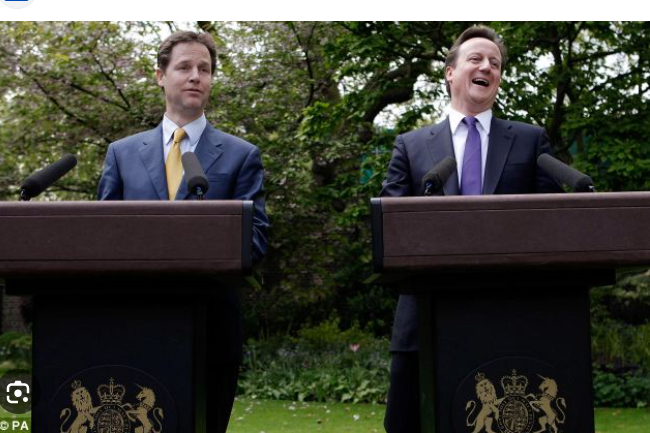
I was sad when Gordon Brown made his valedictory speech. Perhaps I cried; I can’t remember.
Although I preferred David Miliband to his brother Ed, I rejoined Labour during the 2015 election campaign and it seemed to me that Ed was going to make it. This was because I didn’t know anyone who admitted to voting Conservative. Like a spectator at the Grand National, I was saying ‘Come on Ed. COME ON ED!’ but Ed had fallen at the bacon sandwich and the Edstone, and Cameron romped home, so that was another bad night.
The Brexit referendum came and went, leaving disaster in its wake. Cameron resigned, striking me as oddly sympatique in his parting speech. I was sorry for him too, as he had experienced tragedy in his family life. By this time Jeremy Corbyn was in situ as Labour leader, which brought the horrors of antisemitism in my own party, combined with aggressive cult-like behaviour from the demographic known as Corbynists. I left the Labour Party, not precisely when Corbyn became leader, but when he was nominated to run for the leadership by a sufficient number of Labour MPs. I thought they were irresponsible and that, contrary to their expectation, he might win the leadership contest, which of course he did.
Theresa May was now Prime Minister and I quite liked her; felt as if I wanted to go for a drink with her. If my allegiance to Labour hadn’t come to a stop, I would probably have cast a colder eye on the second woman PM of the UK. Her 2017 General Election was a disaster. Expected to win, the Tories lost their majority. Expected to do badly, Corbyn did relatively well and became a Capraesque hero: the honest man who stands tall among the venal and the corrupt: hence the chants of ‘Oh Jeremy Corbyn’ at Glastonbury. But – although the Corbynists denied this furiously – he had a problem with Jews, which aroused a new kind of fear among British Jews, self included, while many on the left accused us of lying in order to protect Israel.
Boris Johnson was chosen to succeed Theresa May. ‘Get Brexit done.’ Was this a good thing or a bad thing? He was perhaps the most likely to beat Corbyn but his brexiteering and louche persona counted against him. Nevertheless, when the election came in 2019, I voted Conservative, as I had done in 2017. Not only could I not vote for Corbyn’s Labour, I wanted to use my vote to their detriment, as far as possible, and that was Tory, not LibDem.
When the exit poll predicted a big Tory majority, I sent up a prayer of thanksgiving. It is, as far as I recall, the only time that I prayed in response to an exit poll. And it was one of the few election nights during which I was happy as the results came in.
Then, last night, General Election 2024. Starmer had done so much to change Labour for the better that I resolved to vote for them again. Then I found that boundary changes meant that my Labour candidate was now Kate Osamor, to whom I did not like to give my vote for a few reasons, involving Holocaust Memorial Day and – a separate thing – something to do with baseball bats. I voted LibDem but I still wanted Labour to win and Keir Starmer to be PM, and so it happened.
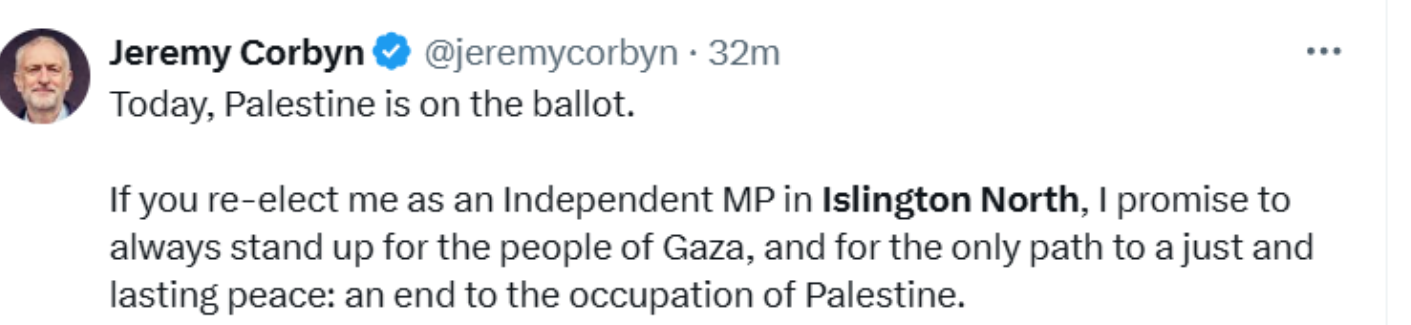
Was it a happy night? Not really. Reform under Nigel Farage was up and coming, often achieving second place in Labour voting constituencies, while Tories came third or lower. Candidates describing themselves as ‘standing for Gaza’ gained about four seats in constituencies described as having a high concentration of Muslim voters. Corbyn swept back into Islington North as an Independent, also for Gaza, this being his tweet on Election Day:
My hope is that Starmer will be a good and effective Prime Minister but I ask myself, ‘What is up with the UK?’ There is a loss of faith in the democratic process, a loss of civility in public life and a loss of safety on the streets. If Keir can go some way towards fixing this, I will vote Labour next time, if I live.
Your God, My God
Posted on: June 16, 2024
Polly was my cousin by marriage. Her mother had died while she was a teenager, likewise my cousin who was her bridegroom had lost his mother, and while still teenagers, they were married. I was a bridesmaid, obliged to wear a turquoise blue dress which was ruched from the neck to the knees, a bad choice for an overweight twelve year old. Within a few years, they had three children.
Later in their marriage, they engaged in rackety diversions: wife swapping parties. An ongoing accommodation with neighbours led to Polly and the husband next door going off together, leaving an abandoned husband and an abandoned wife.
Polly engaged in philanthropic works. She did not enjoy robust good health and seemed often to undergo medical procedures. She had a serious operation and, when I saw her afterwards at a family gathering, she told me that Jesus had appeared to her while she was under anaesthetic. Not without a sense of humour, she seemed aware of something absurd in this assertion and giggled when she reported that she had said to Jesus, ‘But I’m Jewish!’
‘It doesn’t matter,’ Jesus replied, which is the most memorable thing I ever heard Polly say, although in point of fact it may have been Jesus not Polly who said it.
Don’t sweat the small stuff. When God appears to you, it doesn’t matter if He’s wearing tefilin, a turban or a feathered fascinator.
I wasn’t immune myself to the attractions of Christianity but realized when I was about twenty-one, that the shortest route to God was the path of my forefathers, Abraham, Isaac and Jacob, and my grandfathers, Yitzhak and Yaakov. I studied my religion during my early married life, later in academia and still, haphazardly, to this day. After retirement, I attended classical Greek classes, hoping to be able to read the Septuagint and, as a bonus, The New Testament; however I quickly forgot how to recognize the aorist tense or decline τριηρης, meaning trireme.
When we reach our limits in theology and the languages of antiquity, we have to hope that God will appear to us in our time of need, like Jesus to Polly.
There is a war at the present time where God is invoked by opposing sides, one side calling Him Allah and the other, Hashem as well as many other names, such as Shaddai, Ha Makom, Ha Kadosh Baruch Hu (the Almighty, the Omnipresent, the Holy One, blessed be He). I believe ‘The All Merciful’ is one of the Islamic names for God, a beautiful concept. It is the depiction of God at His least merciful which drives this secular generation away from faith, to which enlightenment is considered the antidote.
The Abrahamic faiths, Judaism, Christianity and Islam, share the belief that there is one God. After Abraham’s funeral, Ishmael goes back to the house/tent of Isaac his half-brother. I imagine that they drink tea in china cups and eat sponge cake and, sitting with crossed legs, marvel at the memory of Abraham circumcising himself when he was ninety-nine years of age.
‘He had a steady hand right to the end,’ Isaac tells Ishmael, but Ishmael, who has not seen his father for many years, does not want Isaac to be the maven on all things Abraham. They have the same father and the same God but, if their perceptions of their father are at odds, how much more so, the perception of their God?
I am moved by a multi-season streamed drama, The Chosen, about the life of Jesus, directed by a Christian film-maker, Dallas Jenkins. The Jewishness of the Judean and Galilean environment is evident in every scene. There is a modern aspect to the expressions of emotion yet it adheres to the narrative of the gospels and conveys numinosity which Hollywood biblical epics so often aspired to and so rarely achieved.
Our lives are a mystery; we can hardly doubt this, but they are not all the same mystery. Each of us lives their own mystery, just as each of us dies our own death, alone. Slavoj Žižek joked (or simply said!) that the light at the end of the tunnel comes from another train on the track, heading straight towards us.
Notwithstanding, don’t we all hope to see the light?
The Vagaries of X Support
Posted on: May 23, 2024
‘This time it will be total extermination,’ a hubristic neonazi assures me on X, formerly known as Twitter.

Neonazis do not appear every day in my notifications and Triple C may even be a former acquaintance who used to send me pictures of gas cannisters and promises of another Shoah. I thought of the person as Colorado Adolf, due to his obsessive trolling of a Jewish politician in Colorado as well as his constant praise for Hitler who, as you see, appears in his profile picture.
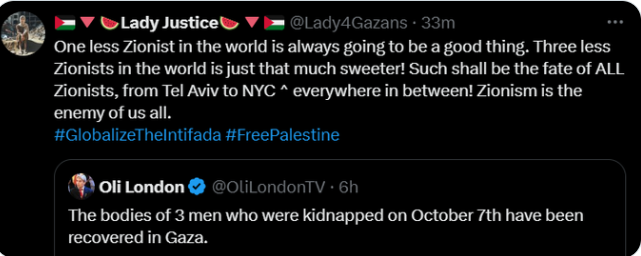
Triple C has one follower, currently tweeting as Lady4Gazans. ‘Lady Justice’ as she calls herself in all her numerous Twitter accounts remembers always to say ‘Zionists’ when she calls for global extermination.

It is her habit to refer to the young Israeli women killed or taken hostage on 7 October as ‘whores’ and she often expresses the thought that ‘they should have stayed in Poland.’
The neonazi Triple C has no difficulty in referring to Jews as Jews. His Hitler fandom spurs him to repeat the aims of the Third Reich, which he insists will soon be realized.
Both Triple C and Lady Justice utilize the ‘Happy merchant’ meme, a Streicherish cartoon of a cunning, grasping Jew, persecuting the world yet fearful of retribution. Lady Justice admires Hamas but not the Nazis who she believes were Jews, offering the word Ashkenazi in support of this theory. They are a match for each other, but her longevity as an X account is likely to exceed his by far. When she tweets anachronistically that Zionists killed Jesus, besides being behind various historical disasters, one can infer that she means Jews but the word Zionists serves to keep her in business, as far as X adjudicators are concerned. Both are adept at alternating their accounts, with minimal changes in the name.

Triple C combines letters and numerals, often simply adding a number to create a new account from one which has already been penalized. I believe this was one of his accounts last year – at least, Triple O shared Triple C’s hatred of Jared Polis, the Governor of Colorado.

I know I am not the only person to report these accounts. Anything gruesomely offensive will be reported many times over, but it takes dedication to get a response from X and sometimes there are mixed messages.

There is a skill to staying on X. One has to be careful, in quoting something outrageous, not to have it attributed to oneself, as hate speech. A friend who referred to a country which hanged gay people was banned from Twitter for many months as the words [they] ‘hang gay people’ was taken to be an instance of homophobic hate.
I have been many years now on Twitter/X and must assume that I am often reported, for the offence of Zionism. Nevertheless, I have not undergone a suspension, although I was advised early on by Twitter not to use profane language.
What can one hope for from X Support? A little, I hope, but not very much. X remains an information exchange and locus of mutual support for people of good will, which is what I supposed it would be when I joined Twitter in 2009. ‘People of good will’ begs the question – who are these people? The X wars are founded on disagreement over precisely this question.
I would have supposed that a person who tweets to me that I am going to be gassed would be an open and shut case for X discipline but it ain’t necessarily so.
One day after I wrote the above:
@CCc149139 has been suspended.
@CCc1491398 has deleted all their posts and replies and is kept in reserve.
@ZZz1397870 is active and abusive.
@Lady4Gazans continues in the same vein, always remembering to say Zionists rather than Jews, however anachronistically.

And tonight, when the bodies of three more hostages have been retrieved from Hamas tunnels, Lady Justice rejoices in their death and wishes it on all Zionists, everywhere. Her tweet gets reported by many but we are ghosted by X, as is so often the case.
Now, in the dog days of August, Lady Justice and Colorado Adolf make new accounts, after days or weeks of silence, and they both take care to tag me, so that I know they are back in town.

The strange tale of Benjamin Cohen
Posted on: April 14, 2024
A killer on the rampage in Sydney’s Bondi Westfield Shopping Mall murdered six people yesterday, and succumbed to the gunshot of a policewoman who fired from close range. This was naturally headline news in the UK, resulting in prompt speculation about the killer, whose name was withheld by the Australian authorities. There was some blurred footage of a thin, dark haired man walking swiftly through the mall, as well as an image of his lifeless body.
The Australian police said they did not believe the attack was terror related, but there was speculation on social media and from some, a presumption that this was an instance of Islamist terror. While the killer had not been identified, this could not be known and later, when he was named as Joel Cauchi with a history of mental illness, it was shown to be false.
Before the killer was named, I saw that the column on an X/Twitter page which shows trending topics, displayed the trend ‘Benjamin Cohen’. I assumed this was a participant in one of the TV reality shows which I never watch, but which account for certain social media trends which, as far as I am concerned, are an undiscovered country. Through various chat groups, I soon saw that ‘The Jew Benjamin Cohen’ was also a significant trend and that a person of this name was being identified as the Bondi mall killer. I did not find any authoritative source for this and saw that a photo of a dark-haired young man, Ben Cohen of Sydney, was being used to assert identity with the man who turned out to be Joel Cauchi.
A baby had been stabbed in the mall and afterwards received surgery and I saw this kind of tweet proliferating on X.

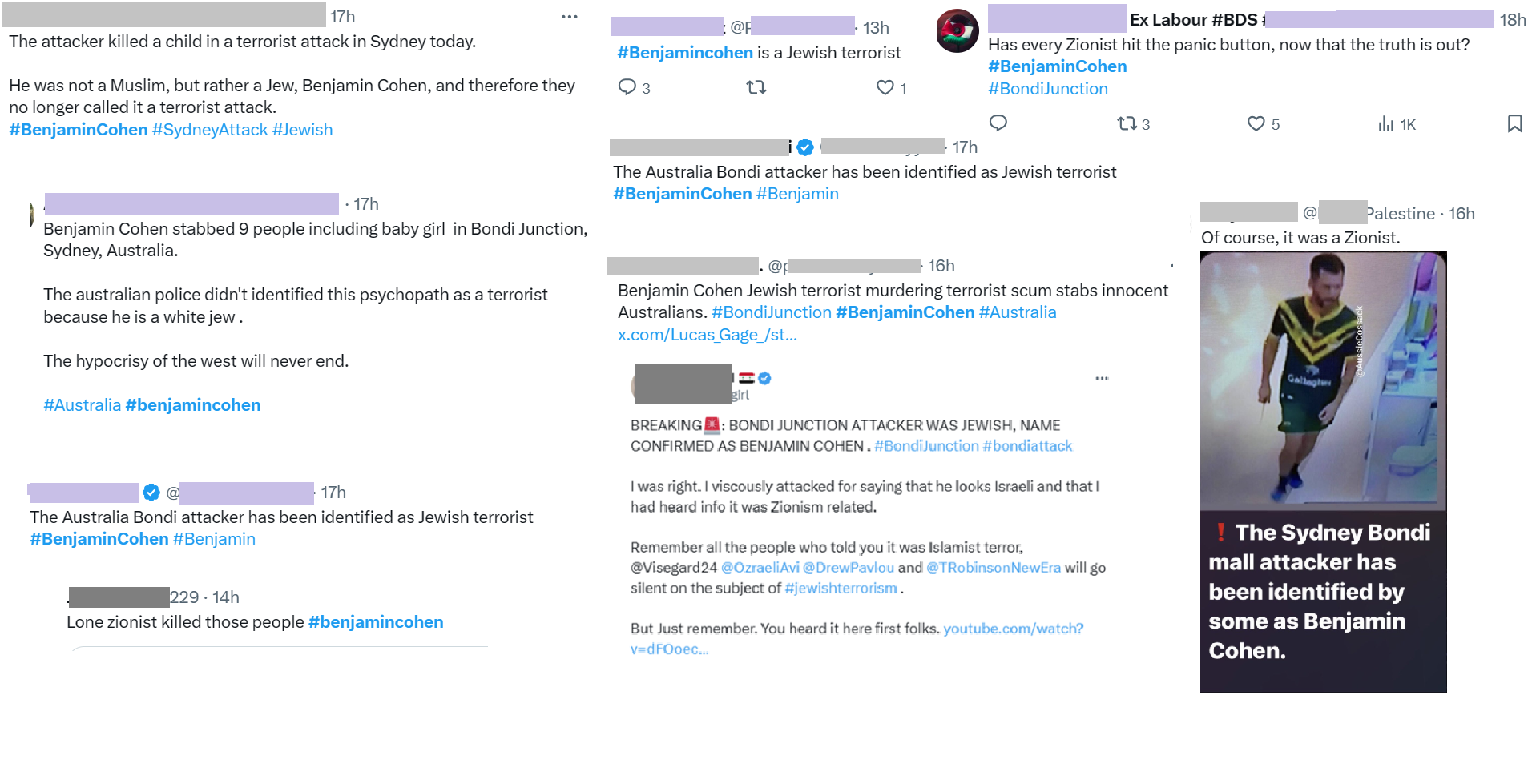
I saw that the identification of the man as Benjamin Cohen was being promoted by anti Israel or anti Jewish activist accounts and thought it was likely to be false but could not know for sure. Why did I care? Answer: the rumour was already being used to abuse Jewish people in general.
Late last night, Australian police divulged the name of the deceased attacker, Joel Cauchi. So far and, as far as I know, this has not been used to libel any particular demographic. The real Benjamin Cohen has made a brief and dignified video in which he regrets the rumour mongering of social media.
Those who yesterday were asserting his guilt have today moved on to Iran’s overnight attacks on Israel, with drones and missiles, 99% of which were intercepted before they could do harm. They are celebrating this as a great victory for Iran.
Social media puts a girdle round about the earth in forty minutes. It has the speed of a ballistic missile, powered remotely and intended to cause maximum damage. Intercepting a lie or an error is not always possible, but one must try.
Second Person Singular
Posted on: April 3, 2024
Sometimes – often, to be honest – if I’m appalled by some garishly antisemitic tweet which grabs my attention, I make a screen shot and post it, as an exposé of the platform X, and the author of the offensive tweet. I make the screen shot rather than repost as I know I’m likely to block them before long or they will block me and I want to keep the evidence.
It then happens sometimes – often, if I’m honest – that a sympathetic person replies along the lines broadly speaking of ‘Your tweet is antisemitic. You are disgusting.’ I look twice, to see if their words are addressed to me and, seeing that they are meant for the tweet’s author, I point out that the word ‘You’ seems to refer to myself, the actual offender being absent. I understand their meaning but if someone tells me ‘You are disgusting,’ I feel as if they mean me, or as if a third party will think they are speaking to me.
This is when the second person singular is misdirected, as if GPS had found a street with a similar name but in the wrong county.
In English the second person plural, ‘Ye,’ is archaic and we neither tutoyer nor vousvoyer. When someone tells me ‘You are a genocidal maniac. You have killed 30,000 innocent people, most of them children,’ do they mean you singular, that I personally and alone have done the deed, or you plural, that all Jews/some Jews/ all Zionists/ some Zionists are the perpetrators? Yesterday an imaginative lady insisted that I have suborned King Charles and the UK government with my ‘filthy blood money’. How many Waterstones booksellers, retired, have the wherewithal to bribe a King? Not I, certainly.
A well known actor tweeted to a well known Jewish actor, demanding that she give some answer regarding the awful killing of seven aid workers in Gaza. There was, I am pleased to say, a backlash from many who thought that Tracy Ann in the UK should not be answerable to Samantha for IDF errors in Gaza. But we know how it goes: we are all expected to answer, unless we slip under the barrier like John Glazer or, restaurant critic Jay Rayner, to show we are not part of that you plural on which the ‘anti Zionists’ fix their sights.
In the Hebrew bible, the author[s] of the Psalms use the first person singular, ‘I’ rather than ‘We’, the latter being more common in liturgy unless the liturgy is taken from the psalms. ‘Why hast thou forsaken me?’ asks David in Psalm 22, famously repeated, in Aramaic, by Jesus on the cross. In congregational prayer, the kehilah prays as one, the quorum of ten persons ensuring that we are engaged in communal worship and yet, in the Shema, the central prayer of all services, the imperative second person singular is used. Hebrew, like French has you singular and plural: ‘Thou shalt love the Lord thy God with all thy heart and with all thy soul and with all thy might.’
The King James Version deployed ‘Ye’ and ‘Thou’ to translate Hebrew atem and atah which is an advantage of the Authorized Version over subsequent translations. It does make a difference.
When the social media trolls tell me ‘You killed children’ (and, believe me, they do), do they mean ye or thou?
I will not say ‘Not I,’ because I will not concede that ‘We’ are guilty of the charges they like to confront us/me with. These accusations come to anyone overtly Jewish on social media or in the public eye, unless they slip under the barrier, exchanging we for ‘they’ and joining in the anathemas.
If you belong to a community, you get accused as a community and you answer on behalf of the community. Likewise, you are created as a community, for example at Sinai:
אַתֶּ֨ם נִצָּבִ֤ים הַיּוֹם֙ כֻּלְּכֶ֔ם לִפְנֵ֖י יְהֹוָ֣ה אֱלֹהֵיכֶ֑ם רָאשֵׁיכֶ֣ם שִׁבְטֵיכֶ֗ם זִקְנֵיכֶם֙ וְשֹׁ֣טְרֵיכֶ֔ם כֹּ֖ל אִ֥ישׁ יִשְׂרָאֵֽל׃
You stand this day, all of you, before your God יהוה —your tribal heads, your elders, and your officials, every householder in Israel.
Deuteronomy 29:9Rabbi Tanhuma said ‘You are pledges, one for another,’ which is a bit like John Donne’s ‘No man is an island.’ The paradox is that each one of us really is an island and, at the same time, each one of us is at Sinai, or in the ghetto or in the increasingly edgy and hostile streets and campuses of the United Kingdom.
׃
Living with a bad press
Posted on: March 30, 2024
When I watch BBC news, which I watch more than any other channel, I know that compassionate people all over the UK are absorbing images of suffering from Gaza and hearing about the children, women, doctors and journalists who seem to be paying the price of war. The viewers are told of imminent starvation, due to Israel withholding humanitarian aid. As I follow COGAT, the Coordinator of Government Activities in the Territories, I have reason to believe that Israel is not withholding aid but that the presence of Hamas and UN agencies delay or impede the distribution of goods. I know that this is not generally believed, the reason being that a country which is said to be starving people, primarily children, women, doctors and journalists, is not likely to be believed when it denies the proposition already in circulation.
The findings of the BBC, Amnesty, the UN and their special rapporteur on the Palestinian territories are cited time and again by progressives and classically conservative antisemites alike to apostrophize diaspora Jews, bound up with concern for Israel’s survival, for our families sheltering from the endless rockets, thoughts of the hostages and whether they are still alive and the need to prevail over Hamas and the Islamic Palestinian Jihad. How can we explain this to the social media belligerents, who post photos of dead children, often holding me personally responsible which, to be fair, is because I generally voice support for Israel and defence against the usual calumnies.
I understand that they believe they are witnessing – via BBC, Sky, CNN and the Guardian – barbaric violence against a defenceless people and they are irritated to be called antisemites, which they strenuously deny. And they wonder if all that persecution of Jews over the centuries, which some of them studied for Key Stage 4 History, was not after all for some good reason. When Roald Dahl said that Hitler did not ‘pick on Jews for no reason’ he was not quite such an outlier as one would hope. The number 109 is attached to so much social media that one recognizes it on sight, like a swastika or the lightening flash of the British fascists. What is 109? They say we were expelled from 109 countries and that, if a child were expelled from so many schools, one would have to suppose that there was something wrong with the child’s behaviour. As shown in the link below, the number 109 is ‘white supremacist numeric shorthand ‘ but white supremacism reaches beyond its own borders and is deployed in the argument against Israel and Zionism by some in the middle ground, who find themselves charged with antisemitism.
https://www.adl.org/resources/hate-symbol/109110
When those driven by righteous fury against Israel are called antisemites, they point out that anti Zionism is not antisemitism; that certain men wearing streimels and peyot are photographed burning Israeli flags; that Palestinians are actually semites while – and here they are stepping inadvertently into the antisemitic quicksand – while Jews are a Turkic people called Khazars. QED, they are not antisemites, and at this point they may remember to post the meme of Shulamit Aloni saying ‘It’s a trick, we always use it.’ If you google these words alone, Shulamit Aloni will come up, mentioned in many articles which set forth our trickiness, our use of the ‘victim card’ to carry out acts of barbarity.
Unfortunately, it has been impossible for me to be unacquainted with the myriad clichés of online antisemitism. If you are on social media, they will come to you.
How does one explain to an apparently well-meaning and conscientious person who makes use of all these clichés, memes and biased agencies that they have strayed on to the road more travelled, where jackboots marched and, before them, the Black Hundreds, the Holy Inquisition, the Crusaders and more. Their alibi is the so called ‘Jewish bloc’ on the Palestinian demos, who hate Zionism even more than they do.
Some insist that we can never explain sufficiently and that this is why Israel has to be strong, against the day when the nations of the world decide, like Roald Dahl, that if we are outliers, outsiders indeed, there must be some good reason.
I know the forms of antisemitism but not the answers to it. I also believe that Israel has to be strong against the day when the nations rise up against us. I believe that some people will risk everything to stand with us, to prevent that happening, but I also know that adversaries are being created day by day. The market for biased reporting is self-perpetuating: the viewers expect it now and may not accept anything else.
The Grave Dancers
Posted on: February 26, 2024
Baron Jacob Rothschild has died, baruch Dayan ha emet. He was eighty-seven, a financier and patron of the arts, not a person whose career I followed closely or someone whose circles – royalty, millionaires and business magnates – would ever intersect with mine.
I’m very sorry to say that his death has trended on X, formerly Twitter, with an explosion of gloating, ill will and cursing. Something similar happened when Henry Kissinger died a short time ago but Kissinger was a statesman with responsibilities on the world stage. I have even seen one of the gloaters remark that these are good times as first Kissinger and now Baron Rothschild has died.
If I were not familiar with the mythology surrounding the Rothschild family on social media, I would not understand the reaction but for a long time I observed the fandom of Jeremy Corbyn on social media, and I saw how ‘the Rothschilds’ were for many of them a malevolent folkloric entity, as represented in the theories of David Icke, who is dissimilar from Mr Corbyn but with an overlap in the support base.
Two years ago and at intervals since then, there was an outbreak of malice on Twitter concerning the untimely death of my friend Dr Pete Newbon, an activist against antisemitism and author and lecturer on the subject of Romanticism in English Literature. It was very painful to see strangers on a social media platform rejoicing in the suffering of this young man and taunting his friends with their graphic imaginings.
Well, I did not know Baron Rothschild so the abuse won’t hit me so hard but it is certainly disagreeable and even alarming.
Here are some examples from Corbynist groups on Facebook of the demonization of the Rothschild family. Needless to say, these are just comments I saw and caught in screen shots, a fraction of those which were posted.
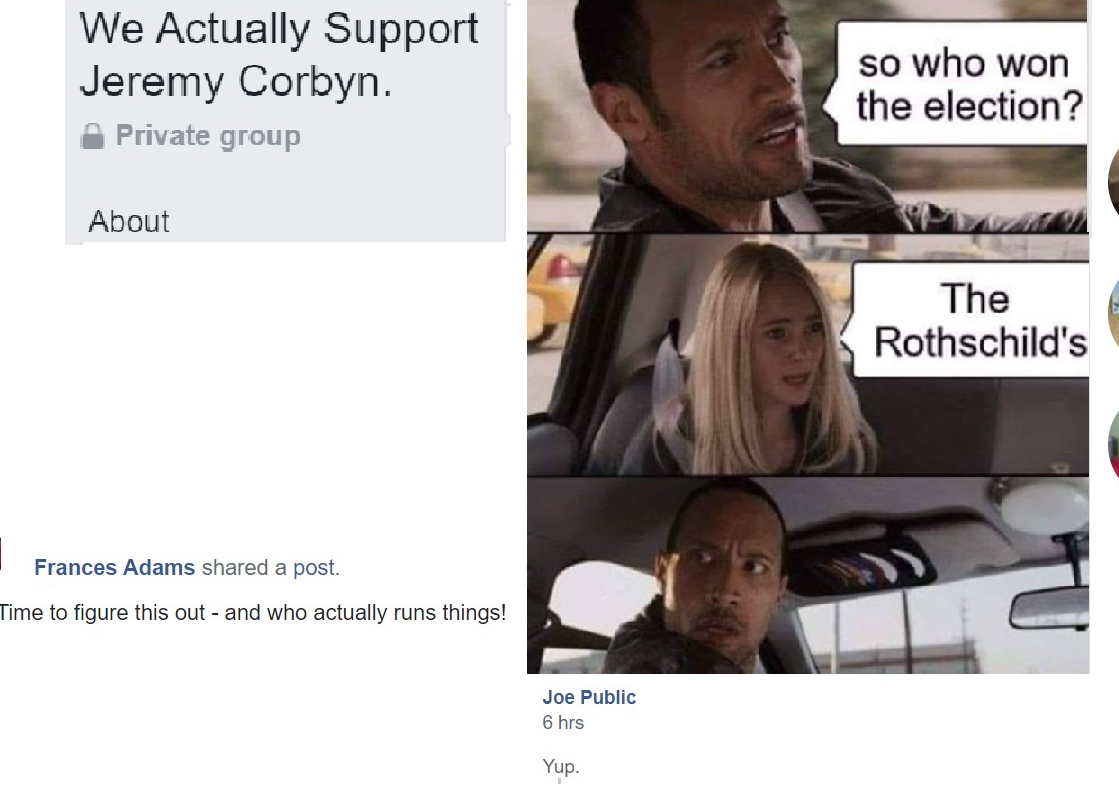
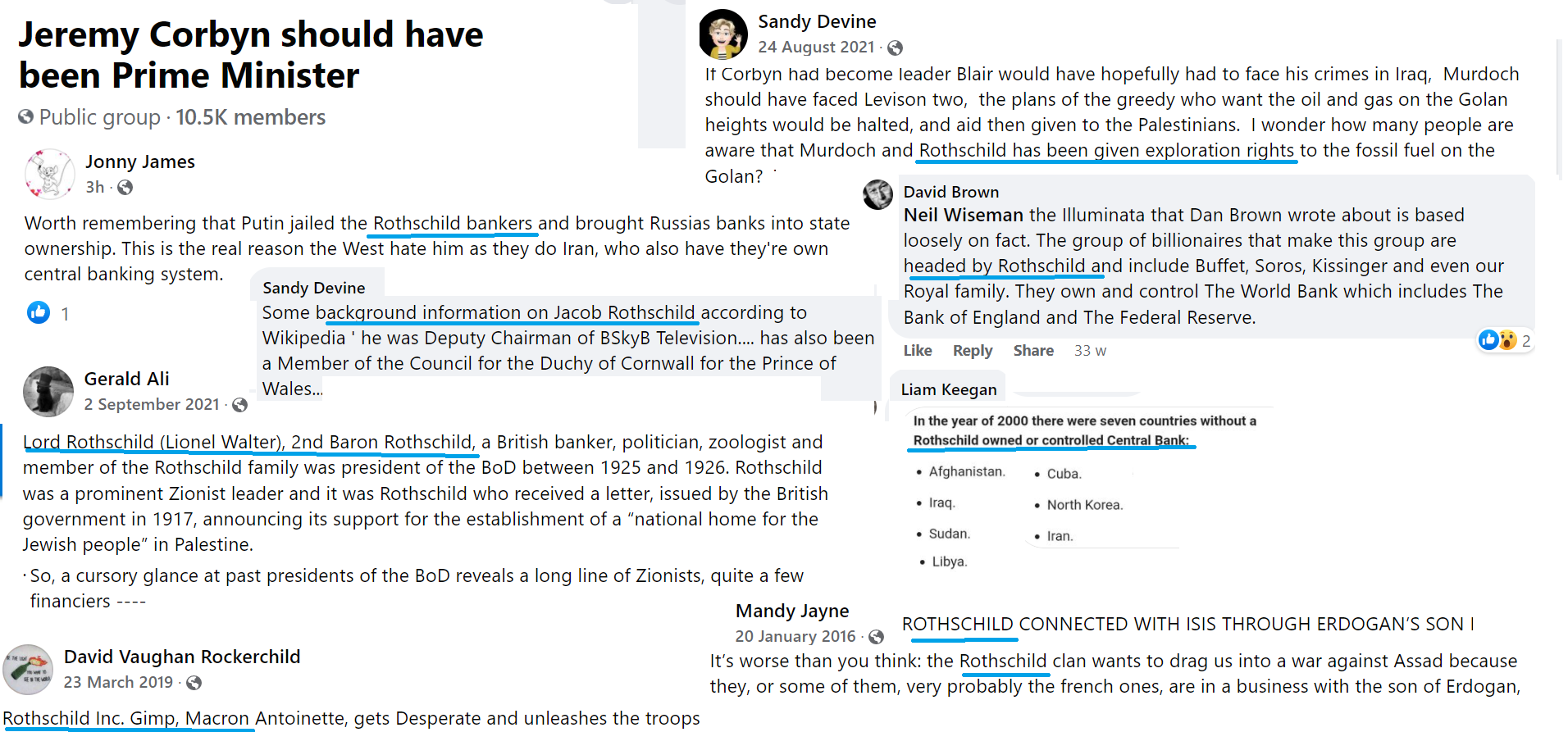


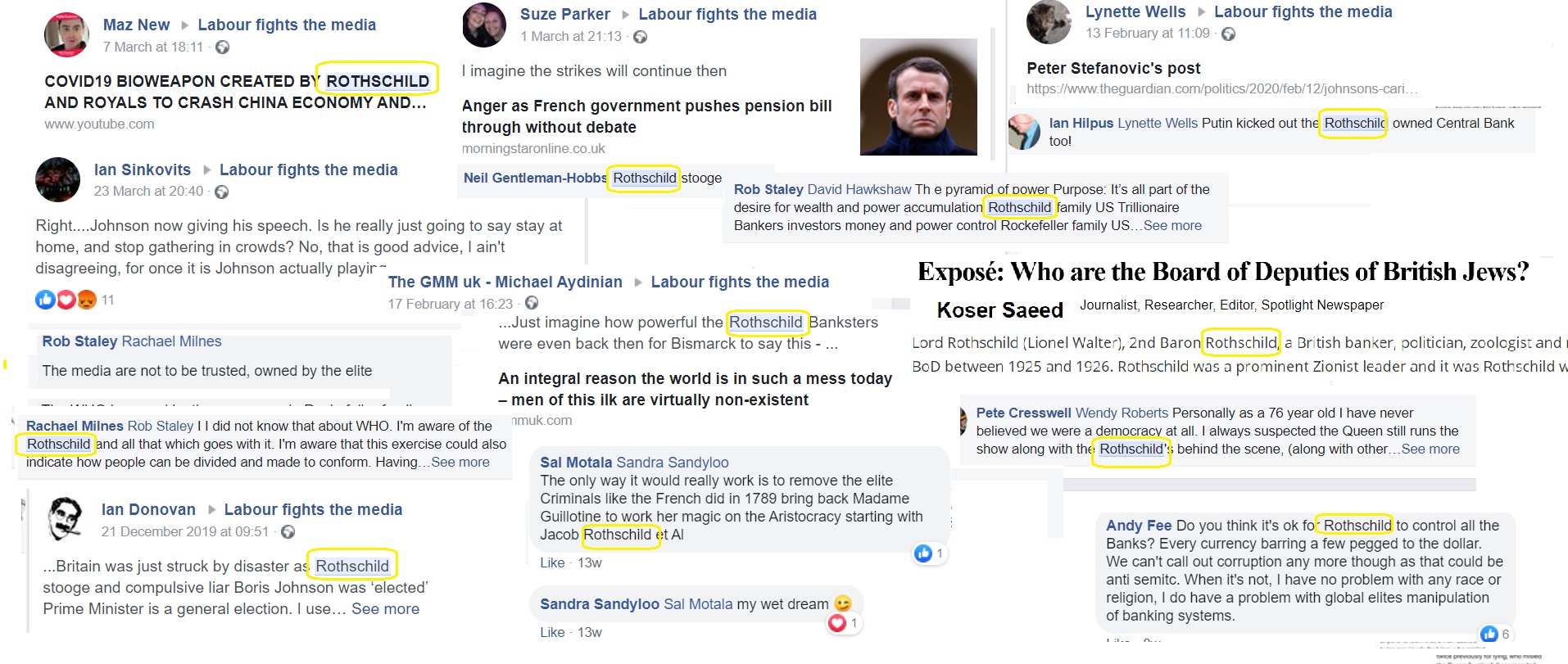


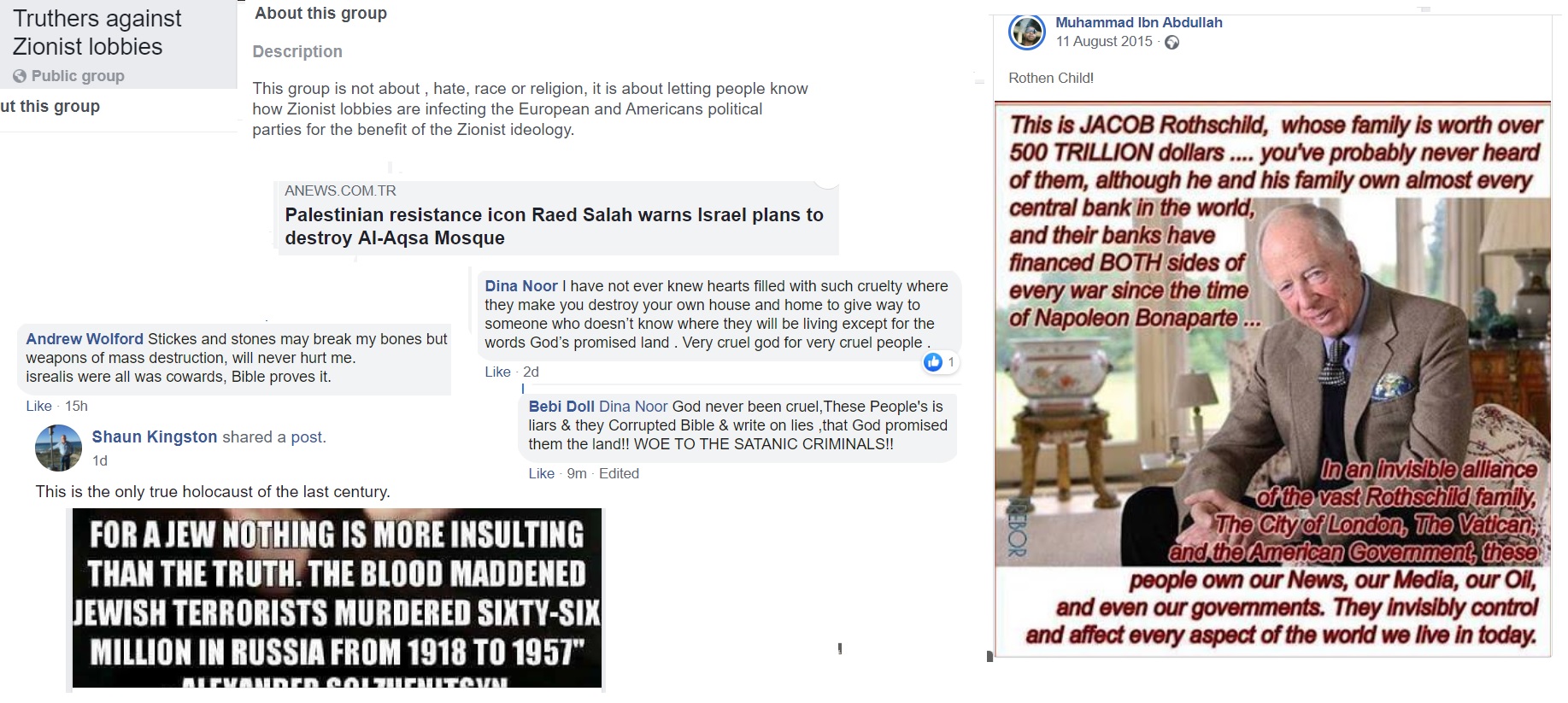
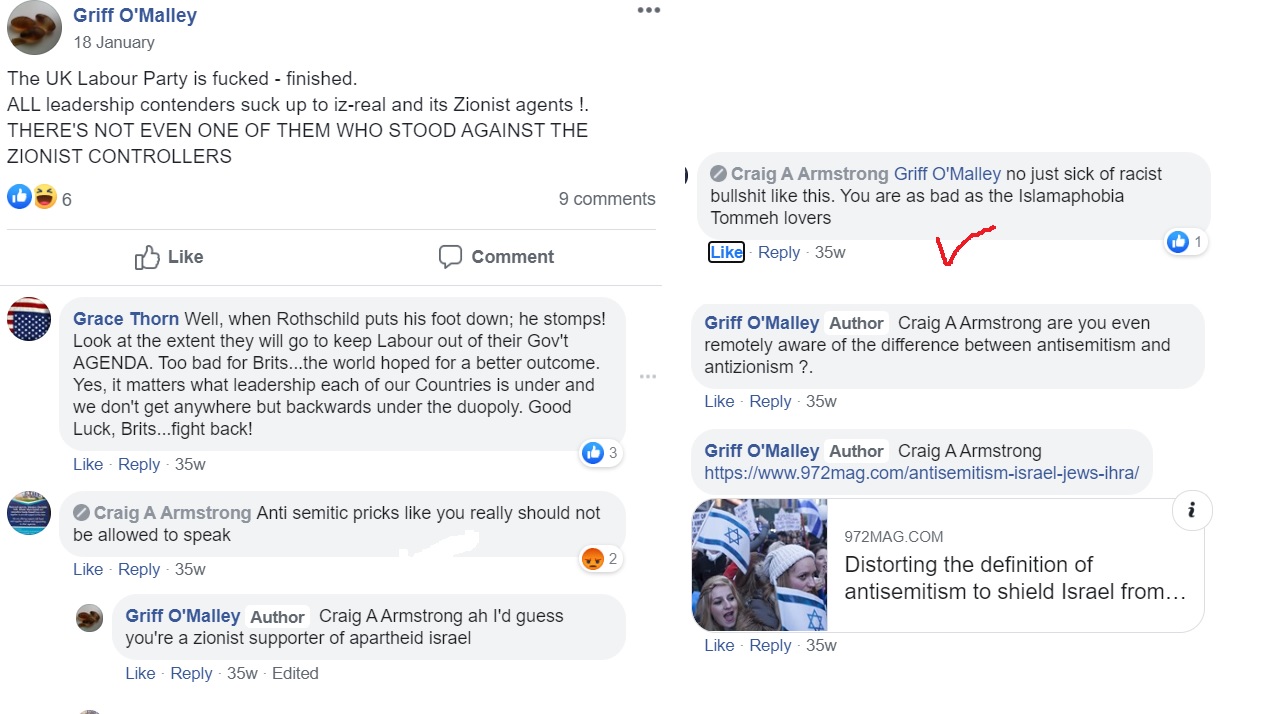


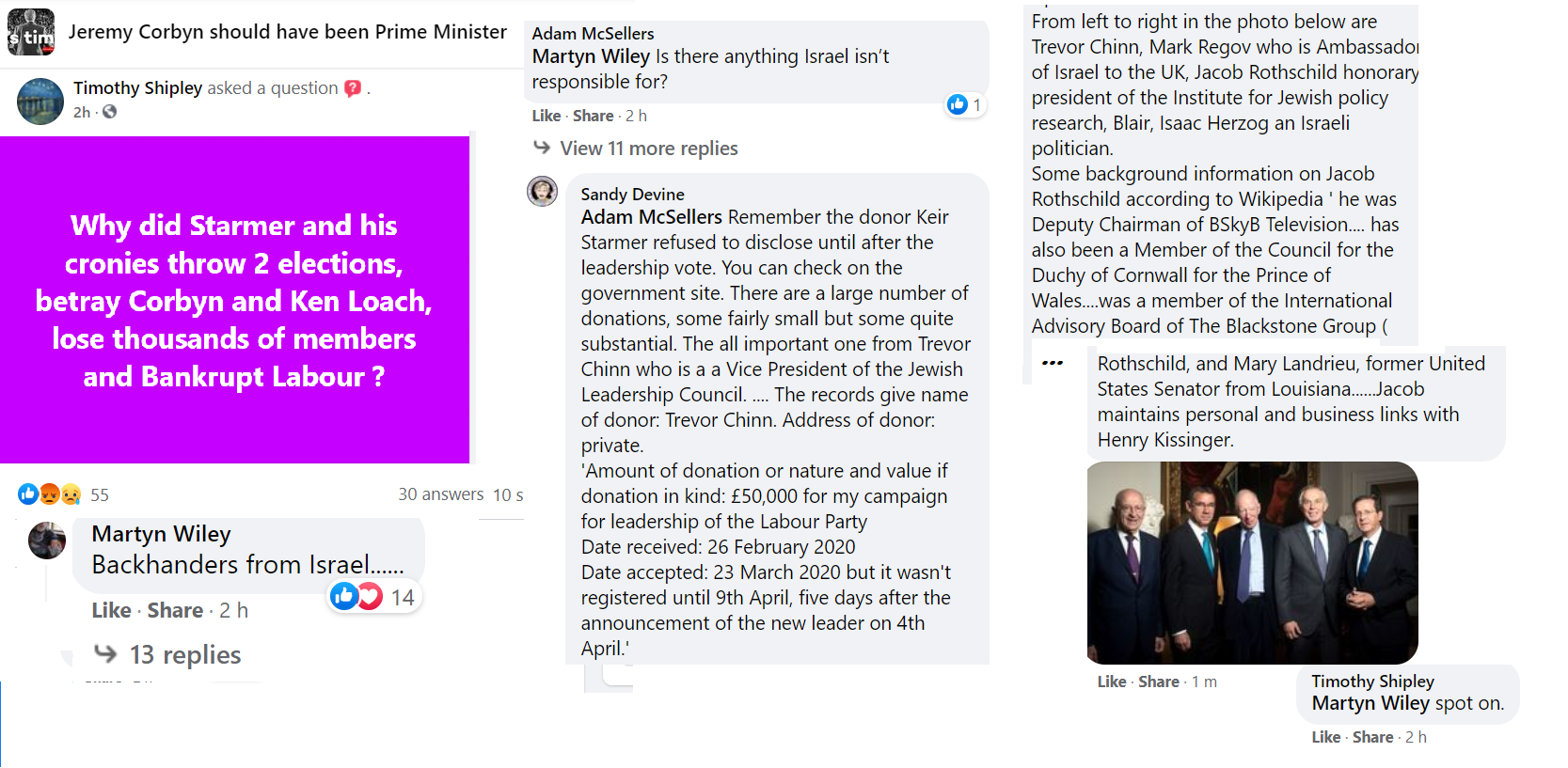

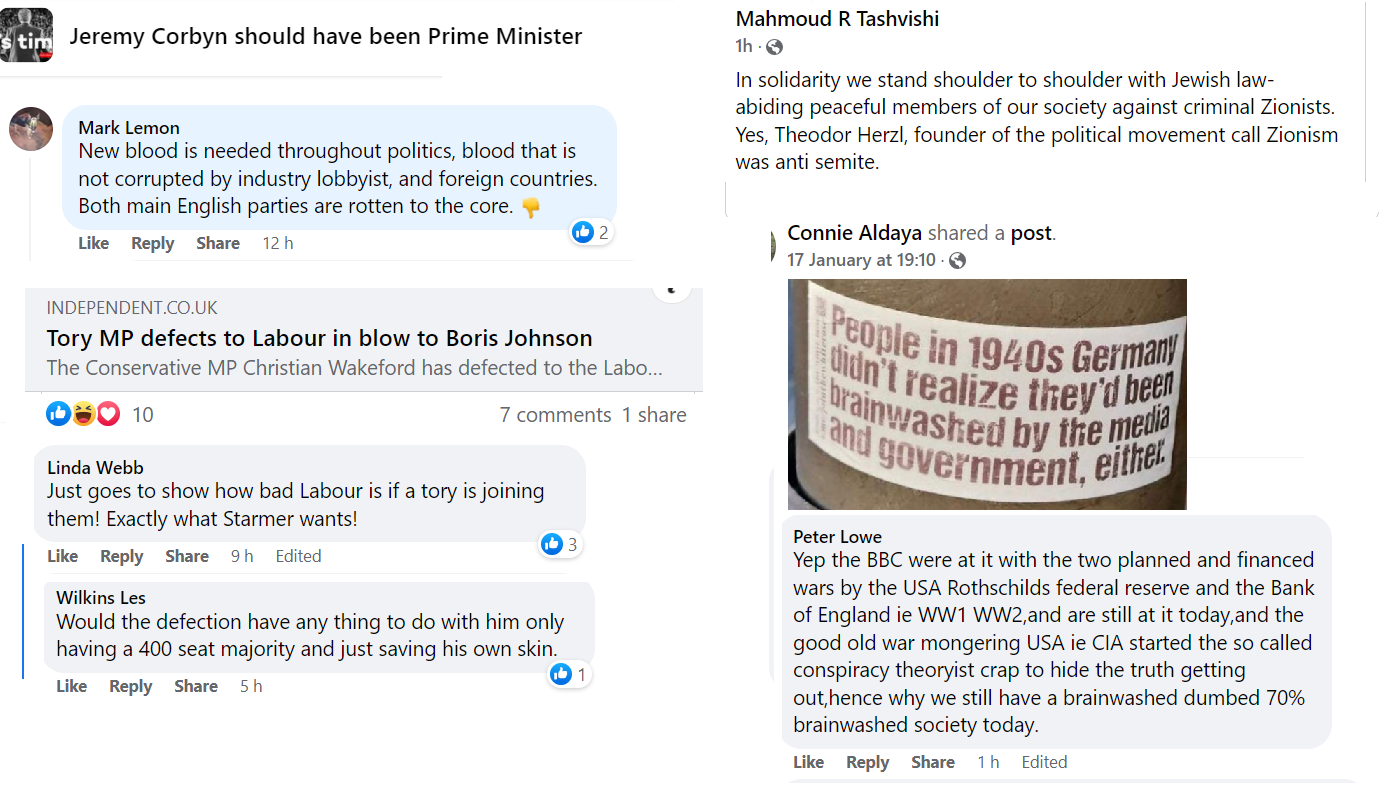
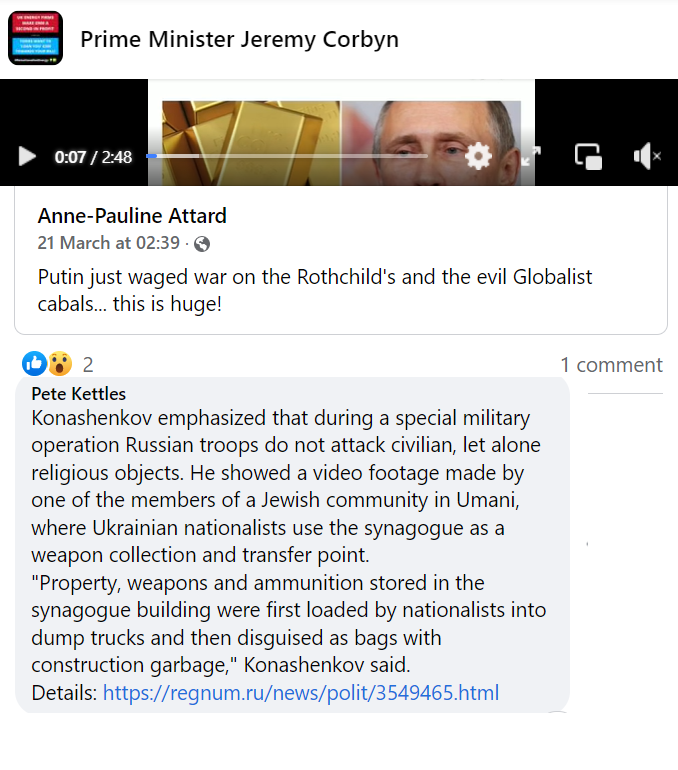

All the above screen shots are from Facebook groups. As for Twitter, such is the glee expressed over the death of Jacob Rothschild, you would think he was Attila the Hun, or worse. This shows a very small sample of messages I personally received, since yesterday, when there were many more.

Kindling the Sabbath Lights
Posted on: February 10, 2024
This is going to be a short post, the story shown in screen shots. The point is that so called anti Zionists reply abusively to a Shabbat greeting on Twitter. We know that Jewish institutions and organizations and individuals in the UK and the USA are coming under attack, and that an overt connection with Israel is not necessary for a person or building to be vulnerable in the present climate.
On Twitter, the proliferation of anti Jewish hate is alarming.
On Friday evening, I posted this tweet which I didn’t think was controversial or provocative.
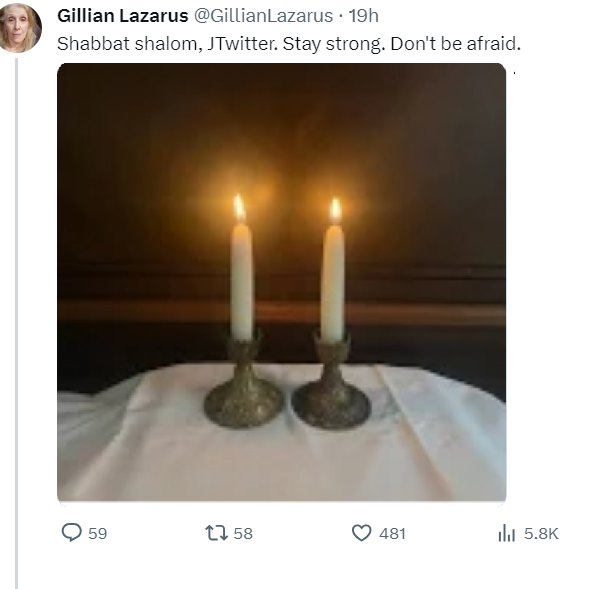
There were hundreds of appropriate and civil replies but the hostile replies were numerous, that evening and the next morning.

The following morning, I found these in my notifications.

Those who think the rise in antisemitism is about Israel are not entirely wrong. Any Jew hater who wants a voice knows to put Israel on the charge sheet, along with world domination, wealth, capitalism and communism. Nick Griffin, who was leader of the racist BNP, declares his support for Palestine in his Twitter account.
Antisemites are opportunists, accusing us of whatever is hateful in society: whether deicide, child murder, treason, apartheid or genocide but I hope you will believe me when I tell you that while ‘genocidal maniac’, ‘baby killer’ and ‘apartheid lover’ are almost daily terms of abuse fired at me and other Jews on social media, I have also been accused of personally killing Jesus – as have we all.
I did wonder if there would have been less hostility if I’d said ‘Good shabbes’ rather than the Hebrew ‘Shabbat shalom’. Were the words ‘Don’t be afraid’ a provocation to those who want us to be afraid?
Am I afraid? Not yet.
And still they come, replying to the same ‘Shabbat shalom’…
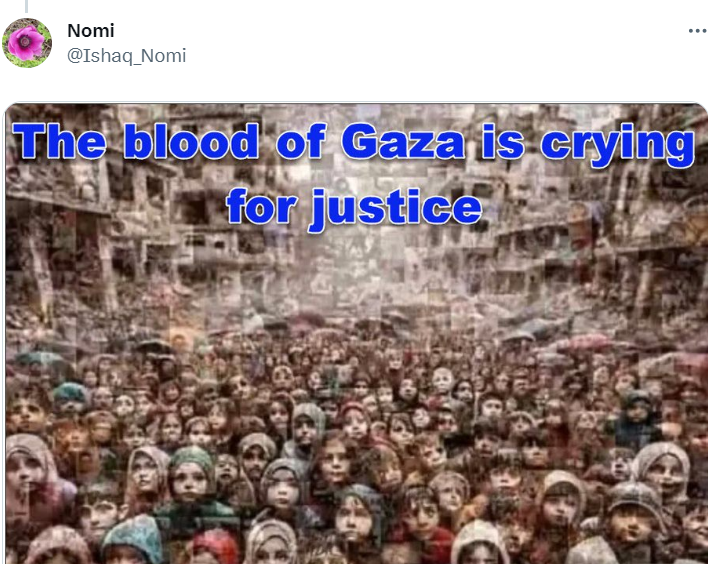

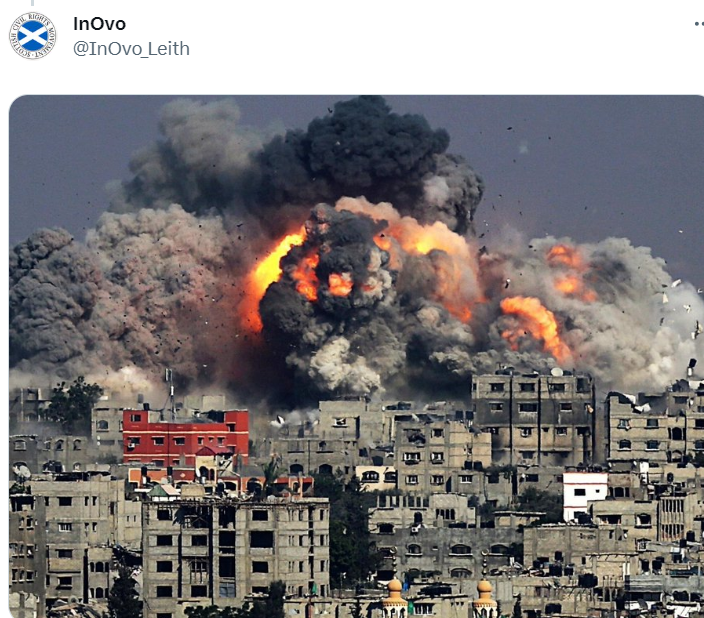
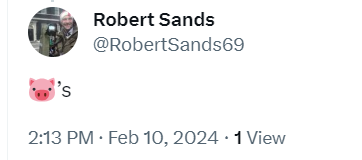
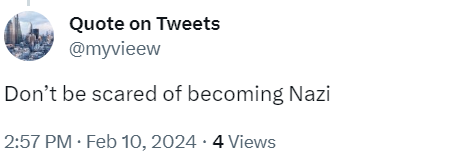
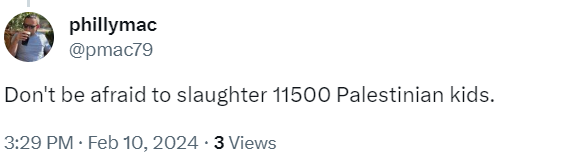

Imagine if I’d said something controversial?
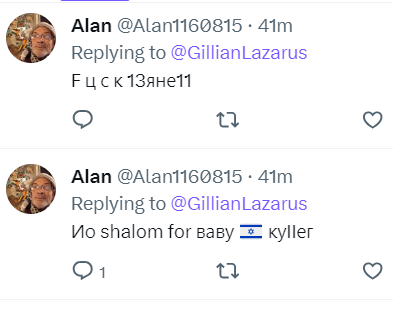
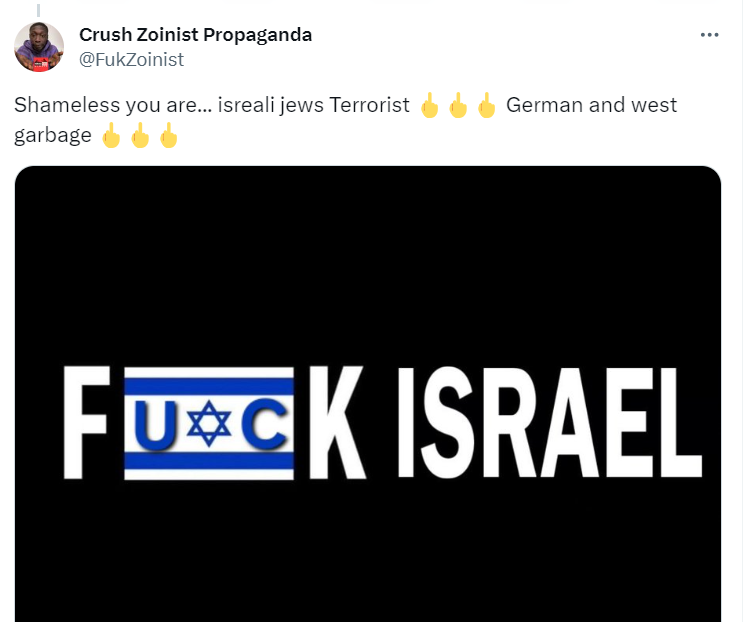
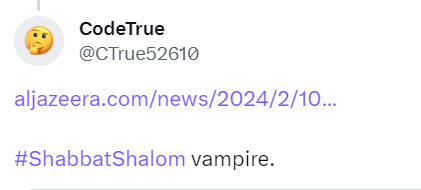


All these abusive replies were in my notifications, the day after I posted ‘Shabbat shalom’. There will be more but I think I need not add them. These are difficult times, which I didn’t expect to see in my lifetime.
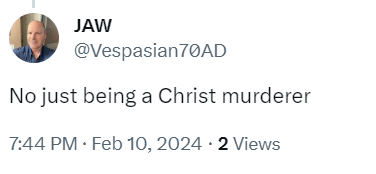
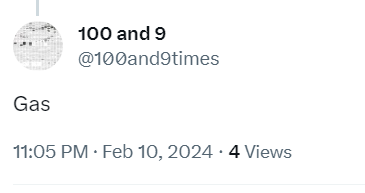

Like most people on Twitter/X, I follow some accounts of public persons , especially journalists, politicians, activists, academics and writers, if I tend to agree with them or if I can learn from them. I make a point of reading their tweets because it’s comforting to see sense and reason persist, even on a platform like X. It never happens that I agree with the entire output of any one of them. It strikes me that some are to my left and some are to my right, but the habit of viewing opinions as positioned latitudinally, left and right, is probably a simplification or a distortion.
Those to the left are outspoken in their opposition to the settlements on the West Bank and to Prime Minister Netanyahu. Those to the right have an enhanced sense of danger and are willing to restrict the movements of anyone posing a likely threat. For myself, I can see both cases.
I also see the pushback on social media against these celebrities or scholars who are committed unambiguously to the survival of Jews in the diaspora and, in most cases, to the survival of Israel. Remarkably, it comes in a one-size-fits-all formulation. All are called genocidal; all are called baby killers; all are called colonialists. Some of the individuals who receive such replies are uninterested – even notoriously so – in the State of Israel. It makes no difference. Stephen Fry was called a ‘genocidal thug’ by many after broadcasting about the rise of antisemitism, although he has in the past signed public letters critical of Israel and, as far as I’m aware, never those in solidarity.
There are variations in the accessories to the standard abuse. Fry’s homosexuality was invoked as a signifier of decadence. In the case of David Baddiel, it is always the Jason Lee impersonations. To Simon Schama, who is perhaps less familiar to authors of abusive tweets than Fry or Baddiel, they tend to post very generalized accusations of mendacity and ignorance. This was a reply I just received respecting my retweet of Simon Schama’s post:

In my own case, not in any way a distinguished or public person but nevertheless voluminously abused on Twitter, the accessory to ‘genocidal maniac’ is that I am old and, as my surname is Lazarus, a really angry adversary will tell me that I am already deceased. Perhaps each one imagines they are the first to have thought of it.
Moderate expressions of sympathy with Israel often produce the most intense ire. If the speaker is reactionary and unreasonable, their words can be used as an indictment against them and against all of us. That is how it is with Itamar Ben Gvir and Bezalel Smotrich. Any level-headed Zionist on social media is likely to be the recipient of memes invoking these government ministers’ most bigoted utterances. Is this to tell us that our moderation is a mask, cunningly concealing our genocidal intentions?
In London, the Saturday marches chant for intifada and revolution. Not for them the two state solution, yet they were quick to condemn Netanyahu when he said that the two state solution is not right now a viable aim. The cardboard placards displaying childlike writing and running paint often liken Israelis to Nazis, thereby laying the ground for the refusal of any kind of accommodation with a State of nine million citizens, while selecting offensive words and phrases calculated to arouse horror in their targets. My experiences on social media lead me to think that there is significant enjoyment for ‘anti Zionists’ in calling for the elimination of Israel from the river to the sea. They may be unsure of the geography but the radicalism fulfils the desire to dehumanize the other while basking in an uncomplicated sense of virtue. They are radicalized by the sound of their own voices, in union with others.
Sometimes in a Twitter dispute, the other person may make some small step towards consensus, if for example they condemn the Hamas atrocities of 7 October or if I, on my side, agree that the settlements in the West bank were an impediment to the late, lamented peace process. Such conversations can end with a degree of civility as everyone is grateful not to be on the receiving end of hate.
Nevertheless, incivility prevails in the majority of cases and, whether they stand to my left or my right, all overt Zionists on Twitter get to be called murderers and white supremacists, even when they are not remotely white, just as black MPs in the UK parliament are considered not black by some opponents coming from their left.
A video is posted of Howard Jacobson, wisely never a participant on Twitter. ‘I’m flabbergasted to see what’s out there now,’ says the author, referring to a resurgence in antisemitism beyond anything seen in the UK in our lifetimes and the victim blaming which followed in some quarters, after 7 October. He speaks mildly and reflectively yet with surprise, almost as if disappointed in our humane and enlightened century. And the reply comes back, in response to the video:

And this:
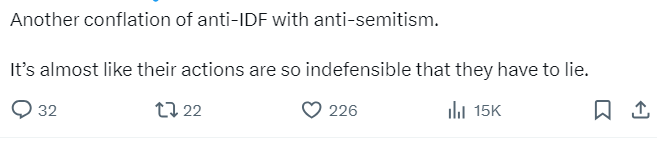
And these:



These were among the replies to Times Radio’s clip from a video of an interview with Howard Jacobson.
It shocks me that the hakhamim and hakhamot (wise men and women) of our age are spoken to thus. Did Jacobson even mention Israel? You might say he did, by referring to 7 October but, in point of fact, it makes no difference. The trolls are levellers who think they can bring down the wise with the less wise.
There is a reason why many of us dread Holocaust Memorial Day. If you post a picture of your lighted memorial candle on social media, someone will tell you that you are a baby killer and send you photos purporting to be from Gaza of the dead and injured, or they will tweet to you the meme of Shulamit Aloni saying ‘It [antisemitism] is a trick; we always use it.’ I imagine an endless line of Shulamit Alonis, like the descendants of Banquo, stretching out to the crack of doom.
It’s Only You
Posted on: January 16, 2024
One of the most striking features of the drama Mr Bates vs the Post Office, which reflected the real life experience of the victimised sub-postmasters, was the insistence from the Post Office helpline that each of them was alone in their predicament with the Horizon software. To be alone is not a sin or a crime, but it introduces fault if you are the only one not to make a system work.
The sense of being alone is psychologically oppressive and weakening but being outnumbered is something all minorities live with, by definition.
Television news showed a demo in Trafalgar Square marking a hundred days that Israeli hostages have been in Hamas captivity. Jewish News reported it thus: ‘Thousands flock to Trafalgar Square, united by one cry: Bring them home now.’ As with our march against antisemitism – which was larger, estimated at more than 100,000 – the atmosphere was sombre and although this was publicised as ‘Stand With Israel’, there was nothing martial about any aspect of the gathering. The Chief Rabbi quoted Psalm 121, ‘I lift up my eyes to the hills,’ and there were speeches from family members of the kidnapped.
On Twitter, photos of the rally taken from the air were mocked by anti Zionists who denied that thousands had gathered, indeed, insisted that there were fewer than a hundred. I was there and know this is nonsense but perhaps they know it too; they just like to insist that our numbers are so few that we are virtually alone.
The popularity of ‘Everyone hates you,’ or ‘So many countries expelled you,’ as a message sent to Jewish people on Twitter shows the impulse to isolate a notional enemy or a potential trouble maker. ‘The whole world knows…’ is also a popular phrase. Sometimes this progresses to ‘You’re lying and you know it,‘ which advances the view that the solitary interlocutor is not only alone but shares in the knowledge of ‘the whole world’, to their detriment. Isolate the person and then negate their reality.
I am often told by sympathetic, thoughtful and determined non Jewish allies that we Jews are not alone at all, and they will not allow us to be on our own. I believe it and am indescribably grateful for it.
It is nearly forty years since I saw Claude Lanzmann’s nine hour film Shoah, which comprised interviews with survivors as well as some nazi perpetrators, alongside footage of the camps. One interview stayed with me more than any other. A man spoke of hiding in the sewer when the ghetto was liquidated. Those hiding alongside him were somehow discovered; they were shot dead and he was on his own. He said, ‘I thought I was the last Jew in the world.’
I remember this when it seems that we are few and isolated; how I had imagined his loneliness, even while knowing with the hindsight of the late twentieth century that we would, as Eylon Levy put it in his speech in Trafalgar Square, rise from the ashes and live.
 Neviim Tovim, blogs by Gillian Gould Lazarus