Archive for the ‘Uncategorized’ Category
Before the Gates of Mercy Close
Posted on: October 11, 2019
Notes for discussion at the synagogue on the afternoon of Yom Kippur 5780
There are six prayer services on Yom Kippur: Kol Nidre when the sun has set, signifying the commencement of the day, the 10th Tishri, then, the next day, the morning service, additional service, afternoon service, memorial service and concluding service. The concluding prayers are called Neilah, beginning with a hymn El Nora Alilah of which the refrain, in the translation in our Reform prayer book (Days of Awe 1985, edited by Rabbi Jonathan Magonet and Rabbi Lionel Blue), is
Help us to forgiveness Before the gates of mercy close.
המצא לנו מהילה בשעת הנעילה
The author of the hymn was Moses Ibn Ezra, eleventh century, from Granada. He was related to and contemporary with Abraham Ibn Ezra, the biblical commentator.
Neilah means locking, so sha’at ha neilah is the hour of the locking or closing of the gates. The gates themselves are not mentioned in the hymn, but there may be a play on words, as sha’ah, hour or time, sounds somewhat like sha’ar, meaning gate.
The action of the long day seems to accelerate when we reach the hour of Yizkor, the memorial service, and as we begin the concluding service, Neilah, there is a sense of hurry, of using the remains of the day, to complete our business of repentance, teshuvah and achieving atonement, kappara, which, despite fervent prayer, is not in our own gift.
Lest there be any doubt that there is limited time now to complete the task, we have the Neilah hymn, which reminds us that the gates of mercy are closing.
The sense of urgency towards the end of the Day of Atonement may be compared to the times in life when we feel we have a short time in which to accomplish a great task.
It can happen on the night before an exam or an interview, or the days before a baby is due, or clearing a home prior to the completion of a sale.
It can happen towards the end of life, when there is something to be accomplished before the gates finally close.
It can happen towards the end of life of another person, a loved one, when there is not enough time to say or do all that we want to say or do.
Towards the end of Neilah, we often read a fable by Kafka, included in our machzor. Kafka’s parable is troubling as the doorkeeper finally closes the door in the supplicant’s face, telling him ‘No one but you could gain admittance through this door, since the door was intended only for you, and now I am going to shut it.’ Who is the man who locks the gate? A white-collar jobsworth from Prague or an angel guarding the gates of heaven? Does the closing of the gate signify the hour of death, or the limitations of mercy?
Those of us in the study group were all familiar with the Kafka story as it is in our prayer book, and some of us thought it was a depressing choice of text, so close to the concluding of Yom Kippur.
I had written a sequel which I read to the group and here it is.
*
His name was Shmulik, the man who waited outside the gate of the Law. He had come all the way from a small Bohemian town called Liberec where he taught at a cheder for little boys who called him Reb Shmulik. His wife had died and he had no children. He hoped to enter through the Gate of the Law and perhaps hear his wife’s voice again, as he had felt at a loss since she died. When he prayed, it was according to the rite but without kavanah.
When he first set eyes on the doorkeeper, he was intimidated by his height and breadth and by the massive furs, which made him appear even larger, but the doorkeeper, despite his unapproachable demeanour, was never threatening and Shmulik became less fearful as time went by.
‘Why is it,’ he asked, ‘that no one else has come seeking admittance?’
‘No one but you could gain admittance through this door,’ said the doorkeeper, ‘since this door was intended only for you. I am now going to shut it.’
Older, frailer and more depressed than when he had started out on the journey, Shmulik returned to Liberec. It was night time when he arrived at his cottage where he lit the one remaining candle and ate a beetroot which had somehow appeared on his work table. Besides teaching at cheder, his main work was making aprons.
At cheder the next day, Reb Shmulik was teaching the boys about the Days of Awe. He spoke about the shofar, and the ram caught in the thicket, in Genesis 22. One of the boys asked if Abraham was right to be willing to sacrifice Isaac. It was a difficult question, but Reb Shmulik said ‘Abraham Avinu was always right, and so it turned out in this case, because of the ram in the thicket.’
A boy called Elisha, not known for good behaviour, called out ‘Not if you were the ram, he wasn’t!’ and some of the boys laughed. Others looked troubled and Reb Shmulik said, ‘If you’re ever worried or troubled by something you learn in this class, you can come and talk to me about it. My door is always open.’
That night, when Shmulik arrived home, there was a bright light streaming from his door. Thinking that he must have left it open by mistake, he hastened his step, fearful that someone had stolen the sewing tools or cloth he used, for making aprons. Arriving at the open door, he saw with trepidation the huge, fur-clad figure of the doorkeeper but, on this evening, the doorkeeper looked milder than usual. With a courteous nod of his head, he held open the door and said, ‘The gates are never closed for ever.’ Then Shmulik went through the door, into the light.
Gillian Lazarus
*
During the morning service, at about midday, our rabbi had told us of the attack on the synagogue in Halle, and that there had been fatalities. That is all I knew until the evening, when Yom Kippur had ended. I read several reports and learned that two people were killed by the far right terrorist, one in the street and one in a kebab shop. I had thought that there must have been guards outside the synagogue, just as we have security guards but, according to news reports, it was the doors of the synagogue which thwarted the killer. Even using a grenade, he was not able to breach the doors. These were the gates of mercy and those who had entered them were saved.
Halle, Germany (CNN) A gunman pushed on the doors of a synagogue, fired several shots at a lock on the door, stuck an explosive in a door jam and lit it.
But he couldn’t get in.
The fact that the door held likely spared the lives of the dozens of people inside the synagogue on Yom Kippur, the holiest day in the Jewish calendar.
Celebrities and politicians who received more than their share of toxic trolling recently campaigned with the hashtag #DontFeedTheTrolls to deny the online aggressors the audience from whom they garner a significant number of followers.
If someone in the public eye, with a following on Twitter of some hundreds of thousands, replies to an insult from a person with a relatively scant following, the interlocutor will reap some benefit from the exposure, even if they themselves become a target of abuse.
Fully on board with #DontFeedTheTrolls, I realized that, as a private person with a not very large following, I don’t have the same duty to mute or block my own trolls. Furthermore, there can be no question that, in their minds, I am the troll while they are battling for truth.
Besides this, it is very hard to ignore an offensive tweet, as innocent bystanders might suppose it to have a grain of truth. If I have twenty friendly notifications on Twitter and one which is insulting, sarcastic or misleading, the latter appears to me as if highlighted in luminous yellow and my impulse is to reply to it without delay.
Sometimes such a message is worded to elicit a response, the phrase ‘I’ll wait,’ commonly appended; or ‘What about Netanyahu?’ as if one may not speak of antisemitism in Europe while the Likud holds sway in Israel.
When someone’s argument is irrational or ill-informed, when they abuse my friends or me, when they send me a picture of a dead child, said to be Palestinian, and tell me that I have agency in the tragedy, I am tempted to give some kind of answer.
Away from the gladiatorial arena of Twitter, I forget, mercifully, which troll is which: they come and they go; they block me or I block them, or they go out to walk their dog or I cook a soup or everyone goes to sleep. Sometimes they are ultra-persistent. I blocked one such person who was famously offensive and eventually suspended from Twitter. Some negative publicity came his way and I noticed that his tweets were attributed to a man of professional standing, who, when photos emerged, had a thoughtful, ascetic expression.
Today I see a person I’ve never noticed going full tilt against a prominent Jewish account, armed with the words ‘liars, fascists, cowards.’ The taunt of cowardice is an appeal for a response. ‘If you’re not afraid, why aren’t you willing to prolong this altercation?’
Sometimes, I try to think conciliatory thoughts about the numerous Twitter users who have called me a child-killer (their word for Zionist), an apartheid racist (their word for activist against antisemitism) or a troll (their word for the Other). I imagine it as a dry run for conflict resolution. How would Brexiteers and Remainers come to a truce if private citizens can’t tolerate each other?
Since writing the above, I have attended a Rosh Hashanah evening service where the rabbi’s sermon was on the subject of ‘lashon hara,’ roughly translated as evil speech, covering anything from gossip to slander. The rabbi referred to the malaise in Parliament of fiercely rancorous language, specifying Boris Johnson’s use of ‘humbug’ and spoke of the uninhibited abuse facilitated by social media, where participants, remote from the adversary on a keyboard far away, hone their skills in offensiveness.
As this is the season for repentance, I thought – as I often do – about my own trollery, when I’ve replied to a provocation with contempt, sarcasm or profane language.
On the second day of Rosh Hashanah, I heard a different rabbi preach about the prevalence of hateful language in public life, also referring to the Prime Minister’s use of ‘humbug’. He spoke of the importance of guarding our words, so as not to do harm with them and cited a midrash, where angry words are compared to arrows, rather than swords. A sword may be withdrawn, but once one releases the arrow, there is no returning it to the quiver. He referred to the meditative prayer at the end of the Amidah:
נצור לשוני מרע ושפתותי מגדבר מרמה
My God, keep my tongue from causing harm and my lips from telling lies.
(Psalm 34: 13)
The prayer continues with the words,
ולמקללי נפשי תדום ונפשי כעפר לכל תהיה
Let me be silent if people curse me, my soul as dust with all.
This is harder to say or mean, as it no longer comes easily to compare oneself to dust. What form would it take in transactional analysis? ‘I am dust, you are not dust’ or ‘We are all dust and that’s OK’? The translation in the Reform prayer book dispenses with the word dust altogether, preferring ‘…my soul still humble and at peace with all’. Either way, those who aim high must aim low and the last will be first.
The purpose of the #dontfeedthetrolls campaign is of course much more pragmatic: choosing to be silent is better than providing a megaphone for trolls to spread their messages. The religious point of view is closer to an idealized version of Twitter Support: hateful speech violates the standards.
I continue to interrogate myself over my own activities on Twitter. Does my sarcasm transgress into cruelty and does my anger border on mania? If the best response to personal abuse is silence, does the same apply in response to verbal aggression against friends, relations, allies, spiritual leaders, respected public figures, and so on, or against minorities which are distinct from my own minority?
Kohelet said עת לחשות ועת לדבר
There is a time to keep silent and a time to speak. (Ecclesiastes 3:7)
The Preacher does not tell us how to speak, simply pointing out that there is a right time and a wrong time, but the rules against lashon hara, hateful speech, are well-attested.
As for balderdash and poppycock, when they occur, or baloney, hooey, hokum, moonshine, piffle or humbug, there is a time for these words too although the more conciliatory option may be to say, like Marge in the film ‘Fargo,’ ‘I’m not sure that I agree with you a hundred per cent.’
After an hour or so wading through antisemitic posts on Facebook Labour forums, making screen shots and displaying them on Twitter, it feels as if all the lashon hara is coming from them. This is not to say that the same doesn’t exist on right-wing forums. It always did, hence my trust in the Left, in time gone by.
This week I heard two rabbis allude to a Talmudic dictum (Arakhin 15b): hateful speech harms the person spoken about, the person speaking and any third party who happens to overhear it. True. What does it do to our souls, when we see and hear and repeat the acrimony that abounds on social media?
In 1873 the halakhist Rabbi Yisrael Meir Kagan published a work called Chafetz Chaim (which was also his sobriquet), on the subject of hateful speech, gossip, slander, lashon hara. Is there ever a time when it is allowed?
Lashon hara was sometimes permitted, based on the precept – ‘Thou shalt not stand by the blood of thy neighbour’ (Leviticus 19:16) – in other words, one should intervene to prevent harm, but the Chafetz Chaim had some provisos. One should speak from experience not hearsay and reflect on one’s words. One should first approach the transgressor privately; one should not exaggerate, enjoy schadenfreude or bring disproportionate harm to the transgressor.
The name Chafetz Chaim means ‘He who delights in life’. It is a reference to Psalm 34:13-14
יג מִי-הָאִישׁ, הֶחָפֵץ חַיִּים; אֹהֵב יָמִים, לִרְאוֹת טוֹב.
יד נְצֹר לְשׁוֹנְךָ מֵרָע; וּשְׂפָתֶיךָ, מִדַּבֵּר מִרְמָה.Who is the person who delights in life and loves many days, that they may see good?
Keep your tongue from evil and your lips from speaking deceit.
What would the Chafetz Chaim have made of social media? I feel sure he would never have fed the trolls. It’s no way to delight in life.
Ducksant and Fucksant
Posted on: August 15, 2019
The toys I played with most, when I was a small child, were eight little plastic dogs, forerunners of the more elaborate Schleich animals which I buy for my grandchildren.
My mother bought the dogs in Woolworths, Mare Street. They were white and I referred to them collectively as The Little White Dogs. I asked my mother the names of the breeds and named the dogs accordingly: Poodle, Retriever, Boston Terrier, Hound, Spaniel, Scottish Terrier, Bulldog and Dachshund. I turned a shoe box into a stage with a proscenium arch, the way my sister showed me, and got the dogs to perform plays, especially pantomimes. The dogs were dressed in shiny coloured paper from Quality Street wrappers. I believed in high production values.
After a while I realized that I hadn’t attributed gender to the dogs but that Spaniel was female, because of her long ears and because she looked like Lady from Lady and the Tramp. Spaniel married Hound.
My mother bought me some more dogs. One was a Labrador but, disconcertingly, the other two were another poodle and another dachshund. I was ambivalent because I hadn’t factored twins into their narrative.
I said to my mother, regarding Poodle 2.0, ‘I’m going to call this one Phoodle.’
And regarding the second dachshund, which I pronounced and spelled ‘ducksant,’ I said ‘I’m going to call him Fucksant.’
My mother looked pained and said ‘Don’t call him that – it isn’t a nice word.’
‘Is it all right if I call him Tucksant?’I asked. My Mum said that was fine.
One day, I was playing with my cousin who was a year older than me. She said she knew a bad word but couldn’t tell me. However, she wrote the word on a piece of paper and handed it to my sister. Provoked at being excluded, I jumped up behind my sister, trying to see the paper, and caught sight of four letters, FUCK.
‘Oh! Fucksant!’ I breathed, aghast.
My Mum and my sister were shocked in turn and told me this was a word I must not say.
A fairly obedient child, I refrained from saying ‘Fucksant’ for some years but one day, when I asked my sister to tell me some swear words, she kindly explained that the F word wasn’t actually fucksant but the four letter monosyllable we all know so well.
When I was nine, ten and possibly eleven, I still played with the dogs, but by now gender was important. I had added to the collection a few little dogs made of china, and they were all girls to make up the numbers. They married some of the original white dogs and had families, also china. One of them was in fact a small Bambi but I pretended it was a dog.
Then they started to have careers. Some were film stars. In those days, there was no stop motion film making at home, but I drew pictures of my dogs in glamorous costumes.
The little white dogs had come a long way, from Woolworths to Hollywood. There were dramas in their lives and adventures, successes and awards.
It was comparable to a child’s transition from playing with baby dolls to a different kind of game, with teenage dolls.
I’ve always held the view that children want to play with toys for longer than adults realize. I used to think it must be terrible to be grown up and not play anymore.
Obviously child’s play today often involves computer games and creative play is assisted by a multiplicity of attractive apps. The small children in my life do this but they also move figures about and make them talk: Lego people, Playmobil people and Schleich animals too.
It seems important to me that children play with toys for as long as possible, even if the nature of the playing is determined by the child’s growing interest in adult life. It is hard to imagine the coupling of Barbie and Ken in the absence of pudenda, but better those two than something on a screen.
Besides, Barbie and Ken may be ill-equipped for coitus, but it doesn’t mean that they never fucksant.
Jewish Voice for Labour was created at the Labour Conference of 2017, a revamp of the group Free Speech on Israel, but with the new and specific purpose of defending Jeremy Corbyn against charges of antisemitism. Ken Loach and Len McCluskey attended the inaugural meeting and Ken Loach was subsequently on a sticky wicket, being interviewed on Politics Live. Jo Coburn challenged him about some leaflets including Holocaust revisionist content handed out at Conference and Loach replied ‘I think history is for us all to discuss.’
Although JVL was boosted by non Jewish supporters such as Loach and McCluskey as well as Jeremy Corbyn and Chris Williamson, their Jewish membership was not at all dissimilar from the Free Speech on Israel membership. Interviewed by the BBC when the channel wanted to give a two-sided account of Labour’s antisemitism issues, the JVL leadership were often on the box.
It soon became apparent that they would defend anyone accused of antisemitism, for example Jackie Walker, Pete Willsman and Chris Williamson. Later on they expressed solidarity with Professor David Miller when he was sacked by Bristol University and with many more: any Labour, Trade Union or student officer who was considered antisemitic became a protegé of JVL (Shaima Dallali is a recent case in point). They blamed Zionists but, mistakenly, they considered non-Zionists, such as Jon Lansman, the founder of Momentum, to be a Zionist, because he acknowledged the problem of antisemitism in Labour under Corbyn. This applied tenfold to David Baddiel, particularly in the wake of his book ‘Jews don’t Count’.
The spécialité de la maison of Jewish Voice for Labour is their claim to be Jewish while espousing the cause of anyone hostile to Israel and maligning anyone who speaks out against antisemitism on the Left. In common with all antisemites of the far right and far left, they deny being against Jews and make a convincing case compared to some. They hold Passover seders themed around freedom, as Passover seders generally are, but one has to suppose without the words, ‘Next year in Jerusalem.’ Indeed, it’s hard to imagine which parts of the Passover Haggadah they do find acceptable.
Vigorously, JVL opposed Labour’s adoption of the IHRA definition of antisemitism.
In March 2018, there was a demonstration in Parliament Square, called by Jewish community leaders, to protest against the antisemitic ethos which now pervaded the Labour Party.
JVL organized a counter-demonstration and were present on the fringes of the crowd, holding up placards to show their support for Jeremy Corbyn and their contempt for the protestors.
Antisemitism was hitting the headlines and, over a period of time Simon Schama, Simon Sebag-Montefiore, Howard Jacobson, former Chief Rabbi Jonathan Sacks z”l, Deborah Lipstadt, John Le Carré, John Mann, Luciana Berger, Ruth Smeeth, Margaret Hodge, Ian Austin, Louise Ellman, Tom Watson, Tracy Ann Oberman, Rachel Riley, Eddie Marsan, Rabbi Julia Neuberger, Maureen Lipman, Baroness Deech, Lord Triesman, Baron Mitchell and, just before the General election of 2019, Chief Rabbi Mirvis spoke out against the spectre haunting the Labour Party. All these and many more were denounced and reviled by Corbyn loyalists, JVL among them.
As soon as I began to watch the JVL group on Facebook, I saw that they had attracted many non-Jewish supporters whose names were familiar to me due to their activism on anti-Zionist social media.
This is the mission statement on JVL’s Facebook page.
Jewish Voice for Labour is a new organisation for members of the Party who believe that the Party must listen to a range of Jewish voices including those that support Palestinian rights and oppose witch hunts.
Who could object to listening to a range of Jewish voices? I have heard Jews arguing about Israel more times than I could possibly remember: about the borders, the wars, the way wars are prosecuted, about the Israeli right, the Israeli left and the religious parties which often hold sway when there is a hung parliament. I haven’t heard any of them express a wish for Israel to be destroyed. Given the broadest possible range of Jewish voices, that wish comes only from the outermost fringes.
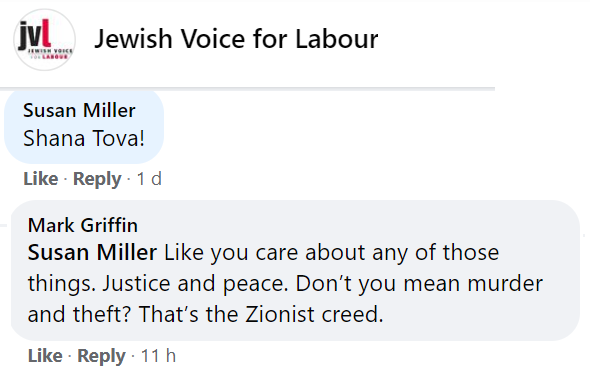
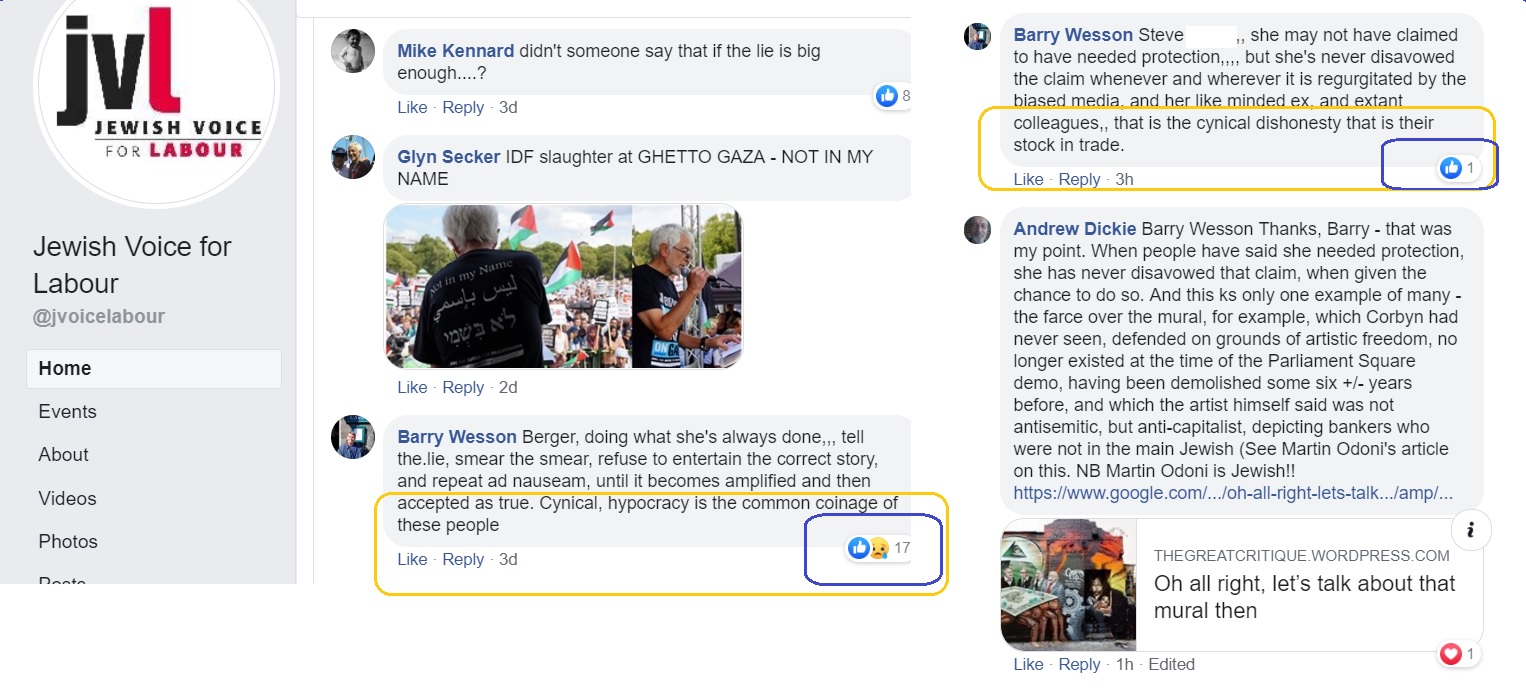
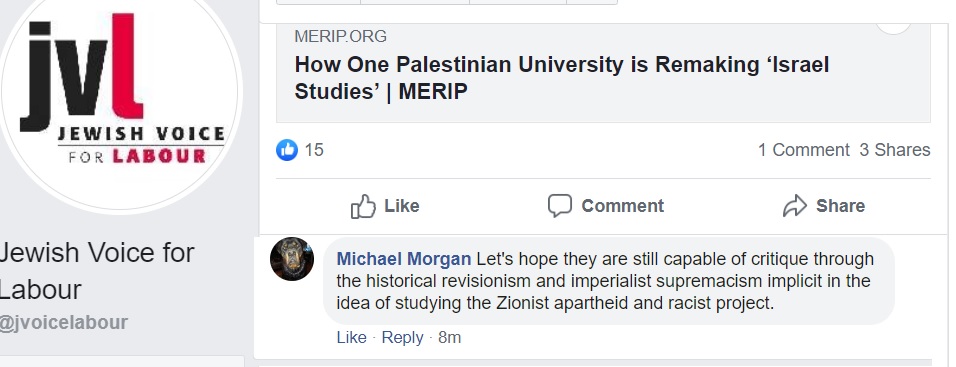
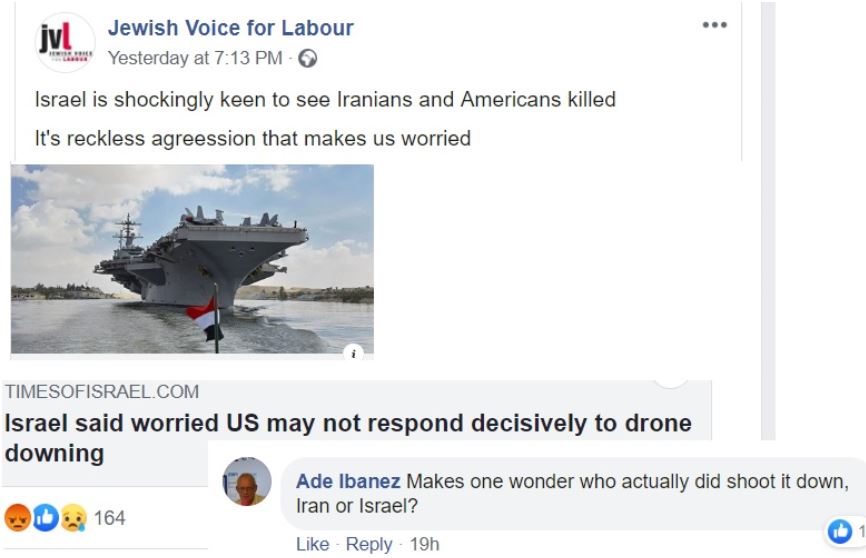
Most problematic is a dynamic in their Facebook group, now with fourteen thousand followers, where JVL will post, usually twice or three times a day, an article or information which puts Israel or opponents of antisemitism in a bad light. The replies are always somewhat more extreme than the original posts, often including old tropes and conspiracy theories about Jews. It is at such times that I would expect the JVL administrators to intervene; to explain that being anti Israel need not involve anti Jewish prejudice.
They never do.
It occurred to me that they might be overly relaxed in their administrative role, perhaps not bothering to read many of the comments on their page.
Apparently this is not the case. Friends of mine who argued back had their comments deleted. Others were blocked. If someone pushed back against an allegation against Israel by providing an article or information inconsistent with the JVL assertion, it would rarely, if ever, be left in situ. The admins are stringent in removing comments which are not explicitly anti Israel or which support their adversaries: Keir Starmer and his supporters, David Baddiel – a non-Zionist whom they call a Zionist – and the personnel of Jewish communal organizations.
Such is their range of Jewish voices.
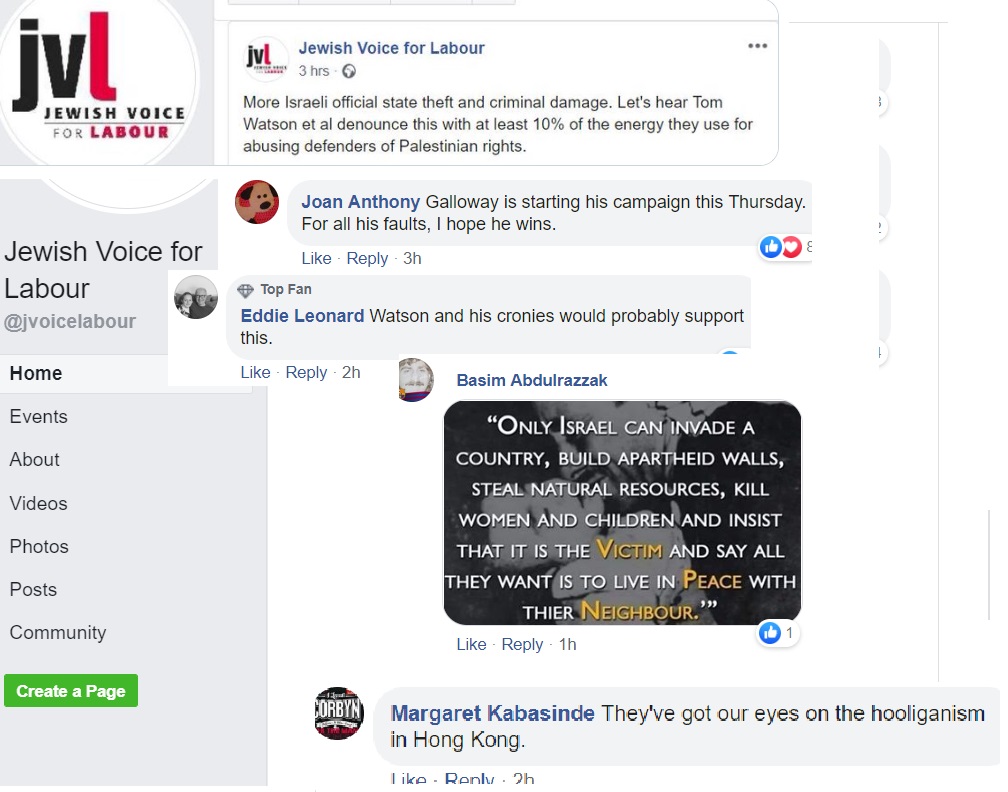
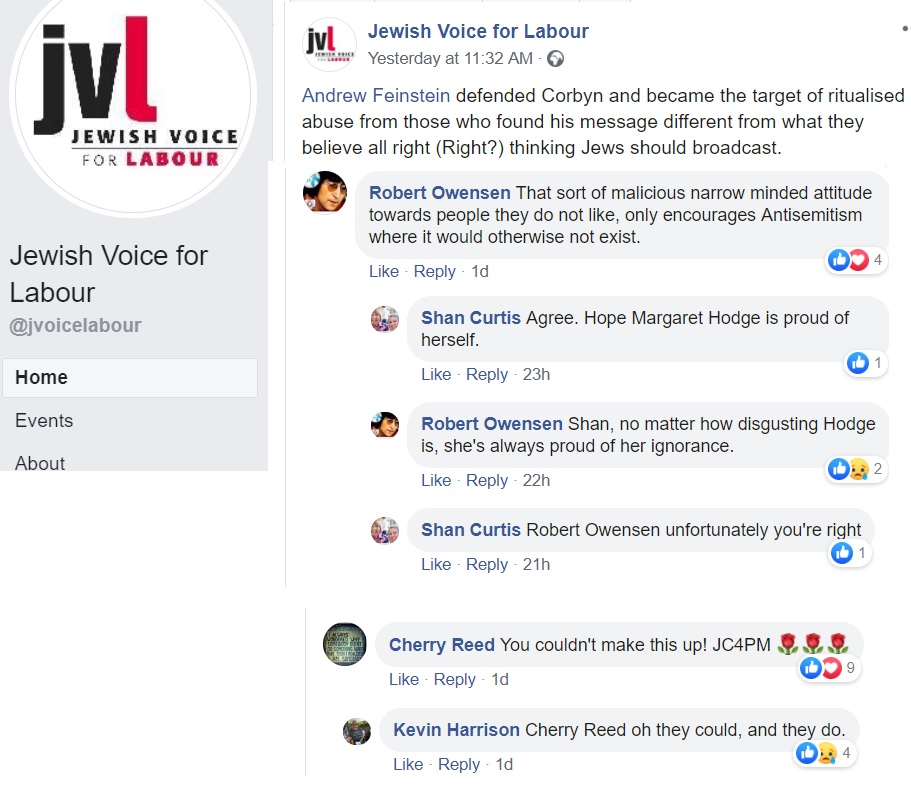
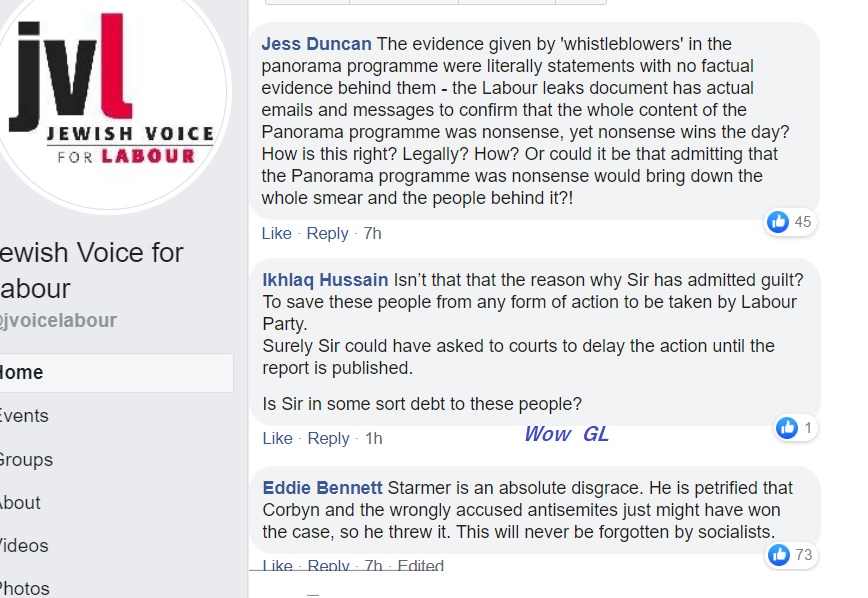
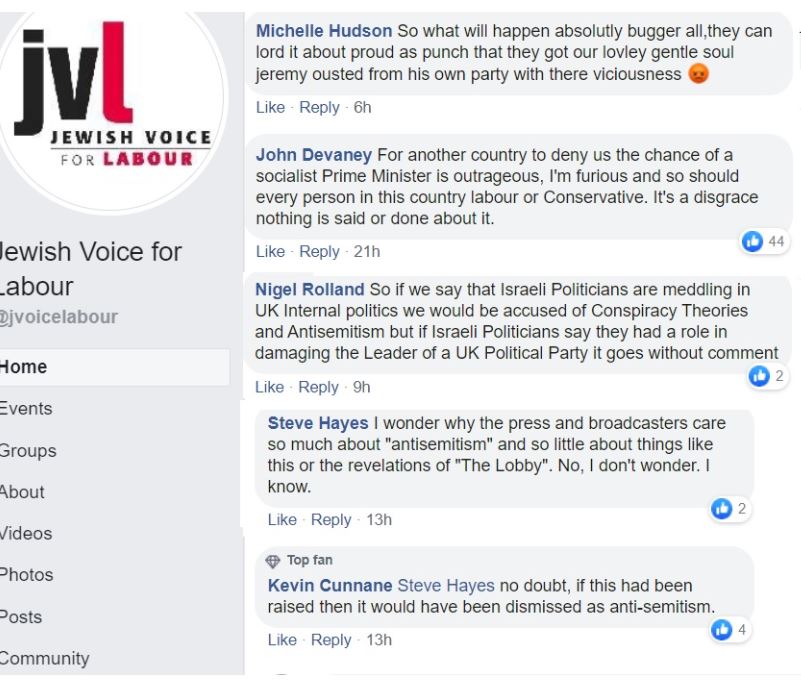
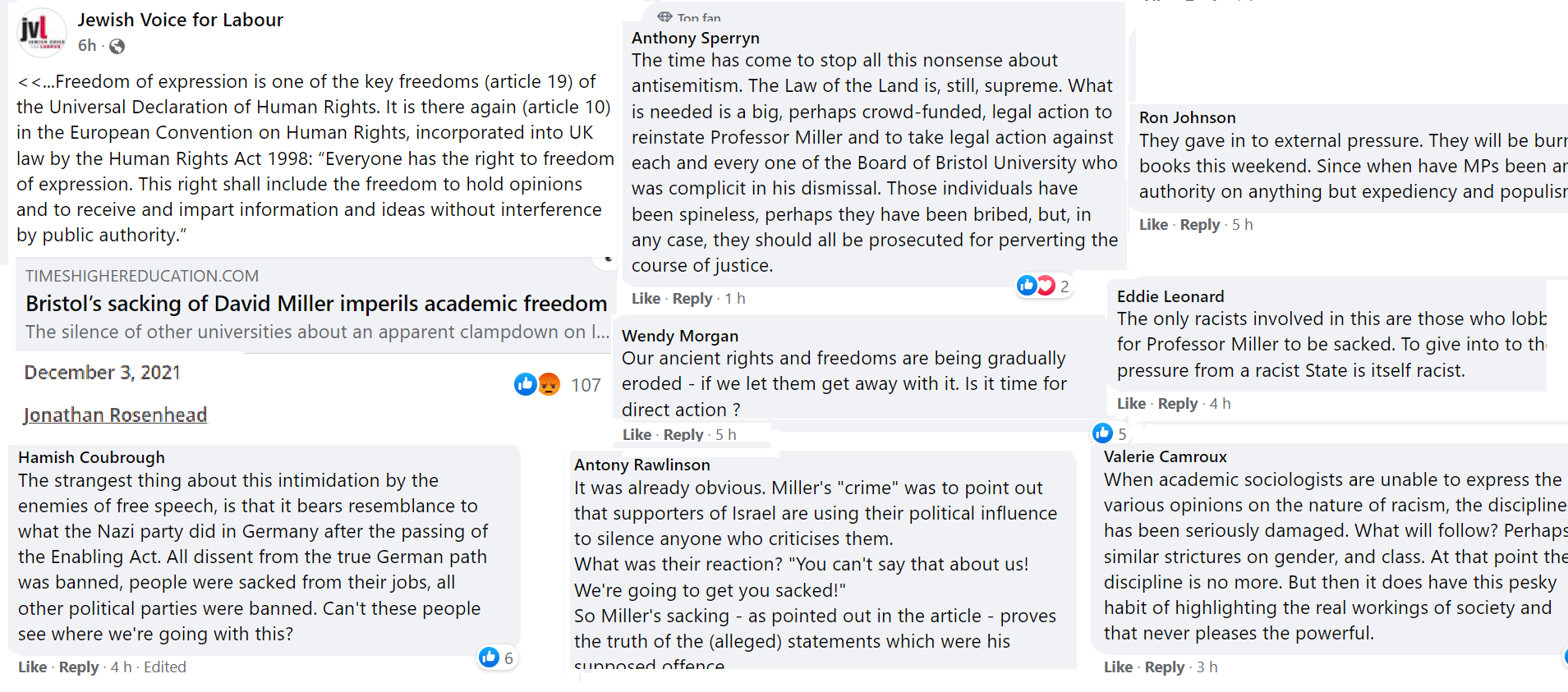
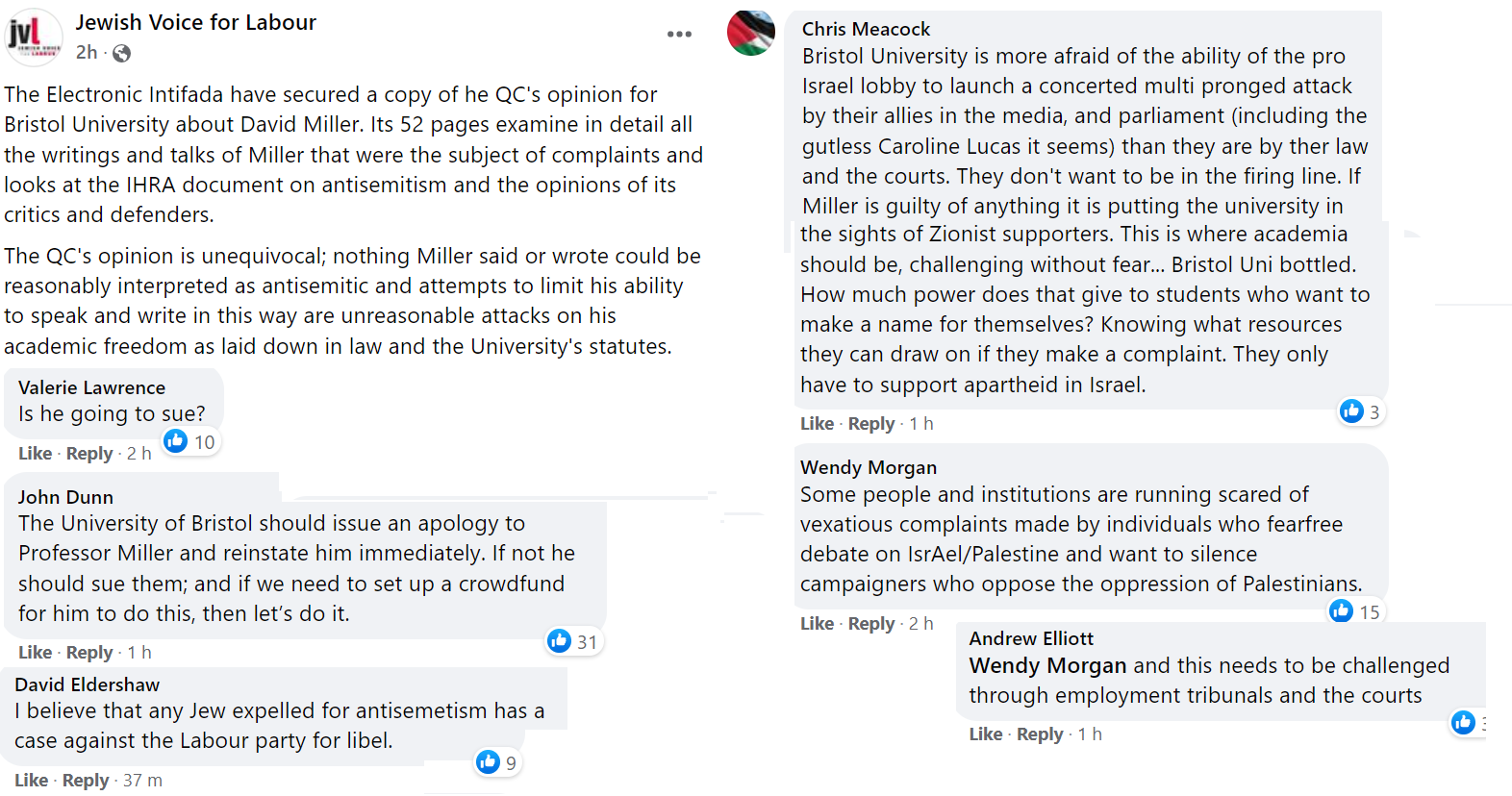
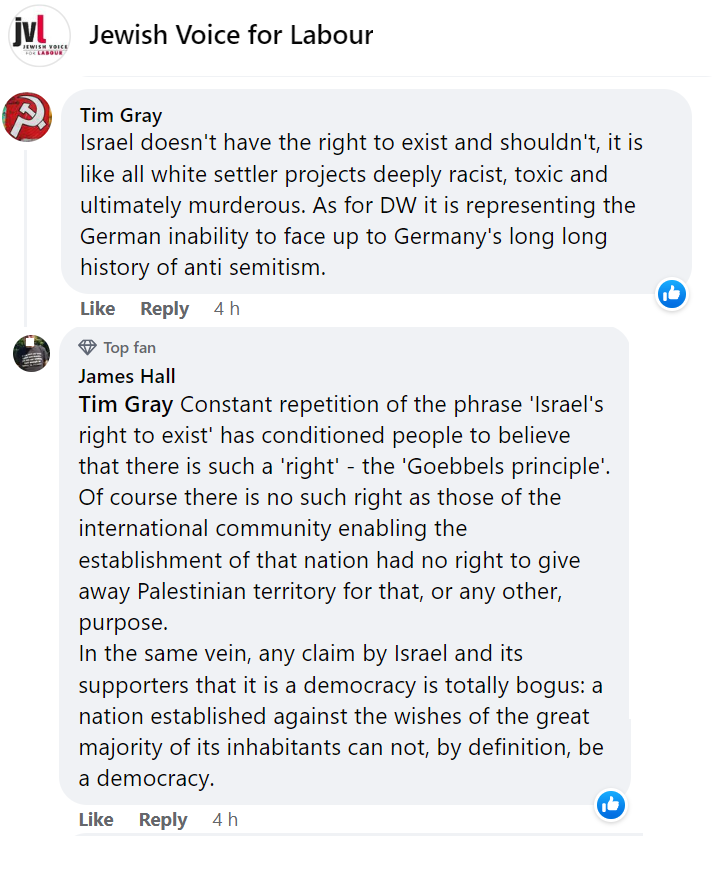
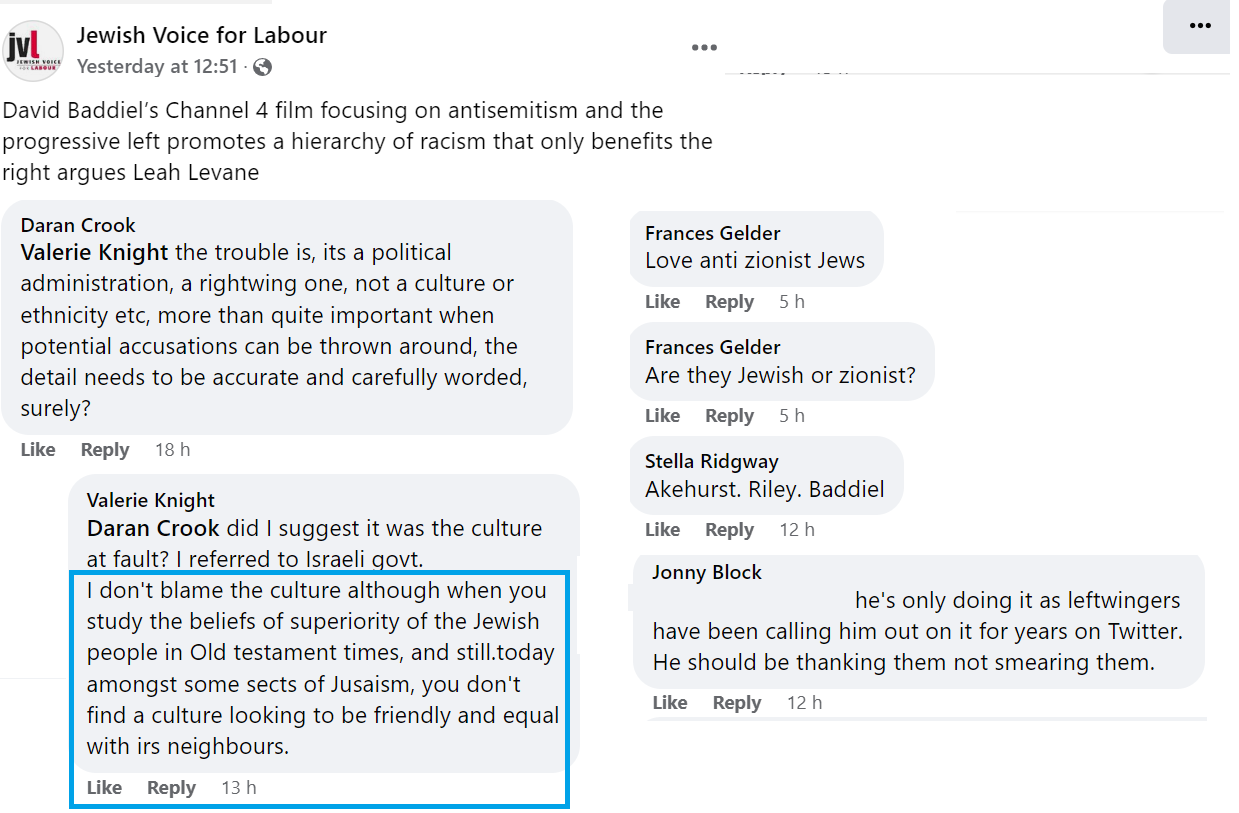
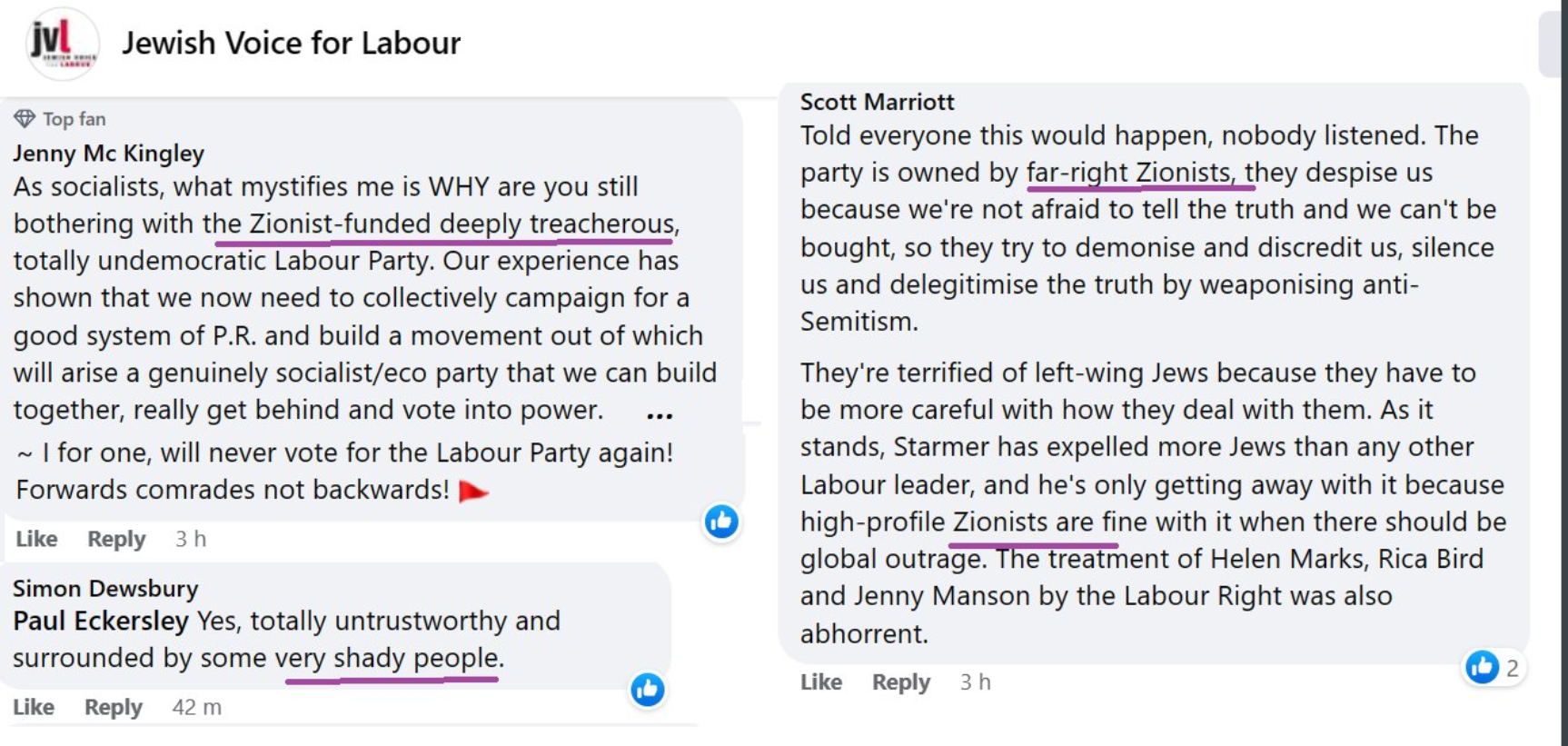
There are JVL members who have long had mutual bonds of friendship and affection with Jeremy Corbyn. Confident in his esteem, they cannot believe he ever entertains an antisemitic thought and they share his antipathy to Zionism, and to Israel, which is anathema to their diasporic vision. As their friend rose from backbench obscurity to national and possibly global celebrity, they too rose in public visibility. In this new limelight, anti Zionism became the unique selling point for JVL while, for Corbyn, it was a magnet to all kinds of enemies of Israel in larger numbers than before. I do not think JVL want to give up all this, even if it means making room in their bed for the people whose comments are shown in the screen shots below.
These are not in chronological order. Some relate to recent events, the Ukrainian war for example and others date back to previous years. The Forde Report has made its appearance, and is commented on. The JVL admins exhort their supporters to greater excesses, and even the comrade who calls Judaism ‘a violently xenophobic ideology’ encounters no word of dissent.
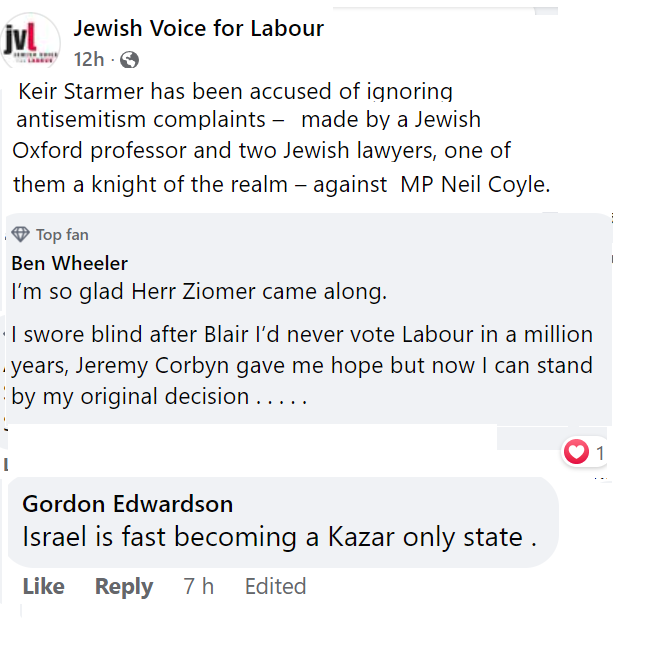


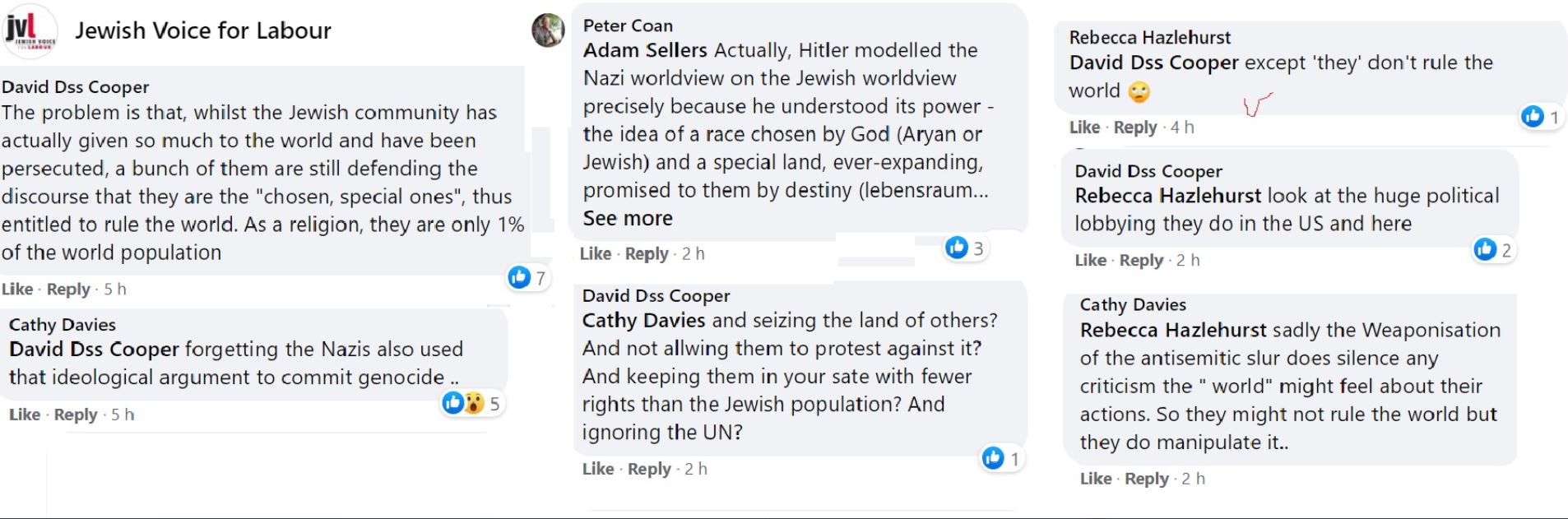

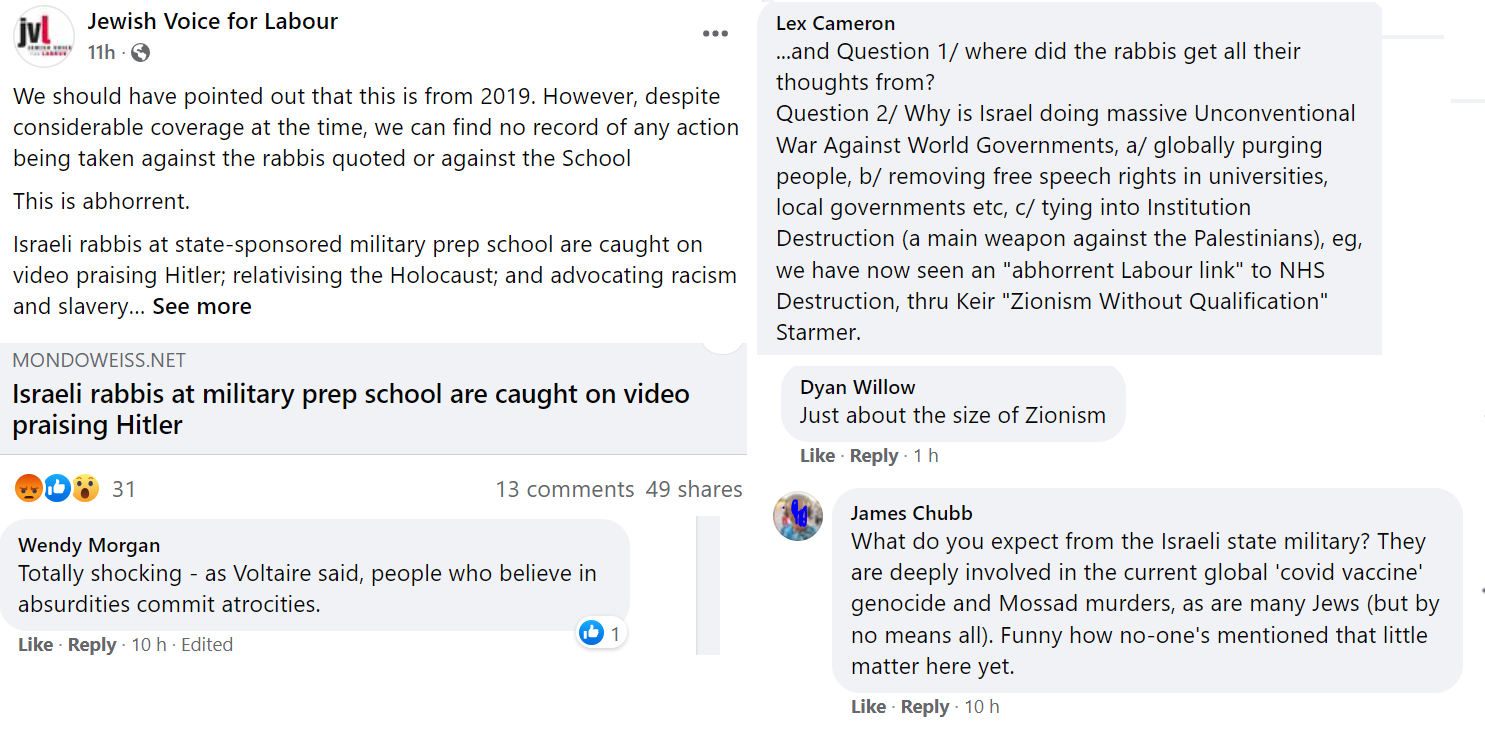


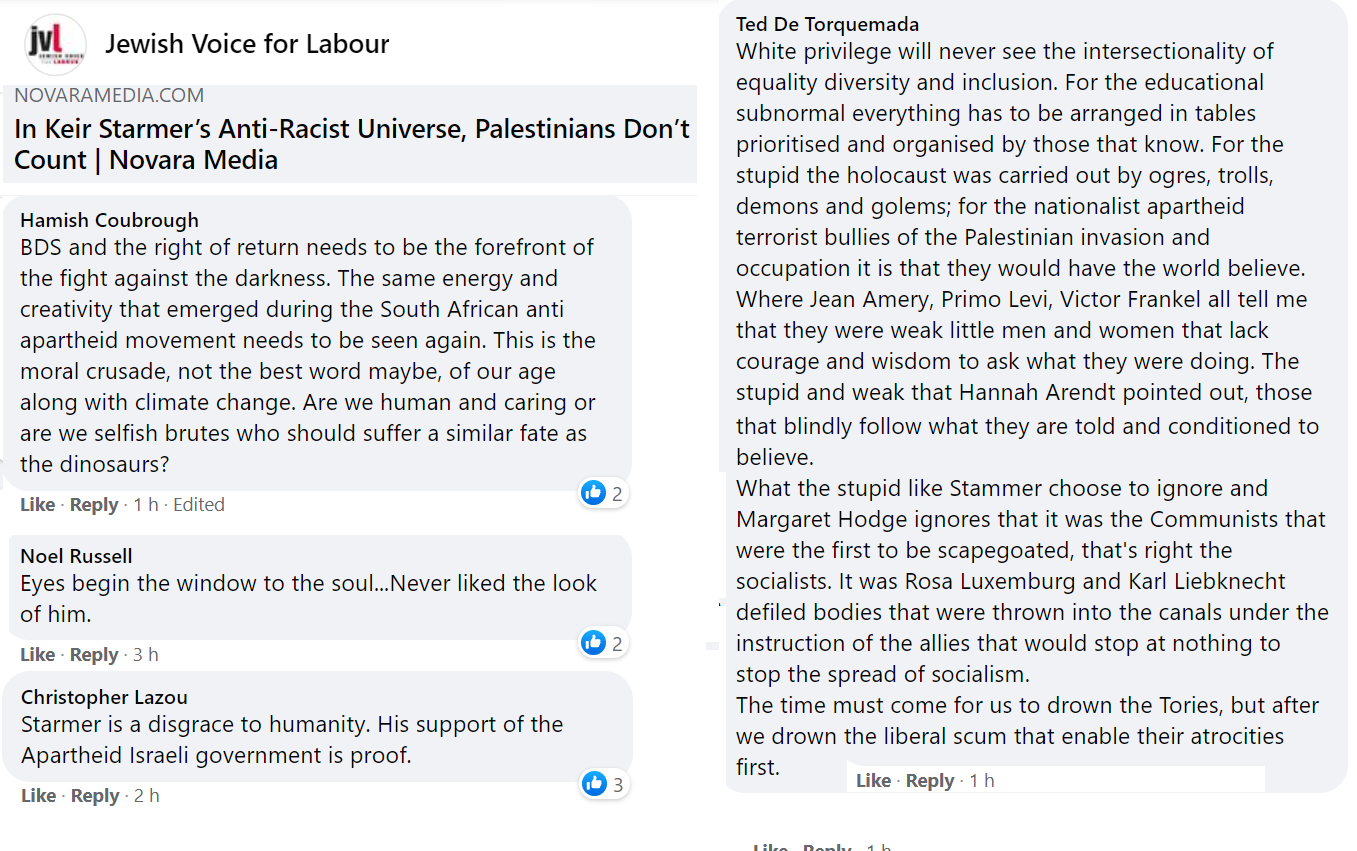





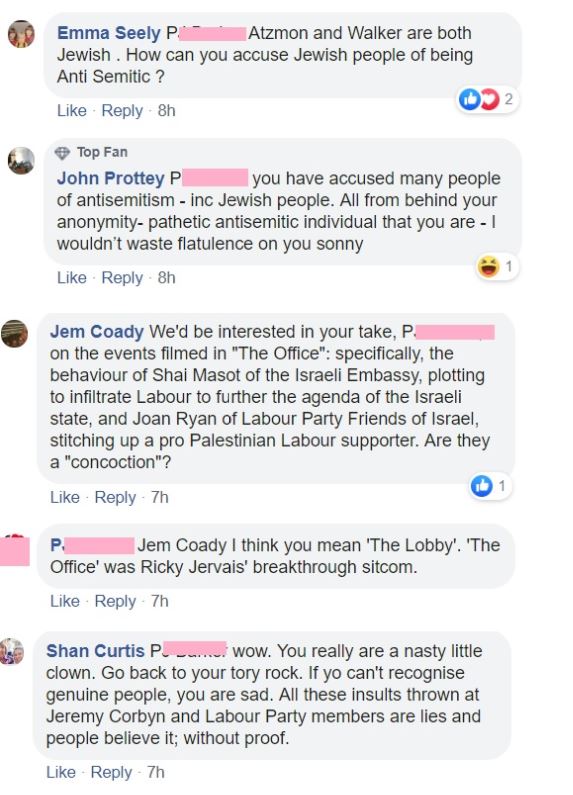
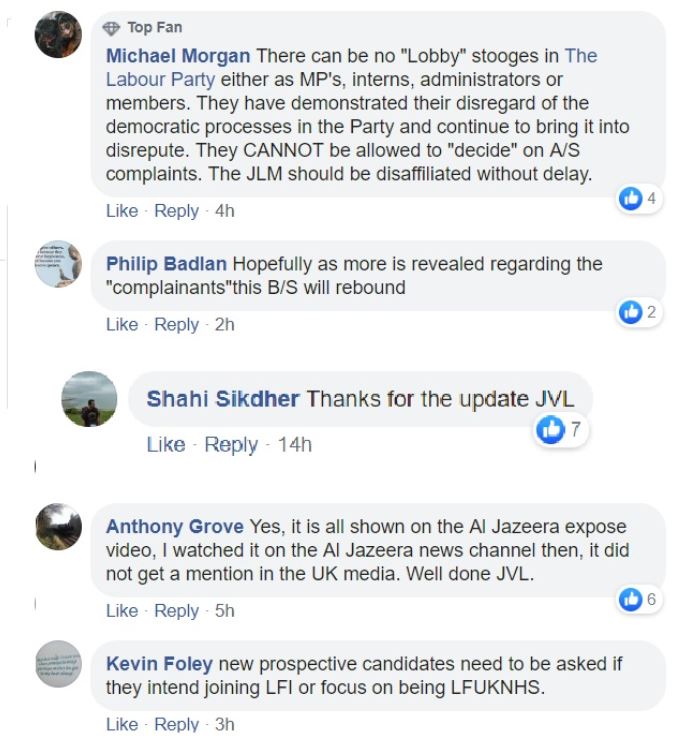
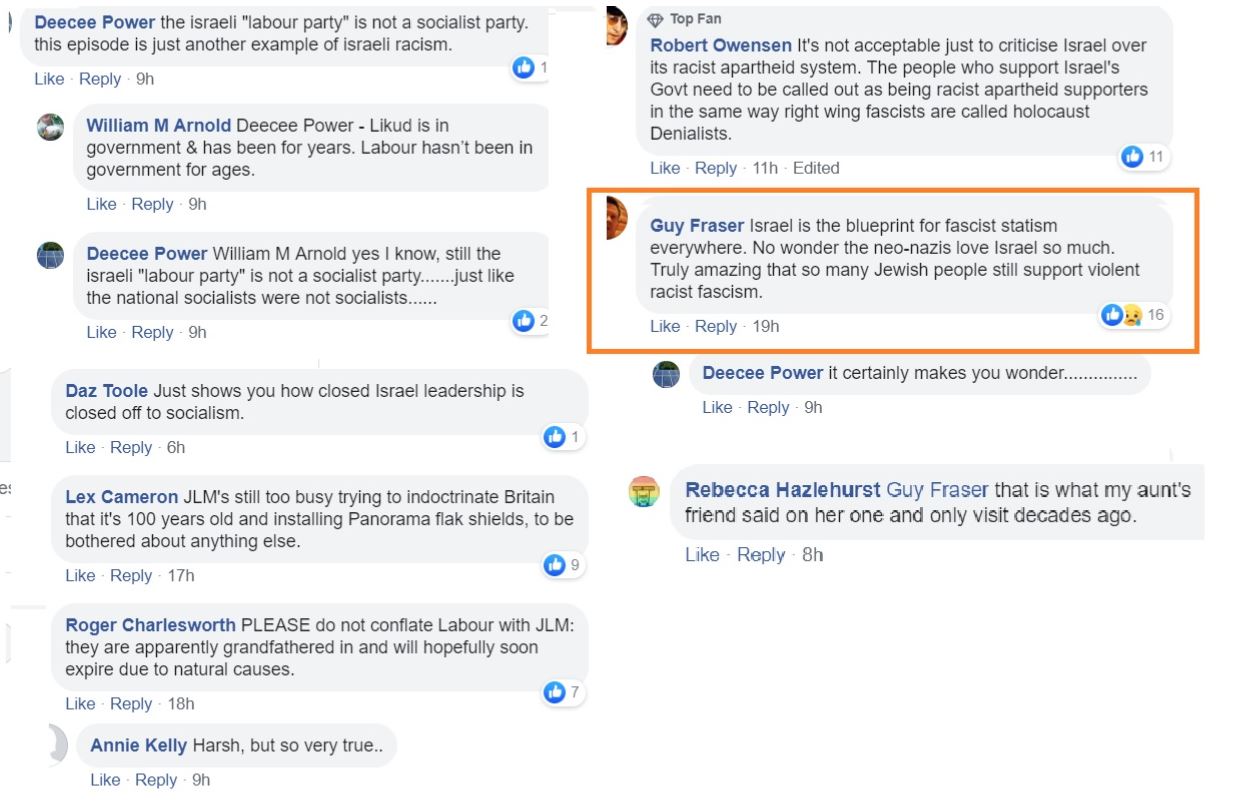
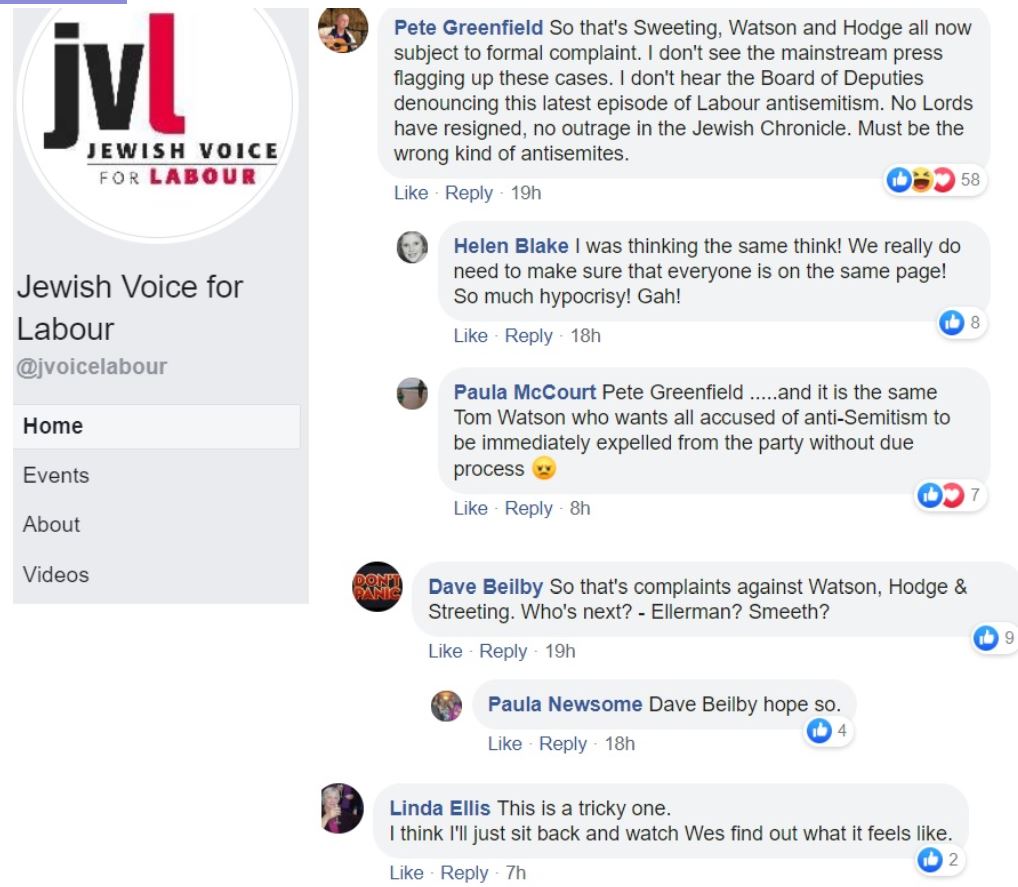



I


The Fast of the Ninth of Av
Posted on: July 31, 2019
Tisha b’Av always appears to me as a blot of the landscape, the black fast, commemorating something remote, a cause relinquished by many. Why mourn for a Temple, the restoration of which would land us in as much trouble as the destruction of the first, in 587 BCE and the second in 70 CE?
As a fast, it is very different from the Day of Atonement.
On Yom Kippur, the community gathers. The scrolls and many of the congregants are dressed in white, we pray together, fast together and together we hear the tekiah gedolah, the long note of the ram’s horn, which signifies the day’s end. By contrast, on the fast of 9th Av, a few diehards come together to sit on the floor and read the Book of Lamentations, then continue the fast in solitary through a dog day morning and afternoon until sunset at around 9pm.
There is an atmosphere before Tisha b’Av, and the name for it is Bein ha Metzarim, between the straits. Some people fast on 17 Tammuz, usually in July, commemorating the day when the Babylonians breached the walls of Jerusalem. Three weeks later, the Temple fell, hence the fast of 9th Av. During the three week period, the orthodox will abstain from shaving, haircuts, celebrations and listening to music. Marriages are not solemnized at this time, a rule which, generally speaking, is not confined to orthodoxy.
During the three weeks of mourning, culminating in the twenty-five hour fast on Tisha b’Av, there are many sorrows to be remembered, besides the destruction of the first and second Temples in Jerusalem. The expulsion of the Jews from England by Edward I in July 1290 and the expulsion of Jews from Spain by Ferdinand and Isabella in August 1492 are said to have occurred on 9 Av, although a Hebrew calendar converter estimates these events as falling a few days short of or following the ninth.
During the more recent catastrophe of the Shoah, destruction and death were present on every day of the year, but certain events occurred on Tisha b’Av, the deportation of Jews from the Warsaw Ghetto being one, while the liquidation of the Lodz Ghetto in 1944 began a few days after the 9th.
There is no baleful magic in the day, to make it a time of foreboding more than any other, but anniversaries are meaningful to us, not just the birthdays and silver weddings, but the anniversaries of the death of a loved one, the date of a battle, a book, a coronation, a discovery. Those who are bereaved often find that the birthday of the departed has particular poignancy in the first year after their death, or perhaps the first few years, or sometimes forever.
The randomness of time and chance are overlaid with meanings which come from personal and communal experience. This day for mourning the destruction of the Temple gathers to itself the threnody of our lives, a stockpiling of grief. Now we have Yom Hashoah and Holocaust Memorial Day to bear some of the weight of remembering the Holocaust. Yom Hashoah was established on its present date of 27 Nisan by David Ben Gurion’s government in 1959. Holocaust Memorial Day, launched in 2001, remembers the Shoah and subsequent genocides in Cambodia, Rwanda and Darfur. The chosen date is the anniversary of the liberation of Auschwitz by the Soviet Union in January 1945.
Tisha B’Av is our ancient day of mourning. It is mentioned in the Mishnah, tractate Taanit (days of fasting).
When Av comes in, gladness must be diminished.
Taanit 4:6.
It is by no means singular to Judaism to put aside days in the calendar and special places for remembering sorrows ancient and modern. It is not even specific to religion. Calendars can regulate grief, provide a time for mourning and a time for comfort.
Tisha B’Av has its silver linings. The day ends and the fast ends; we eat, drink and do what we want. On the following shabbat, a passage from the book of Isaiah is read in the synagogue:
Comfort, comfort my people, says your God
Speak tenderly to Jerusalem, and cry to her that her warfare is ended.
It is called Shabbat Nachamu, the sabbath of comfort, from the first word of Isaiah 40, the set prophetic reading.
Every winter, I find out where Handel’s Messiah is being performed in London and buy a ticket. The beautiful opening aria after the overture is ‘Comfort ye,’ from the King James Version of Isaiah 40 and, when I hear it, I always think of Shabbat Nachamu.
Post script 2022
The coming shabbat will be Shabbat Chazon and the fast of Tisha b’Av begins at motzei shabbat. If you fast, tsom qal.
Labour’s New Leaf
Posted on: July 26, 2019
Last Sunday, I received an email from Team Labour, in Jeremy Corbyn’s name, as follows:
The struggle for liberation of all people is never complete and must always be renewed. As a movement, we educate ourselves and each other to better stand in solidarity with and unite all those facing oppression and discrimination.
That’s why we are launching education materials for our members and supporters to help them confront bigotry, wherever it arises. Over the coming months, the party will produce educational materials on a number of specific forms of racism and bigotry. Our first materials are on antisemitism, recognising that anti-Jewish bigotry has reared its head in our movement.’
I was sceptical although the email looked quite praiseworthy. I read the educational materials and, without agreeing with every point, I thought that they were helpful, particularly this paragraph:
But opposition to the Israeli government must never use antisemitic ideas, such as attributing its injustices to Jewish identity, demanding that Jews in Britain or elsewhere answer for its conduct, or comparing Israel to the Nazis. Many Jews view calls for Israel to cease to exist as calls for expulsion or genocide. Arguing for one state with rights for all Israelis and Palestinians is not antisemitic, but calling for the removal of Jews from the region is. Anti-Zionism is not in itself antisemitic and some Jews are not Zionists. Labour is a political home for Zionists and anti-Zionists. Neither Zionism nor anti-Zionism is in itself racism.
If only these thoughts could be taken on board by Labour supporters, there would be hope at least for a more peaceable time in the Labour movement.
Within a day or two, there was no missing the fact that Dame Margaret Hodge was once again a bête noire par excellence for many of Mr Corbyn’s supporters, inspired by an article in the Skwawkbox, headed thus:
HODGE SUBJECT OF FORMAL ANTISEMITISM COMPLAINT BY ORTHODOX JEWISH MEMBER
There had been a row, apparently between Dame Margaret and a Charedi man called Mr Stern, about the teaching of sex education, including LGBT topics, in schools. Mr Stern was firmly against this and, if I understand correctly, had penned complaints about Margaret Hodge and also The Jewish Chronicle.
It was as if the ‘anti-Zionist’ Corbynists had found an ingenious way of turning around the promise of more stringent measures against antisemitism. They could accuse their Jewish adversaries of antisemitism and request their immediate expulsion from the Labour Party. The narrative of JVL, for example is that all who accuse Labour of antisemitism do so in bad faith – the Livingstone Formulation, as coined by David Hirsh. *
A Story From the Forums
Posted on: July 20, 2019
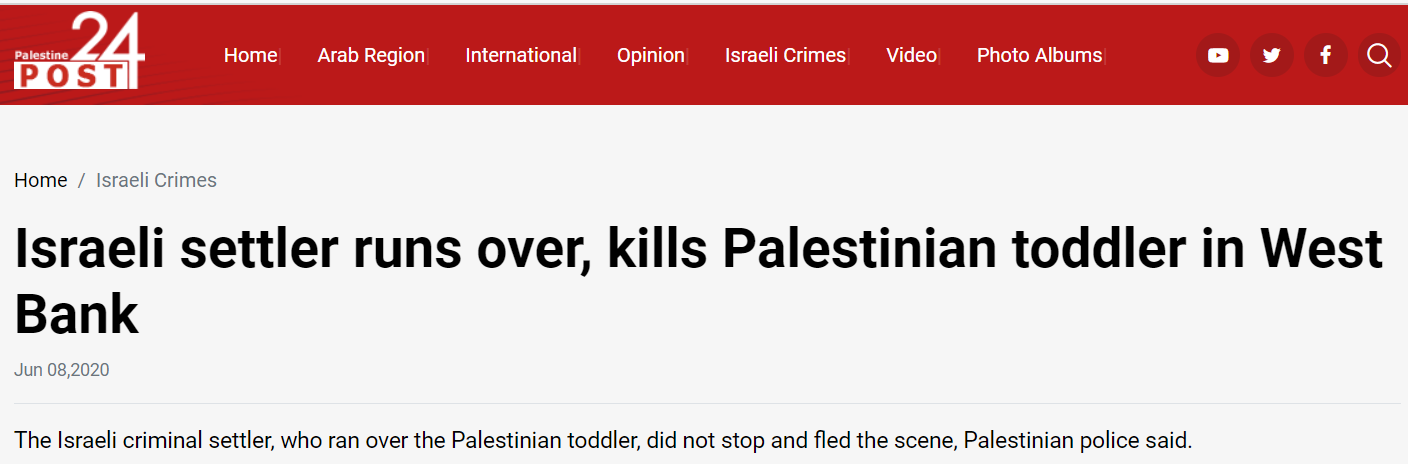
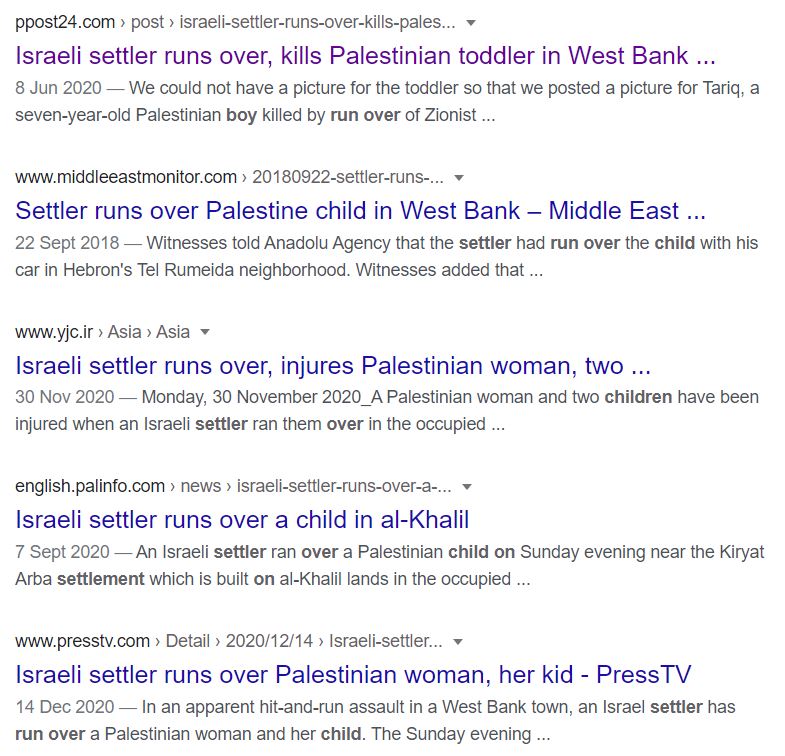
I’m aware that publications hostile to Israel have, for at least ten years, been publishing stories with the headline ‘Settler runs over Palestinian child.’ There are some variations. They may say ‘Jewish settler’ and occasionally the victim will be a woman but, several times a year, the headline will specify a child, boy or girl, age 5 or 8 or sometimes a teenager. Usually, the running over is described as deliberate and the consequence as fatal.
These stories then acquire a momentum of their own, appearing on anti-Israel and anti-Jewish social media. Reports of a road death in April will run for a couple of months before being replaced by a new story with the same headline but citing a different location in the disputed territories. The child may be a different gender from the previous victim and a year or two older or younger.
I became aware of the regularity of these reports by perusing online Corbyn-supporting forums. Once the report has been posted, members of the forum vie with each other in expressing the greatest possible outrage, which always involves imputing inhumanity to the Israeli settlers, Zionists and very often, Jews in general.
I googled on ‘Settler runs over Palestinian child,’ and copious items appeared, all originating from Middle Eastern sources and getting plentiful exposure on English-language forums. I selected one report for each year and made a collage of screen shots, shown below, which is how I usually display antisemitism on Corbynist forums. I then tweeted the image.
It wasn’t until today that I realized a tweet didn’t permit enough words for me to explain the significance of the collage. I deleted my tweet. I thought perhaps someone would take the reports at face value, and believe that settlers deliberately run over Palestinian children on at least a quarterly basis.
If we are not there, how can we know what’s happening? How can we know what isn’t happening? Nevertheless, for the members of, for example, ‘Truthers Against Zionists [sic] Lobbies,’ such reports confirm everything they already believe.
The report I saw yesterday was in fact on the Truthers Against Zionists Lobbies forum, alongside some gross examples of holocaust denial, so these are not people with any kind of credibility and the reports of regular infanticide by murderous drivers are extremely suspect.
A month later, there are new ‘Settler runs over child’ stories doing the rounds. Someone on Twitter yesterday posted a photo of a child with fatal injuries, said to have been inflicted by a settler in a car. I also found an article debunking one of these accounts. Yet still they come.

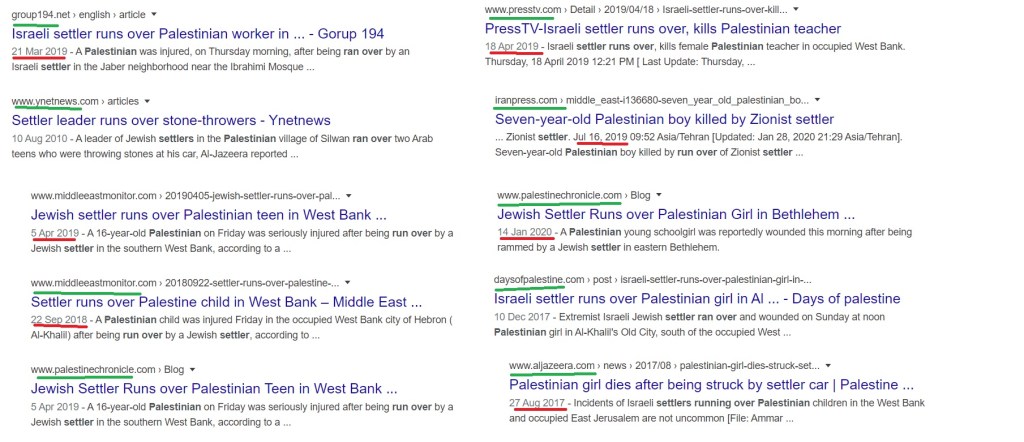
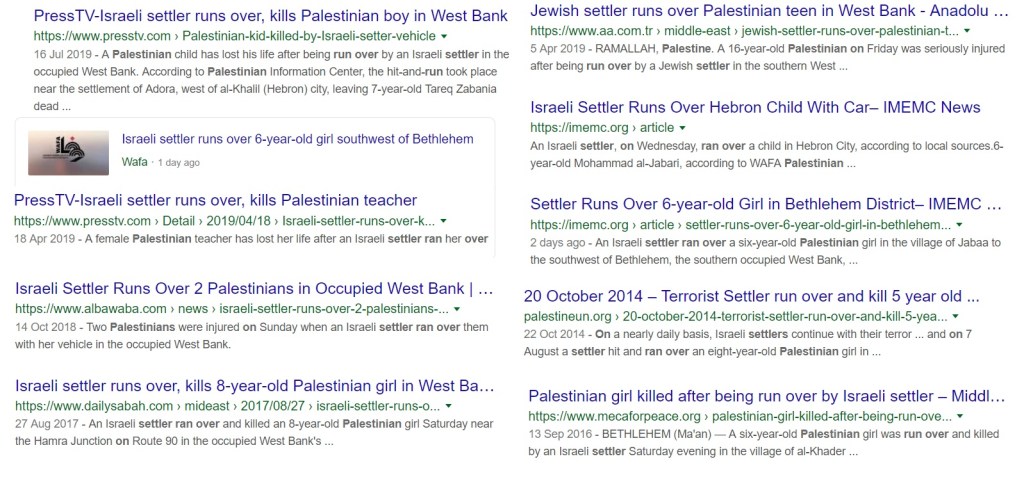
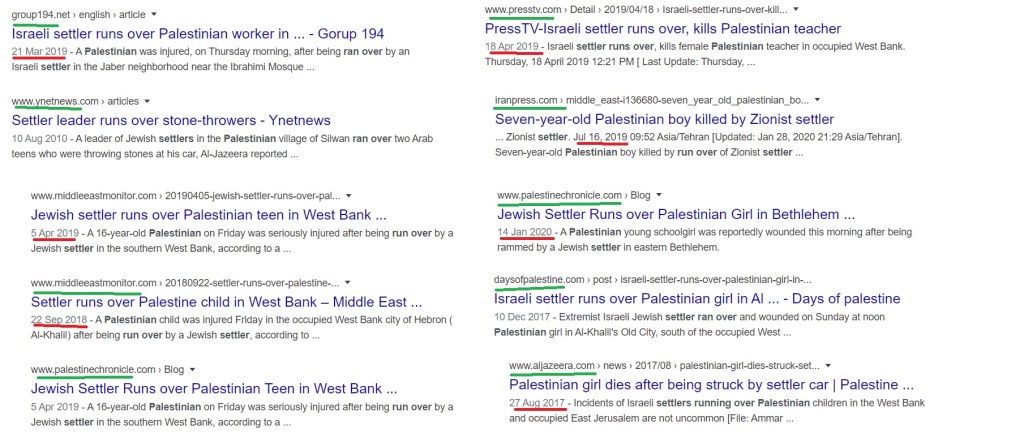
I wrote this post a few years ago but obviously the reports continue. Here is a sample of the 2020 crop.
MSM and Me
Posted on: July 19, 2019
As a young married woman, I liked getting newspapers delivered, especially as I was at home with the baby for most of the day. I got the Guardian, the Radio Times, the Jewish Chronicle and the Observer. My parents used to get the Daily Herald, the Guardian, the New Statesman and the Jewish Chronicle.
Later on, the Guardian’s animus towards Israel donned its high-visibility jacket and I switched first to the Independent, then The Times.
For a while in the 1990s, I stopped getting the Jewish Chronicle because it reported with depressing regularity on antisemitic incidents and the fervent anti-Zionism making an appearance in universities and trade unions.
I got a computer in about 1994, because I needed a word processor and Hebrew software (Dagesh. Anyone remember it?) for my master’s thesis.
Newspapers were expensive and I gave up hard copies but I worked for WH Smith and saw all the newspapers at work. In the canteen on my lunchbreak, I’d spread them out, tabloids and broadsheets, and compare front pages. The tabloids had headlines about celebrities and royal personages and sometimes they had news about people whose names I didn’t recognize: chauffeurs and butlers of the royals, footballers’ wives, celebrities’ other halves.
At some point there was the transition to getting news from online sources. I also began to use online dictionaries, English and other, rather than balancing a large tome on my knees. There was something called My Space which seemed to be hard work and Friends Reunited where people aired grievances about unkind teachers of years gone by.
Then there was Facebook, as we all know, and Twitter, recommended by Stephen Fry as being good fun, so I joined it in 2009.
I didn’t encounter the term MSM, meaning Mainstream Media until the resistible rise of Jeremy Corbyn, although the online alternative media appeared mostly before 2015. Some of these alternative sources of news saw the light of day in the period of the Conservative/LibDem Coalition and came into their own in the age of Corbynism.
Another Angry Voice was established in 2010 as an alternative to the mainstream press. Steve Walker’s The Skwawkbox first appeared in 2012 and Kerry-Anne Mendoza’s The Canary in 2015, with Evolve Politics created the same year. Aaron Bastani’s Novara Media goes back as far as 2011.
Meanwhile, some Corbynist ‘brocialists’ – the angry not-so-young men of the left – contribute regularly to the Guardian, Owen Jones foremost among them, even though the consensus on Facebook Labour forums is that The Guardian is a Zionist rag.
The BBC is denounced daily by both right and left. At the present time, the Corbynist left are infuriated by BBC1’s Panorama, which showed John Ware’s film about interference in defence of alleged antisemites from the Labour leader’s office. Infuriated is an understatement. They are organizing against the BBC, John Ware and the whistleblowers who appeared in the programme. There are petitions on the go and a forum called The Prole Star has posted a request for Corbynist Jews to testify in an alternative film, defending Corbyn. It should not be difficult to find volunteers. Jewish Voice for Labour, Free Speech on Israel and Just Jews exist only to defend Corbyn from charges of antisemitism and to attack those who accuse him. There is a discernible overlap of members so it is possible that the total membership of all three groups does not exceed the membership of any one of them.
It seems that all sides have a beef with the BBC. My own is as follows. When Southern Israel comes under attack from Hamas rockets, I hear about it from Israelis, tweeting from their shelters. The BBC does not report it until Israel fires back, generally after a day or two of rocket fire from Gaza; then the BBC runs a headline along the lines of ‘Israel has attacked Gaza.’
There is such a stigma attached to tabloid newspapers that one is reluctant to cite them as a source for a story, yet it was the Daily Mail which did much of the legwork on the ‘Wreathgate’ story. The culpable history of the Mail is mentioned very often by Corbynists: the Mail’s support for fascism in the 1930s and, more recently, their absurd attack on Ralph Miliband as part of their offensive against Ed Miliband but even a stopped clock is right twice a day. I’ve become accustomed to being asked ‘Did you read that in the Fail?’ (a derogatory nickname for The Mail) when I refer to Labour antisemitism, although only very rarely did I read it in The Mail.
I used to watch Channel 4 News regularly as I liked Cathy Newman and Krishnan Guru-Murthy, but was put off by seeing Jon Snow shouting ‘Fuck the Tories’ at the Glastonbury Festival of 2017, the year of Oh Jeremy Corbyn.
Speaking to HuffPost UK about the report, Jon Snow said in a statement: “After a day at Glastonbury, I can honestly say I have no recollection of what was chanted, sung or who I took over 1000 selfies with”. (from NME, 28 June 2017)
I admire hugely the well-informed, intelligent television journalists who are despised by Corbynists: Laura Kuenssberg, Andrew Neil, Jo Coburn, Emily Maitlis, Robert Peston, Andrew Marr, Emma Barnett.
I search out newspaper articles by Corbynsceptic journalists such as Nick Cohen, David Aaronovitch, Raphael Behr, Jonathan Freedland, Jessica Elgot, Janice Turner, Nicole Lampert and many others.
I listen to radio or television news most of my waking hours now and, while I listen, I read news online. Twitter is very often the first source of breaking news.
I exercise self-discipline to turn away from news. There are books to be read, good television to watch, pictures to paint and, even more importantly, I have a family.
I tend to switch off news items about the suffering of children: items about illness, statelessness, child abuse, murder. One does not have to know about everything.
The most offensive thing said to me by hostile Twitterati is ‘child murderer.’ Anyone Jewish will be called this name, unless they denounce Israel. It can happen if one posts about antisemitism, even when the Israel-Palestinian conflict has not been mentioned. I get sent pictures of mortally injured children, accompanied by tweets, telling me that Israel has done it and often they add considerately that they hope I can sleep at night.
Antisemitism is not about what Jews want it to be about. It is the antisemites as always who choose the parameters and they have made it about Israel.
There is no getting away from the fact that the news makes me sad. My children and friends often say they wish I would look less and be less sad, but I don’t think it can be done.
It is Friday and the sun is in the west.
Shabbat shalom.
If someone calls me stupid or old or quips about the name Lazarus (a valued gift from my ex-husband), I can shrug it off.
If they use pejorative language from the modern lexicon for abusing Jews, I get angry.
The modern lexicon, as opposed to the traditional dictionary, includes ‘supporter of apartheid’ and ‘apologist for child murder’ which references their perception of Israel and attributes to me or like-minded people the features they believe they discern in the State of Israel.
There are at least two possible answers here. One is that I don’t control events in Israel. Another is that they have a false perception of it as uniquely racist and murderous. If I go with the first, I allow them to get away with the usual calumnies. If I go with the second, I allow them to set the parameters of the conversation as being about Israel.
When the suspension of Chris Williamson, MP for Derby North, was discussed on BBC Question time, a gentleman in the audience said:
The Jewish community is very vociferous and obviously they feel they’re being hurt but what’s happening with the Palestinians – the siege, the torture, the kidnappings? I’ve never heard a Jewish community complain about that.
Members of the panel responded to the attempted tainting of ‘the Jewish community,’ but not to the damaging hyperbole about Israel. I don’t blame them. It isn’t easy to extemporize a brief response to both points.
Tweets about the iniquity of Jews depress me. Before Corbyn, they tended to come from the far right; now from both right and left.
Tweets about the iniquity of Israel depress me and are harder to answer, as I am in what Judah Halevi called the edge of the west. (He meant Spain and I’m in London but the expression serves.) If they show an image of an injured child and claim that it illustrates Israeli cruelty, I can query the provenance of the photo, the context and even the authenticity but I can’t swear that it isn’t from Israel unless, as has occurred before, the soldiers are in Guatemalan uniform.
If someone tweets to me that I’ve judged them unfairly, that they didn’t mean what I thought, or understand the implications of their words, I try to listen and give them credit for their serious answer. Any transition from bitterness to civility is both valuable and rare.
I aroused ire by tweeting sympathetically about Kevin Spacey and was persuaded by the responses that I’d been wrong, but didn’t delete my tweet. I’ve tweeted my pro-Remain opinions and been rebuked by Brexiteers whose opinions I value. It doesn’t bother me.
I’ve been called an antisemite by antisemites. That does bother me, because I know it’s a ploy, which can confuse the innocent bystander reading the conversation. It is like a Monty Python sketch set in a psychiatrist’s room where two men wrangle over which one is the psychiatrist and which one the patient. Of course, both claim to be the psychiatrist.
I dislike formulations such as ‘weaponising antisemitism,’ ‘hasn’t an antisemitic bone in his body,’ ‘just because he supports the Palestinians.’ I dislike the term Khazar which is used by both far right and far left. Presumably someone in the world really is a Khazar, and good luck to them.
I don’t tolerate islamophobia from any side. The tweeter will pick out some disreputable deed and attribute it to all Muslims: racism’s modus operandi since time immemorial. They will quote the Qur’an to imply bigotry in Islam. The bible can likewise be quoted, to the apparent detriment of Judaism and Christianity. Orwell can be quoted to his disadvantage and TS Eliot more so; Dostoevsky and Dickens and – not that one cares – Hilaire Belloc.
Nobody likes being on the end of sarcasm but I do produce sarcastic tweets, probably daily. It’s something to bring up when the Selichot season gets underway.
Twitter can be our friend. We can discuss films, books, music, TV, sport, philosophy, languages, recipes, if we find an amenable account. I have made friends. Soup has changed hands and drinks have been consumed.
’The whole world is a very narrow bridge,’ as Nachman of Bratslav pointed out.
כל העולם כולו גשר צר מאוד. והעיקר לא לפחד כלל.
The whole world is a very narrow bridge and the main thing is to have no fear at all.
If Rabbi Nachman had tweeted this, he would have garnered so many likes, but there still would have been somebody calling him a Khazar.
Buying the Jewish Chronicle
Posted on: June 27, 2019
This is too long to tweet but perhaps too short to blog.
Scene: Sainsbury’s, Winchmore Hill
Gillian, standing by the newspaper rack, reaches up for the Jewish Chronicle on the top shelf. She usually reads it online but wants a hard copy of an article of particular interest. Noticing a headline about kashrut, she realizes that this is last Friday’s edition.
‘Not very good for animal rights, is it?’
Gillian turns to see a small, fifty-something woman, smiling with her teeth but not her eyes.
Gillian (face has frozen into G-d knows what expression): Why do you say that?
Woman: You know they cut their throats and hang them upside down?
Pinteresque pause
Woman: Like with halal.
Gillian: Would you want to prevent halal slaughter?
Woman: (no longer smiling) No…you can’t stop people doing what they want, can you?’
Gillian: No
Resume first person. I swept past her, without taking the Jewish Chronicle, walking quickly. I did not linger by the grapefruit to see if they had pink or only red and yellow; I felt for some reason a need to put distance between myself and that woman. In fact, I felt a wish to complete the shopping and leave the store, to go home.
Even in the car, my foot went down harder than usual, bearing in mind that I’m a senior citizen who has only once been done for speeding.
On the way to Sainsbury’s, I’d been thinking about my cousin who, at the age of seventy-five, has decided to make aliyah, ‘to live my remaining years in Israel,’ were his words.
When I reached for the Jewish Chronicle, the thought was in my subconscious that a stranger would comment, yet when I heard the woman speaking to me, I half expected her to say ‘Price of a kosher fowl is something shocking these days.’
But no. It was ‘They cut their throats and hang them upside down.’
Look. I eat meat once, maybe twice a year so I’m de facto vegetarian most of the time. When I do eat meat, it does indeed have the hechsher of the London Board for Shechita.
Maybe the woman was being friendly. If I’d reached for today’s Financial Times, would she have said ‘Private equity is going great guns today’? If it were the Radio Times, would she have commented ‘So Judi Dench is 84? Looks marvelous doesn’t she?’
I don’t know. I just know that if it had been the FT or Radio Times, it would have been a whole different scenario. I didn’t buy the JC today because I remembered that this week’s edition would be out tomorrow. Maybe I’ll buy it in Sainsbury’s in Winchmore Hill. It seems to be a bit of an ice-breaker. Lol.
 Neviim Tovim, blogs by Gillian Gould Lazarus