Author Archive
Troubled by the Deuteronomist
Posted on: August 22, 2014
- In: Pentateuch | Torah
- Leave a Comment
Re’eh Deuteronomy12:29 – 13:19
When I first looked at the Torah reading, Re’eh, with a view to preparing this introduction, it was the day after a ceasefire commenced in Israel and Gaza. All hell was breaking loose in the UK over Baroness Warsi and the Tricycle Theatre. That now seems a long time ago; ceasefires have come and gone; I’m writing this on Wednesday and I feel with pessimistic certainty that there will be further developments by Shabbat.
There was no getting away from the fact that our text begins, “When the LORD your God cuts off before you the nations whom you go in to dispossess, and you dispossess them and dwell in their land…’ and I wondered if it was going to get better as it went on.
The charge against the other nations is that they sacrifice their children to their false gods, particularly a deity called Moloch.
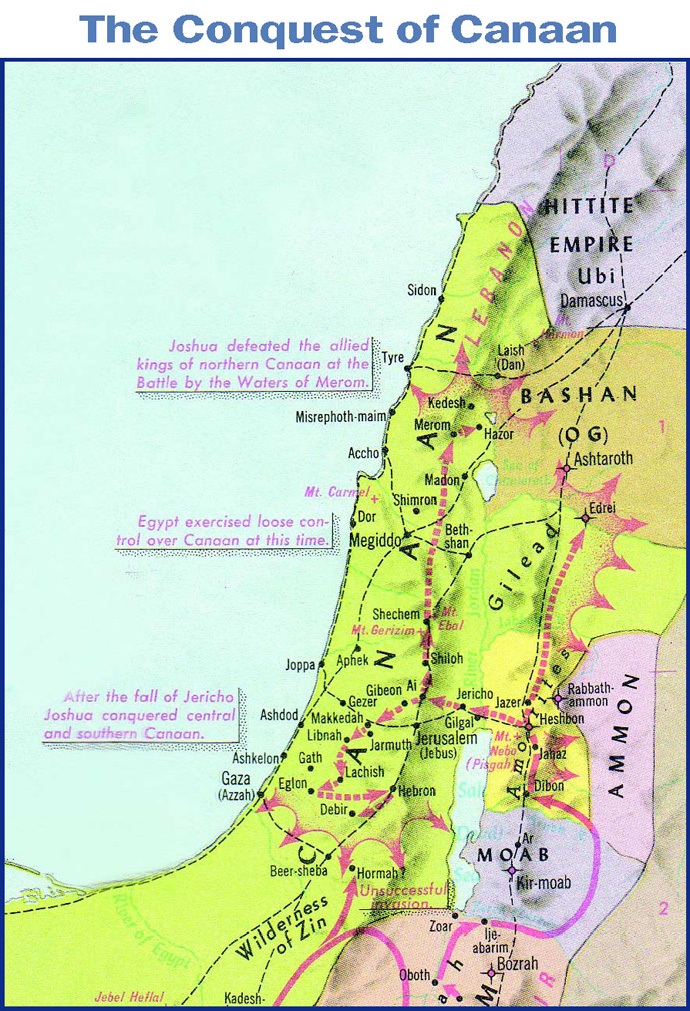
The text goes on to say that, if a false prophet should arise, and promote the worship of other gods by claiming supernatural knowledge of them, this prophet should be rejected and executed. And if members of your family urge you to follow other gods, resist them. Indeed, our text commands that all such people who advocate pagan worship should be put to death. If a whole town turns to paganism, there should be a herem on that town, people, animals and property. The valuables are to be burned and the town is not to be rebuilt. To carry out a herem is translated variously as to ‘ban’ or ‘proscribe’ or ‘totally destroy’. It is used typically of hostile towns, and, in today’s language, signifies ethnic cleansing or genocide. It is a term used very much in the book of Joshua, in which Joshua leads the Israelites into the promised land and battles to displace the Canaanites and other non-Israelite inhabitants.
So what is the agenda of the book of Deuteronomy, and by implication, the book of Joshua, which, according to the documentary hypotheses, has authorship in common with Deuteronomy?
The book of Deuteronomy plays a very significant part in the account, in the second book of Kings, of the reign of Josiah who had ordered repairs at the Temple in Jerusalem. A sefer Torah was discovered, which, by its content, appears to have been Deuteronomy. Josiah had it read aloud to the people and then set about destroying the idolatrous altars which proliferated in Jerusalem and beyond.
Josiah’s zero tolerance of pagan worship may have been influenced by the militancy of the Deuteronomists, or, vice versa; a case has been made (Frank Moore Cross) to say that the book was written to endorse Josiah’s policy. The suggestion that the passage we are going to read was written in a particular, historical context doesn’t sit well with the Torah min shemayyim view, that Moses received Torah on Sinai.
And this, I think, is the difficulty in the present context of synagogue worship. It’s relatively easy for me to explain the parasha by talking about the agenda of the Deuteronomists, but much more difficult to read it as Holy Scripture and then square it with the commandment to love the stranger. It would call for the kind of exegetical contortionism which is beyond me, so all I can say is listen to it yourselves and then, go figure.
It’s because there are passages like this in Tenach, difficult to explain at the very least, that I don’t like to quote other people’s holy books against them. The crimes people perpetrate in the name of scripture are their own crimes, not, as Richard Dawkins would have it, the crimes of religion per se.
And if God did give us the written Torah, he also gave us the world to inhabit. Nothing about our bible gives the impression that this will ever be easy, but then, according to a famous dictum from Pirke Avot, ‘It’s not for us to complete the work, though neither are we free to desist.’ Meaning what, in this context? Let’s say I mean that Torah is always a work in progress, never completed, not unlike the road works in Myddleton Park Road.
BALAK 5774
Posted on: July 1, 2014

This sidra, named Balak after a king of Moab, concerns the more famous Balaam, a pagan prophet and magician who was recruited by King Balak to curse the Israelites. Why did Balak want the Israelites cursed? Well, like Pharaoh in the time of Moses, he felt threatened by a population increase among the Israelites. Balak planned to contain this by getting a reliable and renowned sorcerer to pronounce a curse and stop the demographic expansion.
Archaeological evidence points to a real sorcerer called Balaam son of Beor. An inscription dated to around the eighth century BCE and unearthed in a part of Jordan, which would correspond with Moab, refers to Balaam bar Beor, a visionary. This fragment of an ancient plaster wall was discovered during an excavation in 1967. The eighth century is later than the events in the Wilderness described in our Torah reading, but it shows that Balaam’s name was known and associated with magic.
Balaam’s story in the bible is particularly memorable because he has a talking ass, who sees an angel as they travel to the court of King Balak. The ass opens her mouth to complain when Balaam strikes her with his staff. Then Balaam sees the angel, who tells him to proceed to Moab, but speak only the words which God will put in his mouth. Seeing an angel is probably less surprising than having a talking ass.
In the chapter which we’re going to read, Balaam has arrived at Bamoth-Baal, the high plateau where the Moabites worship their gods and, from there, he can see the encampment of the Israelites spread out below. Balaam tells the king that he requires seven altars, seven bulls and seven rams, which are provided.
God then appears to Balaam and tells him what to say. Balaam utters the first of his oracles – an oracle is a prophetic saying – in which he praises Israel and says ‘How can I curse whom God has not cursed?’
Balak is dismayed but doesn’t give up and tries moving Balaam to another high place, where seven more altars are constructed and more bulls and rams sacrificed.
Balaam then speaks again, a beautiful poem in which he says, ‘I received a command to bless: God has blessed, and I cannot revoke it.’
Twice more, Balak moves Balaam around, installing the requisite altars and supplying the livestock for sacrifice. Each time, Balaam looks upon the Israelite tents below and speaks the benedictions which God puts into his mouth. He says: ‘Mah tovu ohelecha Yaacov, mishkenotecha Yisrael!’ How good are your tents O Jacob, your dwelling places, O Israel.
Yes, these words come from a celebrated pagan sorcerer Balaam, hired by a Moabite king to curse Israel. After delivering the oracles, Balaam goes home, presumably on the same ass as before, and Balak gives up on cursing the Israelites.
Balaam’s oracles are full of archaic language and words uncommon in biblical use. Some scholars believe that these poems predate the narrative, the Balaam story, but there are other opinions, which see in them allusions to later events. Nobody knows.
Balaam has an afterlife in post-biblical writings. He is much discussed in rabbinic literature, mentioned by Josephus and Philo and alluded to in the New Testament and the Qur’an. Midrash offers a divided view, sometimes referring to Balaam as a great gentile prophet and sometimes calling him ‘the wicked Balaam,’ based on another story in the book of Numbers, where Balaam is a subversive figure, inciting the Israelites to idolatry.
Commentators have made a connection between Balaam’s story and Abraham’s role in the binding of Isaac, in Genesis 22. Balaam rose early and saddled his ass taking with him two servants. The same is said of Abraham. Balaam sets out in defiance of God’s command while Abraham journey is an act of extraordinary obedience. An angel appears to Balaam and, reversing the previous commandment, tells him to proceed on his journey to Moab. A heavenly voice calls to Abraham and tells him not to carry out the commandment but to lay no hand on Isaac.
The Akedah narrative ends with the words ‘So Abraham returned to his young men, and they arose and went together to Beersheba. And Abraham lived at Beersheba’. Balaam’s narrative ends: Then Balaam rose and went back to his place. And Balak also went his way.’
Balaam uses certain names of God: Shaddai and Elyon, which are not the most usual names. On the whole, it’s the Patriarchs who call God El Shaddai, God Almighty, and after the Patriarchs, in the Pentateuch, it’s only Balaam who uses it. The name Shaddai appears also on the Balaam inscription found in Jordan. God tells Moses, ‘I appeared to Abraham, Isaac and Jacob as El Shaddai.’ But to Moses He makes himself known by a different name. Regarding the name El Elyon, the Most High God, we hear it in Genesis when we learn that Melchizedek, who blesses Abraham, is the priest of El Elyon.
As for Balak, the Moabite king who plays straight man to Balaam and his talking ass, he is a descendant of Lot, Abraham’s nephew. You may recall how Lot’s narrative was interwoven with that of Abraham. Although that’s another story; it sheds light on the sidra of Balak, Abraham’s distant relation and a descendant of Terach, Abraham’s father.
So maybe the bible’s telling us: you can choose life, but you can’t choose your relations.
GL 5 July 2014
 >
>
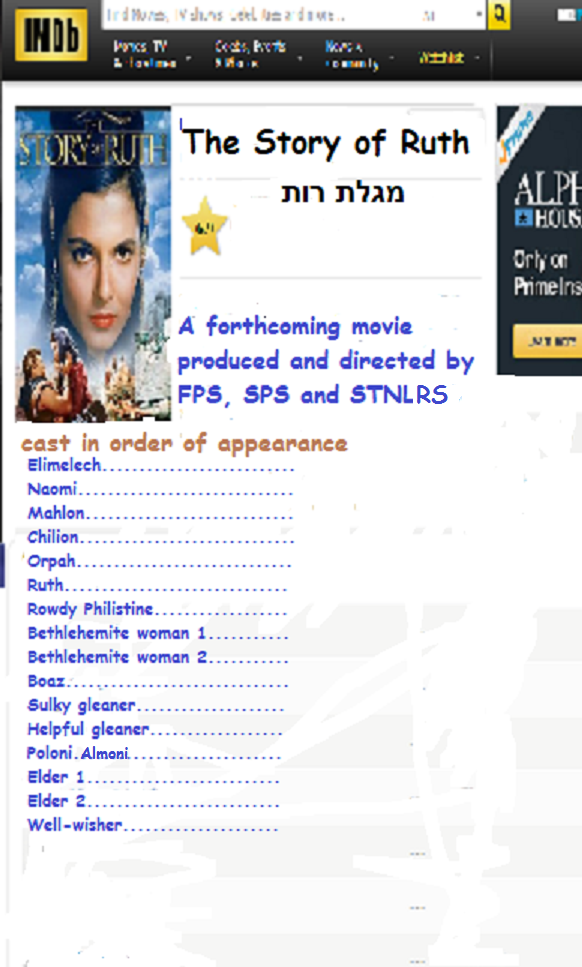
If you were making a movie of the Book of Ruth, how would you spin it?
Characters in order of appearance
Elimelech
It is the period of the Judges, after the Israelites have settled in the land, but before the time of the kings. Elimelech comes from Bethlehem, which makes it likely he’s from the tribe of Judah. This is confirmed when we learn that his relation, Boaz, is from the tribe of Judah.
Elimelech left the Land of Israel because of famine and went to live in Moab which was geographically roughly where Jordan would be today. The Moabites were often hostile to the Israelites, but they had a distant shared ancestry, being descended from Lot, Abraham’s nephew. The Moabites were polytheists and their chief god was Chemosh. According to 2 Kings 3:27, human sacrifice was not unknown.
Chapter I verse 3-4 of Ruth gives the impression that Elimelech died before his two sons married Moabite women.
He was survived by his wife Naomi, and two sons, Mahlon (מחלון) and Chilion (כליון).
Mahlon
Like his brother, he was born in Bethlehem. His name is associated with a Hebrew verb which means ‘to blot out, or erase. Although saddled with this unfortunate name, he survived ten years after his marriage to Ruth the Moabitess, during which time, they continued to reside in Moab. Another view of the name Mahlon is that it derives from mehilah, forgiveness, but I think this may be a Talmudic rather than a biblical word.
Chilion
His name is associated with being completed or finished. He also married a Moabite woman, Orpah, and lived ten years in Moab. Like Mahlon, he died without having children. We do not know his age at death, nor the age of his brother. It seems likely that they the brothers were adults when they got married as it is unlikely their father would betroth them from childhood to non-Israelite women.
The two brothers are something like Rosencrantz and Guildenstern; there is not much discernible difference between them.
The scriptwriter could do what he or she wishes, in order to differentiate their characters.
Naomi
Bereaved of husband and sons and learning that the famine in Judah is over, Naomi resolves to leave Moab and return home. She is well-disposed to her daughters-in-law and wishes them a happy furure, but neither expects nor needs them to accompany her. She is bitterly aware that it is too late for her to have more children, but reminds her daughters-in-law that it is not too late for them. She accepts the situation when Ruth insists on going with her.
When she and Ruth arrive in Bethlehem, she is so changed by time and suffering, that the women say ‘Is this Naomi?’ The name Naomi means ‘pleasant’ and she answers the women: ‘Don’t call me Naomi, call me Marah (bitter), because the Almighty has dealt bitterly with me.’
She encourages (lah lechi biti) Ruth to go to the field to glean corn, which was a means of livelihood for the indigent. It is only when Ruth comes back talking of Boaz that Naomi realizes the positive implications. She knows that Boaz was a kinsman of her late husband, and that he has responsibilities to herself and Ruth. She advises Ruth to glean only in Boaz’s fields.
Before long, Naomi tells Ruth that, seeking her well-being, she has a cunning plan: Ruth should dress up, then go to Boaz in the night and lie down with him. When she says to Ruth ‘He will tell you what to do,’ she may be thinking that Ruth will prompt Boaz to awareness of his duty, as a kinsman to the women, just as Tamar the ancestress of Boaz, prompted Judah to awareness.
Naomi does not, in so many words, tell Ruth to seduce him. The scriptwriter of this film must decide how to write this piece of dialogue between Naomi and Ruth.
The first thing Naomi asks, when Ruth returns from her night with Boaz, is ‘Who are you, my daughter?’ It is an enigmatic question.
Ruth has complete trust in Naomi, and tells her everything.
We learn that Naomi has inherited some land from Elimelech. Whoever buys the land from Naomi must marry Ruth, for this is the duty to Elimelech and his deceased sons.
Boaz buys the land and marries Ruth. When their son is born, the local women rejoice for Naomi, as if this were her grandchild, which, indeed the child is in a way, although they do not have DNA in common. So strong is the connection between Naomi and her daughter-in-law and so strong the obligation of Boaz to the family of Elimelech, that the women say ‘A son is born to Naomi.’
Orpah
Like Ruth, Orpah clings to Naomi and resists going home, yet Naomi’s words persuade her to turn back to her own people.
There’s a midrash which makes Ruth and Orpah sisters, princesses, daughters of king Eglon of Moab. Another midrash makes Orpah very promiscuous, and the mother or grandmother of Goliath.
I suggest that the bible offers enough drama for our film, and that, if we turn to midrashim, the volume of possible sources will complicate matters.
What we see from the biblical account is that Orpah was fond enough of Naomi to want to stay with her, and had sufficient ties with her country and people to want to be with them.
If you think we should use midrash to flesh out Orpah’s story, we can show her liaison with a character who appears in my cast list as Rowdy Philistine.
Ruth
Her significant relationships, as far as we can tell, are with Mahlon, Naomi and Boaz. We do not know if she loved her husband Mahlon, or mourns for him, but we know that she wants to stay with Naomi, until death parts them, living with her, converting to her religion, and being buried near her. During ten years of marriage to Mahlon, she did not convert to Judaism, so why now. If I were writing the film script, I would have a scenario where ruth is in love with Naomi.
In Bethlehem, Ruth wants to glean in the fields for their subsistence. She responds gratefully and modestly when Boaz, the land owner, shows her kindness and generosity. She is frank about being a foreigner.
She goes home, shares the barley she gleaned with Naomi and tells her everything that has happened.
She obeys Naomi without question, going to the threshing-floor where Boaz is asleep.
So honest is Ruth that she explains her presence next to him thus: ‘I am Ruth, your handmaiden. Spread your wing/covering over your handmaiden for you are a redeemer/near kinsman.’ This is a direct reference to a verse in Leviticus:
If your brother becomes poor and sells part of his property, then his nearest redeemer shall come and redeem what his brother has sold
Leviticus 25:25
The wing metaphor recalls Boaz’s words about Ruth taking refuge under the wings of the God of Israel. Alternatively, she may be asking him to spread his covering over her, but, although this is more intimate, the word canaf, meaning wing, is the word Boaz used about God’s protection.
Obeying Boaz, Ruth leaves the threshing-floor early in the morning. She is laden with barley which she takes home to Naomi and tells Naomi, as the bible says, ‘everything the man had done to her.’ (Ruth 3:16)
Ruth does not have a speaking part after this but we learn that Boaz marries her and they have a son, Obed,who will be the grandfather of David. The name Obed means servant. By chance, it resembles the word ‘obedient’ in both sound and meaning, but obedient comes from Latin, obedire (connected with audire, to listen).
The book of Ruth may have been written as a justification of marriage between Israelite men and Moabite women. Ezra and Nehemiah were strongly against such unions, but not everyone agreed, and, if King David’s grandmother was a Moabitess, this consideration would tilt the scales in favour of this kind of mixed marriage.
Rowdy Philistine
This extra-biblical character need only appear if you wish to develop Orpah’s story line.
Bethlehemite Women 1 and 2
These are both single line parts.
First woman: Is this Naomi?
Second woman: No way!
They recognize Naomi, but notice the great change which tragedy has wrought.
Boaz
When casting Boaz, you will need to consider his age and the nature of his interest in Ruth. According to some midrashim, Boaz was elderly (Ruth Rabbah 6:2) and did not even survive his wedding night. So you might want to think twice before casting George Clooney, or an even younger man. I’d quite like to see Sir Ben Kingsley as Boaz.
You could also use dramatic licence to make Naomi rather than Ruth the object of his affection.
The bible describes Boaz as a mighty man of valour or of substance: this could refer to a military past, wealth or personal probity. He certainly owns land and employs reapers, who are in the charge of a servant.
I am picturing Jean Valjean during his period as Monsieur Madeleine, the factory owner.
We see from direct speech Boaz is a devout and kindly man, esteemed by his employees. (Ruth 2:4)
He enquires about Ruth and the servant tells him that she is a foreigner from the land of Moab, specifically a young woman (naarah). So if we think the ten years of marriage have brought Ruth beyond girlhood, this seems not to be the case.
Boaz then tells Ruth to stay in his fields and glean freely, among the other girls, who we assume are Israelite, or Ruth’s foreignness would not have been mentioned by the servant. He tells Ruth he has forbidden the young men, workers or gleaners, to touch her.
Does he single her out because she is foreign (love the stranger), or because he knows of her loyalty to Naomi or because he is attracted to her?
Ruth bows in gratitude and asks Boaz precisely this question, what has she done to deserve his kind attention? His answer is that he knows about her praiseworthy conduct. He says
‘…a full reward be given you by the Lord, the God of Israel, under whose wings you have come to take refuge!”
At meal time, he asks her to sit near him, where she could reach the best things on the table. Ruth, who is modest and unassuming, sits beside the reapers, who pass the food to her. The reapers are Boaz’s staff, while Ruth is one of the poor people gleaning in the corners of the field. A question for the director and scriptwriter: does Boaz sit with the reapers and is Ruth actually sitting close to Boaz, as invited, or has she maintained some distance between them?
Boaz makes sure that Ruth has access to the best of the corn. One could certainly be excused for thinking he was smitten.
Boaz, a hard-working and hands-on land owner, sleeps on the threshing floor where the grain is threshed. He has eaten and drunk and is feeling good as he falls asleep. The authors of a midrash said that he felt good because he’d been studying Torah, not, in case you thought it, because of drink. I couldn’t possibly comment.
His reaction when he wakes to find Ruth beside him does not sound lustful; on the contrary, her presence reminds him of his halakhic duty to his late kinsman Elimelech. By Ruth’s few words, ‘…for you are a near kinsman,’ he understands her purpose and his duty. He praises her because she has not taken an interest in any of the young men, another indicator that he is well past youth and says he will do all she says – although Ruth seems to have said so little.
He explains that there is a nearer kinsman than himself and he will approach this man to see if he will fulfil the duty of the goel. If not, Boaz will marry Ruth. It is hardly a romantic scenario, and although Boaz asks Ruth to remain until morning. Is this to avoid being seen? It seems more likely that she will be seen if she slips away in daylight. Boaz gives her a present of barley, a large, heavy quantity to take back to Naomi.
The same day, Boaz goes to ‘the gate’ where public and commercial affairs are conducted. He finds the nearer kinsman there and calls to him, addressing him as ‘You,’ or ‘So-and-so’ or possibly ‘Yo, dude.’ The Hebrew term is Ploni Almoni, the biblical and Talmudic equivalent of John Smith, Joe Bloggs or Jon Doe. Alternatively, boaz addresses the man by his name, but the scriptural author does not choose to record it.
Boaz explains the situation, an aspect, which we, the readers, did not know: Naomi is selling land which she inherited from her husband. Ploni Almoni has first refusal. Only when Ploni Almoni has jumped at the chance of land acquisition does boaz make it clear that the land comes with marriage to Ruth. You can’t have one without the other.
The kinsman now withdraws and Boaz declares to the elders and witnesses at the gate that he himself will marry Ruth, the widow of Mahlon, so that the name of the late husband will not be lost.
Boaz and Ruth have a son, Oded and the book of Ruth ends with a genealogy which shows David’s descent from Ruth and Boaz. Mahlon’s name is not mentioned in the list of David’s forbears.
Ploni Almoni
This is called a ‘placeholder’ name – according to Wikipedia, most languages use this device, officially or unofficially to denote someone whose name is irrelevant or unknown.
In the Septuagint, Boaz addresses him as ‘Secret one’: Ὠδε κρυφιε.
Rashi, the 11th century commentator on Tanakh and Talmud, had an interesting view. Ploni Almoni’s name was concealed from posterity because he was at fault in rejecting Ruth. When he worried about ruining his heritage by marriage with a Moabitess, he was misinterpreting Torah, which forbids marriage with an Ammonite or Moabite – masculine nouns – but does not forbid marriages with the women of Ammon and Moab.
Ploni Almoni removes his shoe in the presence of witnesses as a sign of renunciation. This became the procedure of yibbum, according to the Mishnah and the Talmud. Boaz now takes command of the situation and redeems the land, Ruth and Naomi, the total inheritance of Elimelech.
Ploni Almoni may be concerned about what people will think, or perhaps he is already married with children. We do not know his reasons, but we know that Ploni Almoni is not a very respectful epithet.
I picture him as a fussy character, worried about appearances, not unlike Mr Collins in Pride and Prejudice. Our script writers however may have other ideas.
The well-wishers (to Naomi) in Chapter 4
Due to budget restrictions imposed by our studios, we have reduced the several well-wishers at the end of Chapter 4 to just one woman. This woman has quite a long speech and I think the rôle should be given to some well-known actress, as a cameo.
The women bless Boaz and Ruth, saying ‘May God make her like Rachel and Leah’; more unusually they say ‘Let your house be like the house of Perez whom Tamar bore to Judah.’
They bless God who has provided a near kinsman for Naomi, in this context, referring to the child of Ruth and Boaz. This baby will be a restorer of Naomi’s nefesh – life, or soul – for Ruth say[s] the women/woman is better to her than seven sons. Strangely enough, it is these women/this woman who name[s] the child, Obed. Stranger still, they/she say[s] ‘A son is born to Naomi.’ Ruth is viewed as a surrogate for Naomi. Remember that Ruth is a Moabitess. Is she regarded as being more acceptable as a surrogate than as a mother?
Epilogue
We will add some text, saying that Ruth was the grandmother of David. I would like to add that Ruth also makes it into the Christian scriptures, in the genealogical list at the beginning of the Gospel According to Matthew. Apart from Mary, only three women are mentioned in the long, mainly patrilinear genealogy. These are Tamar, who disguised herself as a prostitute so that Judah would do his duty by her as a near kinsman; Rahab, the prostitute who helped Joshua and the Israelites at Jericho, and Ruth.
In the illustrious company of these women, who have fallen only to rise, one wonders what really went on between Ruth and Boaz on the threshing room floor.
Bechukkotai 2014
Posted on: May 4, 2014
This is one of the most difficult readings in the Torah and it bears a resemblance to an equally difficult passage in Deuteronomy, which likewise lists the punishments due to the people of Israel, if they reject God and His commandments and follow the gods of the neighbouring peoples. They are known by the Hebrew word Tochechot, which means ‘warnings.’ The preceding verses are a series of blessings which God will bestow if the people keep His commandments, so the passage which we are going to read is a counterbalance – the stick and not the carrot.
The blessings, like the punishments, are collective and it is the people, rather than individuals, who are spoken of as being faithful to God or turning away from Him. In fact, all the warnings are in the second person plural, being addressed to all Israel.
The bottom line is God’s warning that He will punish the people with famine to the extent that they will have recourse to cannibalism. The scriptural author must have had experience of famine, indirect if not direct, as he or she was aware that cannibalism is sometimes a consequence of famine.
Can this be our conception of God? Or is it recognizable as human interpretation of catastrophe, where disaster is seen as the retribution of God and the wages of sin?
Bechukkotai threatens other punishments: exile, subjugation by enemies, sickness, weakness and terror. We find in this Torah reading the saying ‘The sound of a driven leaf shall pursue [those left among you] and they shall flee as in flight from the sword and fall, with none pursuing.’
Then the tone changes. So deep is the abyss that is threatened, that up is now the only possible direction. The sins of Israel will be expiated by confession and suffering, and God will remember his covenant with the Patriarchs. The patriarchs are named here as Jacob, Isaac and Abraham, reversing the usual order. The first named, Jacob, stands for Israel more so than Abraham or Isaac, from whom other nations besides Israel are descended.
This passage suits the temperament of at least two kinds of reader. There are those who make a superstitious connection between catastrophe and retribution. Then there are the critics of bible and particularly Tanakh, who denounce the cruelty of what they often call ‘the God of the Old Testament.’
How can we say those interpretations are unreasonable, given the text, in black and white, on our sefer Torah?
I am not able to answer this, but I can see that the first view, of extreme punishment being deserved, tends to be favourable to cruelty; the second view is certainly critical of cruelty but it is perhaps a facile way of reading of scripture.
There is in today’s Torah portion a binary division: reward and punishment, good and evil, strength and weakness, remembering and forgetting.
It reflects a noticeably binary or dual aspect to the stories of Genesis, with its pairs of brothers from Cain and Abel onwards and the adversarial pairing of women: Sarah and Hagar, Rachel and Leah, and the less famous Adah and Zillah, before the flood. We see it too in the story of the raven and the dove sent out by Noah. In the sacrificial system of Leviticus, we find pairs of birds and pairs of goats; one is chosen for sacrifice, the other discarded and sent away, not unlike Cain and Ishmael, the discarded partners of Abel and Isaac who, each in his own way, is associated with acceptable sacrifice. Here, in Bechukkotai, we have blessings and curses in close juxtaposition.
My view is that our reading of the Torah should be informed by a perception of grey areas and in-between realities. Enlightened interpretation of scriptural texts has been a characteristic of the modern age, if you regard the modern age as beginning around the time of the seventeenth century, when the Jewish philosopher Spinoza got into trouble for his non-literal interpretation of the bible.
There is great complexity in our politics, our ethics, our wars, our relationship with God and, above all, our perception of cause and effect. The Torah is indeed our inheritance and I think it’s desirable that we read all of it, but we should read it carefully. The tradition is to read these reproofs in an undertone and in orthodox tradition, as a single aliyah. Adam Frankenberg, a rabbinical student at LBC, writes:
All the curses are read within one aliyah and verses which are not curses are read before and after them, which not only means that reading them is completed as quickly as possible but also that the curses themselves are not blessed.
It seems to me that, if we are going to read this passage, that is the way to read it.
- In: poetry | Purim
- 2 Comments
Performed by the rabbinic team of XXXXXX
and written by Gillian Lazarus
Chapter one
In the days of King Ahasuerus
They drank without unit awareness
The satraps and princes
Ate shashlik and blintzes
And talked about Queen Vashti’s fairness.
They feasted in Shushan the Palace
Each man had a solid gold chalice
And spent night and day
Knocking back Chardonnay
And a very fine bourbon from Dallas.
After filling his goblet with whisky
The king was predictably frisky
He said ‘No one’s seen
Such a wife as my queen
So I’m going to try something risky.’
Queen Vashti was called to the party
While the king grew increasingly hearty
Saying ‘Let her come wearing
An outfit that’s daring,
I want her to look downright tarty.’
Resplendent with eye kohl and rouge,
Vashti answered ‘I’m nobody’s stooge,
The king is a boozer
A nerd and a loser
And only his chutzpah is huge.’
The king was both angry and grieved
And his hotshot advisors were peeved,
They called Vashti seditious,
Rebellious and vicious,
And this is the plan they conceived:
‘Get rid of the queen and don’t tarry,
And Sir, you should quickly remarry,’
The king’s main enforcer
Insisted ‘Divorce her,
You’ll soon feel as happy as Larry.’
They mailed every Mede and each Persian
Saying ‘Guard against wifely subversion,
If the women protest,
Robust tactics are best
And don’t draw the line at coercion.’
Chapter two
Mordechai, who lived in the city,
Was a man full of kindness and pity
He loved Torah and peace
And he brought up his niece
Who was lively, good-natured and pretty.
He called for his niece and he blessed her
He said ‘I’ve a plan, dearest Esther,
I’ve thought up a ruse
And it’s good for the Jews
All it takes is a bullish investor.
Now you are my pearl and my treasure
An asset, in truth, beyond measure
I don’t wish to scare you
But I mean to share you,
Our aim is His Majesty’s pleasure.’
Esther moved to the king’s royal quarters
Where Persia’s most glamorous daughters
Used oils and cosmetics
And tantric athletics,
Enjoying the natural hot waters.
The king said ‘This Esther’s appealing,
Let her put on a dress that’s revealing
When she’s on my divan
She’ll think, “Oh what a man!”
There’s a looking glass, too, on the ceiling.’
To Mordechai, Esther was loyal
She submitted to being a royal
It was hardly devotion
But clearly promotion
So Esther tried not to recoil.
Two chamberlains meanwhile conspired;
The death of the king they desired,
But Mordechai heard
And their plan was deterred
And he told them ‘Go home, you’re both fired.’
Chapter three
There rose shortly after to power
A certain man, haughty and sour,
He was Haman by name
And was greatly to blame
Making poor people grovel and cower.
Now Mordechai wouldn’t kowtow;
Before God alone would he bow,
No man could assuage
Haman’s terrible rage
‘I’ll see Mordechai hanged,’ was his vow.
He sought out the king to suggest
That all Jews be placed under arrest,
And sentenced to die,
Though he didn’t say why,
And the king did not choose to protest.
For this crime, they selected a date
Haman said ‘We had better not wait,
But just to be sure
We’ll cast lots, known as ”pur”,
Then the Jews will be sent to their fate.’
Chapter four
When the dreadful news reached Mordechai,
He said, with a loud, bitter cry,
‘This decree must be seen
Take it straight to the queen
And I hope for a speedy reply.’
Esther realized with dread that her mission
Meant breaching the king’s prohibition;
To intrude on his court
When an audience was sought,
Could be viewed as an act of sedition.
Said Mordechai, ‘Do not falter
Or we shall be sent to the slaughter
For our lives you must plead,
For the Jews, intercede,
Help will come from a heavenly quarter.’
‘This prospect,’ she said ‘I don’t relish,
Unless the king’s minded to cherish,
But I’ll make the approach
And this subject I’ll broach
And then if I perish, I perish.’
Chapter five
Esther fasted three days and three nights,
Shunning all culinary delights
Then she dressed to the nines
In enticing designs:
A basque and some black fishnet tights.
The king rested on his throne, drowsing,
Sleeping off a long night of carousing,
When Esther drew near,
He said ‘Sweetie, come here,
I find your attire arousing.’
She sidled up at his behest;
He said ‘Tell me babe, what’s your request,’
Esther, no longer scared,
Said ‘I’ve dinner prepared,
You bring Haman and I’ll do the rest.’
‘If this is your wish,’ said the king
‘It seems like a very small thing,
I always assume
Women want more perfume,
Expensive Swiss handbags and bling.’
Haman said to his wife ‘I’m excited
To be in this manner invited,
For in Queen Esther’s eyes
My stock’s on the rise
So I’ll tell her that I’d be delighted.
Yet Mordechai’s conduct still galls me
His refusal to bow just appalls me;
I’ll see the man swing,
Then I’ll go to the king
The esteem of whose wife quite enthralls me.’
Chapter six
At quarter past three in the morning
The king was still tossing and yawning
Then he’d fidget and cough
But he couldn’t drop off
And he longed for the day to start dawning.
A chamberlain wearing a monocle
Read aloud from the court’s Daily Chronicle
It consisted of lists
But no longer exists,
Which is why it was never canonical.
The chamberlain said ‘Here’s a nugget
And nobody’s bothered to plug it
But the Jew Mordechai
Foiled an evil plot by
Installing a wire, to bug it.’
‘So the plot,’ said the king, ‘was recorded,
It was traitorous, wicked and sordid,
But the plotters were sacked
And their telephones hacked
By a man we have not yet rewarded.’
‘Send for Haman, the man I rely on,
He may have some thoughts I can try on;
He can be rather grim
But I get on with him
Just so long as I don’t mention Zion.’
Although he found Haman unnerving,
He said ‘There’s a man most deserving,
So help me devise
Some acceptable prize
As his loyalty’s truly unswerving.’
So Haman considered and, duly,
He thought ‘This refers to Yours Truly.
I’ll soon be raised high
Then I’ll show Mordechai
How I punish the proud and unruly.’
He said ‘Gladly, sir, I’ll be your mentor;
Clothe the man in Chanel and La Renta
Select a fine horse,
Your own stable, of course,
Then he’ll ride through the town’s Arndale Centre.
‘Your idea is too good to waste,’
Said the king ‘And it’s much to my taste
To Mordechai, go
And fix it just so,
Now off with you Haman, make haste.’
Haman went, but his language was blue,
He hatred, if anything, grew,
He cursed his bad luck,
Cried aloud ‘WTF?
I’ll soon be revenged on that Jew!’
When Mordechai mounted the steed,
He said ‘Here’s a turn up, indeed,
I’m not an equestrian,
Just a Red Sea pedestrian,
Shanks’s pony is all that I need.’
Chapter seven
At the banquet of Esther the Queen
There was sushi and nouvelle cuisine,
Chopped liver and borscht
And Bloom’s garlic wurscht
And a jelly, without gelatine.
The king, amidst drinking and laughter
Said ‘Esther just what are you after?
Is it diamonds or land
Or a colliery band
Or some other gift even dafter?’
Then Esther got down on her knees,
Saying ‘Husband, be serious please,
You accepted a bribe
To extinguish my tribe,
Alas! What dark hours are these!’
The king pleaded incomprehension
And asked ‘What’s this bribe that you mention?
My dear, you’re my wife
Any risk to your life,
Would bring on my old hypertension.’
Said Esther ‘This Amalekite
Is the man I would have you indict,’
The king said ‘No kidding?
Well I’ll do your bidding
Now Haman get out of my sight.’
The king then stormed into the garden
He could feel all his arteries harden;
Haman sat next to Esther,
Which greatly distressed her,
And asked her to plead for a pardon.
When the king very shortly returned
His anger now kindled and burned
Barely catching his breath
His said ‘Put him to death
And consider this banquet adjourned.’
Chapters eight, nine and ten
The prospect for Jews now looked healthy,
And Mordechai grew very wealthy
For the king now despised
The plot Haman devised,
Saying ‘Damn but that bastard was stealthy.’
Royal letters were sent near and far
Regarding the month of Adar,
The plot was depraved
But the Jews would be saved
While for Haman it was au revoir.
There followed a great deal of fighting
Which was triggered by Haman’s inciting,
But to Esther’s relief
Haman’s men came to grief
And she put the whole thing down in writing.
Esther wrote in a detailed report
How Mordechai managed to thwart
Those evil intentions
By bold interventions,
And rose to distinction at court.
At Purim we drink like the Persians
With nobody casting aspersions
The villain gets hissed,
We all get Brahms and Liszt
And engage in light-hearted diversions.
So this is the end of our thriller
With Haman condemned as a killer
Mordechai and his niece
Both had gladness and peace,
And that is the gantzer megillah.
Vayyishlach 5774
Posted on: October 27, 2013
“>
There are two monumental episodes in this portion of Genesis.
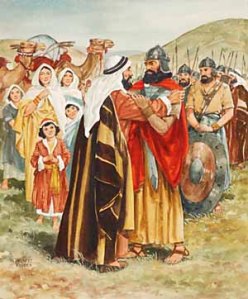
First there is the reconciliation of the estranged brothers Jacob and Esau. Accompanied by his wives and children, and with great trepidation, Jacob crosses the ford into Esau’s territory. He has sent a conciliatory message to Esau and now learns that Esau is coming to meet him, accompanied by four hundred men. Please remember the four hundred men, because we’ll come back to them.
The brothers meet, affectionate Esau and deferential Jacob. It is a touching scene, but midrash puts a different spin on it. The word ‘kissed’ is dotted above each letter in the Torah’s writing.
Rabbi Yannai said ‘…Why is [‘kissed’] dotted? It teaches that Esau came not to kiss [Jacob] but to bite him.’
Talk about putting the worst construction on somebody’s motives – but, in midrash, Esau came to symbolize at least two enemies: the Roman Empire and the Church. Furthermore, he was an ancestor of the Amalekites, a hostile tribe, who have to do with the four hundred men I mentioned.
Jacob offers Esau gifts of livestock, saying ‘Pray, take my blessing,’ an interesting reminder of the time when Jacob took – no, stole – Esau’s blessing, due to him from their father Isaac.
Esau is wealthy himself, refuses at first but then accepts and suggests that he and Jacob should travel together. In a fictionalized version of this episode, the German novelist Thomas Mann shows how desperately Jacob wants to fob Esau off, without giving offence. He gives a variety of excuses: the children are tired, so are the nursing animals, they all need to amble at a leisurely pace. Esau says ‘Let me at least give you some of my military staff, to accompany you,’ and Jacob, seeing possible danger in this set up, swiftly declines the offer. The brothers part and, to the best of my knowledge, they didn’t meet again.
What is it with brothers in Genesis?
Jacob settled in a piece of land he’d bought from Hamor the Canaanite. Hamor’s son Shechem desired Jacob’s daughter Dinah and abducted her. He seduced or perhaps raped her, but then fell in love with her and wanted to marry her. Dinah’s brothers were outraged and wanted revenge on Shechem and his family, but they planned it with Corleone-like care and precision. Their condition for permitting the marriage was that Schechem and his male relations should be circumcised. Shechem readily agreed. While the men were weak, following their circumcision, two of Jacob’s sons, Simeon and Levi fell upon their camp and slew them with swords.
Jacob was beside himself and rebuked his sons for the disproportionate response which could lead to bloody repercussions, but they replied ‘Should our sister be treated like a whore?’
Jacob does not refer to the episode again until he is on his deathbed, addressing each of his sons. He rebukes the eldest, Reuben for sleeping with Jacob’s concubine and he rebukes Simeon and Levi for the Shechemite massacre. This leaves the way clear for the fourth son, Judah, to get a very special blessing, in which Jacob anticipates that the rightful Israelite monarchy will be Judah’s descendants.
In the time of the monarchy, David, Solomon and their descendants are indeed from the tribe of Judah, and their stories are connected with Jacob’s story in several ways. As with Dinah, Tamar, the daughter of David, is the victim of rape and is then avenged by one of her brothers, Absalom. Like Jacob, David has sons who arrogate power to themselves while he grows old. David’s daughter, like one of Jacob’s sons, has a coat of many colours. Absalom and his brother Adonijah, like Reuben, seduce their father’s concubines. As with Simeon and Levi, the kingly inheritance passes to a younger, more suitable brother.
Before becoming king, David fights numerous wars and, on one occasion, attacks a camp of Amalekites, slaying the majority of them, but leaving alive four hundred men. Four hundred Amalekites. One might suppose that these are the descendants of Esau, who came with four hundred men to meet Jacob, and parted from him in peace.
The patriarchs, matriarchs and kings of our bible are flawed human beings and in the book of Genesis, relationships between siblings are problematic, from Cain and Abel to Joseph and his brothers. All the more reason to think that, when Esau and Jacob embrace, this is as good as it gets.
Post Freud, one can discern variants of the oedipal motif in the stories of Noah, Lot, Abraham, Isaac, Jacob, Saul, David and Solomon. Eyleh toledot – these are the generations. No wonder we tell our sons ‘May God make you like Ephraim and Manasseh.’ Those two sons of Joseph seem to have been blameless and he probably got a lot of nachas from them, whereas Jacob was sadly cheated of nachas for most of his life.
GL 28 October 2013<a href="https://neviimtovim.com/wp-content/uploads/2013/10/
Shabbat Shoftim 2013
Posted on: August 4, 2013

Today’s reading, Shoftim, which means ‘judges’ is so-called because the sidra opens with the words ‘You shall appoint judges and officers in all your towns that the Lord your God is giving you, according to your tribes, and they shall judge the people with righteous judgment.’
The verse which follows is repeated in the rabbinic Ethics of the Fathers and in our siddur:
‘You shall not show partiality, and you shall not accept a bribe.’
Devarim 16:19
The expression ‘show partiality’ doesn’t really convey the interesting metaphor in the Hebrew Lo takir panim v’lo tikkach shochad. ‘You shall regard no faces and take no bribe.’
From a previous verse in Deuteronomy, we read that an attribute of God is that He is not partial and takes no bribe, or, in a more traditional translation, ‘God…who regardeth not persons, nor taketh reward.’
Devarim 10:17
Asher lo yissa panim v’lo yikkah shochad, the literal meaning of which is He does not lift up faces and takes no bribe.
In Pirke Avot (4:29), you find the same phrase, V’lo masso fanim, [God] does not lift up faces, and on page 172 of the siddur, again V’lo masso fanim v’lo mikkach shohad, ‘He shows to favour and takes no bribe.’
Respecting persons, acknowledging faces, lifting up the face, showing favouritism is seen as a corrupt practice, which implies a recognition of who might be able to return a favour or who might gainfully be treated as important. This sort of respect works to the advantage of the powerful, influential or rich, who are in a position to return favours.
Masso fanim is part of everyday life and is understandable. The celebrity gets the best table in the best restaurant and the millionaire doesn’t have to wait in line for the bank clerk. Researchers found that, in job interviews, good looks and height are both advantages. You see why Napoleon had to take Europe by force. When Napoleon hadEurope, it was a good thing to be related to him.
Well, Deuteronomy tells us not to be snobbish or sycophantic in dealing with persons, and, in the wider context, it implies that we owe respect to a person for their humanity rather than their status.
There’s a Chasidic story of a certain famous rabbi whose distinction and erudition were belied by his insignificant appearance and ragged clothes. Some yeshiva students encountered him and were disrespectful, even treating him roughly. Afterwards they were mortified to learn it was the great Rabbi Poloni, and went to see him to beg his pardon.’
‘Please accept our apology and forgive our rude behaviour ,’ they begged. ‘We had no idea it was you.’
‘I can’t do that, ‘ said the rabbi, shocking the students who expected him to be kindly and forgiving. ‘I would forgive you,’ he added, ‘but I’m just not in a position to do so. You apologized to me because of who I am. But what about the person you thought I was?’
Shabbat Bemidbar
Posted on: May 13, 2013

This is the opening sidra of the book of Numbers. The reason why Numbers is so called is that, at the beginning of the book, Moses numbers the multitude of Israelites in the Wilderness of Sinai, a census, yielding a result of 603,550. This excludes Levites, women
and children, since the point of the census is to ascertain the numbers of men eligible for military conscription.
Whereas the Greek and Latin names of this book, Arithmoi and Numeri, also refer to the numbers counted, the Hebrew name Bemidbar means ‘In the wilderness.’ The words Bemidbar Sinai, in the wilderness of Sinai, occur in the first sentence, and Numbers does indeed relate the wanderings of the Israelites in the wilderness, their battles and rebellions and Moses’ continuing struggle to control and satisfy the mixed multitude of whom he is the reluctant leader.
Tribe by tribe, the Israelite men are counted, Levites excepted, as their role is to maintain the Tabernacle. A chieftain of each tribe is designated to assist Moses and Aaron in the census.
The Israelites camp in tribes, each tribe under their own banner, like the regiment of an army. The disposition of the tribes as they journey forth from their camp has every appearance of being strategic; essentially they are a fighting force.
Censuses in the bible tend to be discouraged. In Mesopotamian and Israelite cultures, they were considered unlucky, and a verse in Exodus prescribes that, when a census is taken of the people of Israel, each person counted has to pay a half shekel tax to avert plague and, as it happens, the number of half shekels contributed by Israelite men over twenty years of age amounted to 603,550 half shekels.
As you’ll see from the haftarah (1 Samuel 2) David’s unauthorised census resulted in a plague. Why was his census unauthorised? Nachmanides, following a midrashic tradition, said it was because David didn’t count to assess his military force but simply to know the size of the nation he ruled.
When Moses counts the number of potential warriors, he counts them l’gulglotam which means by their heads, or by their skulls, a term used elsewhere in connection with polling, or counting persons, for tax or census purposes.
Our English word polling, used in connection with voting in elections, is similarly based on the original meaning of the word poll, as the top of the head. When it comes to the polling booth, where the anonymous individual casts his vote in secret ballot, we have the same
delicacy about naming the voters as persons. The names are on the electoral register – that is how you get to vote – but the vote has a dynamic life of its own, not traceable to the person who voted.
The Israelite warriors, when counted, also become something other than persons. Their individuality is sunk in the collective noun of the fighting force the zva b’Yisroel, the host of Israel, just as the Israeli Defence Force today is called Zva Haganah L’Yisrael. As the
Israelites cross the wilderness, in danger of attack from many hostile tribes, the counting of the heads seems to be a regrettable necessity. By contrast with Moses, David takes a census, in the security of his kingdom and the plague follows. Numbering the population is adangerous activity, not to be embarked on lightly, perhaps because there is a humanitarian risk when one reduces a person to a number.
Moses and Aaron count the Israelites in units according to their tribe and their fathers’ houses. This creates a record of the relative size of the tribes in the second year after the Exodus. The largest tribe is Judah, being more than twice as populous as the smallest tribe,
Manasseh. In fact the three smallest tribes at that time were Ephraim, Benjamin and Manasseh, all Rachel’s tribes rather than Leah’s. This seems to indicate a lower fertility rate in those tribes, unless, even in the wilderness, they had recourse to what Mark Twain called lies, damned lies and statistics.
5773
href=”https://neviimtovim.com/wp-content/uploads/2013/05/ruth_and_naomi_400.jpg”><img src=”https://neviimtovim.com/wp-content/uploads/2013/05/ruth_and_naomi_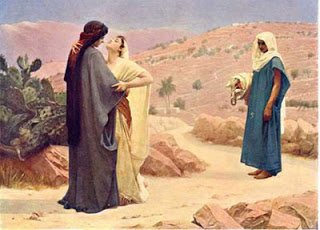
Ruth is set in the time of the Judges and, in a non Hebrew bible, is found directly after the book of Judges. A family from Bethlehem goes to live in Moab, because of a famine in their land. The husband and wife are Elimelech and Naomi. Elimelech dies in verse 3 and his two sons marry Moabite women, Orpah and Ruth. In verse 5, the two sons die, not surprisingly, because their names, Mahlon and Killion mean sickness and vanishing, which does not bode well for either of them.
So, as is the case with the American TV series Mad Men, it looks as if the story will be about the men, but it’s really about the women.
The survivors, as is well known, are Naomi and her Moabite daughters-in-law. Learning that the famine has ceased in Judah, Naomi resolves to go home and, speaking affectionately but firmly to Ruth and Orpah, she urges them to return to their families,
where they may, God willing, marry again and have children.
There is a midrashic tradition that Orpah and Ruth were sisters, the daughters of King Eglon of Moab (Ruth Rabbah 2:9) who, in turn (according to the same midrash), was the son of Balak.
The expression ‘the land of Judah’ in verse 7 is not used very often until the division of the kingdom following Solomon’s reign when Judah became the name of a kingdom. Prior to the time of Ruth, this expression occurs only once1and designates the land occupied by the tribe of Judah. It occurs also in David’s narrative, where Judah becomes important, being David’s own tribe and the centre of his eventual kingdom.
Naomi says ‘Turn back’ three times to her daughters-in-law2 corresponding to the discouragement given to prospective converts who present themselves to the Beth Din.3 We can see why Orpah might go, but why does Ruth stay? She is the template for all converts. Why is she so insistent? Is it about Naomi or about the ephemeral Mahlon, or about Torah?
Midrash claims that Orpah becomes the grandmother of Goliath, and depicts her in a negative light, as exceedingly promiscuous. There is no basis for this in the book of Ruth, but midrashic literature often takes a binary approach; if one of a pair is the hero, the other must be the villain. This is especially noticeable in midrashic narratives about Esau and Jacob.
On arrival in Bethlehem, they become the centre of attention for the women. Naomi expresses her bitterness at the way God has treated her, taking her husband and sons, and tells the women to call her Marah – bitter – instead of Naomi, which means pleasant.
The barley harvest is around the time of Pesach. The narrator emphasises Ruth’s foreignness, not only calling her Moaviyah, a Moabite woman, but adding, perhaps tautologically, that she comes from Moab.
The second chapter introduces a new character: Boaz, a relation of Naomi’s late husband. Boaz is a name associated with strength, and, as any freemason will know, is the name of one of the pillars upholding the porch of Solomon’s temple.
Gleaning the harvest from the corners of a landowner’s field was the right of the poor, in accordance with Leviticus:
When you reap the harvest of your land, do not reap to the very edges of your field or gather the gleanings of your harvest. Leave them for the poor and for the foreigner residing among you.4
It is Ruth who offers to go and glean corn which will be a means of subsistence for herself and Naomi. Naomi’s reply in verse 2 is Go my daughter, lah lechi. This is the feminine of lech lecha, an expression associated with significant events. Naomi calls Ruth biti, my daughter, but we have already seen that she called both Ruth and Orpah her daughters.
How does it happen that Ruth gleans in the field of Boaz, the very person who is related to her father-in-law? The Hebrew is vayyiker mikreyah – ‘it so happened’. Furthermore, Boaz singles out Ruth for attention, but instead of asking ‘Who is this young woman?’ he asks ‘Whose young woman is this?’ To whom does she belong? In Ruth’s particular case, there is no male person to whom she belongs. Husband, father, father-in-law are conspicuously absent. So to whom does Ruth belong?5
The servant’s answer is that she is a girl from Moab. Perhaps the servant’s implicit answer to Boaz’s question is ‘Nobody we know.’
Boaz extends his protection to Ruth, telling her to glean only from his field, and when she asks what she has done to deserve this, Boaz reveals that he knows the story of Ruth and Naomi, and how Ruth left her homeland. His next words are the origin of those traditionally spoken to proselytes:
The LORD repay you for what you have done, and a full reward be given you by the LORD, the God of Israel,under whose wings you have come to take refuge.
Ruth thanks Boaz for treating her kindly, even though she is a foreigner; her exact words being ‘You have spoken kindly to your maidservant, though I am not like one of your maidservants.’
Boaz continues to give her protection and generous opportunities for gleaning. She takes a quantity of barley back to Naomi, who remarks that Boaz is their kinsman and that the situation looks promising.
In the third chapter, Naomi has formulated a plan concerning Ruth and Boaz, who may have obligations to them beyond generosity, namely, the duty of levirate marriage.
The Hebrew for ‘his name should not be blotted out’ is lo yimacheh shemo. The name of Mahlon is interestingly cognate with the verb mem het hé, to blot out.
Naomi’s plan is rather compromising for Ruth. It involves lying down with Boaz in the middle of the night, an action which seems guaranteed to attract his attention.
So what’s the motivation behind Naomi’s cunning plan? Is it Ruth’s happiness, their future security or the fulfillment of the law? And what is Ruth’s motivation in following Naomi’s instructions to the letter?
Ruth goes to the threshing floor where Boaz, who has been drinking, is asleep, uncovers his feet and lies down. It is not certain whether she lies next to him, or, perpendicularly, at his feet. When Boaz wakes, startled, asking who is there, Ruth identifies herself and then says ufarashta kenafecha al amatecha, literally ‘Spread your wing over your handmaiden.’
Note that Boaz has already spoken of Ruth the proselyte as seeking refuge under the wings of the Shechinah. Now she seeks refuge under Boaz’s wing – kanaf – translated as ‘skirt’ in the KJV.
Ruth tells Boaz the reason why she has a claim on his protection: ki goel atah, ‘for you are a redeemer’ or ‘a near kinsman’ or ‘close relative’. The term goel is used in Leviticus in this specific sense of redeeming the property of a relative, so that it remains in the family:
If your brother becomes poor and sells part of his property, then his nearest redeemer shall come and redeem (goel) what his brother has sold.7
Are we looking at a romantic episode, prompted by love or desire or at a halakhic issue, complicated by the fact that Boaz is not Ruth’s brother-in-law, that the property of Elimelech is involved and that Ruth is a convert?
Boaz praises Ruth – in fact he calls her an eshet hayil – much as Judah praised Tamar when she alerted him to his duty towards her as the widow of his sons:
She is more righteous than I, since I did not give her to my son Shelah.8
We will see from the genealogy at the end of Ruth that Boaz is himself a descendant of Judah and Tamar, through their son Perez.
At this point in the narrative, we do not know that there is an inheritance involved, and Ruth’s approach to Boaz seems to be connected with the law of yibbum, or levirate marriage.
When brothers live together, and one of them dies childless, the dead man’s wife shall not be allowed to marry an outsider. Her husband’s brother must cohabit with her, making her his wife, and thus performing a brother-in-law’s duty to her. The first-born son whom she bears will then perpetuate the name of the dead brother, so that his name will not be obliterated from Israel.9
The quandary of Henry VIII was in weighing up this verse against Leviticus:
You shall not uncover the nakedness of your brother’s wife; it is your brother’s nakedness.10
If a man takes his brother’s wife, it is impurity. He has uncovered his brother’s nakedness; they shall be childless.11
The continuation of the Deuteronomy text shows that there is some disgrace attached to the man who refuses to marry his brother’s childless widow.
And if the man does not wish to take his brother’s wife, then his brother’s wife shall go up to the gate to the elders and say, ‘My husband’s brother refuses to perpetuate his brother’s name in Israel; he will not perform the duty of a husband’s brother to me.’ Then the elders of his city shall call him and speak to him, and if he persists, saying, ‘I do not wish to take her,’ then his brother’s wife shall go up to him in the presence of the elders and pull his sandal off his foot and spit in his face. And she shall answer and say, ‘So shall it be done to the man who does not build up his brother’s house.’ And the name of his house shall be called in Israel, ‘The house of him who had his sandal pulled off.’12
There is a great deal of Talmudic and medieval commentary on yibbum and halitzah, which is the loosening of the shoe.
Now, Boaz tells Ruth that she has a kinsman more closely related than himself. This other kinsman must be given the option of performing his duty and Boaz says he will speak with him in the morning. Meanwhile, he asks Ruth to stay the night. Have they slept together? Will they sleep together? Rashi, in his commentary on Ruth, quotes a midrash thus:
Rabbi Judah said: His evil inclination was contending with him, “You are single, and she is single; be intimate with her” ; and he took an oath to his evil inclination, saying ‘As the Lord lives, I will not touch her.13
For the sake of appearances, she left before daylight, so that nobody else would know she had spent the night there. Before she left, Boaz gave her six seahs of barley, to take back to Naomi. This is a large and heavy quantity, a single seah being currently estimated as 7.33 litres. One thinks of Rebecca performing the demanding task of watering Eliezer’s camels.14
When Ruth returns to Naomi, the first thing Naomi says is ‘Who are you, my daughter?’ Ruth answers by telling Naomi everything that has happened and Naomi wisely tells Ruth to wait patiently, as Boaz will attend to the matter that very day.
In Chapter 4, Boaz goes about the business of sounding out the other possible goel. He sees this man at the gate, which was the public area where men of affairs conducted transactions and exchanged news. Curiously, Boaz does not address this man by name; at least, the narrative withholds his name, as Boaz calls him Ploni Almoni. This is the biblical and Talmudic equivalent of John Doe or Joe Bloggs, the designation for an unnamed person. Translations will vary. ‘Friend’ reflects better on Boaz than the KJV ‘Ho such a one!’
Boaz has Ploni Almoni and the elders seated at the gate and explains the following: Naomi has returned from Moab and is selling a piece of land which she inherited from her husband Elimelech. Ploni Almoni has first refusal, but, if he doesn’t want to buy the land, Boaz will
do so. However, Ploni is willing to buy. Boaz then explains that, if he buys the property, he also acquires Ruth the Moabitess, the widow of Elimelech’s son, in order to maintain the name of the dead in connection with his inheritance. Ploni now withdraws from the
purchase.
What is Ploni’s motivation? The targum suggests that he was already married, which seems a very good reason, but his direct speech is ‘I cannot redeem it for myself, lest I impair my own inheritance.’ The suggestion is that he considers marriage to a Moabite transgressive, which seems to be the implication of the verse in Deuteronomy which states:
No Ammonite or Moabite may enter the assembly of the LORD. Even to the tenth generation, none of them may enter the assembly of the LORD.15
Rashi finds this reasoning faulty, commenting:
He should have interpreted: ‘an Ammonite, but not an Ammonitess; a Moabite, but not a Moabitess.’ Yet he said, ‘lest I mar my heritage.’
In fact Rashi believed this error was the reason why the man’s real name was obliterated from the text.
We saw that, according to Deuteronomy 25, a man who refuses to marry his brother’s widow has his shoe loosed in a ritual called halitzah, the ceremonial release from levirate marriage. Rashi explains that what occurs here, which does not correspond precisely to
halitzah, is an act of acquisition. There are of course other views – Rabbi Louis Jacobs, for example, wrote:
Halitzah appears in the biblical book of Ruth in which Boaz, a close relative of Naomi, agrees to marry Ruth and act as redeemer for Mahlon, her dead husband. He may only do so after a closer relative than Boaz formally relinquishes the right of redemption by removing his sandal and handing it to Boaz.16
Boaz confirms before the witnesses that he has bought the inheritance of Elimelech, Mahlon and Chilion from Naomi, including Ruth, whom he will marry to raise the name of the dead on their inheritance.
The witnesses express their blessing, and say ‘May your house be like the house of Perez, whom Tamar bore to Judah.’ Not only are is there a similarity between the union of Judah and Tamar and that of Boaz and Ruth, but also, Boaz, as we will see, is a descendant of
Perez.
Boaz marries Ruth and they have a son. One might expect the people to say this is a son for Mahlon, which would be the form in a levirate marriage. In fact the women say ‘There is a son born to Naomi.’ This does not indicate that Naomi was the biological mother of the child.
The nursing17 of the child by Naomi does not mean that Naomi had breast milk, as omenet can mean foster mother.
Most important is that a redeemer has been found for the entire family of Elimelech, the dead and the living.
The child Obed becomes the father of Jesse who was the father of David. Boaz’s descent from Perez is attested in the final verse of the book. Thus David is a descendant of Judah on one side and, on the other, of Moab. This would be extremely controversial if the book of
Ruth was written in the post-exilic time18 of Ezra and Nehemiah who actively opposed the intermarriage19 of Israelites with Canaanites, Ammonites, Moabites and all the neighbouring peoples. There is a case for considering that the book of Ruth is a subversive anti-Ezra document, supporting intermarriage and making polemical use of David’s putative descent from Ruth.
 Neviim Tovim, blogs by Gillian Gould Lazarus

What’s a gezerah kashah when it’s at home?
Posted by: Gillian Gould Lazarus on: September 25, 2014
Harsh Decrees on this Scepter’d Isle
The prayer Avinu Malkenu is a petition to God, asking Him to give us and our children life, health, peace and forgiveness in the coming year, and also, to spare us from persecution:
Avinu Malkenu, batel me-alenu col gezerot kashot.
Our Father, Our King, abolish all oppressive laws against us.
Does this part of Avinu Malkenu belong only to our history or is it relevant also to the here and now?
It is related of R. Eliezer that once he stepped down before the Ark and recited the twenty-four benedictions for fast days and his prayer was not answered. R. Akiba stepped down after him and exclaimed: Our Father, our King, we have no King but Thee; our Father, our King, for Thy sake have mercy upon us; and rain fell. When the people saw that he was answered with this prayer, they added it to their supplications and petitions.
Ta’anit 25b
One of the questions I’d like us to consider is, Is it safe? That is to say, is the United Kingdom, as it’s still called, a safe place for Jews in 2014, 15, 20, 30?
On August 21st, the Jewish Chronicle published an article by David Aaronovitch titled ‘Now’s not the time to pack the suitcase and leave the UK.’ The article was moderate, tending to allay fears aroused by the backlash to the recent conflict of summer 2014. David Aaronovitch wrote on 21 August 2014 in the Jewish Chronicle:
During the recent conflict with Gaza, Operation Protective Edge, there was much discussion, not just in the media but among ourselves and in our families, about a sense of danger, or threat or simply discomfort, in the face of an alleged rise in anti-semitic acts and an almost indisputable rise in anti-Israel sentiment.
Now the other question I would like to ask is connected with this particular day, Yom Kippur, this particular prayer, Avinu Malkenu and this particular supplication to God, ‘Annul all oppressive decrees against us.’
We saw that, in Talmudic times, to alleviate drought, the rabbis turned to God and prayed for rain.
In all the countless gezerot kashot of our history, Jews have turned to God and prayed ‘Hoshienu,’ ‘Save us,’ the last word of the Avinu Malkenu prayer.
Is this a matter for God, or so much between man and man that we hardly expect God to hear our petition?
Our society: British for most of us, and our community: Jewish, are more secular than ever before. Historically, when Jews were persecuted in the diaspora, they prayed – hence the petition in question, batel me-alenu… They recited psalms. There is evidence that they were not equipped to fight back against the pogroms, but meanwhile, there was the dawn of Socialism, Zionism, aliyah, the halutzim – pioneers. Prayer was perhaps not the priority of these ideologists. So, when you say this prayer, is it with hope for God’s intervention, that God will indeed abolish all oppressive laws against us? Is our fate in God’s hands? Can prayer change what happens in the world?
The Jewish Encyclopedia offers some background to Avinu Malkenu. The number and order of the verses vary according to the minhag of different communities. The Sephardi rite differs from the Ashkenazi which is itself heterogeneous. A Gaonic version from the ninth century consisted of 22 verses arranged in alphabetical order. It became the Ashkenazi custom to recite them each morning and evening during the Ten Days of Penitence after the Amidah. The prayer is not found in the prayer books of Saadiah Gaon and Maimonides. The origin of Avinu Malkenu is R. Akiva’s prayer on a fast day proclaimed because of a drought: “Avinu Malkenu, we have no King but Thee; Avinu Malkenu, for Thy sake have compassion upon us” (Ta’anit 25b). The orthodox practice is still that if the Yom Kippur falls on Shabbat, Avinu Malkenu is recited only during the Ne’ilah service.
Anthony Julius, author of ‘Trials of the Diaspora’ distinguishes between enmities and defamations. The book was published in 2010 and it responded to a wave of anti-semitism following operation Cast Lead in 2009. He cites prevalent widespread notions which he calls ‘tropes’ – anti-semitic tropes; examples would be references to a powerful Jewish lobby and/or wealth and influence, and/or conspiracy. A common perception, or misperception, would be that Jews claim anti-Semitism where none exists or exploit Shoah. There is also the revival of the well-attested belief that Jews are childkillers, steeped in blood. No self-respecting, liberal critic of Israel would impute this directly to Jews, but it was commonly stated of Israel in the summer just gone.
It would have been very difficult to go through this summer without hearing the plight of the Palestinians likened to the Holocaust and the Israelis likened to Nazis. The word ‘Zionazi’ trended on Twitter. Swastikas appear on banners embedded in the Israeli flag which of course features the Star of David, a symbol for Jews in the diaspora as well as in Israel.
None of these attitudes are enshrined in the law of our land. On the contrary, we are in no small way protected by law.
How has law treated us since the readmission of Jews to England in 1656?
In 1753, a bill which allowed Jews to become naturalized by application to Parliament was passed, with strong Tory opposition, by a Whig majority who included religious toleration in their party agenda. The Board of Deputies was founded in 1760. The first half of the nineteenth century saw the establishment of The London Board for Shechita, the Jews’ Free School, the Jewish Blind Society, the Marriage Registration Act which recognized the authority of the Board of Deputies. University College London was founded in 1827, the first university in England to admit students regardless of race, class or religion although it was not until 1871 that Jewish students were admitted to Oxford and Cambridge.
Regarding civic life and parliament, it was a long haul between 1847 and 1858., Lionel de Rothschild got elected but couldn’t take his parliamentary seat until parliament dispensed with the requirement to take a Christian oath. David Salomons likewise was elected in the intervening years and was fined £500 for voting after refusing to take the oath. In the case of Disraeli, being a Christian convert made all the difference, though not, of course, where defamation was concerned.
By the time of the massive immigration of Jews from Tsarist Russia, from the 1880s to the 1910s, the nature of anti-Jewish oppression in Britain was not so much constitutional as defamatory. Anthony Julius makes a strong case that casual anti-semitism is endemic in English Literature. In the 1930s, there were the Blackshirts as well as informal, institutional anti-semitism in the Foreign Office and, it would seem, among the aristocracy.
Since the Second World War, numerous acts have been passed for the protection of social and racial minorities, for example the Race Relations Act of 1976.
In 2001, Holocaust Memorial Day was established in the UK and in 2004 The United Nations voted in favour of commemorating the Holocaust. Besides this, The European Commission against Racism and Intolerance, a part of the Council of Europe, called on its member nations to ‘ensure that criminal law in the field of combating racism covers anti-Semitism” and to penalize intentional acts of public incitement to violence, hatred or discrimination, public insults and defamation, threats against a person or group, and the expression of antisemitic ideologies. It urged member nations to “prosecute people who deny, trivialize or justify the Holocaust’. According to the The Racial and Religious Hatred Act of 2006, it is an offence in England and Wales to incite hatred against a person on the grounds of their religion.
The 1999 McPherson report into the Stephen Lawrence case defines a racist incident as ‘… any incident which is perceived to be racist by the victim or any other person,’ yet, when Jews construe a remark or an action as anti-semitic, they are often regarded as over-sensitive, paranoid or manipulative.
Meanwhile, there are social movements of an arguably oppressive nature.
The United Nations General Assembly Resolution 3379, of November 1975 determined that Zionism was a form of racism and racial discrimination. In 1978, UNESCO organized the first World Conference Against Racism, where a resolution (3379) was passed, equating Zionism with racism.
At the 2001 meeting of the World Conference Against Racism, delegates from Israel, the US and Canada walked out over a draft resolution which singled out Israel for criticism and likened Zionism to racism.
At the 2009 WCAR, President Ahmadinejad made a provocative speech, combining holocaust denial with an attack on Israel as racist in concept and practice. The British ambassador to the UN was among those who walked out during this speech.
The critical position of the UN contributes to a perception of Israel as a pariah state, which is now so widespread that it is no longer exclusive to the extreme right wing, the extreme left wing or Islamist, jihadi groups. Opposition to Israel is sometimes taken as axiomatic in Academia, the Arts and Trade unions. The result is that many British Jews suffer some negative affect from such organizations as BDS, the PSC and the sloganizing of The Respect Party. Jewish students are liable to experience hostility within the Students’ organizations. The tendency of media to headline news from Israel is a source of anxiety for many Jews, as is the recent rise in anti-Semitic incidents.
The reason for the sense of danger which haunts many of us can be attributed, disputed, researched and surmised.
My question is, how does it enter into our lives as a community and a congregation and how does it affect the way we, as individuals, feel when we say the words Avinu Malkenu, batel me-alenu kol gezerot kashot, Our Father, Our King, abolish all repressive laws against us.?
.