Archive for December 2024
Foreword
Last night, a woman in the BBC Question Time audience in Cheltenham held forth, reproaching the Labour MP on the panel for what she called ‘friendship with Israel’. Gaining confidence as she heard the gathering applause, she spoke of Israel ‘targeting babies, children, hospitals and schools’. ‘Enough of this rhetoric about antisemitism,’ she proceeded, to a perceptible rise in audience sympathy, ‘if you support Palestinian babies.’
Her warning against ‘the rhetoric about being antisemitic for supporting Palestinian babies’ clearly struck a chord with the audience and I reflected that perhaps some of them had been called antisemitic or knew people who were called antisemitic and thought it was unfair and untrue. It could be said that it takes a Jew to know what is antisemitic, but then we are likely to disagree among ourselves and, mercifully I have encountered many non-Jews who understand very clearly the difference between criticism of Israel and antisemitism. If they see it so clearly, I wonder, why are others so myopic?
Dear Friends
I get the impression that people of good will are often perplexed by the term antisemitism. They don’t want it fired at them like a poison dart but are not sure if we are unreasonable, aiming it at persons you think are merely making points, about war and peace, wealth and poverty, vengeance and forgiveness. You have watched the news on BBC and Sky; read the Guardian and the Independent, heard the Pope and Gary Lineker, and you want to take up a position against Israel’s wars, but you don’t want to give offence to your Jewish friends, colleagues and, possibly, relations. You’ve been told that comments about Israel are distinct from statements about Jews but noticed that diaspora Jews seem to believe we have a horse in Israel’s race. You’ve seen that some Jews call some other Jews antisemites and thought that hardly seems reasonable. And perhaps someone told you that Jews look down on non-Jews, calling them goyim which sounds like a bad name.
Last point first: the Hebrew word goy means nation, and goyim is the plural. If you look at a biblical concordance, you’ll see that it occurs many times; 560 times, according to Google’s counting and, every time, it refers to a nation or nations, including the Israelite nation. In post biblical times, the word has been used to ‘other’ non-Jews, rather as the word ‘foreigner’ has an othering stratum, separate from its essential meaning. The far right, in our own time, refer to ‘the goyim’ intending always to say it is what we Jews call non Jews whom, they claim, we exploit and enslave. The far right are almost the only people who admit to being antisemitic, and even then, not always.
You may want to know how it happens that a Jewish person might be called an antisemite, either fairly or unfairly. Every nation has its traitors and, in this, we are no different. I would say that a Jewish antisemite is someone who not only separates themself from the community but intends harm towards the community – or identifies with people who intend to do us harm. When I was young, there was animosity between proponents of traditional, orthodox Judaism and Progressive Judaism, where women were ordained as well as men and certain laws, such as driving on Shabbat, were relaxed. Now a graver animosity is between those who care for Israel and others who suppose that they must dissociate and condemn it. Undoubtedly, this makes for very bitter hostility and draws into the argument non Jews who have strong opinions for or against Israel, an extension of the argument which probably helps to perpetuate it some of the time. This is not to deny that I’m infinitely grateful to Israel’s friends and the non-Jewish warriors against antisemitism who instinctively recognize it when they see it.
The present government of Israel has critics within the country, so numerous that demonstrations of many thousands filled the streets every week, fearing that the authority of the Supreme Court would be eroded by policies of the Netanyahu administration. Now there are demonstrations by those who think more could be done to bring the hostages home. Others believe that the government should make long term security a priority above all other issues and that the Iranian proxies can be given no quarter.
I don’t expect you to have the answers to geopolitics and wars. I understand that your hearts are moved by the suffering of children, continually depicted on our news stations as the reporters devote themselves to showing the human cost of war. In my opinion, they understate the human cost for Israelis who have suffered bombardment from Gaza, Lebanon, Iran and Yemen. Israel has invested in effective defences and shelters so the numbers of the dead are not as great as those in the countries which attacked it.
You may have heard that antisemitism does not, contrary to dictionary definitions, mean hatred of Jews but persecution of people who speak languages cognate with Hebrew, predominantly Arabic. There are some who say they are not remotely antisemitic as, although they dislike Jews, they have nothing but love and compassion for Arabs, particularly Palestinians. There is even a fad, around Christmas time, for claiming that Jesus was Palestinian as he was born in Bethlehem, now in the West Bank. This might have worked when the name ‘Palestinians’ signified Jews resident in the British Mandate of Palestine, but the implication that Jesus was an Arab is a curious rewriting of the New Testament and you may be sure that, when Easter comes around, the same people will not be arguing that Judas and Caiaphas were Palestinians.
I can see how complicated are all these matters to people who were not born knowing the word ‘antisemitism’ and I have one message in this letter which I want to convey.
After the Holocaust in the Second World War, certain terms were coined to apply to the murder of the six million, not on the battlefield, but by the intentional use of bullets, gas, starvation and scientific experimentation: such terms as genocide, war crimes and crimes against humanity, planned by the Nazi leadership and carried out by civil servants, army personnel and grunt level workers. It has become a popular device to adapt the terminology, making us Jews the perpetrators of genocide, calling us Nazis, telling us ‘You have become what you hated’ and posting cartoons on social media showing German stormtroopers morphing into IDF soldiers or Jewish children in the deathcamps redrawn as Gazan infants.
My message to you is – don’t do this. Why would anyone want to depict us as our most bestial persecutors? It is like the delight some people take in speaking of the existence of slavery in Africa before millions were captured and shipped away in the transatlantic slave trade. If it was done to you, your enemies will want to say you do it to another.
Most days on X, someone will anathematize me as a ‘genocidal maniac’. It is simply a thing to say to a Jewish person who is deeply – or even shallowly – connected with Israel, to cause maximum pain, to give greater offence than any F word or C word can communicate – although they generally give these words a whirl alongside the rest of it.
If you really don’t want to give offence, don’t use the inaccurate shorthand of hatred but use moderate, considered language.
To those who already do so, many thanks, and to those who stand with us without being asked, a blessing on your heads.
Post script: There’s something I forgot to mention but was reminded of when I saw it in progress today.
Antagonist: Israelis all come from Poland and like killing babies and stealing land; plus they are sexual perverts.
Our guy: That’s an antisemitic generalization.
Antagonist: Antisemitism is being against Jews. I’m just against Zionists and you’re an antisemite for conflating Israel with Jews.
The fact is, most of the antagonists who post ludicrous errors about Israel do appear to be motivated by an animus which preceded Israel’s present wars. They do not understand the connection between diaspora Jews and Israel. It is an empirical connection, which they might understand better if they visited Israel or talked to more Jews. Such conversations on social media usually lead to the DARVO * moment when the antagonist calls our guy an antisemite. When the antagonist follows the template of centuries old anti Jewish discourse, but substituting ‘Zionists’ or ‘Israelis’ for ‘Jews’, the chances are that they will harm us if they can, even if we live in Stamford Hill, Salford, Golders Green or Barnet, rather than Haifa, Tel Aviv, Sderot or Jerusalem.
And it is already happening.
*DARVO: Deny, Attack, Reverse Victim and Offender
Lost Knowledge
Posted on: December 9, 2024

A reliable informant (one of my daughters) told me that the 1979 television film of Jack Rosenthal’s The Knowledge was available on Youtube and that it had stood up well to the ravages of time. I found it and watched. The Knowledge refers to the qualification required of London taxi drivers, knowledge of topography and routes from any one place in London to any other. The story concerns half a dozen hopeless hopefuls, learning the Knowledge and being examined by a sardonic and bullying instructor gloriously portrayed by Nigel Hawthorne.
One of the candidates, Ted Margolis (Jonathan Lynn) from a Jewish family of cab drivers, is eager, borderline sycophantic and blessed with a retentive memory. Highly motivated, he is the first of the group to qualify as a cabbie by completing the Knowledge. When he breaks the news to his fellow candidates, they share his euphoria. They want to take him to the pub to celebrate but Ted tells them that he doesn’t drink. The worldly Gordon finds this difficult to believe and Ted says, ‘What do you want, I’m a Yiddisher boy. Cards, yes; women, certainly; drinking – one small [sounds like ‘eggnog’ but the sound isn’t quite clear] at Christmas.’
Nevertheless, they go off to the pub together and subsequently Ted loses his new green badge for being drunk in charge of a motor cycle. He is later seen applying his photographic memory to Hebrew phrases, and finally is in Tel Aviv, wearing a tembel hat and studying a road map of the city.
1979. I tried to imagine these scenes being written and screened today: Jewish references in a bitter-sweet comedy and, more than this, the fearless, unself-conscious way in which Ted reminds his friends, ‘I’m a Yiddisher boy.’ Didn’t we all do this: make humorous references to our Jewish lives to offer our non Jewish friends a bit of metaphorical chren, a spicy, tasty condiment daubed on the side of the conversation? Maybe we didn’t. In any case, who would do that now? Who would write it into their comedy?
The author of The Knowledge, Jack Rosenthal, who died twenty years ago, was married to Maureen Lipman. She was herself well loved by the public at that time and it was much later, particularly during her opposition to Jeremy Corbyn’s Labour, that she was vilified on Corbynist social media. It happened often to Jewish women who spoke against Corbyn, whether they were politicians or entertainers: Margaret Hodge, Maureen Lipman, Rachel Riley, Tracy Ann Oberman, Luciana Berger, Ruth Smeeth, Louise Ellman were reviled but Miriam Margolyes who was anti Israel was considered exemplary as a Jewish celebrity.
The bile against Maureen Lipman was staggering in Corbynist groups on Facebook, as you see here:
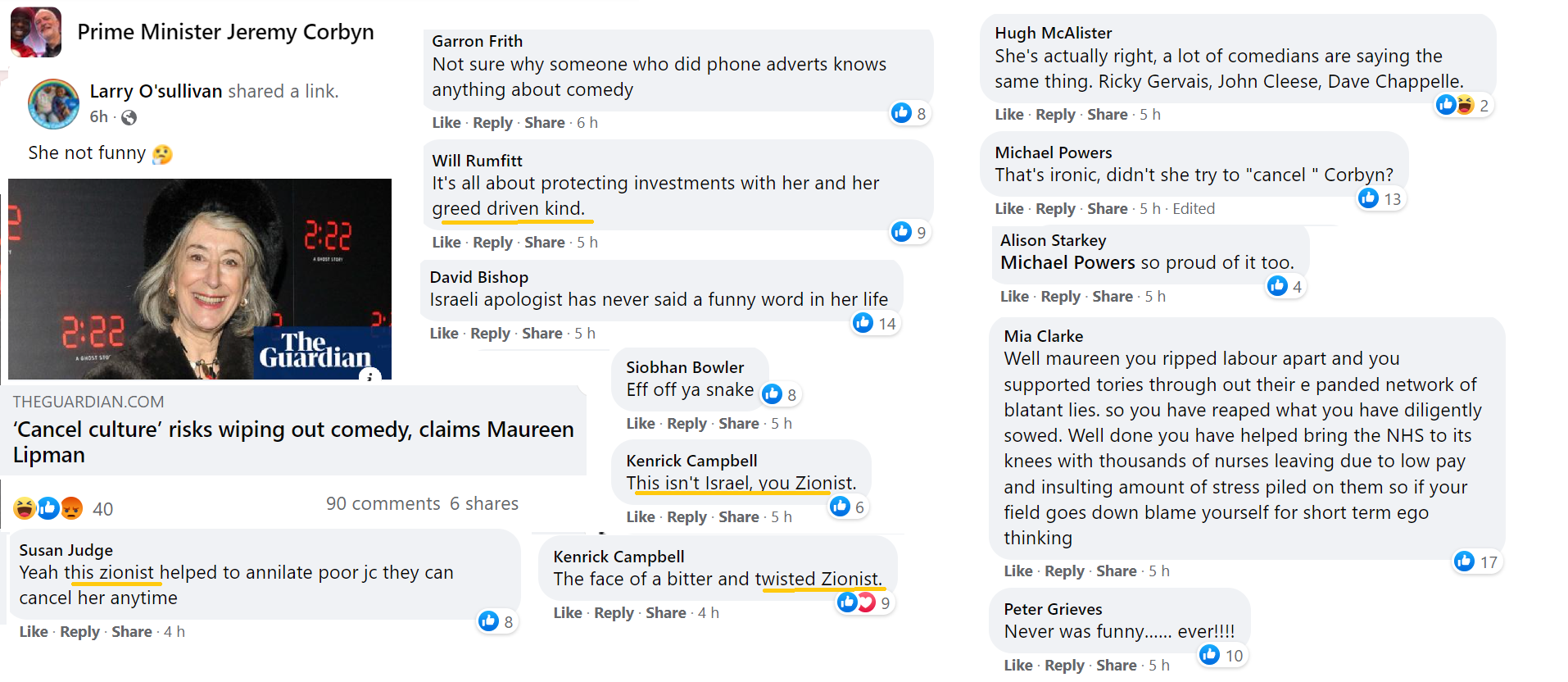

Notwithstanding being Jewish, Maureen Lipman had come close to being a National Treasure. Jews can still hold this position if they repudiate Israel, unless, like Stephen Fry, they speak out against the renaissance of antisemitism. Then they become persona non grata in certain circles.
The United Kingdom seemed one of the safest places on earth to be Jewish, for most of my life. Ted Margolis, in The Knowledge, made aliyah before it was strictly necessary.
Syncretism and Me
Posted on: December 5, 2024
I love everything about Christmas: angels, shepherds, fairy lights, dazzling trees in public squares, carols, old movies, good will to all men, a family get together in which kosher turkey is served, a vegan Christmas pudding and – as the first night of Chanukah falls this year on 25 December – doughnuts.
I have fairy lights in my flat, sometimes even out of season and exquisite glass baubles, each one different from the other, hang insecurely from wires across my ceiling. I have no Christmas tree apart from a naked pine tree which grows in the garden. I am extremely fond of Christmas trees but it seems to me a bridge too far to have one in the house and decorate it, although I know I would enjoy doing so.
Last week, when I picked up some Chanukah candles in a Jewish gift shop, I noticed that crackers were on sale, Chanukah crackers with little dreidels and no doubt chocolate coins inside them. I felt a moment of disapproval but then thought, ‘Who am I to talk?’ I did not buy them and went for transparent dreidels with sweets inside them, for my grandchildren.
I like to go to midnight mass at a beautiful church just ten minutes away. Seven years ago, late on Christmas Eve, my youngest daughter gave birth, after a long labour, to a little girl. An hour later, turning up for midnight mass, I said excitedly to the shammas, I mean the usher, ‘My daughter just had a baby!’
His eyes swiveled anxiously round the lobby, and I explained ‘Not here! In a hospital.’
I do not speak the prayers, obviously, but I shake hands with the people around me when the congregation is called upon to exchange a sign of peace. I don’t mind being a stranger there, although there was one time when a vicar, in his sermon, said that Israel would have stopped Mary and Joseph going into Bethlehem. What did he suppose was meant by ‘Once in royal David’s city…?’
I have been a little apprehensive since then, though not enough to stop me going, and there have been other vicars, preaching on other themes. I like the scent of candles as I enter the church. When the congregants line up for communion, I remain unperturbed in my seat. I feel good will.
That is really the essential thing, the season of good will, Luke 2:14:
Glory to God in the highest, and on earth peace, good will toward men.
It’s nice in Latin too:
Gloria in altissimis Deo et in terra pax in hominibus bonae voluntatis
…and, since you ask, in the original Greek:
Δόξα ἐν ὑψίστοις θεῷ καὶ ἐπὶ γῆς εἰρήνη ἐν ἀνθρώποις εὐδοκίας.
I will include here a photo I took of the tree in Muswell Hill, just outside the Everyman cinema, because I liked it.

 Neviim Tovim, blogs by Gillian Gould Lazarus